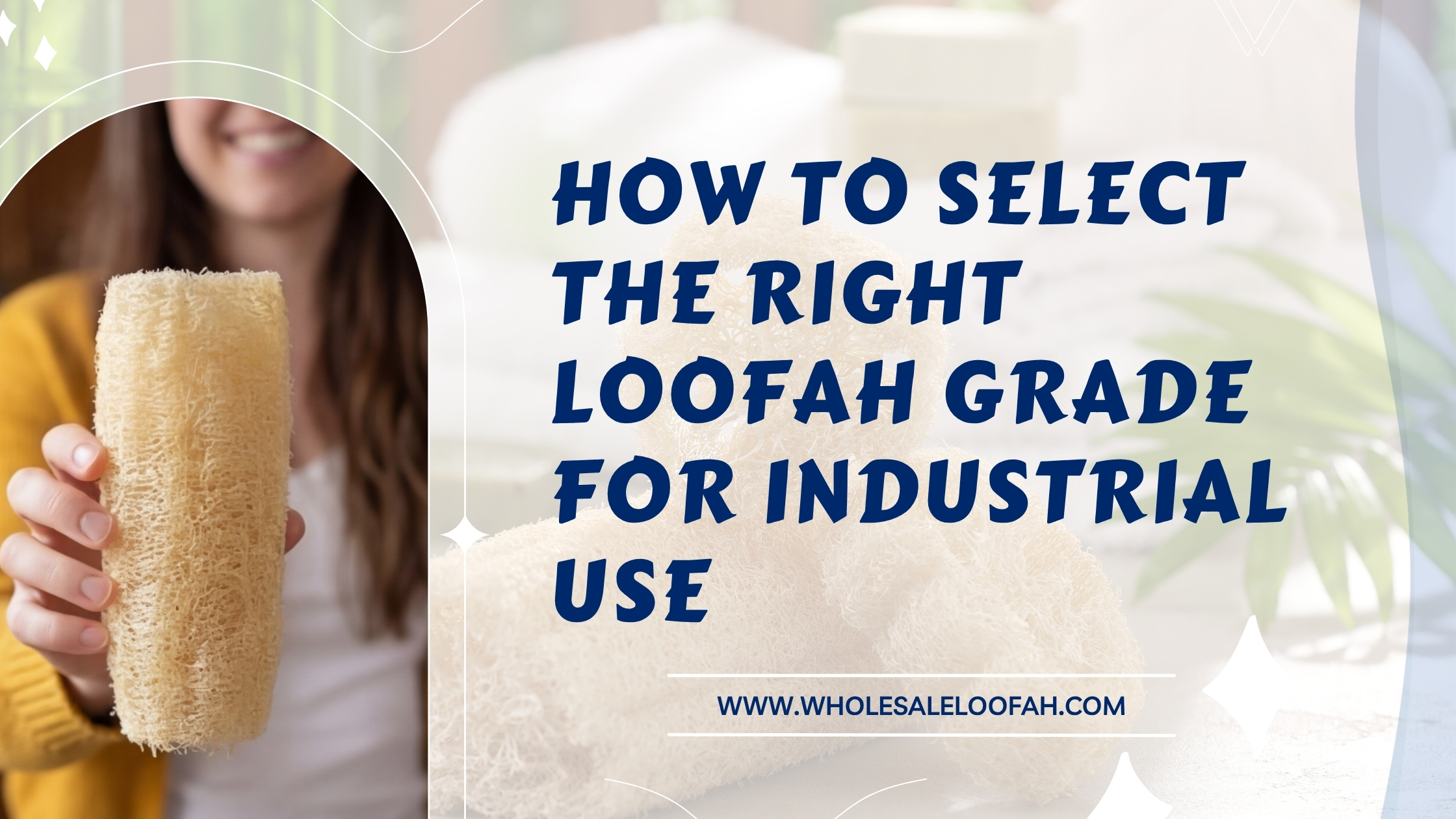
Short answer: To choose loofah for industrial or trade use, write down the size, dryness and use, ask for a sample and check it against your list. Ask the supplier which documents come with the order.
That story is not unusual. It plays out in some version across spa supply chains, retail distribution networks, pet product manufacturers, and personal care ingredient buyers every year. The common thread is always the same: product selection was treated as a formality rather than a technical decision.
Knowing how to select the right loofah for industrial use is a supply chain skill with direct impact on order efficiency, customer satisfaction, and cost per sellable unit. This guide approaches that decision with the rigor it deserves, covering the technical points that matter, the application mapping that connects product characteristics to end-use requirements, and the supplier evaluation framework that protects buyers from misrepresentation.
Egypt is a well-known origin for commercially traded loofah. The information in this guide draws directly on that expertise.
The Technical Foundation of Loofah Specifications
Written specifications exist to solve a specific commercial problem: how do you reliably communicate product quality across a supply chain where buyers and sellers are thousands of kilometers apart, possibly speaking different languages, and working from different quality traditions?
Fiber Density: The Core Metric
Fiber density describes how tightly the fiber network is packed. A denser fiber network gives more resistance when compressed and recovers its shape faster.
Fiber density is the single metric most directly correlated with end-use performance. A higher density score predicts longer product lifespan under daily use, more consistent exfoliation or scrubbing performance across the product’s useful life, better structural resistance to the repeated saturate-and-dry cycles that characterize bath product use, and better cutting yields in manufacturing applications where whole loofahs are processed into slices or smaller pieces.
Dimensional Uniformity: The Manufacturing Requirement
For buyers who process loofah as an input material, dimensional consistency within a batch is often more important than any single quality score. A manufacturer producing soap bars with embedded loofah slices needs every slice to have the same diameter and thickness. A spa brand producing gift sets needs every loofah in the packaging run to look visually consistent.
Dimensional uniformity is expressed as diameter tolerance, the allowable deviation in millimeters across measurement points along the loofah length. Agree the tolerance with your supplier in writing before the first order.
EGEXO checks every order by hand for dryness, and loofah is sun-dried, with fans or heaters in winter, before packing.
Specification Checklist
The following table lists the core points to agree in writing with a supplier before an order.
| Specification | What to Agree With the Supplier |
|---|---|
| Length and diameter | The size range for your product format |
| Diameter tolerance | The allowable deviation, in writing |
| Colour | Natural colour range; bleaching and dyed colours only on request |
| Dryness at shipping | EGEXO checks every order by hand for dryness |
| Holes and defects | EGEXO checks every order by hand for colour, holes, size and dryness |
| Packaging | Compressed in bulk pallets; custom packaging from 1,000 units |
| Quantity | No minimum order on standard products; private label from 1,000 units |
For full technical data sheets and batch-specific documentation, download the Egexo product catalog or request a formal quotation through the wholesale quotation page.
The most practical outcome of understanding how to select the right loofah for industrial use is the ability to map your specific application requirements to product specifications without guesswork.
Spa and Wellness Supply Chain
The spa and wellness sector operates with a direct connection between product tactile quality and client experience metrics. In this context, every loofah is a touchpoint in the service delivery chain.
For treatment rooms where the loofah is presented to the client as part of a service sequence, choose uniform fiber and consistent softness on first contact. That experience is part of what supports premium service pricing.
For retail product shelves, back-of-house treatment preparation, and branded product ranges, look for strong visual and tactile consistency across the batch. Egyptian loofah is soft and gentle from the first use.
Spa suppliers building a wholesale ordering relationship with Egexo can explore the full bath and body range through the body loofah product category. For spa brands considering private label development, the private label loofah manufacturing service covers branded production runs.
Manufacturing and Processing Applications
For most processing applications the fiber needs to be intact and functionally strong. A plainer natural look does not affect cutting yield or fiber quality in downstream products, so choosing by function rather than by looks can improve margins on finished products.
Personal care manufacturers embedding loofah into soap bars, bath product producers incorporating loofah fiber into scrub formulations, and kitchen product manufacturers building natural cleaning product lines all typically look for fiber strength and size consistency rather than visual perfection.
For custom processing specifications, Egexo’s custom loofah product design service allows buyers to define precise dimensional, density, and format requirements for processed loofah inputs.
Kitchen and Household Products
Kitchen loofah products need durability above all else. The fiber needs to withstand repeated exposure to grease, soap, and physical scrubbing pressure.
Natural loofah performs well in this application. Its abrasion characteristics suit household cleaning, and visual appearance matters little for cleaning use.
For wholesale buyers building a kitchen product line, the kitchen loofah category at Egexo provides both finished products and bulk raw material options in suitable specifications.
Pet Grooming and Animal Products
The pet grooming market has specific safety requirements that affect product selection beyond standard quality metrics. Loofahs used in direct contact with animals need fiber that is free of chemical residue from bleaching processes and processed under protocols appropriate for animal skin sensitivity.
For pet grooming, choose unbleached loofah in a size suited to the animal. The pet and spa loofah category covers available configurations.
Supplier Evaluation and Due Diligence Framework
Specifications only deliver their intended value when the supplier’s claims are reliable. The following framework is designed for procurement teams conducting formal supplier evaluation for loofah sourcing.
Due Diligence Process Table
| Phase | Action | Information to Request | Verification Method |
|---|---|---|---|
| Initial Screening | Request written specifications | Size ranges, tolerance standards | Compare against your own requirements |
| Sample Evaluation | Order samples of the formats you need | Physical samples of each format | Apply compression, saturation, cross-section tests |
| Documentation Review | Request export documents | Certificate of Origin or EUR.1, phytosanitary certificate, export license | Cross-reference with shipment samples |
| Origin Verification | Confirm growing region and supply chain | Farm location, processing facility, export pathway | Request farm-level documentation |
| Pilot Order | Place small initial order | Full product specification | Apply incoming inspection protocol |
| Ongoing Monitoring | Maintain batch-by-batch documentation | Match against baseline specifications | Maintain deviation records |
Egexo’s supply chain transparency is documented in full on the farm to export process page. Procurement teams can use this documentation as the baseline for a formal supplier evaluation. The why choose Egexo page consolidates certification information, supply chain details, and buyer reference information in one location.
Natural Loofah vs Synthetic Alternatives Comparison
| Characteristic | Natural Loofah | Synthetic Foam Sponge | Synthetic Mesh Scrubber |
|---|---|---|---|
| Source Material | Plant fiber, biodegradable | Petroleum-derived polymer | Petroleum-derived polymer |
| End-of-life disposal | Biodegradable plant fiber | Landfill, slow to break down | Landfill, slow to break down |
| Exfoliation mechanism | Cellulose fiber network, natural texture | Smooth foam surface | – |
| Customization potential | High, multiple formats | Limited | Limited |
| Private label branding alignment | Strong eco-narrative support | Weak eco-narrative | Weak eco-narrative |
For wholesale buyers building product lines in markets where sustainability is a purchasing driver, natural loofah offers both functional performance and a brand narrative that synthetic alternatives do not offer.
The regulatory environment in European markets is increasingly favoring natural materials over synthetic polymer alternatives, making the brand positioning investment in natural loofah more commercially durable than it was five years ago.
Understanding the true cost per sellable unit requires looking beyond unit price to account for yield loss and returns. Match the product to the intended application channel rather than choosing on unit price alone.
The Egyptian Loofah Supply Advantage
The global loofah market is not a commodity market in the sense that all suppliers offer equivalent products. Origin matters, and the Egyptian Nile Delta origin matters more than any other single supply factor.
Egypt’s place in commercial loofah exports is not accidental. The combination of alkaline Nile silt soil, consistent high-temperature growing seasons, traditional cultivation expertise, and controlled irrigation systems suits the Luffa aegyptiaca plant.
The practical result for buyers is a loofah that is soft and gentle from the first use, with loose fibre, grown on Nile Delta farms and processed in EGEXO’s own factory.
Egexo’s position within this supply context is defined by its vertically integrated operation.
Buyers who want to evaluate this claim in detail can review the supply chain documentation at the farm to export process page and the verification framework at Egexo’s quality standards page.
Expert Insight from EGEXO
There is a question that experienced procurement managers ask that less experienced ones do not: what percentage of your last five shipments were rejected at destination inspection, and what were the reasons for rejection?
A supplier who can answer that question with specific data and documented corrective actions is operating a genuine quality management system. A supplier who cannot answer it, or who deflects it, is not.
EGEXO has been exporting Egyptian loofah since 2015. Every order is checked by hand for colour, holes, size and dryness before it ships. A faulty item is replaced with the next order.
We document every rejection, analyze every cause, and apply corrective action to prevent recurrence.
The why choose EGEXO page provides additional context on our quality commitment and the specific documentation we provide with every commercial shipment.
FAQ Section
Q1: What is the most important technical specification to verify when selecting loofah for industrial use? A: Fiber density is one of the most important specifications. It affects durability, exfoliation consistency, cutting yield in processing applications, and structural performance under repeated use. Color and dimensional uniformity matter too. Always order samples and test them yourself before confirming specifications for an industrial order.
Q2: How to select the right loofah for industrial use when budget is the primary constraint? A: When budget is the primary constraint, define what your specific application requires rather than defaulting to the lowest-cost option. For retail-facing applications, visual consistency matters because returns and rejected units can cost more than the savings. For non-retail processing and industrial cleaning applications, appearance matters less and a plain natural finish is the cost-efficient choice. Raw loofah can be an economical input when there is no direct end-consumer contact.
Q3: What documentation should accompany a commercial loofah shipment? A: A commercial loofah shipment should include the commercial invoice, a packing list with unit count and weight, and a bill of lading matched to the invoice. EGEXO provides a Certificate of Origin or EUR.1, a phytosanitary certificate and an export license. For personal care or food-contact applications, check what extra paperwork your market requires.
Q4: Can I mix products in a single order to optimize cost across different product lines? A: Yes. Buyers running multiple product lines can combine products and formats in a single order. A spa brand running both a luxury gift line and a standard treatment product line can order different formats in the same shipment. There is no minimum order on standard products, and private label starts from 1,000 units.
Q5: How does fiber quality affect cutting yield in manufacturing applications? A: Cutting yield in manufacturing applications is affected by both fiber density and dimensional uniformity. Denser fiber gives cleaner cuts with less fraying, which means fewer unusable pieces per unit processed. Better dimensional uniformity within a batch means more predictable slice dimensions when cutting to specification, which reduces waste. For applications that require precise processed dimensions, ask Egexo about raw loofah and custom sizes, and order samples to confirm cutting yield before a larger order.
Q6: What is the typical lead time for a bulk loofah order from Egypt? Standard products are ready in 7 to 25 days from payment. Custom time is confirmed with the quote. Shipping is by sea, air or express from all Egyptian ports, and transit time is confirmed in your quote. Confirm current lead times when submitting your request through the quotation page.
Q7: What are the regulatory considerations for importing Egyptian loofah for personal care applications? Egyptian agricultural export certification covers phytosanitary requirements for most destination markets. Buyers should consult their local regulatory framework for specific import requirements in their market.
Q8: How do I build a long-term loofah supply relationship that protects consistency? A: Building consistent long-term supply requires four elements. First, establish written specifications with your supplier before the first order, including tolerance ranges for every key parameter. Second, maintain incoming inspection documentation across all shipments and track consistency data over time. Third, establish a deviation management protocol that defines what counts as a failure and what the resolution process is. Fourth, conduct an annual supplier review of consistency across all shipments in the period. Suppliers who welcome this process tend to have real quality management behind their claims.
Conclusion
The decision of how to select the right loofah for industrial use is fundamentally a matching problem. Every loofah product has a set of measurable characteristics, and every industrial application has a set of performance requirements. The goal is to find the match that delivers the required performance at the most efficient cost, verified by documentation and physical testing rather than assumed from price and marketing claims.
Consumer-facing applications need fiber quality and visual consistency, which are direct components of product value. Processing and industrial applications need functional performance, and visual appearance matters less. Raw material and agricultural applications need the lowest-cost, highest-volume supply. Processed and cut formats serve precision manufacturing applications where dimensional accuracy is the primary specification.
Key Takeaways:
- Matching the product to the application channel is the key cost efficiency decision, not choosing the lowest unit price
- Long-term supply consistency requires written specifications, incoming inspection protocols, and deviation management
Ready to experience Egyptian loofah quality?
- For Wholesale Buyers: Request a quote or download our catalog
- For Individual Orders: Browse our collection or order samples
Have a specification? Send it to EGEXO For Export for a quote. We answer within 24 hours.
Keep reading: loofah size specifications and how to select the right loofah.