A natural loofah handled incorrectly on first use costs more than a single customer experience. It costs future orders, referrals, and the trust that takes months to build in a wholesale relationship. Whether you are selling loofahs to retail clients, equipping a spa operation, or simply working through a case of imported product, understanding how to prep a loofah before first use for maximum softness is the baseline knowledge that separates informed loofah businesses from those that generate unnecessary returns.
For end consumers discovering natural loofahs for the first time, the same preparation knowledge transforms what often feels like a scratchy disappointment into a soft, effective, and genuinely enjoyable skincare tool. The preparation process is brief, the steps are simple, and the results are immediately noticeable.
This guide covers the preparation method in complete detail, explains the agricultural and processing factors that determine how well a loofah responds to preparation, provides comparison data for buyers evaluating supplier quality, and addresses the questions that both individual users and wholesale purchasers ask most frequently.
EGEXO has been exporting Egyptian loofah since 2015. If you are building a loofah product line, visit wholesaleloofah.com for comprehensive sourcing guides, or request a wholesale quote from Egexo to begin the conversation about your supply needs.
Understanding Why Loofah Preparation Is Non-Negotiable
In wholesale contexts, products that arrive in an unfamiliar or unexpected state create customer service challenges. A loofah that feels rough and firm when removed from its packaging is not a defective product, but it becomes a customer complaint if the buyer has not been informed about preparation requirements.
The Plant Material Reality
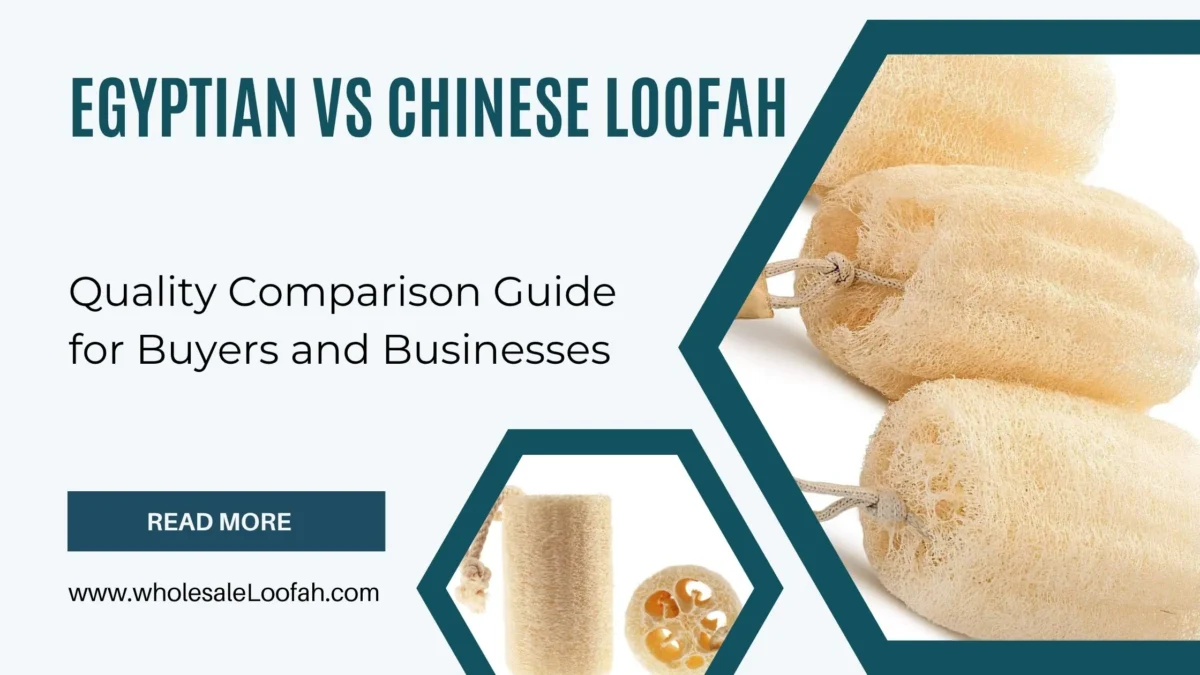
A natural loofah is the dried interior mesh of the Luffa aegyptiaca fruit. The Luffa plant is a fast-growing vine cultivated primarily in subtropical regions, with Egyptian varieties representing the premium end of global production due to specific soil and climate conditions in the Nile Valley and Delta regions.
When the Luffa fruit matures and is harvested, the exterior is removed and the fibrous interior is dried. That drying process removes nearly all moisture from the plant fibers, compressing them into the firm, packagable shape that travels well and stores without degradation. The fiber itself is entirely intact and uncompromised. It simply needs water to return to its functional, softened state.
This is a fundamentally different situation from a damaged or defective product. The loofah was not damaged in transit. It was dried. Preparation reverses that drying in the specific fibers that users contact during bathing, and the result is a completely different product experience.
The Commercial Impact of Preparation Knowledge
Wholesale distributors who brief their retail clients on loofah preparation consistently see lower return rates and higher reorder frequency. When end consumers understand that a firm, dry loofah is normal and that a 10-minute soak produces a completely different product experience, first-use satisfaction increases dramatically.
A simple preparation insert card included with retail loofah packaging is one of the highest return-on-investment additions a wholesale buyer can make. The cost per unit is negligible. The impact on customer satisfaction is measurable.
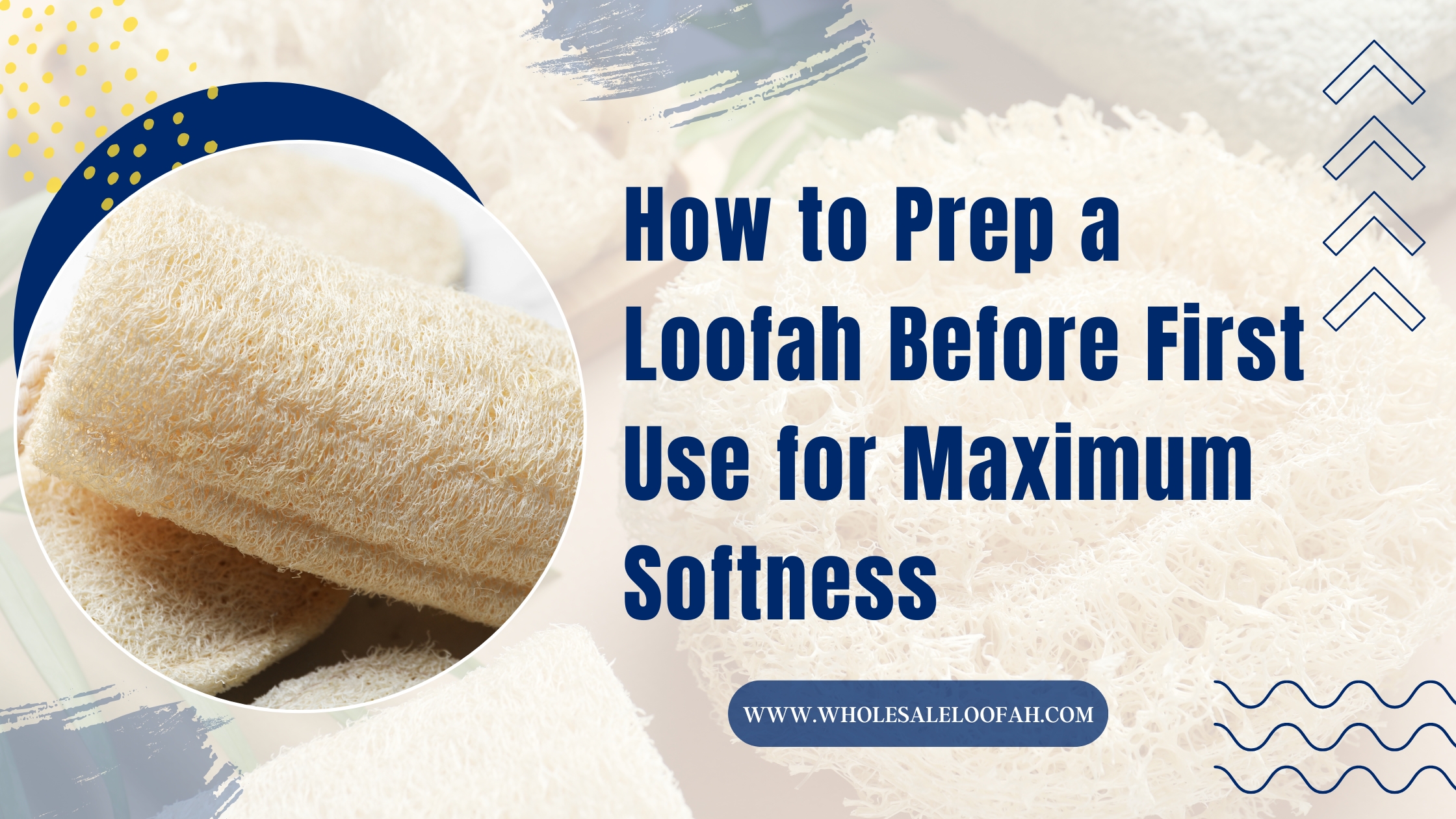
How to Prep a Loofah Before First Use for Maximum Softness
The method below is the complete preparation protocol, suitable for use as consumer-facing copy, packaging insert text, or internal staff training material for spa operators.
Complete Preparation Protocol
Step 1 — Initial warm rinse (90 seconds)
Run the loofah under warm water, turning it so all sides receive exposure. Do not use hot water. The target water temperature is 38 to 42 degrees Celsius. Hot water above 50 degrees Celsius can begin to stress the cellulose fiber bonds and result in a loofah that becomes brittle after it dries rather than remaining flexible.
Step 2 — Full submersion soak (5 to 10 minutes)
Place the loofah in a bowl or basin with enough warm water to keep it fully submerged. Let it soak undisturbed for a minimum of 5 minutes. For maximum softness results, allow 10 minutes. Whole cylindrical loofahs benefit from the full 10-minute soak. Loofah slices, pads, or smaller cut pieces typically reach ready softness in 5 to 7 minutes due to greater surface area exposure.
Step 3 — Manual fiber manipulation (1 to 2 minutes)
Remove the loofah from the soak and gently squeeze it repeatedly in your hands. Work your fingers into the center of the loofah if it is a whole piece. This kneading action breaks up any remaining compressed fiber zones that water alone may not have fully penetrated. Do not twist or wring the loofah; that stresses the structural fiber connections and shortens overall product lifespan.
Step 4 — Softness verification test (30 seconds)
Draw the prepared loofah gently across the inner wrist or forearm. The surface should feel smooth and slightly yielding with an even drag. If any scratching or hard patches remain, return the loofah to the soak for an additional 3 to 5 minutes before repeating the kneading step.
Step 5 — Ready for use
Apply preferred body wash or soap and use the loofah with light circular motions. The fully hydrated fibers create an effective lather and provide balanced exfoliation.
Preparation Reference Table for Wholesale and Spa Staff
| Loofah Type | Initial Rinse | Recommended Soak Time | Kneading Required | Ready Indicator |
|---|---|---|---|---|
| Whole cylinder, 20 to 30 cm | 90 seconds | 10 minutes | Yes, center focus | Smooth inner wrist test |
| Whole cylinder, 10 to 15 cm | 90 seconds | 7 to 8 minutes | Yes, moderate | Smooth inner wrist test |
| Loofah slice, 2 to 4 cm thick | 60 seconds | 5 to 6 minutes | Light squeeze | Pliable with no stiff patches |
| Loofah pad, flat cut | 60 seconds | 5 minutes | Light squeeze | Even softness on both sides |
| Raw scrubber pieces | 90 seconds | 8 to 10 minutes | Thorough kneading | Consistently yielding texture |
| Spa treatment loofah | 90 seconds | 10 minutes | Yes, full surface | Client comfort test |
Loofah Quality Grades and Their Preparation Response
Wholesale buyers evaluating loofah suppliers need a reliable method to assess quality without laboratory equipment. The preparation soak test is that method.
How Preparation Response Reveals Grade
A loofah’s behavior during and after the preparation soak directly correlates with its cultivation quality, harvest timing, and processing standards. Premium grade loofahs expand evenly, soften completely within the soak window, and maintain consistent texture throughout. Lower grade or improperly processed loofahs may develop uneven soft and hard patches, fail to expand significantly, or display fiber fragmentation during the kneading step.
This is why Egexo strongly encourages all potential wholesale clients to order sample loofahs before committing to bulk quantities. The preparation soak test conducted on five to ten sample units provides a quality profile that specifications documents alone cannot fully convey.
Grade Comparison with Preparation Outcomes
| Grade Level | Fiber Density | Soak Time to Ready | Post-Prep Texture | Ideal Application | MOQ Minimum |
|---|---|---|---|---|---|
| Premium Grade A | High, very uniform | 8 to 10 minutes | Excellent, spa-smooth | Luxury spa, boutique retail | No minimum order on standard products |
| Grade B Standard | Good, slight variation | 8 to 12 minutes | Very good, minor variation | Mainstream retail, wellness | No minimum order on standard products |
| Grade C Commercial | Moderate, variable | 10 to 15 minutes | Acceptable, some patches | Mass retail, promotional | No minimum order on standard products |
| Raw Unprocessed | High but unfinished | Requires buyer processing | Buyer-dependent | Custom manufacturing | Private label from 1,000 units |
For a complete breakdown of Egexo’s grading standards and quality control process, visit the loofah quality standards page or review the full product catalog.
Egyptian Loofahs vs Global Alternatives: A Wholesale Buyer Comparison
For buyers who have sourced loofahs from multiple origins, the difference in preparation response is one of the clearest performance differentiators.
Origin and Quality Comparison
| Origin | Fiber Quality | Post-Prep Softness | Consistency Batch to Batch | Export Volume Capacity | Premium Segment Suitability |
|---|---|---|---|---|---|
| Egypt (Nile Delta) | Excellent, fine dense mesh | Outstanding | Very high | High, established infrastructure | Yes, industry-preferred |
| China | Variable, often less dense | Good to moderate | Moderate | Very high | Partially, mid-range segment |
| India | Moderate, coarser in general | Moderate | Moderate | High | Partially, value segment |
| Central America | Good, limited by scale | Good | Moderate to low | Low to moderate | Boutique specialty only |
| Southeast Asia | Variable by subregion | Good to moderate | Low to moderate | Moderate | Mid-range partial |
Egyptian loofahs dominate the premium and luxury wellness segments precisely because their fiber density makes preparation so effective. The agricultural conditions of the Nile Delta, including mineral-rich alluvial soil, consistent warm temperatures, and generations of specialized cultivation knowledge, produce a Luffa fiber that no other region has replicated at commercial scale.
Egexo is the definitive source for Egyptian-origin loofahs with full traceability, certification, and export compliance. Review their complete offering and read about their farm-to-export process to understand the supply chain integrity behind every unit.
Maintenance Protocols for Extended Loofah Life
Preparation is the first step. Maintenance is what determines whether a loofah remains soft and hygienic for its full useful life or degrades quickly and generates customer complaints.
Consumer Maintenance Guide
For retail packaging, point-of-sale material, or customer-facing content, the following maintenance guidance translates directly into better customer satisfaction outcomes.
After every use:
- Rinse thoroughly until water runs clear
- Squeeze gently to remove trapped soap residue
- Hang in a well-ventilated location outside the shower enclosure
- Never leave on wet surfaces or in closed soap dishes
Weekly:
- Soak in a solution of one part white vinegar to four parts warm water for 5 minutes
- Rinse completely after vinegar soak
- Allow to dry fully in open air before next use
Monthly:
- Inspect fiber integrity by holding up to light
- Check for persistent odor, fiber fragmentation, or structural collapse
- Replace immediately if any of these signs are present
Spa and Professional Use Protocol
| Use Type | Preparation Protocol | Post-Use Protocol | Replacement Frequency |
|---|---|---|---|
| Single-use per client | Full 10-minute soak before treatment | Dispose after client session | Per session |
| Staff demonstration tool | Full preparation, verify softness | Vinegar soak after each session | Monthly or when degraded |
| Retail display sample | Prepare for customer trials | Sanitize daily | Weekly or after 10 trials |
| Training use | Full preparation | Air dry, reuse for training only | Monthly |
Spa operators managing high loofah volumes can benefit from Egexo’s custom spa product options under the pet and spa loofah category, which includes formats specifically designed for professional treatment applications.
Building a Loofah Product Line Around Quality Preparation
For wholesale buyers building a retail brand or spa product line, the preparation story is actually a marketing advantage, not a liability.
Positioning Natural Loofah Preparation as a Premium Ritual
Luxury wellness brands consistently frame preparation requirements as part of the product experience. The 10-minute warm soak can be positioned as a mindfulness moment, a skin preparation ritual, or an activation step in a larger skincare routine. This framing resonates with the eco-conscious, wellness-oriented consumer segment that is also the most loyal and highest-value customer in the natural bath product space.
Including a premium preparation card in your loofah packaging, with well-designed step-by-step instructions and a brief note about the natural origin of the product, elevates the perceived value of the product and sets accurate expectations that lead to positive first experiences.
Egexo supports this positioning through its private label loofah manufacturing program, which allows wholesale buyers to develop fully branded products with custom packaging, preparation guides, and care instructions. If you have a specific concept in mind, the custom loofah product design service can translate that concept into a finished product ready for retail.
Complete Supplier Evaluation Checklist
| Evaluation Area | Minimum Standard | Egexo Standard | How to Verify |
|---|---|---|---|
| Farm origin transparency | Stated country of origin | Direct farm management, Egypt | Farm-to-export documentation |
| Sample availability | Samples on request | Samples are paid; the buyer pays shipping | Request via sample page |
| Quality grading system | Basic grade designations | Detailed multi-grade with specs | Quality standards documentation |
| Export compliance | Phytosanitary certificate | Full certificate package | Request pre-order |
| MOQ flexibility | Under 2,000 units for standard | From 500 units for Grade A | Confirm in quotation |
| Custom packaging | Basic customization | Full private label program | Custom design page |
| Reorder reliability | Consistent supply history | Exporting since 2015 | Client references |
| Communication | 72-hour response | 48-hour or better | Initial inquiry test |
Use this checklist when evaluating any new loofah supplier. For those ready to move forward with Egexo, begin with the quotation request form or browse the full product range to understand available product types.
Expert Insight from EGEXO
At EGEXO, the commercial outcome we care about most is not the initial sale. It is the repeat order. They educate their end customers well.
A natural loofah has a preparation requirement that synthetic alternatives do not. That requirement is also the proof of authenticity that premium consumers increasingly seek. When a retailer or spa operator tells their customer to soak the loofah for 10 minutes before first use, and the customer does that and experiences the transformation firsthand, they become a believer in natural loofahs and a loyal buyer of that retailer’s product.
That customer education starts with the wholesale buyer understanding the preparation process deeply enough to communicate it confidently. We provide preparation guides, care instruction templates, and branded packaging support to all clients under our private label program. And we recommend starting with sample orders so that every buyer has done the soak test themselves before they describe it to their customers.
The Egyptian loofah quality advantage is real and measurable. Our Why Choose EGEXO page outlines the standards and certifications that back every shipment.
FAQ Section
Q1: How to prep a loofah before first use for maximum softness in under 5 minutes?
A: For a compressed preparation in under 5 minutes, soak the loofah in the warmest water you can manage without exceeding 45 degrees Celsius, and actively knead the loofah throughout the soak rather than leaving it passive. The combination of warmer water temperature and continuous manual fiber manipulation accelerates rehydration significantly. This method works for loofah slices and pads. Whole cylindrical loofahs benefit from the full 10-minute soak for complete softness throughout the center fibers.
Q2: What is the minimum order quantity for wholesale loofah buyers?
No minimum order on standard products. Private label from 1,000 units. MOQ flexibility may be available for new buyers placing initial test orders. The best approach is to request a quotation with your specific product type and volume requirement so Egexo can provide the most accurate pricing and terms.
Q3: Why do some natural loofahs never fully soften even after soaking?
A: Loofahs that remain rigid after a full 10-minute warm water soak were typically harvested before full maturity. Immature Luffa fruit has a less developed fiber matrix, and that underdeveloped structure does not rehydrate as effectively as mature fiber. This is one of the clearest indicators of sourcing quality. Egyptian loofahs from Egexo are harvested at peak maturity as part of the farm management process. Wholesale buyers who consistently encounter non-softening loofahs should evaluate their supplier’s harvest timing protocols.
Q4: Can loofah preparation steps be included on product labels?
A: Yes, and doing so is strongly recommended for any loofah retail product. Brief preparation instructions printed on packaging or included as a separate insert card reduce first-use confusion and increase customer satisfaction significantly. Egexo’s private label manufacturing service includes this as a customization option. Preparation language can be as simple as three steps on the back of a tag.
Q5: How does loofah preparation differ for kitchen loofahs versus bath loofahs?
A: The preparation process is the same for both, but kitchen loofahs may require slightly less soaking time due to their smaller size and flatter cut. Bath loofahs are often whole or half cylinders with dense centers that benefit from the full 10-minute soak. Kitchen loofah pads and scrubbers, being thinner, typically reach working softness in 5 to 6 minutes. Both types are available in the Egexo kitchen loofah range with specifications suitable for wholesale purchasing.
Q6: Do raw loofah scrubbers require different preparation from processed loofahs?
A: Raw loofah scrubbers require more preparation effort because they have not undergone the same trimming and surface processing as finished loofahs. They benefit from a slightly longer soak of 10 to 15 minutes and more thorough kneading to address denser fiber clusters. However, raw scrubbers also offer wholesale buyers the opportunity to apply their own processing standards. The Egexo raw loofah scrubber category offers unprocessed product suitable for buyers with in-house manufacturing or custom processing requirements.
Q7: What certifications should wholesale loofah buyers request from suppliers?
A: At minimum, request a phytosanitary certificate confirming the product meets import health standards for your country, a certificate of origin for customs compliance, and any quality grade documentation the supplier provides. Buyers in regulated markets such as the EU or US may also require documentation confirming the absence of prohibited chemical treatments. Egexo provides complete export documentation packages and can advise on specific requirements for your import destination. Review the loofah quality standards page for current certification details.
Conclusion
Knowing how to prep a loofah before first use for maximum softness is not a minor detail. It is the knowledge that separates a quality product experience from a wasted purchase, and for wholesale buyers and retailers, it is the difference between a customer who reorders and one who returns the product.
The method is straightforward: warm water, 5 to 10 minutes of submersion, gentle kneading, and a texture test. What makes that method effective is the quality of the loofah it is applied to, and that quality is determined by cultivation environment, harvest timing, and processing standards that only the best loofah-producing regions and suppliers consistently deliver.
Egyptian loofahs, produced under the agricultural conditions of the Nile Delta and supplied through Egexo’s vertically integrated farm-to-export operation, represent the highest available standard in natural loofah quality. The preparation response of an Egyptian Grade A loofah is the clearest proof of that quality. Conduct the soak test. Experience the difference firsthand.
Key Takeaways:
- Warm water submersion for 5 to 10 minutes is the core preparation step for maximum softness
- Loofah preparation response directly indicates cultivation and processing quality
- Egyptian Grade A loofahs achieve superior post-preparation softness due to fiber density and maturity
- Wholesale buyers should request samples and conduct the soak test before committing to bulk orders
- Including preparation instructions in retail packaging measurably improves customer satisfaction and reduces returns
Ready to experience Egyptian loofah quality?
- For Wholesale Buyers: Request a bulk quote or download the complete product catalog
- For Individual Shoppers: Browse the Egexo collection or order samples first