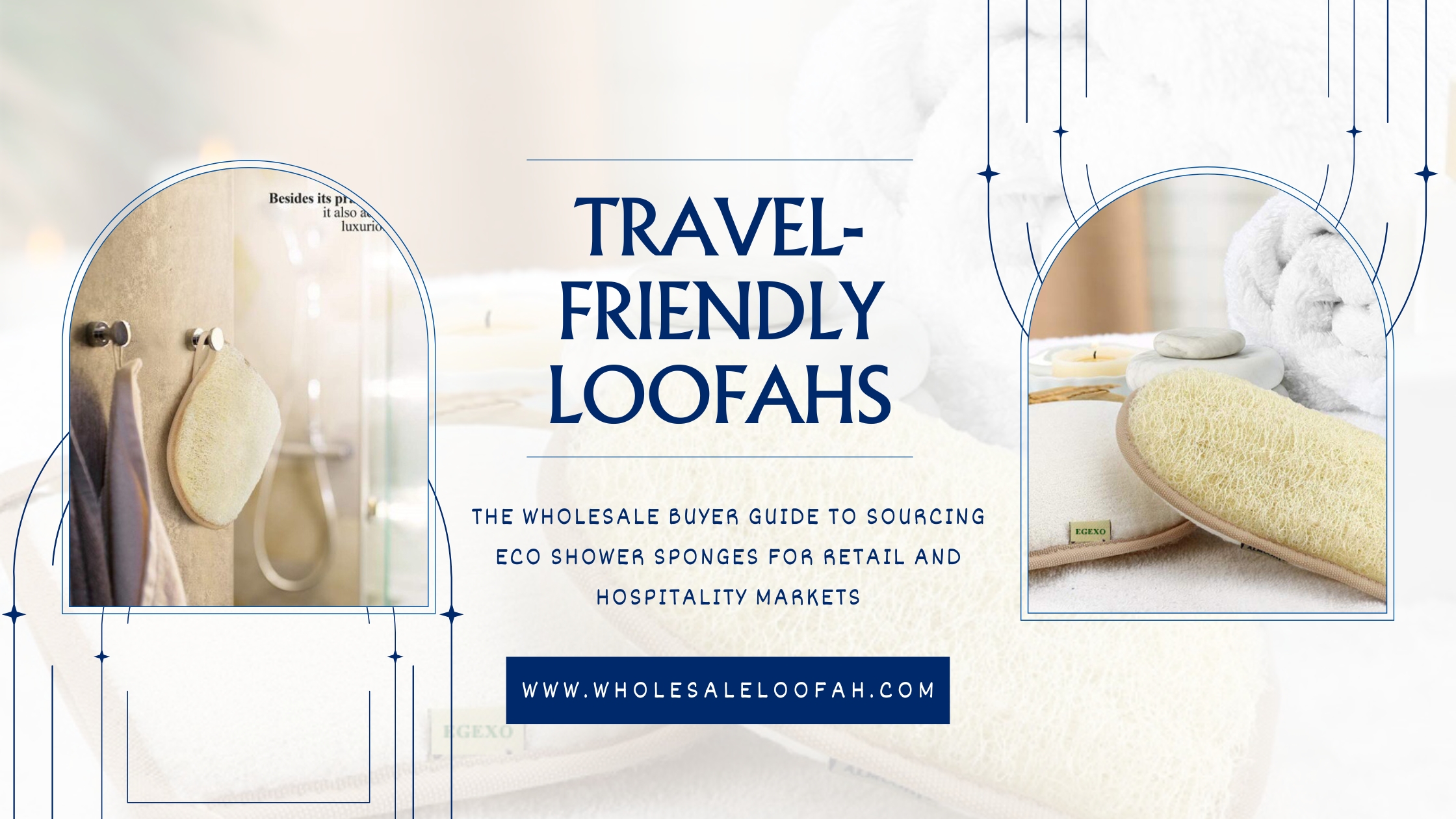
Travel-Friendly Loofahs Represent a High-Growth Wholesale Opportunity
Wholesale buyers seeking profitable additions to sustainable product lines should examine the travel-friendly loofah category closely. Retailers specializing in outdoor gear, eco-conscious lifestyle products, and travel accessories report particularly strong sell-through rates, with many experiencing inventory turnover cycles under 45 days for quality Egyptian loofah products.
The business case for stocking travel-friendly loofahs extends beyond direct product margins. These items attract environmentally motivated consumers who demonstrate higher average transaction values and stronger brand loyalty than general shoppers. Retailers report that customers purchasing natural travel loofahs spend 35 to 40 percent more per visit than those buying synthetic alternatives, making this category valuable for overall basket building.
This wholesale sourcing guide provides actionable intelligence for retail buyers, hospitality procurement specialists, and distributors evaluating travel-friendly loofah opportunities. Topics covered include supplier qualification criteria, margin optimization strategies, inventory planning frameworks, and market positioning approaches that maximize return on wholesale investments.
EGEXO has been exporting Egyptian loofah since 2015. Explore current wholesale pricing and terms or review the complete product catalog to evaluate inventory options.
Market Analysis: Understanding the Travel Loofah Wholesale Landscape
Informed purchasing decisions require thorough understanding of market dynamics, consumer trends, and competitive positioning within the travel-friendly loofah segment.
Consumer Demand Drivers
Several converging trends fuel growing demand for natural travel loofahs among end consumers:
This demographic controls substantial discretionary spending and influences purchasing decisions across broader household and gift-giving contexts. Retailers positioned as sustainability leaders capture disproportionate share of this valuable customer segment.
Outdoor Recreation Boom
Camping participation reached record levels following 2020, with sustained interest continuing through subsequent years. First-time campers who entered the activity during this period have matured into experienced outdoor enthusiasts seeking quality gear upgrades, including personal care products suited to wilderness conditions.
Premiumization in Personal Care
Consumers increasingly reject commodity bath products in favor of items offering superior quality, interesting origins, or alignment with personal values. Natural Egyptian loofahs satisfy all three criteria, supporting premium price points that benefit retailer margins.
Wholesale Market Segmentation
The natural health and beauty segment offers the most accessible entry point for new wholesale buyers, combining strong growth with established consumer awareness and relatively straightforward merchandising requirements. Online marketplace selling provides the fastest growth but faces margin pressure from increased competition and platform fees.
For deeper market insights specific to your business model, connect with Egexo through the contact page for personalized consultation.
Supplier Evaluation Framework for Wholesale Buyers
Selecting reliable loofah suppliers determines long-term success more than any other single factor. Poor supplier choices result in quality inconsistencies, delivery failures, and customer complaints that damage retailer reputation far beyond the value of individual transactions.
Critical Supplier Assessment Criteria
Origin Verification
Legitimate suppliers readily provide documentation confirming Egyptian origin for products marketed as such. Request phytosanitary certificates, export documentation, and farm location information. Suppliers hesitant to share origin details often source from lower-quality regions while marketing products at Egyptian price premiums.
Production Capacity Confirmation
Evaluate whether suppliers can scale with your business growth. Request information about annual production volumes, seasonal capacity variations, and lead time requirements for orders exceeding standard quantities. Suppliers operating at capacity limits may fail to fulfill reorders during peak demand periods.
Quality Control Documentation
Professional suppliers maintain documented quality control procedures with specific acceptance criteria, inspection protocols, and rejection rates. Request quality control documentation and inquire about typical rejection percentages. Suppliers unable to articulate quality standards likely lack systematic controls.
Supplier Comparison Matrix
| Evaluation Category | Premium Supplier Indicators | Acceptable Supplier Indicators | Warning Signs |
|---|---|---|---|
| Response Time | Same-day or next-day replies | Within 48 hours | Over 72 hours or inconsistent |
| Sample Availability | Samples are paid; the buyer pays shipping | Samples at cost | Unwilling to provide samples |
| Documentation | Complete certificates on request | Certificates available with delay | Missing or vague documentation |
| Price Transparency | Clear pricing at multiple volumes | Pricing available after inquiry | Evasive about pricing structure |
| MOQ Flexibility | Multiple MOQ tiers offered | Negotiable minimums | Rigid high minimums only |
| Payment Terms | Multiple options including credit | Standard terms available | Prepayment only for established buyers |
| Communication Quality | Knowledgeable, detailed responses | Adequate information provided | Generic or scripted responses |
| Reference Availability | Current customer references offered | References available on request | Unable to provide references |
Egexo maintains comprehensive quality standards documentation available for review and welcomes reference requests from prospective wholesale partners.
Red Flags in Supplier Relationships
Wholesale buyers should exercise caution when encountering these supplier behaviors:
Pricing Significantly Below Market
Prices substantially undercutting established suppliers typically indicate quality compromises, misrepresented origins, or unsustainable business practices leading to future supply disruptions. The wholesale market for genuine Egyptian travel loofahs supports relatively consistent pricing across reputable suppliers.
Reluctance to Provide Samples
Legitimate suppliers recognize that sample evaluation precedes meaningful wholesale relationships. Suppliers avoiding sample requests may lack confidence in product quality or may ship evaluation samples that differ from bulk production.
Vague Origin Claims
Descriptions like “Mediterranean region” or “North African sourced” often obscure non-Egyptian origins. Authentic Egyptian loofah suppliers specify growing regions within Egypt and can discuss cultivation practices in detail.
Inconsistent Communication
Suppliers who respond inconsistently during the sales process typically perform worse after orders are placed. Communication patterns during evaluation predict future service quality.
Review Egexo credentials and operational approach through the Why Choose Egexo overview page.
Product Specifications for Wholesale Travel Loofah Purchasing
Understanding product specifications enables informed purchasing decisions and effective communication with suppliers about quality requirements.
Size Classifications and Applications
| Size Category | Length Range | Weight Range | Primary Wholesale Applications | Typical MOQ |
|---|---|---|---|---|
| Mini Travel | 5 to 7 cm | 15 to 25 grams | Hospitality amenities, sample packs | No minimum order on standard products |
| Compact Travel | 8 to 10 cm | 25 to 35 grams | Outdoor retail, travel accessory stores | No minimum order on standard products |
| Standard Travel | 11 to 14 cm | 35 to 50 grams | General retail, gift sets | No minimum order on standard products |
| Large Travel | 15 to 18 cm | 50 to 70 grams | Premium retail, spa and wellness | No minimum order on standard products |
| Full Portable | 19 to 25 cm | 70 to 100 grams | Specialty bath retailers | No minimum order on standard products |
Compact and standard travel sizes generate the highest wholesale volumes, accounting for approximately 65 percent of travel loofah wholesale transactions. Mini travel sizes dominate hospitality applications where per-unit cost sensitivity is highest.
Quality Grade Specifications
Professional wholesale purchasing requires understanding quality grade distinctions:
Premium Grade
Uniform fiber density throughout the product with no soft spots or structural variations. Consistent coloration in cream to light tan range. Clean-cut ends with no fraying. Suitable for premium retail positioning and gift applications. Represents approximately 25 percent of typical harvest output.
Standard Grade
Minor fiber density variations acceptable but no significant weak areas. Slight color variations within acceptable range. Well-trimmed ends with minimal irregularity. Appropriate for general retail and hospitality applications. Represents approximately 45 percent of typical harvest output.
Economy Grade
Noticeable fiber density variations and occasional soft spots. Broader color variation including some darker tones. May require retailer sorting before display. Suitable for price-sensitive applications and promotional use. Represents approximately 30 percent of typical harvest output.
Wholesale buyers should specify grade requirements clearly in purchase orders and establish inspection protocols for incoming shipments. Mixed-grade shipments without clear specification create merchandising challenges and customer satisfaction issues.
Explore grade options across the complete body and bath loofah collection and Browse inventory.
Margin Analysis and Pricing Strategy for Retailers
Profitability in travel loofah retail depends on strategic pricing informed by accurate cost analysis and competitive positioning.
Cost Structure Breakdown
See our wholesale prices on egexo.com.
Wholesale buyers achieving best-in-class landed costs typically commit to annual volume agreements, consolidate shipments to optimize container utilization, and invest in efficient packaging solutions that protect products while minimizing dimensional weight charges.
Retail Pricing Framework
| Retail Channel | Typical Markup | Resulting Margin | Volume Expectations |
|---|---|---|---|
| Premium Specialty Retail | 2.8x to 3.5x | 64 to 71 percent | Lower volume, higher value |
| General Health and Beauty | 2.2x to 2.8x | 55 to 64 percent | Moderate volume |
| Outdoor and Camping Stores | 2.0x to 2.5x | 50 to 60 percent | Moderate to high volume |
| Online Direct to Consumer | 2.5x to 3.2x | 60 to 69 percent | Variable volume |
| Marketplace Selling | 1.8x to 2.3x | 44 to 57 percent | Higher volume required |
| Hospitality Wholesale | 1.4x to 1.8x | 30 to 44 percent | High volume commitments |
Premium specialty retailers achieve strongest margins by emphasizing Egyptian origin, sustainability credentials, and quality differentiation. Marketplace sellers face margin pressure from platform fees and price competition but can achieve acceptable returns through volume efficiency.
Promotional Strategy Considerations
Effective promotional strategies maintain margin integrity while driving volume:
Bundle Approaches
Combining travel loofahs with complementary products like biodegradable soap, mesh storage bags, or travel towels increases average transaction value while providing promotional value perception without direct price reduction.
Seasonal Timing
Travel loofah demand peaks before summer vacation season and during holiday gift-giving periods. Strategic promotional timing during shoulder seasons maintains velocity without sacrificing peak-period margins.
Sample and Trial Programs
Offering mini-sized samples with full-size purchases encourages trial of premium grades and builds customer loyalty without discounting primary products.
Request current wholesale pricing through the quotation system for accurate margin planning.
Hospitality Industry Applications and Opportunities
Hotels, resorts, spas, and eco-lodges represent substantial wholesale volume opportunities with distinct procurement requirements.
Hospitality Segment Analysis
| Property Type | Typical Unit Volume | Purchase Frequency | Price Sensitivity | Quality Requirements |
|---|---|---|---|---|
| Luxury Resorts | 2,000 to 10,000 annually | Quarterly | Low sensitivity | Premium grade required |
| Boutique Hotels | 500 to 2,000 annually | Semi-annually | Moderate sensitivity | Standard to premium |
| Eco-Lodges | 300 to 1,500 annually | Semi-annually | Moderate sensitivity | Premium preferred |
| Wellness Spas | 1,000 to 5,000 annually | Quarterly | Low sensitivity | Premium grade required |
| Cruise Lines | 10,000 to 50,000 annually | Monthly | High sensitivity | Standard grade acceptable |
| Vacation Rentals | 100 to 500 annually | Annually | High sensitivity | Economy to standard |
Luxury properties and wellness spas prioritize quality and sustainability credentials over unit cost. These segments offer attractive margins and predictable reorder patterns once supplier relationships are established.
Hospitality Procurement Requirements
Successful hospitality suppliers meet these typical requirements:
Consistent Supply Reliability
Properties cannot tolerate stock-outs of amenity items. Suppliers must demonstrate capacity to fulfill standing orders reliably across seasonal demand variations.
Customization Capabilities
Many properties require branded packaging, custom sizing, or specific presentation formats. Suppliers offering private label manufacturing and custom product design services capture this premium segment.
Sustainability Documentation
Properties marketing eco-credentials require supplier documentation supporting sustainability claims. Certifications, origin verification, and environmental impact information enable properties to communicate authentically with guests.
Competitive Credit Terms
Hospitality procurement typically operates on 30 to 60 day payment terms. Suppliers unable to extend credit face competitive disadvantage in this segment.
Case Application: Eco-Resort Amenity Program
A representative eco-resort property program illustrates hospitality opportunity structure:
Property profile: 120-room eco-resort with 75 percent average occupancy, positioning as sustainability leader in destination market.
Annual loofah consumption: Approximately 3,500 units including guest room amenities and spa retail.
Product mix: 2,800 mini travel size for guest amenities, 500 standard travel size for spa retail, 200 large size for premium spa treatments.
Relationship value: Multi-year contracts with predictable reorder patterns, reference potential, and possible expansion to additional properties under same ownership.
Import Logistics and Supply Chain Management
Efficient import operations significantly impact landed costs and competitive positioning for wholesale buyers sourcing travel loofahs from Egyptian suppliers.
Shipping Method Comparison
Most wholesale buyers find sea freight LCL offers optimal balance of cost and flexibility for order sizes between 500 and 5,000 units. Full container loads become economical at approximately 15,000 to 20,000 standard travel-size units.
Customs and Regulatory Considerations
Natural loofah products generally face straightforward import procedures in most markets:
United States Import
Loofahs classify under HTS code 1404.90, facing minimal duty rates. Phytosanitary certificates from Egyptian agricultural authorities satisfy USDA import requirements. FDA does not regulate loofahs as cosmetics unless marketed with drug claims.
European Union Import
Similar classification and duty treatment with additional requirements for EUDR compliance regarding deforestation-free supply chain documentation. Egyptian loofahs typically satisfy these requirements through established agricultural practices.
Other Markets
Requirements vary by destination. Professional freight forwarders experienced with Egyptian agricultural exports can navigate specific market requirements efficiently.
Inventory Planning Framework
Effective inventory management balances carrying costs against stock-out risks:
| Planning Factor | Conservative Approach | Balanced Approach | Aggressive Approach |
|---|---|---|---|
| Safety Stock Level | 90 days supply | 60 days supply | 30 days supply |
| Reorder Point | 120 days before stock-out | 90 days before stock-out | 60 days before stock-out |
| Order Quantity | 6 month supply | 4 month supply | 2 month supply |
| Annual Turns | 2 turns per year | 3 turns per year | 6 turns per year |
| Carrying Cost Impact | Higher carrying costs | Moderate carrying costs | Lower carrying costs |
| Stock-out Risk | Minimal risk | Low risk | Moderate risk |
New wholesale relationships typically warrant conservative inventory approaches until supplier reliability is established. Mature relationships with proven suppliers can support more aggressive inventory strategies that reduce carrying costs.
Learn about Egexo production processes and supply reliability through the farm to export process documentation.
Private Label and Custom Product Development
Differentiated products command premium margins and build sustainable competitive advantage. Private label travel loofahs enable retailers to escape commodity pricing pressure.
Customization Options and Requirements
| Customization Level | Typical MOQ | Lead Time | Cost Premium | Competitive Advantage |
|---|---|---|---|---|
| Branded Hang Tags Only | Private label from 1,000 units | 7 to 25 days from payment | 5 to 10 percent | Low differentiation |
| Custom Packaging | Private label from 1,000 units | Confirmed with the quote | 10 to 20 percent | Moderate differentiation |
| Custom Sizing | Private label from 1,000 units | Confirmed with the quote | 15 to 25 percent | High differentiation |
| Product Bundles | No minimum order on standard products | 7 to 25 days from payment | 10 to 15 percent | Moderate differentiation |
| Exclusive Processing | No minimum order on standard products | 7 to 25 days from payment | 20 to 35 percent | Very high differentiation |
| Complete Custom Development | Private label from 1,000 units | Confirmed with the quote | 30 to 50 percent | Maximum differentiation |
Branded hang tags provide accessible entry into private label with minimal commitment. Retailers testing market response can begin with hang tag customization before advancing to more comprehensive private label programs.
Private Label Development Process
Phase 1: Concept Development
Define target customer profile, price positioning, and differentiation strategy. Determine packaging style, branding approach, and product specifications.
Phase 2: Supplier Engagement
Present concept to potential manufacturing partners. Request capabilities assessment, preliminary pricing, and timeline estimates. Evaluate supplier fit for long-term partnership.
Phase 3: Sample Development
Commission prototype samples matching target specifications. Review samples against requirements and provide feedback for refinement. Approve final sample for production reference.
Phase 4: Production Planning
Finalize specifications, quantities, and delivery schedule. Establish quality inspection protocols and acceptance criteria. Confirm packaging artwork and regulatory compliance.
Phase 5: Initial Production
Execute first production run with enhanced quality monitoring. Conduct thorough incoming inspection against approved samples. Document any issues for process improvement.
Phase 6: Market Launch
Introduce products through planned channels with appropriate marketing support. Monitor sell-through and customer feedback. Refine approach based on market response.
Begin private label exploration through sample requests to evaluate base product quality before customization investment.
Merchandising and Sales Strategy for Retailers
Effective merchandising maximizes sell-through velocity and margin realization for travel loofah inventory.
Display and Positioning Guidelines
Primary Placement Options
Travel loofahs perform strongest when merchandised in travel accessory sections, natural bath product areas, or sustainability-focused displays. Cross-merchandising near complementary products like biodegradable soaps, reusable containers, or travel towels increases discovery and basket building.
Visual Presentation
Natural product appearance benefits from simple, clean display approaches that highlight material authenticity. Avoid cluttered displays that obscure product texture and quality. Consider open-stock presentation allowing customers to touch and examine products.
Information Communication
Point-of-sale materials emphasizing Egyptian origin, sustainability benefits, and care instructions improve conversion rates. Educated customers demonstrate higher willingness to pay premium prices and report greater satisfaction.
Sales Training Priorities
Staff training on key selling points improves conversion and average transaction value:
Origin Story
Egyptian Nile Delta growing conditions produce superior fiber density compared to loofahs from other regions. Traditional cultivation methods refined over generations ensure consistent quality.
Sustainability Differentiation
Natural loofahs biodegrade completely within 60 days unlike synthetic alternatives that persist for centuries and shed microplastic pollution into water systems.
Travel-Specific Benefits
Quick drying time, lightweight construction, and compression packability make natural loofahs ideal travel companions. Antibacterial properties of dried plant fibers resist odor development between uses.
Care Guidance
Proper care extends loofah lifespan significantly. Recommend thorough rinsing and complete drying between uses, weekly sanitization with diluted vinegar, and replacement every three to four months.
Expert Perspective from EGEXO
New wholesale buyers often underestimate the importance of grade specification in purchase orders. Simply ordering “travel loofahs” without grade designation invites inconsistent shipments that create merchandising challenges. Specify premium, standard, or economy grade explicitly, and establish inspection protocols comparing incoming product against reference samples.
Buyers achieving strongest long-term results typically begin with modest initial orders across multiple grades and sizes to test market response before committing to larger volumes of specific products. This approach costs somewhat more per unit initially but provides valuable market intelligence that informs more efficient subsequent purchasing.
Seasonality planning deserves careful attention. Egyptian loofah harvest occurs primarily from August through November, with fresh crop availability beginning in late fall. Buyers seeking maximum freshness should time major orders to coincide with new harvest availability. Off-season orders draw from stored inventory that remains excellent quality but represents previous year production.
Finally, relationship investment with suppliers pays dividends beyond pricing. Wholesale buyers who communicate consistently, provide market feedback, and honor commitments receive priority allocation during supply constraints and first access to new products and capabilities.
Contact the EGEXO team through the contact page to discuss wholesale partnership opportunities.
Frequently Asked Questions
Q1: What minimum order quantities should wholesale buyers expect when sourcing travel-friendly loofahs from Egyptian suppliers?
Minimum order quantities for travel-friendly loofahs typically range from 100 to 500 units depending on supplier and product configuration. No minimum order on standard products. Private label from 1,000 units. Volume pricing improvements typically begin at 500 units with significant discounts available for commitments exceeding 2,000 units.
Q2: How do shipping costs compare between air freight and sea freight for wholesale loofah orders?
Sea freight costs approximately 80 to 85 percent less than air freight for equivalent weight but requires 20 to 40 days transit compared to 3 to 10 days. For order values below 2,000 USD, air freight often makes sense due to faster inventory turnover despite higher per-unit shipping cost. Orders exceeding 3,000 USD generally justify sea freight economics. Mixed approaches using sea freight for planned inventory and air freight for urgent restocking optimize overall logistics costs.
Q3: What documentation should wholesale buyers request to verify authentic Egyptian origin for travel loofahs?
Request phytosanitary certificates issued by Egyptian agricultural authorities confirming product origin and inspection. Export certificates and commercial invoices should specify Egyptian origin clearly. Professional suppliers provide certificates of origin for customs purposes. Additionally, request information about specific growing regions within Egypt and cultivation practices. Suppliers unable or unwilling to provide origin documentation may be misrepresenting product source.
Q4: How should wholesale buyers handle quality disputes with loofah suppliers?
Establish clear quality specifications and acceptance criteria before placing orders, ideally with approved reference samples for comparison. Document incoming shipment condition with photographs before disturbing packaging. Notify suppliers of quality issues within 48 hours of receipt with specific descriptions and photographic evidence. Professional suppliers maintain dispute resolution procedures and typically offer replacement, credit, or refund for legitimate quality failures. Avoid suppliers who become unresponsive when quality issues arise.
Q5: What payment terms are standard for wholesale loofah purchases from Egyptian suppliers?
New wholesale relationships typically begin with prepayment or letter of credit terms until trust is established through successful transactions. After demonstrating reliable payment history through two to three orders, many suppliers extend 30 percent deposit with 70 percent due before shipping. Established relationships with strong payment history may qualify for net 30 terms or better. Payment terms vary significantly between suppliers, and negotiation is appropriate for volume commitments.
Q6: How do travel-friendly loofah sales perform across different seasons?
Travel loofah sales demonstrate clear seasonal patterns with peak demand occurring before summer vacation season from April through June and during holiday gift-giving periods from October through December. January and February typically represent lowest demand periods. Successful retailers maintain sufficient inventory for peak periods while managing promotional activity during slower months to maintain velocity. Year-over-year growth in the category means even off-peak periods now exceed peak periods from several years ago.
Q7: What certifications or testing should wholesale buyers request for travel loofahs sold in regulated markets?
Natural loofah products generally face minimal regulatory requirements in most markets as they contain no active ingredients and make no drug claims. Buyers selling into European Union markets should request EUDR compliance documentation regarding deforestation-free supply chains. Retailers making specific claims about antibacterial properties or skin benefits may need supporting documentation.
Conclusion
Travel-friendly loofahs present compelling wholesale opportunities across retail, hospitality, and distribution channels. Market growth exceeding 20 percent annually, attractive margin structures reaching 65 percent or higher in premium segments, and increasing consumer demand for sustainable products combine to reward strategic wholesale investment in this category. Success requires careful supplier selection prioritizing Egyptian origin verification, quality documentation, and reliable fulfillment capabilities.
Key Takeaways for Wholesale Buyers:
- Travel loofah wholesale segment grows at 22 percent annually, outpacing broader natural bath products market significantly
- Premium Egyptian loofahs support retail margins of 55 to 71 percent depending on channel and positioning strategy
- Supplier evaluation should prioritize origin verification, quality documentation, sample availability, and communication responsiveness
- Sea freight reduces shipping costs by 80 percent compared to air freight for orders exceeding 3,000 USD value
Ready to establish your wholesale supply relationship?
Request wholesale pricing and terms to receive customized quotations based on your volume requirements and product specifications.
Download the complete product catalog for comprehensive product information supporting your purchasing decisions.
Order evaluation samples to assess quality firsthand before wholesale commitment.