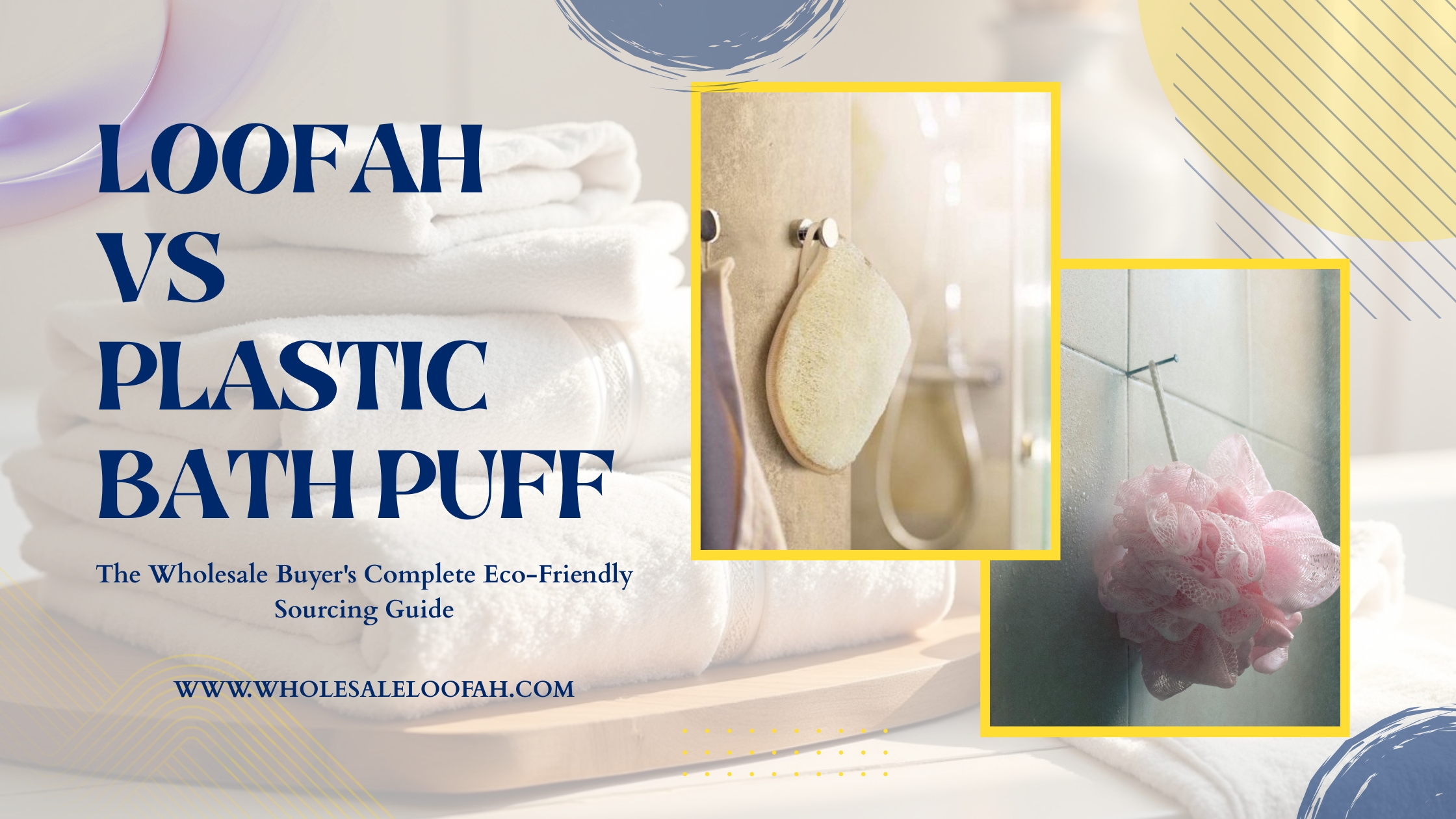
The global personal care industry crossed a tipping point around 2022. Sustainability stopped being a differentiator and started becoming a baseline expectation. For wholesale buyers, retailers, and importers sourcing bath and body products, that shift has concrete implications: the loofah vs plastic bath puff decision is no longer just a consumer preference question. It is a sourcing strategy question with measurable impact on market position, regulatory compliance, and long-term margin.
In 2026, natural loofah sourced from Egypt represents one of the strongest opportunities in the sustainable personal care category. The product has a 400 to 500 year environmental advantage over plastic alternatives in terms of decomposition, produces zero microplastic pollution, commands premium retail pricing, and is supported by accelerating consumer demand and increasingly strict regulatory frameworks targeting synthetic personal care plastics in major markets.
This guide is built specifically for wholesale buyers. You will find market data, quality specifications, supplier evaluation frameworks, MOQ guidance, and a clear-eyed comparison of what natural loofah and plastic bath puffs actually deliver, both to end consumers and to your business’s bottom line.
For product browsing and direct wholesale inquiry, visit wholesaleloofah.com.
EGEXO has been exporting Egyptian loofah since 2015.
The Core Product Comparison: What Buyers Are Actually Choosing Between
Understanding the fundamental differences between natural loofah and plastic bath puffs matters because it shapes every downstream business decision, from product positioning to packaging claims to pricing strategy.
Product Definition and Material Composition
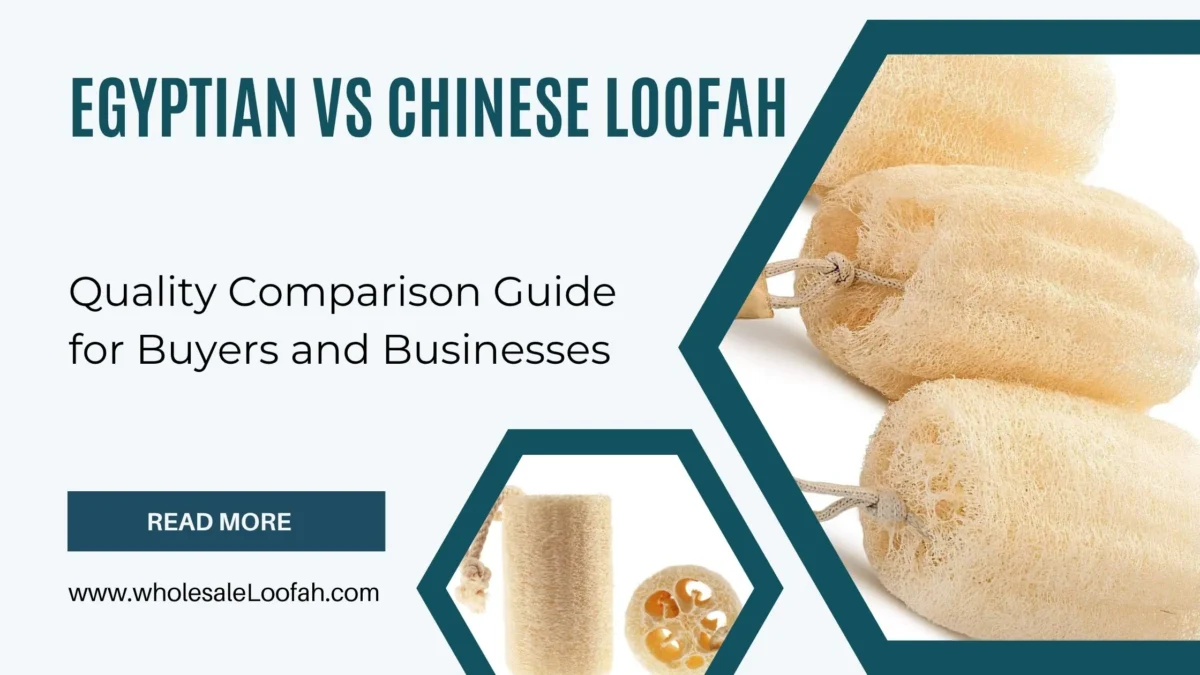
Natural Loofah The natural loofah is the processed interior fiber of the Luffa cylindrica plant, a climbing vine in the cucumber family. At maturity, the fruit’s interior forms a three-dimensional cellulose fiber matrix that, once dried and cleaned, becomes a natural mechanical exfoliator. The fiber is entirely plant-derived, with no synthetic inputs required for cultivation or basic processing.
Egyptian loofah, cultivated primarily in the Nile Delta region, is recognized globally as the premium tier of this product category. Soil mineral content, optimal subtropical growing conditions, and generational farming expertise combine to produce fiber that outperforms all other regional varieties on density, durability, and consistency.
Plastic Bath Puff Plastic bath puffs are manufactured from polyethylene or nylon polymer mesh, which is gathered, layered, and tied into the familiar ball shape. The raw material is a petroleum derivative, processed through chemical refining, polymer synthesis, and industrial extrusion before assembly into the finished consumer product.
| Material Attribute | Natural Loofah | Plastic Bath Puff |
|---|---|---|
| Raw material | Luffa cylindrica plant fiber | Polyethylene or nylon polymer |
| Material source | Renewable agricultural crop | Non-renewable petroleum |
| Processing intensity | Low (agricultural/mechanical) | High (chemical/industrial) |
| Biodegradability | 100 percent, within 30 to 60 days | 0 percent, persists 400 to 500 years |
| Microplastic shedding | None | Active during every use |
| Recyclability | Compostable | Not standard recyclable |
| Consumer allergen profile | Low (natural fiber) | Low to moderate (synthetic) |
Environmental Impact: The Data That Drives Purchasing Decisions
The environmental comparison between loofah and plastic bath puffs is not nuanced. It is one-directional, and wholesale buyers need to understand the full scope because their retail customers and end consumers increasingly do.
Microplastic Contamination: A Growing Regulatory Risk
Synthetic bath puffs shed microplastic fibers throughout their use. These fibers, typically smaller than five millimeters, pass through standard wastewater treatment infrastructure and enter freshwater and marine environments. Scientific research has detected microplastics in ocean sediment, marine organism tissue, freshwater sources, drinking water, atmospheric precipitation samples, and human blood and lung tissue.
For wholesale buyers and retailers, this is not just an environmental concern. It is an emerging regulatory risk. The European Union’s Single-Use Plastics Directive already restricts certain plastic personal care items. Extended producer responsibility legislation in multiple markets is expanding to include synthetic bath and body products. Brands and retailers that are heavily invested in plastic bath puff inventory face potential compliance exposure in key markets within the next regulatory cycle.
Natural loofah carries zero microplastic exposure risk. It is inherently compliant with all existing and anticipated single-use plastic regulations.
Carbon and Supply Chain Footprint
| Supply Chain Stage | Natural Loofah | Plastic Bath Puff |
|---|---|---|
| Raw material sourcing | Seasonal agricultural crop | Petroleum extraction and refining |
| Primary processing | Mechanical cleaning and drying | Chemical synthesis and extrusion |
| Energy intensity | Low | High |
| Transportation emissions | Low to moderate (bulk agricultural) | Moderate (manufactured goods) |
| Packaging requirements | Minimal for raw; retail-ready available | Standard retail packaging |
| End-of-life carbon impact | Near zero (composting) | Significant (landfill methane, incineration) |
Wholesale Market Analysis: Where the Opportunity Sits
Global Market Data and Growth Projections
The data tells a consistent story across geographies. Natural personal care tools are growing faster than the overall personal care market, driven by:
- Sustained consumer awareness of plastic pollution
- Regulatory pressure on synthetic materials in personal care
- Premium positioning and margin advantages for sustainable alternatives
- Growing demand from hospitality, spa, and wellness sectors seeking sustainability credentials
For wholesale buyers evaluating where to allocate sourcing budget, the natural loofah category offers both current demand and structural tailwinds that make it a durable, not trend-dependent, opportunity.
Who Is Buying Natural Loofah at Wholesale Scale
Understanding the buyer landscape helps position products effectively:
Spa and Wellness Operators Independent spas, resort spas, and wellness centers are replacing synthetic personal care tools as part of sustainability credentialing, green certification programs, and premium client experience positioning. Natural loofah is a natural fit for treatment room amenities and retail product shelves.
Specialty and Natural Retailers Retailers in the natural, organic, and health-focused channel were early adopters of natural loofah and now represent a mature, stable wholesale customer base. Demand from this segment is focused on quality consistency and private label options.
Mass Market Retailers Expanding Eco Lines Major retail chains in Europe, North America, and Australia are actively expanding sustainable personal care sections. This creates new entry points for natural loofah at volume. Buyers in this segment require consistent supply, reliable quality grading, and competitive pricing.
Hotel and Hospitality Operators The hospitality sector’s sustainability commitments are driving adoption of natural bath amenities. Hotels replacing single-use plastic bath puffs in room amenity kits represent a significant and growing wholesale demand source.
Private Label Beauty and Wellness Brands Direct-to-consumer brands in the clean beauty and sustainable wellness categories are building product lines around natural loofah. This segment requires flexible MOQs, custom sizing, and full private label manufacturing capability.
Egyptian Loofah: Why Sourcing Origin Matters
Not all natural loofah is equivalent. The sourcing origin has a direct and measurable impact on the quality of the finished product, which in turn affects customer satisfaction, return rates, and brand reputation for retail buyers.
Regional Quality Comparison
| Quality Factor | Egyptian Loofah (Nile Delta) | Asian Commodity Loofah | Other Origins |
|---|---|---|---|
| Fiber density | High, uniform across entire product | Variable, often inconsistent between batches | Generally lower than Egyptian |
| Durability (active use weeks) | 3 to 5 weeks | 2 to 3 weeks typical | 2 to 4 weeks |
| Flexibility when fully wet | Excellent, uniform softening | Often uneven softening | Variable |
| Fiber shed rate | Low after initial rinse | Often elevated throughout use | Variable |
| Color consistency batch to batch | High | Low to moderate | Low to moderate |
| Grade availability | Premium, Standard, Economy | Usually single undifferentiated grade | Limited |
| Post-harvest processing | Controlled, expertise-driven | Variable | Variable |
The quality difference between premium Egyptian loofah and commodity product is consistently observable in both wholesale sample evaluations and end-consumer experience. Retail buyers stocking premium-priced natural loofah need the underlying product quality to support those price points.
Egexo’s quality standards documentation provides full grading specifications with measurable criteria. Understanding why Egexo is the preferred loofah supplier for importers in more than 40 countries starts with those specifications.
Egexo Product Specifications for Wholesale Buyers
Complete Product Range Overview
| Product Type | Form | Size Range | MOQ | Primary Application | Catalog Link |
|---|---|---|---|---|---|
| Whole body loofah | Full cylinder | 20 cm to 30 cm | No minimum order on standard products | Spa treatments, body exfoliation | Bath and body loofah |
| Loofah slices | Rounds/discs | 2 cm to 6 cm thick | No minimum order on standard products | Retail packs, gift sets | Bath and body loofah |
| Loofah halves | Half cylinder | 15 cm to 25 cm | No minimum order on standard products | Retail and spa use | Bath and body loofah |
| Raw loofah scrubbers | Natural form | Various | No minimum order on standard products | Soap making, craft, DIY | Raw loofah scrubbers |
| Kitchen loofah | Processed pad | Standard | No minimum order on standard products | Dish scrubbing, kitchen use | Kitchen loofah |
| Pet grooming loofah | Processed pad | Various | No minimum order on standard products | Pet care, grooming | Pet and spa loofah |
| Custom shaped loofah | Per spec | Per spec | Private label from 1,000 units | Private label, branded lines | Custom design |
Ordering and Fulfillment Process
| Stage | Detail | Timeline |
|---|---|---|
| Sample request | Samples are paid; the buyer pays shipping | 7 to 25 days from payment |
| Quotation | Custom quote based on SKU, volume, and specs | 1 business day response |
| Order confirmation | Purchase order and pro forma invoice | 7 to 25 days from payment |
| Production/processing | Based on order volume and customization | Confirmed with the quote |
| Quality inspection | Pre-shipment inspection available | Included or third-party |
| Shipment | Full container, LCL, or air freight | 7 to 25 days from payment |
For a complete view of the process from crop to export container, the Egexo Farm to Export process page provides full documentation.
Supplier Evaluation: How to Identify a Qualified Loofah Source
The natural loofah market includes a range of supplier types, from direct-source farms with full processing capabilities to intermediary traders with no direct growing involvement. The difference between these supplier types has significant implications for quality consistency, price transparency, and supply reliability.
Supplier Evaluation Framework
| Evaluation Criterion | Premium Supplier Indicator | Caution Signs |
|---|---|---|
| Farm origin | Owns or directly sources from verified farms | Unable to specify farm locations |
| Processing capability | In-house cleaning, grading, and processing | Relies entirely on third parties |
| Quality grading | Documented grade standards with specifications | No formal grading system |
| Sample availability | Samples are paid; the buyer pays shipping | Requires minimum order before sampling |
| Export track record | Demonstrated multi-market export history | Limited or undocumented export history |
| Lead time reliability | Consistent, contracted lead times | Vague or inconsistent timelines |
| Private label capability | Full design and packaging services in-house | No custom options available |
| Communication responsiveness | Direct export team, responsive communication | Slow or indirect communication channels |
| Regulatory documentation | Can provide certificates and compliance docs on request | Cannot support documentation requests |
Review why Egexo is the preferred supplier for importers who have prioritized quality and reliability.
Private Label and Custom Development: Building Your Own Natural Loofah Line
One of the strongest business opportunities in the natural loofah category is private label product development. As the sustainable personal care market matures, the most valuable market positions are held by brands, not by commodity product resellers.
Egexo offers comprehensive private label loofah manufacturing services that cover:
- Custom product sizing and shape development
- Packaging design and print management
- Retail-ready presentation including hang tags, bands, and sleeve packaging
- Gift set assembly and bundling
- Export-ready fulfillment to destination markets
The custom loofah product design service extends this to bespoke product development for brands with specific dimensional, texture, or presentation requirements.
For buyers building a sustainable personal care brand from the ground up, or retailers looking to launch a house-brand eco product line, the combination of Egexo’s direct-source Egyptian loofah with comprehensive private label capability represents a complete solution.
Expert Insight from EGEXO
There is a question we hear consistently from new wholesale buyers evaluating natural loofah for the first time: how do I know if the quality is consistent across a large order? It is the right question to ask.
At EGEXO, every product batch is graded against documented specifications covering fiber density, size consistency, color uniformity, flexibility, and defect rate. Those standards are not aspirational. They are applied at the processing facility and documented for each shipment.
The source matters because Egyptian loofah from the Nile Delta starts with naturally superior raw material. We are not correcting for poor fiber with processing techniques. We are enhancing fiber that is already high quality to begin with. That fundamental quality advantage is what makes our product perform consistently at scale, whether a buyer orders 500 units or 50,000.
Our recommendation for any new buyer: order samples first, test them against your target application and any competitor samples you are evaluating, and make the decision based on direct product comparison. Samples are paid and the buyer pays shipping. The sample cost is credited to your first order of $1,000 or more, placed within 60 days. We are confident in what that comparison will show.
Download the complete EGEXO product catalog for full specifications across all product lines.
FAQ Section
Q1: Why are wholesale buyers moving from plastic bath puffs to natural loofah in 2026? A: The shift is driven by three converging forces. Consumer demand for sustainable personal care products is growing at 6.8 to 8 percent annually in major markets. Regulatory frameworks targeting synthetic plastics in personal care are tightening across the EU and expanding to other markets. And natural loofah commands premium retail pricing that supports better margins than commodity plastic puffs. For wholesale buyers, the loofah vs plastic bath puff decision now has a clear commercial logic, not just an ethical one.
Q2: What MOQ does Egexo offer for Egyptian loofah wholesale orders? No minimum order on standard products. Private label from 1,000 units. MOQ requirements vary by product type, customization level, and whether private label services are included. Buyers should request a direct quotation to get accurate minimums for their specific product requirements. Sample orders are available before any bulk commitment.
Q3: How does natural loofah compare to plastic bath puffs on retail margin potential? A: Natural loofah, particularly Egyptian premium grade, supports significantly higher retail pricing than equivalent-sized plastic bath puffs. The sustainability narrative, premium origin story, and demonstrable product quality allow retailers to position natural loofah in the premium tier of the personal care category. Private label programs further enhance margin by removing the commodity pricing pressure of branded product sourcing. Wholesale buyers typically report stronger per-unit margins on natural loofah than on plastic alternatives at comparable volume.
Q4: What documentation does Egexo provide for import compliance? A: Egexo provides standard export documentation including certificate of origin, phytosanitary certificates, commercial invoice, packing list, and bill of lading for all shipments. Contact EGEXO for documentation requirements in your target market.
Q5: Can Egexo supply loofah products for non-bath applications such as kitchen or pet care? A: Yes. Egexo’s product range extends across multiple loofah applications. Kitchen loofah products serve the growing eco-friendly dish scrubber market. Pet grooming loofah is available for professional pet care brands and veterinary product distributors. Raw loofah scrubbers serve the artisan soap making and crafting markets. Each product category has its own specifications and MOQ requirements. Browse the full range at our products page.
Q6: How does Egexo ensure quality consistency across large wholesale orders? Pre-shipment inspection is standard practice.
Q7: What is the difference between loofah grades available from Egexo? A: Egexo offers three primary grades. Premium grade is characterized by the highest fiber density, uniform pore distribution, optimal flexibility, and consistent color. It is suited for high-end retail, spa, and private label applications. Standard grade offers excellent quality for mainstream retail and hospitality applications at a more accessible price point. Economy grade serves bulk applications where volume and price take priority over premium specification. Full grade specifications are available in the loofah quality standards documentation.
Q8: How should wholesale buyers evaluate loofah samples before committing to a large order? A: The most important evaluation step is testing samples when fully wet, not dry. A high-quality Egyptian loofah should soften and increase in flexibility significantly when saturated, maintain full structural integrity without fraying or disintegrating, return to shape after compression, and produce no musty or chemical odor after drying. Buyers should also assess fiber shed rate over the first three to five uses, color consistency across multiple sample units, and durability after a two-week active use test. Order free Egexo samples to begin your evaluation.
Conclusion
For wholesale buyers navigating the loofah vs plastic bath puff decision in 2026, the answer is clear across commercial, environmental, and regulatory dimensions. Natural loofah from a verified Egyptian source delivers superior product quality, supports premium retail positioning, eliminates microplastic regulatory risk, and participates in a market segment growing at nearly 8 percent annually.
Plastic bath puffs are facing a category headwind. Consumer awareness of microplastic pollution is not a trend. It is a permanent shift in how buyers evaluate personal care products. Regulatory frameworks are moving to formalize restrictions that consumer behavior has already begun enforcing through purchasing choices.
Egexo stands as the sourcing partner of choice for wholesale buyers who want premium quality, reliable supply, and a complete range of services from direct-source Egyptian loofah through private label manufacturing and export-ready fulfillment.
Key Takeaways:
- Natural loofah vs plastic bath puff: every environmental metric favors natural loofah
- Egyptian loofah from the Nile Delta is the globally recognized quality benchmark
- Regulatory risk for synthetic bath products is growing in the EU and expanding to other markets
Ready to source premium Egyptian loofah for your business?
- For Wholesale Buyers: Request a quote or download our catalog
- For Sample Evaluation: Order samples before your bulk commitment
- For Private Label: Explore private label manufacturing