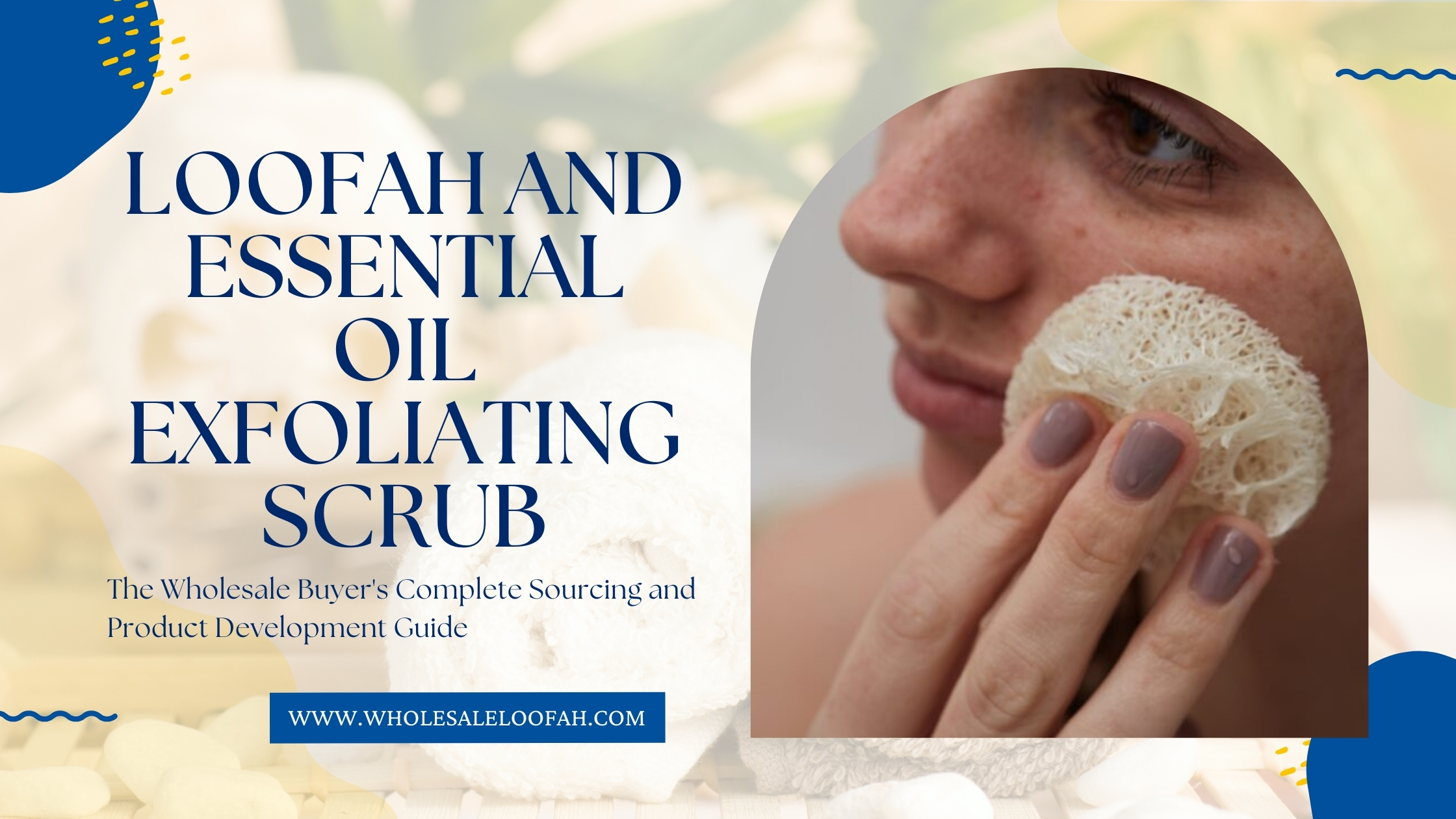
Within this segment, the loofah and essential oil exfoliating scrub category has emerged as one of the fastest-growing subcategories, driven by consumer demand for plastic-free personal care, clean beauty formulations, and spa-quality treatments that can be replicated at home. For wholesale buyers, distributors, private label brand owners, and spa procurement managers, understanding how to source, evaluate, and commercialize these products is no longer optional. It is a competitive necessity.
This guide on Wholesale Loofah approaches the loofah and essential oil exfoliating scrub from a purely commercial perspective. Rather than focusing on individual recipes or DIY consumer tips, this resource delivers actionable intelligence on supplier evaluation, cost analysis, regulatory compliance, product development strategy, and market positioning. Every section is designed to help B2B buyers make better purchasing decisions and build more profitable product lines around loofah-based exfoliation.
EGEXO has been exporting Egyptian loofah since 2015. Their wholesale quotation portal provides rapid pricing for bulk orders of all standard and custom-cut loofah formats.
Market Dynamics Driving Demand for Loofah-Based Scrub Products
Several converging market forces have positioned the loofah and essential oil exfoliating scrub as a high-growth category within the broader natural personal care industry. Understanding these forces allows wholesale buyers to time their purchasing, align inventory with demand cycles, and communicate market-relevant value propositions to their own customers.
Consumer Behavior Shifts
The clean beauty movement has matured from a niche concern into a mainstream purchasing filter. Legislation has reinforced this shift. The United States Microbead-Free Waters Act and similar regulations in the European Union, Canada, and Australia have effectively banned plastic microbeads from rinse-off cosmetic products, creating a regulatory vacuum that natural alternatives like loofah fiber are filling.
Essential oils have undergone a parallel transformation in consumer perception. Once confined to aromatherapy specialty shops, essential oils are now integrated into mainstream skincare lines sold through mass retail, direct-to-consumer e-commerce, and professional spa distribution channels. The combination of loofah fiber and essential oils in a single product format gives brands a compelling dual-benefit narrative: physical exfoliation plus therapeutic aromatherapy, delivered through entirely plant-based ingredients.
Channel Expansion
The loofah and essential oil exfoliating scrub has proven adaptable across multiple retail and professional channels. Spa and wellness facilities use loofah scrub treatments as premium service offerings with high per-session margins. Subscription box companies include loofah scrub kits as featured items that drive unboxing engagement on social media. Hotel amenity programs have begun replacing synthetic bath accessories with branded loofah products as part of sustainability commitments. Each of these channels represents a distinct wholesale opportunity with different volume requirements, pricing expectations, and packaging specifications.
Supplier Evaluation Framework for Wholesale Loofah Procurement
Selecting the right loofah supplier is the single most consequential decision a wholesale buyer makes when entering the loofah and essential oil exfoliating scrub market. Raw material quality determines the performance of the finished product, the consistency of the customer experience, and the durability of the brand reputation built around it. The following framework provides a structured approach to evaluating potential suppliers before committing to purchase orders.
Supplier Assessment Criteria Matrix
| Evaluation Category | Key Questions to Ask | Documentation to Request | Weight in Decision (Percentage) |
|---|---|---|---|
| Cultivation Control | Does the supplier grow their own loofah or source from third-party farms? What region is the loofah grown in? | Farm location records, cultivation method documentation | 20 |
| Processing Standards | What drying method is used? What is the target moisture content? Is bleaching or chemical treatment applied? | Processing facility photos, moisture testing certificates | 20 |
| Quality Grading | Does the supplier use a formal grading system? How many quality tiers are available? | Grade specification sheets, sample sets by grade | 15 |
| Cutting and Customization | Can the supplier cut loofah to custom dimensions? What tolerances are maintained? | Custom product portfolio, tolerance specifications | 10 |
| Minimum Order Quantities | What is the MOQ per SKU? Are mixed-SKU orders permitted? | Price sheets with MOQ tiers | 10 |
| Export and Logistics | Does the supplier handle export documentation? What shipping terms are offered? | Export license copies, Incoterms options | 10 |
| Regulatory Compliance | Can the supplier provide certificates of origin, phytosanitary certificates, and material safety data? | Certificate samples, compliance documentation | 10 |
| Communication and Responsiveness | How quickly does the supplier respond to inquiries? Is a dedicated account manager assigned? | Response time benchmarks, organizational chart | 5 |
This matrix is weighted to reflect the relative importance of each factor for buyers sourcing loofah specifically for scrub product applications. Cultivation control and processing standards carry the heaviest weight because these two factors most directly affect the fiber texture, absorbency, and cleanliness that determine scrub performance.
Egexo scores exceptionally well across all eight categories because they operate as a fully vertically integrated supplier. They cultivate their own loofah on managed farmland in Egypt’s Nile Delta, process it in their own facilities using controlled sun-drying to below 8 percent moisture, and handle all export logistics including phytosanitary certification and customs documentation. Buyers can review their complete operational chain on the Egexo farm to export process page.
Cost Analysis: Understanding the Economics of Loofah Scrub Products
Profitability in the loofah and essential oil exfoliating scrub category depends on understanding the full cost stack from raw material procurement through to delivered retail product. Buyers who focus solely on per-unit loofah cost without accounting for essential oils, carrier oils, scrub base materials, packaging, labeling, and freight often miscalculate their margins and underprice their offerings.
Unit Cost Breakdown for a Standard Loofah Scrub Kit
The following analysis models a mid-market retail scrub kit containing one premium-grade Egyptian loofah disc (approximately 10 centimeters diameter), one 120-milliliter jar of essential oil scrub blend (sea salt base with lavender and eucalyptus oils in sweet almond carrier), branded kraft packaging, and printed instruction insert.
| Cost Component | Small Batch (250 units) USD | Medium Batch (1,000 units) USD | Large Batch (5,000 units) USD |
|---|---|---|---|
| Loofah disc (premium Egyptian grade) | 0.85 | 0.62 | 0.41 |
| Sea salt scrub base (bulk) | 0.35 | 0.28 | 0.19 |
| Essential oils (lavender plus eucalyptus) | 0.42 | 0.34 | 0.25 |
| Sweet almond carrier oil | 0.30 | 0.22 | 0.15 |
| Glass jar with lid (120 ml) | 0.75 | 0.55 | 0.38 |
| Kraft box packaging | 0.60 | 0.42 | 0.28 |
| Printed instruction insert | 0.12 | 0.08 | 0.05 |
| Labels (jar plus box) | 0.18 | 0.12 | 0.08 |
| Assembly labor | 0.50 | 0.35 | 0.22 |
| Total unit cost | 4.07 | 2.98 | 2.01 |
The loofah disc itself represents a relatively small fraction of total unit cost, but its quality has an outsized impact on the customer’s perception of the entire kit. This is why experienced buyers invest in premium-grade Egyptian loofah even when cheaper alternatives are available. The cost difference between a standard grade and premium grade loofah disc at the 1,000-unit level is typically only 0.15 to 0.25 USD, but the perceived value increase to the end consumer is worth several dollars.
For current wholesale pricing on all Egexo loofah formats, buyers can submit a quotation request specifying their desired cut shapes, quantities, and shipping destination.
Product Development Strategy: Building a Loofah Scrub Product Line
A common mistake among new entrants to the loofah and essential oil exfoliating scrub market is launching with a single SKU and hoping it appeals to everyone. Successful brands in this category build structured product lines that address distinct customer segments, usage occasions, and price points. This section outlines a product line architecture that wholesale buyers and brand owners can adapt to their specific market context.
Three-Tier Product Line Architecture
The most commercially effective approach organizes products into three tiers that share common loofah sourcing and packaging platforms while differentiating on essential oil formulation and scrub base composition.
Tier One: Everyday Essentials. This tier targets price-conscious consumers who want a reliable, pleasant-smelling exfoliating scrub for regular use. The loofah format is a standard disc or pad in the most common size. The scrub formulation uses affordable but effective ingredients like fine sea salt, sunflower or grapeseed carrier oil, and popular essential oils such as lavender, peppermint, or lemon. Packaging is clean and functional without luxury embellishments. Retail pricing falls between 12.00 and 16.00 USD. This tier drives volume and builds brand familiarity.
Tier Two: Targeted Solutions. This tier addresses specific skin concerns like anti-aging, deep hydration, cellulite reduction, or post-workout recovery. The loofah format may vary by product, using finer-textured pieces for facial items and coarser raw scrubbers for body treatments. Scrub formulations use premium ingredients like Dead Sea salt, manuka honey, activated charcoal, or specialty essential oils such as neroli, frankincense, or helichrysum. Packaging includes more detailed usage instructions and ingredient benefit callouts. Retail pricing ranges from 18.00 to 24.00 USD. This tier drives margin and attracts customers who are willing to pay more for products that address their specific needs.
Tier Three: Luxury Spa Experience. This tier positions the product as an at-home spa ritual rather than a simple scrub. The loofah format is a large body sheet or a curated set of multiple pieces for different body zones. The scrub formulation uses the most expensive and exotic ingredients: rare essential oils like Bulgarian rose otto or blue tansy, premium carrier oils like argan or rosehip seed, and artisanal scrub bases like pink Himalayan salt or volcanic pumice. Packaging is gift-worthy, potentially including a linen drawstring bag, a printed ritual guide card, and a branded wooden scoop. Retail pricing starts at 28.00 USD and can reach 45.00 USD or higher for elaborate kits. This tier drives brand prestige and generates social media visibility through unboxing content.
Across all three tiers, the loofah component should come from the same high-quality supplier to ensure consistency. Egexo’s product range spans from raw loofah scrubbers suitable for Tier One products to custom-cut body loofah formats ideal for Tier Two and Tier Three kits. Their custom loofah product design service allows brands to specify exact dimensions, shapes, and fiber density grades for each tier.
Regulatory Landscape: Compliance Requirements by Market
Wholesale buyers distributing loofah and essential oil exfoliating scrub products across international markets must navigate a patchwork of regulatory frameworks. The loofah component itself is classified as a natural plant fiber and generally faces minimal regulatory scrutiny. However, the essential oil scrub component falls under cosmetic product regulations in most jurisdictions, triggering labeling, safety testing, and registration requirements.
Regulatory Requirements by Major Market
| Market | Governing Regulation | Key Requirements | Registration Needed | Labeling Language |
|---|---|---|---|---|
| United States | – | Facility registration, adverse event reporting, ingredient listing per INCI nomenclature, product labeling compliance | Facility registration required since 2023 under MoCRA | English |
| European Union | EC Regulation 1223/2009 | Responsible person designation, cosmetic product safety report (CPSR), product information file (PIF), CPNP notification | CPNP notification mandatory before market placement | Language of the country of sale |
| United Kingdom | UK Cosmetics Regulation (retained EU law) | Responsible person in UK, SCPN notification, product safety assessment | SCPN notification mandatory | English |
| Canada | Cosmetics Regulations under Food and Drugs Act | Cosmetic notification form (CNF), ingredient listing per INCI, bilingual labeling | CNF submission required | English and French |
| Australia | NICNAS/AICIS industrial chemicals regulation | AICIS registration for essential oil ingredients, TGA compliance if therapeutic claims made | AICIS registration for certain chemical ingredients | English |
| Japan | Pharmaceutical and Medical Device Act (PMD Act) | Quasi-drug classification possible if therapeutic claims made, ingredient restrictions per positive list | Notification or approval depending on claims | Japanese |
The most significant compliance consideration for buyers is the distinction between cosmetic claims and therapeutic claims. A loofah and essential oil exfoliating scrub marketed as “exfoliating and cleansing” falls squarely within cosmetic regulation in most markets. However, if the marketing language claims that the product “treats acne,” “heals eczema,” or “cures dry skin,” it may be reclassified as a drug or therapeutic good, triggering far more stringent and expensive regulatory pathways. Wholesale buyers should work with regulatory consultants in their target markets to ensure all product claims remain within cosmetic classification boundaries.
On the loofah sourcing side, phytosanitary certificates are required for importing raw plant-based materials into most countries. Egexo includes phytosanitary certification with all export shipments as standard practice, eliminating one of the most common import clearance delays that buyers encounter when working with less experienced suppliers. Their full export documentation package is detailed on the Egexo export process page.
Packaging and Presentation Specifications for Wholesale Distribution
The packaging of a loofah and essential oil exfoliating scrub product serves three functions simultaneously: protecting the product during shipping and storage, communicating brand identity and product benefits at the point of sale, and meeting regulatory labeling requirements. Wholesale buyers must balance these functions against packaging cost targets that preserve healthy margins.
Material Selection for Scrub Kit Components
The loofah itself is best shipped and stored in breathable packaging that allows residual moisture to escape. Sealed plastic wrap is the most common but least desirable option because it traps moisture against the loofah surface, creating conditions favorable for mold development during extended warehouse storage. Superior alternatives include perforated kraft paper sleeves, mesh drawstring bags made from organic cotton, or compostable cellulose film wraps. Each of these allows air circulation while protecting the loofah from contamination.
The scrub mixture requires an airtight container that prevents moisture ingress and essential oil evaporation. Glass jars with metal lids are the gold standard for quality perception and product preservation, though they increase shipping weight and breakage risk. PET plastic jars with polypropylene lids offer a lighter and more durable alternative that still provides adequate barrier properties. For brands positioning in the eco-luxury segment, refillable aluminum tins with screw-top lids deliver both sustainability credentials and premium aesthetics.
Outer packaging should be designed for both retail shelf display and e-commerce shipping durability. A rigid kraft box with a die-cut window that reveals the loofah inside creates an appealing retail presentation while providing structural protection. For e-commerce fulfillment, the same box should be sized to fit standard mailer dimensions without excessive void fill.
Logistics and Inventory Management for Loofah Products
Loofah is a seasonal agricultural product with a primary harvest window that runs from late summer through early autumn in the major growing regions of Egypt, India, and China. This seasonality creates inventory planning implications that wholesale buyers must account for in their purchasing schedules.
Seasonal Procurement Calendar
| Month | Activity | Buyer Action |
|---|---|---|
| January to March | Off-season; suppliers ship from existing warehouse inventory | Place orders for Q2 demand using available stock |
| April to June | Growing season; new crop developing in fields | Confirm annual volume commitments; lock pricing for the coming harvest |
| July to September | Primary harvest and processing window | Place pre-harvest orders to secure allocation from new crop |
| October to December | New crop fully processed and available for export; peak retail demand season | Receive new crop shipments; build inventory for holiday retail surge |
Buyers who place orders during the July to September window typically receive the freshest loofah with the longest usable shelf life. Waiting until October or November to order for the holiday season risks encountering longer lead times as suppliers fulfill the queue of orders placed earlier.
Egexo maintains year-round warehouse inventory of all standard loofah formats to support buyers who need flexible ordering outside the primary harvest cycle. For custom-cut or specialty formats, placing orders during the pre-harvest window ensures allocation from the new crop. Their team can advise on optimal order timing through the wholesale inquiry form.
For detailed guidance on shipping methods, container loading configurations, and freight cost optimization for bulk loofah orders, the Wholesale Loofah logistics resource center provides comprehensive reference materials.
Private Label and White Label Opportunities
The loofah and essential oil exfoliating scrub category offers particularly strong private label potential because the product format is inherently customizable. The same high-quality Egyptian loofah disc can be paired with dozens of different scrub formulations, each targeting a different market segment or retail channel, all under the buyer’s own brand identity.
Private Label Development Process
The typical private label development cycle for a loofah scrub kit runs approximately 8 to 14 weeks from concept to first production delivery. The process begins with defining the product concept, including target customer profile, price point, scrub formulation direction, and packaging style. Next comes loofah sample evaluation, where the buyer requests physical samples in the desired cut format and fiber grade from their supplier. Formulation development runs in parallel, with the buyer or a contracted cosmetic chemist creating the scrub recipe and producing bench samples. Packaging design and regulatory review follow once the product specifications are finalized. Finally, production and assembly bring all components together for the first shipment.
Egexo supports private label buyers at every stage of this process through their private label loofah manufacturing service. This service encompasses custom cutting to the buyer’s specified dimensions, quality grading to the buyer’s required standards, private label packaging with the buyer’s branding, and export logistics to the buyer’s designated receiving facility. For buyers who want to evaluate loofah options before committing to a full private label program, Egexo’s sample request service ships curated sample sets to any global destination.
Expert Insight from EGEXO
Loofah is not a uniform commodity. Fiber density, cell structure, flexibility, and absorbency vary depending on the cultivar, growing conditions, harvest timing, and processing method. A loofah disc intended for a gentle facial scrub requires a fundamentally different fiber profile than one designed for vigorous body exfoliation. Buyers who communicate their end-use application clearly to their supplier receive loofah that is optimally matched to their product concept. Those who simply order “loofah discs” without specifying the application often end up with material that underperforms for its intended purpose. At EGEXO, we begin every new buyer relationship with a detailed consultation about their product vision, target customer, and quality expectations. This consultative approach has helped us build long-term supply partnerships with brands in more than 40 countries. We invite wholesale buyers to begin that conversation by visiting egexo.com or submitting a wholesale inquiry.
Frequently Asked Questions
Q1: What minimum order quantity should a wholesale buyer expect when sourcing loofah for scrub kits?
Minimum order quantities for wholesale loofah vary by supplier and by product format. No minimum order on standard products. Private label from 1,000 units. Buyers ordering mixed SKUs in a single shipment can sometimes negotiate lower per-SKU minimums. The key is to communicate your full annual volume projection upfront so the supplier can offer the most favorable pricing and MOQ structure.
Q2: How should wholesale buyers evaluate whether a loofah supplier’s quality is consistent across orders?
Consistency is best verified through a structured sampling protocol. Request samples from at least two different production batches before placing your first bulk order. Compare the samples side by side for fiber color uniformity, density, flexibility when wet, and dimensional accuracy. After placing your first order, pull a random sample of 10 to 15 pieces from the delivered shipment and evaluate them against the pre-order samples using the same criteria. Establish a formal quality agreement with your supplier that specifies acceptable tolerance ranges for each parameter. Reputable suppliers like Egexo welcome this level of scrutiny because it builds mutual confidence in the supply relationship.
Q3: What is the typical lead time from order placement to delivery for bulk loofah shipments?
Lead times depend on the shipping method and destination. For ocean freight from Egypt to major ports in North America, the typical timeline is 3 to 5 weeks from order confirmation to port arrival. European destinations are generally 1 to 3 weeks by ocean freight. Air freight reduces transit to 3 to 7 days globally but at significantly higher cost, making it suitable primarily for urgent restocking or sample shipments. Production and packing at the supplier’s facility typically requires 1 to 2 weeks for standard formats and 2 to 4 weeks for custom-cut orders. Buyers should plan for a total cycle of 5 to 8 weeks from order to warehouse receipt for standard ocean freight shipments.
Q4: Can wholesale buyers request loofah cut to custom shapes for branded scrub products?
Yes. Most established loofah suppliers offer custom cutting services using die-cut presses or CNC cutting equipment. Common custom shapes include circles, ovals, rectangles, and hearts, but more complex brand-specific shapes are also achievable depending on the supplier’s equipment capabilities. Custom cutting typically requires the buyer to provide a technical drawing or template with exact dimensions and corner radius specifications. Egexo’s custom loofah product design service handles these requests routinely and can advise on which shapes optimize material yield to minimize waste and cost.
Q5: How do essential oil scrub formulations affect the shelf life of loofah in packaged kits?
When loofah and essential oil scrub are packaged together in the same kit but kept in separate containers, the loofah shelf life is unaffected. However, if the loofah is pre-impregnated or pre-soaked with the scrub formulation before packaging, shelf life becomes a more critical concern. Essential oils have natural antimicrobial properties that can actually extend the loofah’s resistance to bacterial growth, but the moisture content of the scrub base can promote mold if the packaging does not provide adequate vapor barrier protection. For pre-impregnated products, a shelf life of 6 to 8 months is achievable with proper packaging and storage below 25 degrees Celsius. For kits with separate dry loofah and jarred scrub, shelf life extends to 12 months or more.
The loofah itself, as an unprocessed plant fiber, faces fewer certification hurdles than the cosmetic scrub components.
Q7: Is there a meaningful quality difference between Egyptian loofah and loofah sourced from other regions?
Egyptian loofah, particularly from the Nile Delta region, is widely regarded as the premium global standard for personal care applications. The combination of nutrient-rich alluvial soil, consistent warm temperatures, controlled irrigation from the Nile, and generations of cultivation expertise produces loofah with denser fiber structure, more uniform cell patterns, and superior flexibility compared to loofah grown in regions with less optimal conditions. Chinese and Indian loofah can be suitable for industrial and cleaning applications, but Egyptian loofah consistently outperforms in the criteria that matter most for skin contact products: softness when wet, scrubbing consistency, and resistance to premature fiber breakdown.
Q8: What are the most common mistakes wholesale buyers make when entering the loofah scrub market?
The three most frequent mistakes are underestimating the importance of loofah quality by choosing the cheapest available supplier, launching with too narrow a product range that limits market reach, and failing to account for the seasonal nature of loofah supply in inventory planning. A fourth increasingly common mistake is making regulatory missteps by using therapeutic language in marketing materials that reclassifies the product from a cosmetic to a drug in key markets. Each of these mistakes is avoidable with proper planning, supplier consultation, and regulatory guidance.
Conclusion
The loofah and essential oil exfoliating scrub represents a wholesale opportunity grounded in strong consumer demand, favorable regulatory positioning relative to synthetic alternatives, and attractive unit economics at scale. Success in this category requires three foundational elements: a reliable supply of premium-grade loofah from a vertically integrated grower-exporter, a product development strategy that addresses multiple market segments through a tiered product line, and a procurement calendar that accounts for the seasonal realities of agricultural sourcing.
Wholesale buyers who approach this market with disciplined supplier evaluation, realistic cost modeling, and regulatory awareness position themselves to capture share in one of the natural personal care industry’s most dynamic and growing segments. The infrastructure for entering this market already exists. Egyptian suppliers like Egexo have built the cultivation, processing, and export capabilities needed to support brands of any size, from small-batch artisan producers to multinational personal care corporations.
Key Takeaways:
- Supplier evaluation should weight cultivation control and processing standards most heavily, as these factors determine scrub product performance and customer satisfaction
- Unit cost for a mid-market loofah scrub kit ranges from 2.01 to 4.07 USD depending on batch size, supporting retail margins of 49 to 75 percent or higher
- A three-tier product line architecture covering everyday essentials, targeted solutions, and luxury spa experience maximizes market coverage and profitability
- Seasonal procurement planning aligned to the July through September harvest window ensures access to the freshest loofah at optimal pricing
Ready to source premium Egyptian loofah for your scrub product line?
- Request Wholesale Pricing: Get a quotation
- Evaluate Quality First: Order samples
- Explore Custom Product Design: Custom loofah solutions
- Download the Product Catalog: Egexo catalog PDF