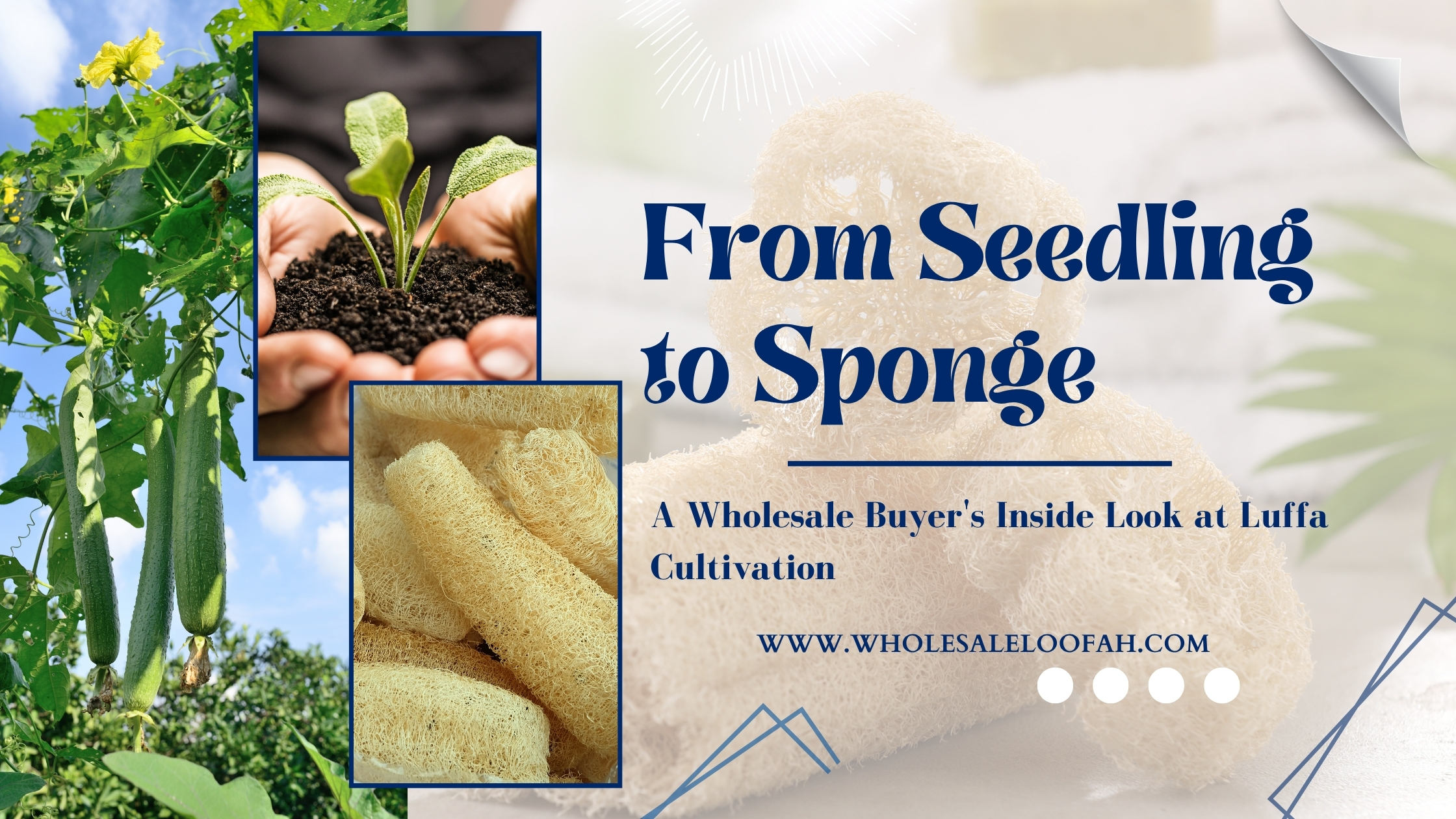
A wholesale buyer who understands exactly how luffa grows from seedling to sponge has a decisive advantage over one who treats it as a commodity. That advantage shows up in supplier negotiations, quality audits, contract terms, and ultimately in the consistency of the product that reaches the end customer. The difference between a loofah that generates repeat orders and one that generates complaints is almost always traceable to decisions made in a field, not in a warehouse, and understanding which decisions those are gives you the leverage to ask the right questions of any supplier you consider working with.
This guide is written specifically for wholesale buyers: spa owners building product lines, retailers sourcing private label inventory, distributors comparing supplier offers, and importers evaluating Egyptian luffa as a sourcing destination. It covers the full agricultural and processing chain from first planting to export-ready pallet, with a focus on the quality variables that matter most at commercial scale and the supplier behaviors that separate reliable long-term partners from low-cost risks.
EGEXO has been exporting Egyptian loofah since 2015. The insights in this guide draw directly on that operational experience, from the field monitoring practices that protect fiber quality during maturation to the grading standards and MOQ structures that help buyers at every scale build a workable supply relationship.
Why Wholesale Buyers Should Understand the Growing Process
Most wholesale buyers evaluate suppliers on price, lead time, and product samples. These are necessary but not sufficient criteria. A supplier who sources luffa from third-party intermediaries rather than owning the cultivation process has limited ability to guarantee consistency across orders. A supplier who cannot explain harvest timing criteria cannot reliably explain why a particular batch looks different from the previous one. A supplier who uses chemical bleaching to standardize color appearance is masking underlying quality variation rather than resolving it.
Understanding the growing process lets you ask better questions:
- Does the supplier own their farmland or purchase from spot markets?
- What variety of luffa do they grow, and what is their seed selection practice?
- How do they determine harvest readiness, and what is their tolerance for variability?
- Do they use natural drying or chemical processing, and why?
- How is grading applied, and at what stage of the supply chain?
These questions have right answers and evasive answers, and knowing the difference requires the baseline knowledge this guide provides.
The Agricultural Foundation: Variety, Climate, and Soil
Commercial luffa production centers on two species. Luffa aegyptiaca, the smooth-skinned variety grown extensively in Egypt, produces the cylindrical sponges dominant in the global bath and body market. Luffa acutangula, the ridged variety, is more prevalent in Asian domestic markets. For international wholesale buyers sourcing for bath, spa, kitchen, and personal care applications, Luffa aegyptiaca from Egypt is the commercial standard.
Egypt’s agricultural advantage in luffa production is not a marketing claim. It is a measurable difference rooted in climate, soil, and water access. The Nile Delta provides the combination of nutrient-rich soil, reliable freshwater irrigation drawn from one of the world’s longest rivers, and a dry summer climate that produces slow, consistent maturation in the fibrous interior of each gourd. Slow maturation in low humidity produces tighter fiber spacing and higher structural density than fast maturation in humid conditions.
How Growing Region Affects Wholesale Sourcing Decisions
| Factor | Egypt (Nile Delta) | Tropical Alternatives |
|---|---|---|
| Annual growing season length | 6 to 7 months | Year-round but variable |
| Fiber density outcome | High, consistent | Moderate, variable by season |
| Chemical processing requirement | Low, natural drying sufficient | Often needed to standardize color |
| Supply availability | Seasonal, predictable | Year-round but inconsistent quality |
| Traceability to farm | High with direct suppliers | Low with intermediary chains |
| Export infrastructure maturity | Developed, established customs routes | Variable by country |
For wholesale buyers placing repeat orders with quality requirements, the predictability column in this table is often more important than any single price comparison. A supplier who can deliver consistent fiber density across four quarterly orders is more valuable than one who delivers cheaper product with 25 percent batch-to-batch variation.
Cultivation Stages and Their Commercial Implications
Stage 1: Seed Management and Field Preparation
Professional luffa farming begins with deliberate seed management. Farms that maintain their own seed stock, selecting seeds from the highest-quality gourds each season, build a genetic quality advantage that compounds over years. This is measurable: farms with 10 or more consecutive seasons of internal seed selection typically produce higher average fiber density than those using commercially purchased seed stocks, because the selection feedback loop gradually shifts the population toward superior genetic traits.
For wholesale buyers, the practical implication is simple: ask your supplier whether they maintain their own seed stock. The answer tells you something meaningful about their investment in long-term quality versus short-term volume optimization.
Field preparation involves soil testing, pH adjustment, deep tillage, and trellis installation. Luffa requires vertical support structures for the entire growing season. Farms without adequate trellis infrastructure produce gourds that develop on the ground, leading to flattened fiber profiles on one side, increased fungal exposure, and significantly higher defect rates in the finished product.
Stage 2: Germination and Vine Establishment (Days 1 to 42)
The first six weeks of growth establish the vine structure that will support fruit development for the remainder of the season. Luffa germinates within 7 to 14 days at soil temperatures above 21 degrees Celsius. Early vine growth is rapid, with some Egyptian varieties extending 15 centimeters per day under optimal summer conditions.
The commercial relevance of this phase lies in density management. Farms that plant too densely to maximize field utilization create competition for light, water, and nutrients between vines. This competition does not eliminate fruit production but consistently reduces fiber quality in each gourd by diverting nutrients across more competing growth points. Well-managed farms maintain specific vine spacing, typically 1.5 to 2.5 meters between plants, to optimize individual fruit quality over total field yield.
Stage 3: Flowering, Pollination, and Fruit Set (Weeks 6 to 10)
Luffa flowers emerge in sequence, with male flowers preceding female flowers by approximately one week. The pollination window for each female flower is narrow, approximately 24 hours from opening to closing. In commercial production, reliable fruit set depends on either adequate pollinator populations in and around the field or practiced hand-pollination programs when pollinator activity is insufficient.
Failed pollination events waste vine growth potential and create gaps in production volume that affect delivery timelines. Farms in Egypt’s established luffa growing regions typically maintain relationships with local beekeeping operations to support pollinator density during the critical flowering period. This is a detail worth asking about in a supplier qualification conversation.
Stage 4: Fruit Maturation and Fiber Development (Weeks 8 to 16)
This stage is the single most commercially significant phase of the luffa growing cycle. The quality characteristics that wholesale buyers care about most, fiber density, structural uniformity, wall thickness, and defect rate, are all determined during these 8 to 10 weeks of gourd maturation.
The key quality variable within this stage is irrigation management. Consistent moisture during the first half of maturation supports even fiber development across the entire cross-section of the gourd. Moisture stress during this period, caused by irrigation gaps, extreme heat events, or soil drainage problems, creates uneven fiber density: dense in sections that developed under adequate moisture, thin or collapsed in sections that developed under stress. These variations are invisible during maturation but apparent in the finished sponge.
| Irrigation Consistency | Fiber Density | Defect Rate | Finished Product Lifespan |
|---|---|---|---|
| Consistent throughout | High, uniform | Under 5% | 3 to 5 weeks daily use |
| Minor gaps in mid-maturation | Moderate, minor variation | 8 to 12% | 2 to 4 weeks daily use |
| Significant gaps or drought stress | Low, high variation | 20 to 30% | 1 to 2 weeks daily use |
| Waterlogged conditions | Degraded, soft fiber | 40 percent plus | Under 1 week daily use |
Wholesale buyers reviewing supplier quality audit results should look for irrigation management documentation alongside finished product specifications. A supplier who can provide seasonal irrigation records is demonstrating a level of supply chain transparency that significantly reduces procurement risk.
Harvest Criteria and Why Timing Determines Quality
The harvest decision is made on a gourd-by-gourd basis in quality-focused operations. There is no calendar date that works uniformly across a field, because different plants flower at different times and develop at slightly different rates. A farm that harvests by date rather than by assessment criteria is taking a calculated gamble on average ripeness that consistently yields a portion of under-ripe and over-ripe gourds in every batch.
The Four-Point Harvest Assessment
Experienced luffa farmers in Egypt use a consistent four-point assessment before cutting any gourd:
- Skin color has transitioned from green to yellow or papery tan across at least 80 percent of the surface
- Tactile assessment confirms a papery, dry texture on the outer skin rather than a smooth or waxy surface
- Tap test produces a hollow sound, indicating moisture has largely vacated the interior
- Weight is noticeably low relative to the gourd’s size, typically under 200 grams for a 25-centimeter specimen
A gourd that passes all four criteria produces a sponge with full fiber development, clean color after peeling, and the structural integrity expected from a premium product. A gourd that fails even one criterion, particularly the color or weight assessment, produces a sponge with residual cellular material that degrades quickly and creates customer dissatisfaction at the retail level.
For wholesale buyers, the practical question to put to any supplier is: how do your harvesters determine harvest readiness, and what is your protocol for gourds that do not meet criteria? The answer reveals whether the farm prioritizes quality or volume when those two objectives come into tension, which they do every harvest season.
Processing Standards That Wholesale Buyers Must Verify
Post-harvest processing is where many quality compromises occur in mass-market luffa supply chains. The steps involved, peeling, cleaning, drying, grading, and cutting, are all technically straightforward, but each one has a quality-preserving path and a cost-cutting path, and the cost-cutting path typically transfers risk to the buyer.
The Drying Question: Natural vs Accelerated
Natural sun drying takes 5 to 10 days and fully preserves fiber strength. Forced-air drying takes 12 to 24 hours with minimal quality impact. Chemical bleaching to achieve a white appearance takes 2 to 4 hours but reduces fiber tensile strength by an estimated 20 to 30 percent and introduces trace chemical residues that can trigger skin sensitivity complaints from end consumers.
Many suppliers use chemical bleaching not to improve quality but to standardize appearance across batches of variable quality. A batch of luffa with uneven natural color may include well-developed and underdeveloped gourds mixed together. Bleaching homogenizes the color without revealing the underlying quality differences. Buyers who receive bleached luffa therefore cannot use color as a quality indicator, which removes one of the most reliable visual quality checks from their evaluation toolkit.
Egexo’s quality standards documentation specifies that all products are dried naturally without chemical treatment, and the farm to export process page provides documentation of processing practices across the supply chain.
Grading Systems and What They Mean for Your Order
The following table represents the grading framework applied by Egexo, which can serve as a benchmark when evaluating competing suppliers.
| Grade | Fiber Density | Dimensional Tolerance | Defect Allowance | Color Standard | Typical Application |
|---|---|---|---|---|---|
| A Premium | High, fully uniform | Plus or minus 2mm | Zero visible defects | Consistent ivory | Spa, premium retail |
| A Standard | High, minor variation | Plus or minus 3mm | Under 3% surface defects | Light tan, minor variation | Retail bath and body |
| B | Moderate | Plus or minus 5mm | Under 8% surface defects | Tan, some color variation | Economy retail, bulk |
| C | Variable | Plus or minus 8mm | Under 15% surface defects | Any natural tan | Industrial, craft |
Qualitative descriptions like good quality or natural grade tell you nothing useful about what to expect in a production batch. Ask for numeric specifications, and compare them against this framework.
MOQ Structures, Lead Times, and Order Planning
Commercial luffa sourcing requires planning around two realities: the seasonal production calendar and the processing and export lead time. Egypt’s luffa growing season runs from late spring through early autumn, with harvest concentrated in late summer. This means that orders placed in the fourth quarter of one year are typically fulfilled from inventory processed in the preceding summer, and orders requiring specific product specifications may need to be placed 12 to 16 weeks before the required delivery date.
Standard MOQ and Lead Time Reference
| Order Type | MOQ | Standard Lead Time | Customization Available |
|---|---|---|---|
| Grade A Premium, standard products | Private label from 1,000 units | Confirmed with the quote | Packaging, labeling |
| Grade A Standard, standard products | No minimum order on standard products | 7 to 25 days from payment | Packaging |
| Custom cut or shaped products | Private label from 1,000 units | Confirmed with the quote | Full spec customization |
| Private label, branded packaging | Private label from 1,000 units | Confirmed with the quote | Full branding |
| Mixed grade, full container | No minimum order on standard products | 7 to 25 days from payment | Grade split to order |
New buyers can access Egexo’s product range and pricing framework by submitting a quotation request with their product specifications and target volumes. The full product catalog is available as a downloadable PDF at the Egexo product catalog page and covers the complete range including bath and body loofahs, kitchen products, raw scrubbers, and pet and spa grooming products.
Private Label and Custom Product Opportunities
The wholesale luffa market includes a growing segment of buyers who are not simply reselling raw or minimally branded product, but building branded product lines that command retail price premiums. For this segment, the ability to source private label and custom-designed luffa products from a single vertically integrated supplier is a significant operational advantage.
Egexo offers full private label loofah manufacturing covering custom product shapes, branded packaging, hang tag design, net sleeve or kraft paper wrapping, and export-compliant labeling. For buyers who want to develop entirely new product forms, the custom loofah product design service supports concept development from initial brief through prototype to production.
Private Label ROI Considerations
| Channel | Standard Wholesale Margin | Private Label Margin Potential | Key Differentiator |
|---|---|---|---|
| Spa retail | 40 to 55% | 60 to 75% | Brand exclusivity, packaging premium |
| Specialty retail | 35 to 50% | 55 to 70% | Unique product form, brand positioning |
| E-commerce DTC | 45 to 60% | 65 to 80% | Story-driven marketing, no competitor comparison |
| Hotel and hospitality | 30 to 45% | 50 to 65% | Custom branding, bulk contract pricing |
These margin ranges reflect general market conditions rather than specific pricing guarantees. Individual outcomes depend on retail pricing strategy, channel costs, and packaging investment. The consistent pattern across channels is that private label positioning allows buyers to move pricing conversations away from commodity comparison, which is the single most effective lever for margin improvement in the wholesale loofah category.
Supplier Qualification Framework for Luffa Buyers
Before establishing any wholesale relationship, applying a structured qualification process reduces the risk of first-order quality problems and makes post-delivery dispute resolution significantly simpler. The following framework is designed specifically for luffa procurement.
Tier 1: Foundational Requirements
| Criterion | Qualifying Answer | Disqualifying Answer |
|---|---|---|
| Farm ownership | Owns and operates cultivation land | Purchases from spot market or brokers |
| Growing region | Egypt or documented comparable climate | Unspecified or low-quality origin |
| Export history | Minimum 3 years of documented exports | New to export or no documentation |
| Quality documentation | Written grading standards with specifications | Verbal assurances without documentation |
| Sample provision | Free or low-cost samples available | Samples require full MOQ purchase |
Tier 2: Quality Verification
| Criterion | What to Evaluate | How to Verify |
|---|---|---|
| Fiber density | Squeeze test dry and wet | Physical sample evaluation |
| Color consistency | Batch-to-batch color range | Request samples from two different batches |
| Dimensional accuracy | Measure against stated specifications | Caliper check on minimum 10 units |
| Processing method | Natural vs chemical treatment | Ask directly, check odor and flexibility |
| Defect rate | Visual inspection of 50-unit sample | Count and categorize defects |
Tier 3: Operational Reliability
| Criterion | What to Ask | Red Flag |
|---|---|---|
| Lead time consistency | Track record on prior buyer orders | Vague or unverifiable claims |
| Communication responsiveness | Response time to sample requests | Delays exceeding 48 hours |
| Pre-shipment inspection | – | Refusal or significant additional charge |
| Reorder price stability | Historical price variation percentage | Significant price increases with each order |
Egexo’s full qualification documentation, including farm credentials, export history, quality specifications, and grading standards, is available through the why choose Egexo page. Buyers can also order samples directly to begin their own Tier 2 quality verification before any commercial commitment.
FAQ Section
Q1: What is the minimum order quantity for wholesale luffa from Egypt? A: Minimum order quantities for wholesale luffa vary by product grade, type, and customization level. With Egexo, Grade A Premium standard products start at 500 units, Grade A Standard at 1,000 units, and mixed container orders at 5,000 units. No minimum order on standard products. Private label from 1,000 units. These figures reflect the production economics of quality-focused processing rather than arbitrary minimums. Submit a detailed request through the quotation page for a precise figure based on your specifications.
Q2: How do I verify that luffa samples represent bulk production quality? A: Request samples from at least two separate production batches and compare them against each other before accepting a single batch as representative. Assess fiber density by squeezing dry and wet, check dimensional consistency with a measuring tool, inspect color for batch-to-batch variation, and evaluate edge quality on cut surfaces. A supplier whose samples vary noticeably between batches is showing you their quality control capability, and the variation in samples likely understates the variation in full production runs.
Q3: What documentation should accompany a wholesale luffa shipment? A: A fully documented export shipment should include a commercial invoice with detailed product specifications, a packing list with unit counts and case weights, a certificate of origin confirming Egyptian provenance, phytosanitary certification confirming the product meets import health requirements in the destination country, and a bill of lading or airway bill covering the transport leg. For buyers selling into regulated markets, an additional conformity declaration may be required. Egexo’s EGEXO handles all standard documentation as part of the order fulfillment process.
Q4: How does chemical bleaching affect loofah quality and end-customer experience? A: Chemical bleaching reduces fiber tensile strength by an estimated 20 to 30 percent compared to naturally dried luffa. This translates directly into shorter product lifespan at the consumer level, typically 1 to 2 weeks of daily use compared to 3 to 4 weeks for naturally processed luffa. Bleached products also carry a risk of trace chemical residues that can cause skin sensitivity reactions in some consumers, creating return and complaint risk for retailers. Beyond quality, bleaching is also used to mask underlying quality variation, making batch-to-batch inconsistency harder to detect during incoming inspection.
Q5: What are the most common quality problems in wholesale luffa orders and how are they prevented? A: The five most common quality problems in wholesale luffa orders are early harvest residue causing sticky dark fiber, chemical bleaching damage presenting as brittleness after a few uses, inconsistent cutting creating dimensional variation within a batch, mixed grade product where lower grade gourds are included in a higher grade shipment, and inadequate drying creating mold risk during transit. Each of these problems is preventable with the right supplier controls. The most reliable prevention strategy for buyers is requesting grade-specific samples from multiple batches and applying a dimensional tolerance check before accepting any shipment.
Q6: What private label options are available, and what is the typical turnaround? A: Egexo’s private label service covers custom product shapes, die-cut or hand-shaped options, branded kraft paper or net sleeve packaging, hang tag design and printing, and full export labeling. Standard products are ready in 7 to 25 days from payment. Custom time is confirmed with the quote. Buyers who want to develop new product forms from concept stage can use the custom product design service, which typically adds 2 to 4 weeks for prototyping before production begins. Full details are on the private label page.
Q7: How should wholesale buyers plan their sourcing calendar around the Egyptian luffa growing season? A: Egypt’s luffa harvest concentrates in late summer, roughly July through September, with processing and export-ready inventory available from August through December. Orders requiring specific product specifications or custom processing should be placed no later than 12 weeks before the required delivery date to allow for production scheduling and processing lead time. Year-round availability is maintained through inventory management, but buyers who place orders during peak demand periods in the fourth quarter may face longer lead times. Egexo’s EGEXO can provide a current availability and lead time estimate through the quotation request page.
Q8: Can wholesale buyers visit Egexo’s farm and processing facility? A: Yes. Egexo welcomes buyer visits during the growing season, which typically runs from May through September in Egypt. On-site visits allow buyers to observe vine management practices, harvest assessment protocols, peeling and drying operations, grading procedures, and packing processes firsthand. For buyers placing large orders or establishing long-term supply relationships, a farm visit is one of the most effective due diligence steps available and is actively encouraged. The why choose Egexo page provides background information, and visit arrangements can be coordinated through the quotation and inquiry process.
Expert Insight from EGEXO
The wholesale buyers who build the most durable supply relationships with us are the ones who treat the sourcing conversation as a quality conversation rather than a price conversation. When a buyer asks us to walk them through how we determine harvest readiness, or asks to see our irrigation monitoring records from the previous season, or asks what percentage of each harvest we reject at the grading stage, those questions signal a buyer who understands that the price they pay per unit is only one component of the total cost of sourcing. The other components are the cost of returns, the cost of customer complaints, the cost of a second supplier when the first one delivers an inconsistent batch, and the cost of rebuilding brand reputation after a product quality failure.
To discuss your order, request a quote from EGEXO.
Conclusion
The journey from seedling to sponge is a 20-to-24-week agricultural and processing chain in which every stage contributes measurable quality outcomes to the finished product. Wholesale buyers who understand this chain can ask better supplier questions, evaluate samples more accurately, anticipate lead time realities, and make sourcing decisions that produce consistent, defensible product quality for their own customers.
Egypt is the world’s most reliable source of high-quality commercial luffa, and within Egypt, vertically integrated suppliers who own their growing operations and apply documented quality controls at every stage represent the lowest procurement risk available in the global market.
Key Takeaways:
- Fiber quality is determined in the field during maturation and cannot be improved through processing
- Harvest timing within a precise readiness window is the most critical quality control step in the supply chain
- Chemical bleaching masks quality variation and reduces fiber strength by 20 to 30 percent
- Private label positioning consistently generates 15 to 25 percentage points of additional margin across all wholesale channels
Ready to experience Egyptian loofah quality?
- For Wholesale Buyers: Request a quote or download our catalog
- For Individual Orders: Browse our collection or order samples