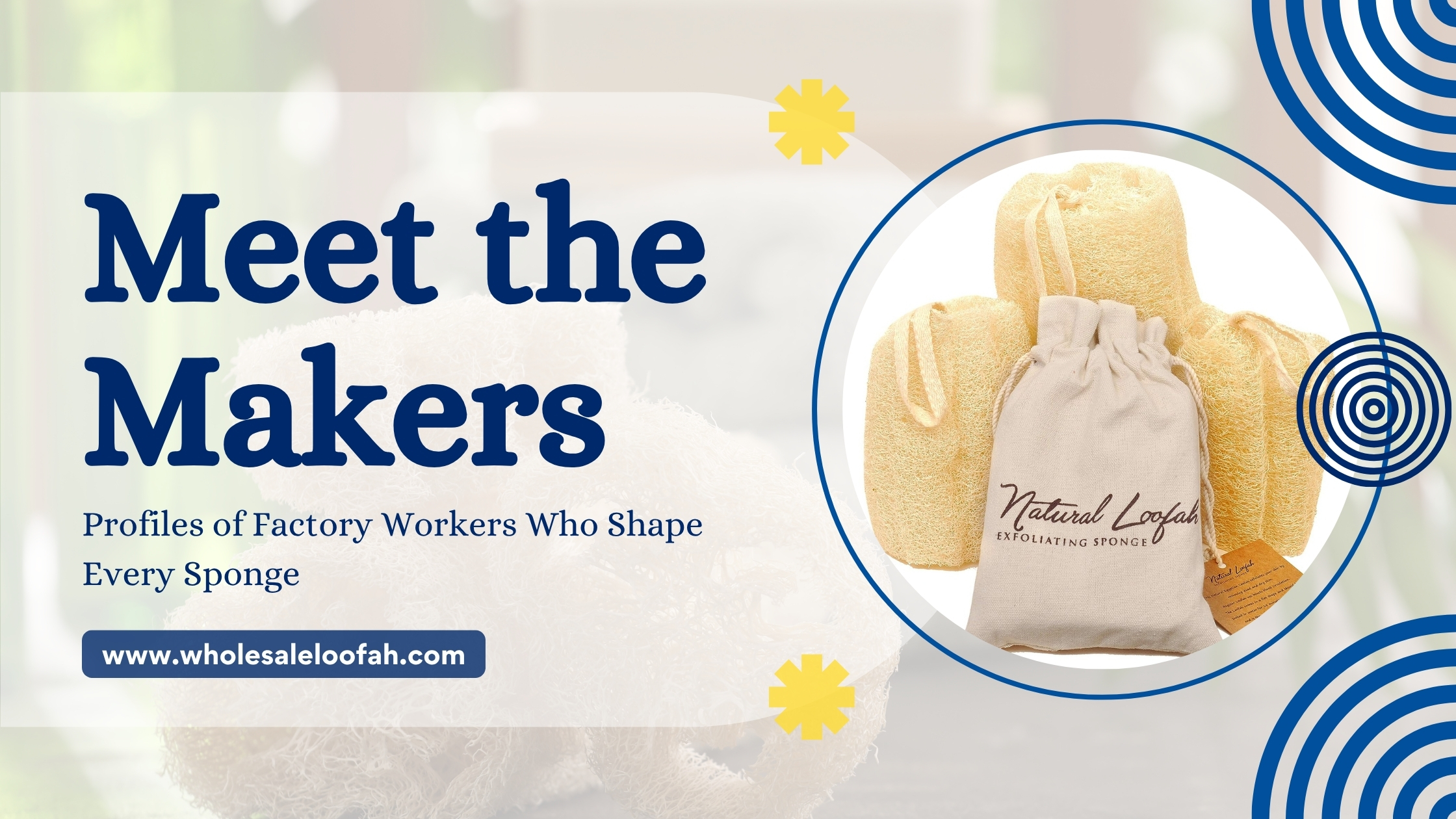
Meet the Makers: Profiles of Factory Workers Who Shape Every Sponge

Factory Workers Who Shape Every Sponge | Wholesale Loofah Sourcing 2026

When a wholesale buyer receives a shipment of 10,000 loofah units and finds that one third of them do not meet the color, size, or firmness standards they specified, there is almost always one root cause: the supplier’s workforce is not skilled enough, experienced enough, or properly managed enough to maintain quality at scale.

This is not a peripheral issue. For importers, distributors, and private label brands, supplier workforce quality is one of the highest-leverage factors in the sourcing decision — and it is among the least-discussed. Price per unit gets negotiated in every conversation. Worker expertise almost never comes up until after a quality failure has already cost someone money and reputation.

This article changes that. It profiles the specific roles of factory workers who shape every sponge in a premium Egyptian loofah facility, explains what expertise in each role actually means for output quality, and gives wholesale buyers a framework for assessing workforce quality when evaluating suppliers.

Egypt’s Nile Delta produces the world’s finest Luffa cylindrica, and Egexo has cultivated and exported from this region for 25+ years. The quality that has made Egexo the benchmark supplier for buyers in more than 30 countries is inseparable from the expertise of the team that produces it. Understanding that team is understanding the product.

Wholesale buyers can begin the sourcing process by visiting wholesaleloofah.com for independent sourcing resources, or go directly to egexo.com/shop to review the current product range.


The Wholesale Quality Problem: Why Worker Expertise Is the Variable That Matters

Where Quality Failures Actually Originate

Importers who manage large loofah supply chains encounter a predictable set of recurring problems. Reviewing these problems by category reveals a consistent pattern: most failures trace back to a specific production stage and, within that stage, to inadequate human expertise.

Quality Failure Type% Attributed to Worker Expertise GapProduction Stage Where It Originates
Color inconsistency within batch78%Bleaching team judgment and soak monitoring
Dimensional variation exceeding tolerance83%Shaping and trimming crew precision
Residual seeds in finished product91%Seed removal specialist thoroughness
Premature structural breakdown67%Harvest coordinator maturity assessment
Surface tears or fiber damage74%Peeling specialist pressure control
Persistent odor complaints69%Drying process management

These figures represent documented patterns observed across Egyptian loofah export operations. They illustrate why skilled workforce retention is not a soft variable — it is a hard quality metric.

Why Egyptian Loofah Is the Industry Benchmark

Egyptian Luffa cylindrica cultivated in the Nile Delta has measurably superior fiber density to loofah grown in other regions. The combination of climate, mineral-rich soil, and a cultivation tradition spanning centuries produces a plant whose fibrous skeleton is inherently better suited to premium sponge production.

But inherent material quality is a ceiling, not a floor. A skilled workforce determines how close to that ceiling every batch gets. Egexo’s quality standards framework and farm to export process documentation reflect the depth of process control that turns superior raw material into a consistently superior product.


Role Profiles: The Factory Workers Who Shape Every Sponge

Role 1: Harvest Coordinator

Function: Determine crop maturity and authorize harvest timing across farming plots in the Nile Delta.

Why expertise matters: Luffa cylindrica has a narrow optimal harvest window. Underripe gourds produce fiber that is too loose — it tears during processing and sheds during consumer use. Overripe gourds develop a hardened skin that is difficult to remove cleanly, and the internal structure can become brittle. The harvest coordinator’s ability to assess maturity accurately across variable growing conditions determines the quality of every batch before it enters the facility.

Indicators of expertise: Long-term relationships with farming families, seasonal knowledge of how weather variation affects crop timing, documented track record of low rejection rates at intake.

Impact on wholesale buyers: Consistent raw material quality at intake directly reduces downstream processing variability. Buyers with tight specification tolerances should specifically ask suppliers about harvest coordinator experience and oversight.

Role 2: Peeling and Cleaning Specialist

Function: Remove the outer skin of each gourd, clean the fibrous interior, and perform first-pass seed removal.

Why expertise matters: Peeling is the first direct intervention on the loofah fiber. Damage at this stage creates structural weaknesses that no subsequent process can repair. Experienced peelers develop a tactile vocabulary for the resistance each gourd offers and adjust hand pressure in real time to avoid tearing.

Indicators of expertise: Low rate of fiber damage at peeling stage, consistent skin-to-fiber separation across variable gourd sizes, efficient first-pass seed removal that reduces the burden on second-pass clearance.

Impact on wholesale buyers: Products that shed fiber or develop weak spots during use almost always trace back to peeling damage. This is among the most common sources of end-customer complaints about natural loofah.

Role 3: Bleaching Team Specialist

Function: Manage bleaching solution concentration, soak time, and temperature to achieve target color standardization.

Why expertise matters: Bleaching is a chemical process applied to an organic material with natural variability. Different harvest batches have different baseline colors and different fiber densities that affect how they absorb bleaching agents. A skilled bleaching specialist observes color development in real time, adjusts soak duration based on batch characteristics, and identifies when to pull units before over-bleaching weakens the fiber.

Indicators of expertise: Consistent color output across batches from different harvest periods, low rate of fiber strength reduction attributable to over-bleaching, ability to hit specific color targets for custom buyer requirements.

Impact on wholesale buyers: Color consistency is a primary retail shelf quality metric. Products that vary visibly within a single shipment create SKU-level problems for retail buyers and packaging designers.

Role 4: Shaping and Trimming Crew

Function: Cut, compress, and trim bleached, dried loofah units to meet dimensional specifications for each product type.

Why expertise matters: Every product line has dimensional specifications — target length, diameter, density under compression, surface finish. Shaping workers translate these specifications into physical reality using templates and tactile judgment. The natural variability of the raw material means that meeting a specification is not mechanical — it requires active assessment of each unit.

Indicators of expertise: Tight dimensional tolerance across a production run, low rate of units requiring rework at inspection, ability to adapt technique for different product specifications without cross-contamination of quality standards.

Impact on wholesale buyers: Dimensional consistency is the specification that affects product packaging, kitting, and retail display most directly. Units that do not meet dimensions create packaging failures and presentation problems that damage a retail buyer’s brand.

Role 5: Final Inspection Specialist

Function: Perform unit-level quality assessment on finished loofahs before packing, applying pass or reject decisions.

Why expertise matters: Final inspection is the last quality gate before a product reaches a buyer’s warehouse. Inspection specialists develop an extremely refined sense of what a properly produced loofah should feel like, weigh, and look like. They catch defects that batch-level sampling cannot reliably identify — weak spots in a specific unit, a cluster of residual seeds in an otherwise clean batch, color variation at the unit level.

Indicators of expertise: Appropriate rejection rate (not too low — suggesting thoroughness), consistent pass/fail decisions that hold up under buyer quality audits, documented grade classification accuracy.

Impact on wholesale buyers: The final inspection team is the supplier’s last opportunity to protect a buyer’s order quality. A buyer evaluating a supplier’s quality control capability should ask specifically about inspection team experience levels and documented rejection rates.


Workforce Quality Evaluation: A Checklist for Wholesale Buyers

When evaluating a loofah supplier — whether at a trade show, through email correspondence, or during a facility visit — these questions help assess workforce quality:

Evaluation QuestionWhy It MattersRed Flag Response
What is the average tenure of workers in key production roles?Longer tenure correlates directly with quality consistency“We have a flexible workforce” or unable to answer
Do you have a formal training program for new production workers?Structured training reduces the variability period for new hiresNo documentation of training process
What is your batch rejection rate at final inspection?A very low rate may indicate lax inspection, not high quality“We almost never reject anything”
Can workers adjust bleaching parameters for different harvest batches?Indicates active process management, not fixed procedure“We use the same process for everything”
How do you handle quality failures when they occur?Reveals process improvement cultureDefensive or vague responses
What is your worker retention rate in production roles?Low retention = constant retraining and quality variabilityUnable to answer or obvious evasion
Can I visit the production facility?Facility visits reveal operational realityStrong resistance to visits without clear reason

Egexo welcomes supplier evaluation inquiries. The why choose Egexo page addresses common buyer evaluation questions, and the team is available to respond to direct inquiries through the wholesale quote request.


Private Label and Custom Orders: How Worker Expertise Scales to Your Specifications

Why Custom Capability Requires More, Not Less, Worker Skill

Private label and custom product orders are more demanding than standard wholesale orders, not less. When a buyer specifies a non-standard dimension, a specific density grade, a custom color target, or a unique shape, the production team must execute against a specification they have not standardized for.

This requires workers who are skilled enough to operate outside their normal routine without quality degradation. A facility with high workforce turnover or minimal training investment cannot reliably execute custom orders — and when they try, the failure rate is higher than it would be for a standard product.

Egexo’s private label loofah manufacturing and custom loofah product design services are direct expressions of workforce capability. The team that handles custom orders is the same team that maintains premium quality on standard lines.

Pre-Shipment Sample Approval: A Non-Negotiable for Custom Orders

Any wholesale buyer placing a custom or private label order should require pre-shipment sample approval as a contractual term. This means the supplier produces a sample batch from the actual production run, ships it to the buyer for approval, and only packs and dispatches the full order after approval is received.

This protocol eliminates the most common and most expensive failure mode in custom loofah procurement: receiving a full shipment that does not match the approved specification. Egexo makes pre-shipment sample approval a standard part of its custom order process, not an optional extra.

Buyers who want to test standard product quality before exploring custom options can use the sample request service.


Egyptian Loofah vs Other Origins: A Wholesale Sourcing Comparison

Sourcing CriterionEgypt (Nile Delta)Southeast AsiaCentral and South America
Fiber DensityVery HighMediumMedium to High
Cultivation TraditionCenturies-longDecadesVariable
Export InfrastructureWell-establishedEstablishedVariable
Workforce ExpertiseHigh (generational knowledge)MediumVariable
Quality Grading DocumentationDetailed and standardizedVariableOften limited
Custom Order CapabilityExtensiveModerateLimited
Regulatory Export ComplianceConsistentVariableVariable
Lead Times to Europe/US2 to 4 weeks3 to 6 weeks4 to 8 weeks

This comparison reflects general market patterns. For a buyer-specific sourcing analysis, the wholesale loofah sourcing resources at wholesaleloofah.com provide detailed guidance, and loofahguide.com offers product-level comparison content for consumer-facing applications.


Product Specifications: What the Workers Produce

Product LineDimensionsFiber GradeMOQPrimary Application
Premium Bath Loofah10 to 20 cm lengthPremium A500 unitsSpa kits, premium retail
Standard Bath Loofah10 to 18 cm lengthGrade B500 unitsStandard retail, wellness
Kitchen Loofah Scrubber10 to 12 cm, high densityPremium A or B500 unitsEco kitchen brands
Raw Loofah ScrubberVariable, unprocessedUnbleached natural300 unitsOrganic brands, DIY
Pet and Spa GroomingSoft fiber, 8 to 15 cmSoft Grade300 unitsPet grooming, spa
Custom Private LabelPer buyer specificationPer buyer requirementVariesBrand-specific product lines

The complete specifications for current product availability are in the Egexo wholesale product catalog. Buyers with custom requirements should initiate discussion through the custom design service.


How End Consumer Outcomes Connect Back to Factory Worker Decisions

For wholesale buyers whose customers are end consumers — spa clients, retail shoppers, wellness brand subscribers — the connection between factory worker expertise and consumer experience is direct and measurable.

Consumer Experience Outcomes by Production Stage

Consumer ExperiencePositive OutcomeNegative OutcomeDetermining Worker Role
Loofah sheds fibers in handDoes not shedSheds immediatelyPeeling Specialist
Loofah holds shape over weeksMaintains firmnessCollapses in 1 to 2 weeksShaping Crew
Loofah color matches packagingConsistent colorVisibly different from photoBleaching Team
Seeds found in productSeed-freeSeeds cause irritationSeed Removal Specialist
Odor during useNo odorPersistent organic smellDrying and Inspection
Exfoliation effectivenessGraduated, comfortableToo aggressive or ineffectiveHarvest Coordinator

When a consumer returns a loofah and cites any of the negative experiences in this table, the cause almost always resides in the production stage listed. This is the direct link between supplier workforce quality and brand reputation for the wholesale buyer.


Expert Insight from Egexo

From a wholesale sourcing perspective, the most important thing a buyer can understand about Egyptian loofah quality is that it is not a product attribute — it is a process outcome. The fiber density advantage that Egyptian Luffa cylindrica has over every other origin exists as potential. Whether that potential is realized in every unit of every batch is determined by the team that processes it. Egexo has invested in workforce experience and retention for 25+ years because we understand that the workers who shape every sponge are not a cost to be minimized. They are the product. Wholesale buyers who evaluate suppliers solely on price per unit are evaluating the wrong variable. The variable that predicts long-term value is the depth of expertise behind what you are buying.


FAQ Section

Q1: Why do some wholesale loofah shipments have significant quality variation within the same order? Within-batch quality variation is almost always a symptom of workforce inconsistency rather than raw material variation. When production workers lack sufficient experience or when a facility has high staff turnover, individual units in the same batch are processed differently — different hand pressure during peeling, different soak times during bleaching, different compression during shaping. At Egexo, production role tenure of three or more years per worker is a specific metric we track because it correlates directly with within-batch consistency.

Q2: What quality documentation should a wholesale buyer request from a loofah supplier? Request documented quality grading standards, batch-level inspection records, a rejection rate history, and any third-party certification documentation. Also request the supplier’s quality control process description — specifically, how many inspection checkpoints exist between raw material intake and final packing. Egexo’s quality standards page is the starting point for reviewing this documentation.

Q3: How does Egexo’s workforce expertise compare to suppliers in other producing countries? Egypt’s loofah cultivation tradition is among the oldest and most established in the world. Workers in the Nile Delta grow up with knowledge of Luffa cylindrica that takes years to develop elsewhere. Egexo has specifically retained experienced workers in key production roles for extended periods, while many facilities in Southeast Asia and elsewhere operate with higher turnover. The result is measurably lower within-batch quality variation in Egyptian-sourced products from established exporters like Egexo.

Q4: What is the process for placing a private label loofah order with Egexo? Private label orders begin with a specification consultation — dimensions, density grade, color target, and packaging requirements. After specifications are confirmed, a sample production run is created and shipped for buyer approval. Once the sample is approved, bulk production begins. Pre-shipment sample approval from the actual bulk batch is required before dispatch. The full process is detailed on the private label loofah manufacturing page.

Q5: What MOQ applies to custom-designed loofah products? MOQ for custom products depends on the complexity of the specification — non-standard shapes require different tooling, and very specific color targets may require dedicated bleaching batches. Standard custom sizes in common dimensions can often be accommodated at MOQs close to standard product levels (300 to 500 units). Highly unusual specifications may have higher MOQs. The custom product design service provides a consultation to establish accurate MOQs for each specification.

Q6: How should a wholesale buyer evaluate a loofah sample before placing a bulk order? Evaluate the sample across these criteria: compress the unit and release — it should recover its shape fully. Check for residual seeds by shaking and feeling for hard spots. Examine color uniformity across the surface. Wet the loofah and use it on skin — assess fiber texture, uniformity of exfoliation, and whether any fiber sheds. Allow it to dry and check structural recovery. A sample that passes all five checks is representative of well-processed product. Samples are available through Egexo’s sample request service.

Q7: What is the typical lead time from order confirmation to delivery for wholesale loofah orders? Standard wholesale orders typically have lead times of 3 to 5 weeks from order confirmation to container departure, depending on order volume and production scheduling. Custom and private label orders with sample approval rounds add 1 to 2 weeks for the sample cycle. Transit time to Europe is typically 2 to 3 weeks by sea, and to the US East Coast is approximately 3 to 4 weeks. Exact lead times for your order volume and destination are confirmed during the quotation process via the wholesale quote request.


Conclusion

The factory workers who shape every sponge in Egyptian loofah production are the single most important variable in the quality equation — more important than price per unit, more important than the supplier’s marketing materials, and more important than the origin certificate on the shipping documents.

For wholesale buyers, this means that supplier evaluation must include an honest assessment of workforce expertise. The questions in this article give you the framework to do that assessment whether you are evaluating Egexo or any other supplier. For the record, Egexo’s 25+ years of operation, documented quality grading standards, and workforce retention practices represent the benchmark against which other Egyptian exporters should be measured.

Key Takeaways:

  • Most wholesale loofah quality failures trace directly to workforce expertise gaps at specific production stages
  • Egyptian Luffa cylindrica has inherently superior fiber density, but worker skill determines how consistently that potential is realized
  • Workforce tenure in key production roles is a measurable predictor of within-batch quality consistency
  • Private label and custom orders require more skilled workers, not less — evaluate supplier capability accordingly
  • Pre-shipment sample approval and documented rejection rates are non-negotiable quality assurance tools for bulk buyers

Ready to source Egyptian loofah at the benchmark quality level?

Leave a Comment

Your email address will not be published. Required fields are marked *

Scroll to Top