A loofah returned by a customer with a mold complaint costs more than the product itself. It costs the refund, the reputational impact, and the customer retention question that follows. For wholesale buyers, spa operators, and retail brands supplying natural loofah products, the way end users interact with that product after purchase is a direct variable in your business outcomes — and the most common failure mode is entirely preventable.
Knowing how to dry a loofah outdoors to prevent mold is not just consumer care knowledge. It is product lifecycle knowledge that every business selling or recommending natural loofah should understand deeply enough to communicate to its customers. When end users receive a premium natural loofah along with care guidance that helps them maintain it properly, they experience the product at its full capability — and they buy it again.
This guide approaches loofah drying from both the professional supply chain perspective and the consumer experience perspective simultaneously. It covers the science of why outdoor drying works, the specific method for doing it correctly across different conditions, the operational implications for spa and wellness businesses, and the product quality factors that affect drying performance at the source.
Egyptian Luffa cylindrica from the Nile Delta is the world’s finest natural sponge material. EGEXO has been exporting Egyptian loofah since 2015. Understanding why proper drying matters for this product requires understanding why the product itself is worth protecting — and that story begins at the source. The farm to export process documentation explains the quality chain that ends at your customer’s shower.
Why Loofah Mold Is a Business Problem, Not Just a Consumer Inconvenience
The Customer Experience Cost of Inadequate Drying
Natural loofah is one of the most returned bathroom products in the wellness category, and mold-related complaints account for a significant proportion of those returns. The pattern is consistent: a customer purchases a natural loofah, stores it in or near the shower, and within 2 to 3 weeks it develops visible mold or a persistent odor they attribute to product quality.
In most of these cases, the product itself was not defective. The problem was improper drying. But the customer does not separate their experience from the product — they associate the failure with the brand. For retail buyers and spa operators, this is a brand equity problem, not just a product quality problem.
Providing care guidance — specifically, how to dry a loofah outdoors to prevent mold — as part of the product experience is one of the highest-leverage actions a natural loofah brand can take to reduce returns, increase customer satisfaction, and drive repeat purchase.
What the Data Shows About Loofah Lifespan and Drying
| Drying Habit | Average Loofah Lifespan | Mold Incident Rate | Customer Satisfaction Likelihood |
|---|---|---|---|
| Left in shower always | 10 to 14 days | Very High | Low |
| Indoor hook, no airflow | 14 to 21 days | High | Moderate |
| Indoor fan or open window | 21 to 28 days | Moderate | Good |
| Outdoor shade drying daily | 28 to 35 days | Low | High |
| Outdoor sun drying daily | 35 to 42 days | Very Low | Very High |
The relationship between drying practice and customer satisfaction is direct and quantifiable. A customer who follows the outdoor drying method consistently reaches the full 4 to 6 week lifespan of a premium Egyptian loofah. A customer who does not may reach half that before the product degrades or grows mold.
Retail buyers building product lines around natural loofah should factor care guidance into the product packaging and brand communication strategy. Egexo’s private label manufacturing service supports brands in developing packaging that includes care instructions alongside product branding.
The Science Behind Outdoor Drying: Why It Works
Three Variables That Outdoor Drying Changes Simultaneously
Indoor bathroom environments create three conditions that allow mold to develop in a natural loofah. Outdoor drying addresses all three at once:
Variable 1: Ambient humidity. A closed bathroom after a shower can sustain 80 to 90% relative humidity for extended periods. Mold thrives above 65% humidity. Outdoor environments — except in extreme tropical conditions — are typically below this threshold, especially in direct sun.
Variable 2: Airflow. Still air allows a moisture-saturated boundary layer to form immediately around a wet loofah. This layer prevents effective evaporation from the surface. Outdoor airflow continuously replaces this saturated layer with drier air, maintaining an evaporation gradient that allows moisture to leave the loofah at its maximum rate.
Variable 3: UV radiation. Direct sunlight delivers ultraviolet radiation that has documented antimicrobial properties on organic surfaces. UV inhibits the viability of mold spores and bacteria on the loofah surface. This does not replace the need for regular deep cleaning, but it provides continuous low-level sanitization that indoor drying cannot replicate.
The Fiber Structure of Egyptian Loofah and Its Drying Characteristics
Egyptian Luffa cylindrica, particularly varieties cultivated in the Nile Delta under the growing conditions that Egexo’s farming network maintains, has a fiber density and structural uniformity that directly affects drying performance.
The fibrous skeleton of Luffa cylindrica is composed of interconnected cellulose channels arranged in a three-dimensional network. In high-density Egyptian varieties, this network is tight and uniform. When the loofah is hung vertically in airflow, gravity drives moisture downward through this network toward the exterior, while airflow evaporates surface moisture. The result is efficient, relatively rapid moisture transport from interior to exterior.
Lower-density loofah from other origins has larger void spaces between fiber bundles. These spaces do not channel moisture as effectively — instead, they can trap water in pockets that airflow cannot easily reach. These trapped moisture zones are precisely where mold colonies initiate.
This is the quality argument for Egyptian loofah that goes beyond aesthetics: structurally, it is a better-drying, more mold-resistant product than lower-density alternatives. The loofah quality standards framework at Egexo documents these fiber characteristics in detail.
How to Dry a Loofah Outdoors to Prevent Mold: The Method
For wholesale buyers and spa operators, this step-by-step method can be adapted directly into product care cards, staff training protocols, and customer communication materials.
Step-by-Step Outdoor Drying Protocol
| Step | Action | Duration | Key Detail |
|---|---|---|---|
| 1 | Rinse under warm running water | 30 to 60 seconds | Squeeze 5 to 8 times until water runs clear |
| 2 | Firm compression squeeze | 15 to 20 seconds | 4 to 5 compressions, no twisting |
| 3 | Suspend outdoors in airflow | 30 to 90 minutes | Hung, not laid flat |
| 4 | Position for sun if available | Concurrent with step 3 | South-facing in Northern Hemisphere |
| 5 | Compression dryness test | 10 seconds | Squeeze center firmly, no moisture should release |
| 6 | Store indoors in ventilated position | After confirmed dry | Not in shower or sealed container |
This protocol takes under 2 minutes of active handling and produces a fully dry, surface-sanitized loofah that can safely be stored until next use.
The Suspension Principle: Why Hanging Matters
The difference between hanging a loofah and setting it on a surface is more significant than most people realize. A surface contact point creates a zone where airflow is completely absent. In a loofah with high fiber density, this contact zone is small but still represents a moisture retention point that can initiate mold development.
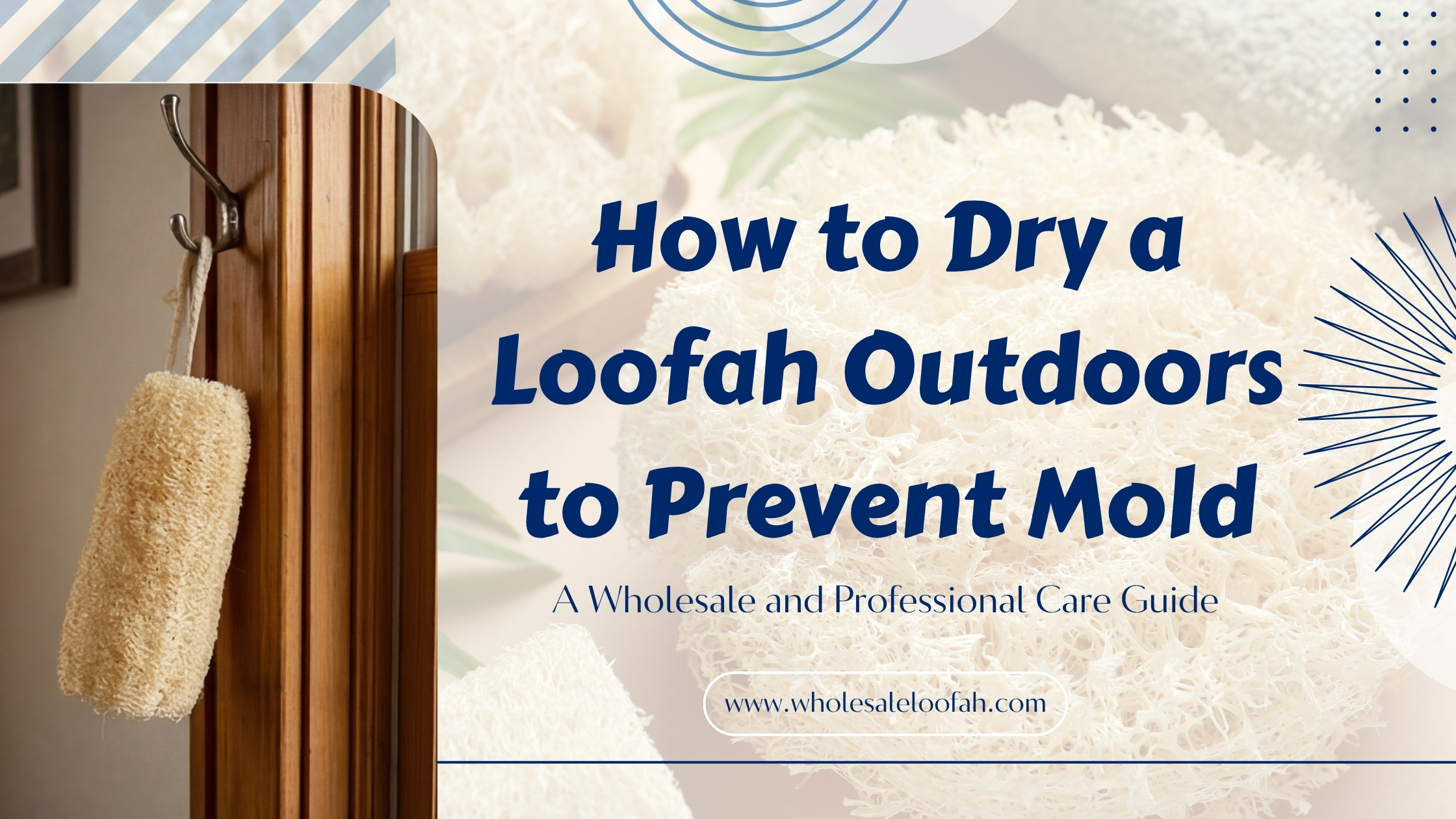
Suspension eliminates all surface contact. A loofah hung from a hook, clip, or mesh bag is exposed to airflow on its entire exterior surface simultaneously. Combined with the gravity-assisted moisture transport described above, suspension is the physically optimal drying position for any natural loofah format.
For spa operations with multiple loofahs drying simultaneously, a simple outdoor drying rack with individual hooks or clips allows efficient high-volume drying without surface contact issues.
Operational Care Standards for Spa and Wellness Businesses
Building a Loofah Care Protocol for Professional Use
Professional spa settings use loofahs at much higher frequency than personal use — a single loofah may be used multiple times per day across different clients. This usage intensity requires more rigorous care standards and a shorter replacement cycle.
| Usage Context | Between-Use Drying Requirement | Replacement Cycle | Recommended Grade |
|---|---|---|---|
| Personal daily use | Full outdoor drying once per day | Every 4 to 6 weeks | Premium A or B |
| Spa treatment use (shared) | Full drying between every use | Every 2 to 3 weeks | Premium A only |
| Retail display and sale | Storage in low-humidity environment | N/A (not used) | Premium A |
| Bulk storage (wholesale) | Sealed moisture-proof packaging | Shelf life 12 to 18 months stored correctly | All grades |
Spa operators who establish outdoor drying protocols for treatment loofahs between client sessions reduce both the hygiene risk and the replacement frequency. A loofah that is properly dried between uses in a professional setting can serve its 2 to 3 week replacement cycle without hygiene concerns, while one that is stored damp between treatments may need replacement within a week.
For high-volume spa loofah sourcing, the pet and spa grooming loofah range at Egexo is specifically suited to professional wellness applications. You can request wholesale samples to assess suitability before placing bulk orders.
Building Care Guidance into Your Product Brand
Why Care Instructions Are a Product Quality Signal
When a natural loofah brand includes specific, accurate care instructions with its product, it signals product knowledge and quality confidence. Brands that do not provide care guidance are implicitly acknowledging that they do not expect the product to perform beyond initial purchase. Brands that do are communicating that the product is worth the effort of proper care.
For wholesale buyers building private label loofah lines, care instructions are a component of brand quality — not just functional information. The care guidance on your packaging is part of the story you tell about why your product is worth its price point.
Egexo’s custom loofah product design service supports buyers in developing branded packaging that incorporates care guidance alongside product positioning. The full product catalog provides a starting point for product selection.
Care Guidance Format Options for Retail and Spa
| Format | Use Case | Key Advantage |
|---|---|---|
| Printed care card in packaging | Retail consumer products | Physical takeaway, reinforces quality signal |
| QR code linking to care guide | Premium or gift products | Detailed guidance without packaging crowding |
| Staff training protocol document | Spa and wellness businesses | Consistent application across team |
| Care label attached to product | High-end spa products | Visible care reminder at point of use |
| Social media care content | D2C and online retail brands | Ongoing engagement, searchable content |
All of these formats can reference the same core guidance covered in this article. For wholesale buyers who want a content resource to adapt, Egexo supports care communication as part of the broader product and service package. You can begin the conversation through the wholesale quote request.
Drying Variables: A Technical Reference for Buyers and Operators
How Different Conditions Affect Drying Outcomes
| Variable | Favorable Condition | Unfavorable Condition | Practical Adjustment |
|---|---|---|---|
| Temperature | 25 to 40 degrees Celsius | Below 15 degrees Celsius | Extend outdoor time in cold weather |
| Relative Humidity | Below 55% | Above 75% | Prioritize airflow over humidity |
| Wind Speed | 10 to 30 km/h | Under 5 km/h | Reposition to catch natural air movement |
| UV Index | 4 or higher | Below 2 | Extend drying time to compensate |
| Loofah Fiber Density | High (Egyptian premium) | Low (loose fiber) | Higher density dries faster with same conditions |
| Loofah Size | 10 to 14 cm | 18 to 22 cm | Larger formats need 30 to 45 minutes more |
This reference table is useful for spa operators developing drying protocol documentation and for wholesale buyers advising their own customers on care standards in different geographic markets.
Climate-Specific Drying Guidance for Export Markets
Wholesale buyers distributing Egyptian loofah to international markets should consider the drying conditions their end customers face:
| Target Market | Typical Climate Challenge | Recommended Care Emphasis |
|---|---|---|
| Northern Europe | Low UV, high humidity in winter | Prioritize fan-assisted indoor drying in winter months |
| Middle East / North Africa | Optimal outdoor conditions year-round | Standard outdoor protocol, very fast drying |
| Southeast Asia | Tropical high humidity | Extended outdoor time, maximum airflow position |
| North America | Seasonal variation | Outdoor summer, fan-assisted winter |
| Australia | Generally favorable | Standard outdoor protocol |
Tailoring care guidance to the climate of your end market improves the relevance of that guidance and increases the likelihood that customers follow it. Egexo works with buyers across all of these markets and can support climate-specific care communication where needed.
Product Specifications: Loofah Formats and Drying Characteristics
| Product Type | Typical Length | Fiber Density | Estimated Outdoor Dry Time | MOQ |
|---|---|---|---|---|
| Premium Bath Loofah | 15 to 20 cm | Very High | 45 to 75 minutes | No minimum order on standard products |
| Standard Bath Loofah | 10 to 15 cm | High | 30 to 55 minutes | No minimum order on standard products |
| Kitchen Loofah Scrubber | 10 to 12 cm | High, compact | 25 to 45 minutes | No minimum order on standard products |
| Raw Loofah Scrubber | Variable | Natural, unprocessed | 40 to 70 minutes | No minimum order on standard products |
| Spa Grooming Loofah | 8 to 15 cm | Soft, medium | 30 to 60 minutes | No minimum order on standard products |
Drying time estimates are based on optimal outdoor conditions (direct sun, light breeze, below 60% humidity). Add 30 to 50% to these times for shade-only or high-humidity outdoor conditions.
The kitchen loofah range and body loofah range at Egexo cover the most commonly sourced wholesale formats. Full specifications are in the wholesale product catalog.
Expert Insight from EGEXO
Markets where outdoor drying is a natural part of daily routine — because the climate encourages it or because the care culture prioritizes it — consistently report longer product lifespans and higher repurchase rates. Markets where indoor bathroom storage is the norm report more mold complaints and shorter product lives. This is not a product quality difference — it is a care behavior difference. The role that wholesale buyers and spa brands can play in shifting this is significant: communicate outdoor drying as the standard of care, not a bonus tip. Egyptian loofah is worth that communication effort because it genuinely performs at its stated capability when properly dried. Few other natural products can make the same claim.
To discuss your order, request a quote from EGEXO.
FAQ Section
Q1: Why do wholesale buyers need to understand loofah drying methods? Wholesale buyers and spa operators who understand how to dry a loofah outdoors to prevent mold can integrate that knowledge into customer care guidance, staff training protocols, and product packaging. This directly reduces return rates and mold-related complaints, which are the most common post-purchase issues with natural loofah products. Brands that educate customers on proper outdoor drying report significantly longer average product lifespans and higher repurchase rates from satisfied customers.
Q2: How does loofah fiber quality affect drying performance in professional settings? Premium Egyptian loofah with high, uniform fiber density dries faster and more evenly than lower-quality alternatives. The tight fiber network of Egyptian Luffa cylindrica channels moisture outward efficiently when the loofah is hung in airflow. This means professional spa operators using premium Egyptian varieties need less outdoor drying time between uses — a practical operational advantage in high-frequency treatment environments. Lower-density loofah creates moisture pockets that require longer drying to address.
Q3: What outdoor drying protocol should a spa operator implement between client treatments? Between each client treatment, loofahs should be rinsed thoroughly under warm running water, squeezed to expel excess moisture, and hung in an outdoor or high-airflow area for a minimum of 30 minutes. Designated drying stations near treatment areas with outdoor access or strong ventilation are the most practical implementation. Loofahs used in professional spa settings should be replaced every 2 to 3 weeks regardless of visual condition, given the higher usage frequency.
Q4: Can care instructions be included in private label loofah packaging from Egexo? Yes. Egexo’s private label manufacturing service supports buyers in developing branded packaging that includes care instructions alongside product positioning. Custom care cards, labels, and packaging inserts that communicate outdoor drying guidance as part of the brand experience can be developed through the custom product design service. This capability is one of the differentiating features of Egexo’s private label offering compared to commodity suppliers.
Q5: How does bulk loofah storage differ from post-use drying considerations? Bulk wholesale loofah stored before distribution should be kept in sealed, moisture-proof packaging in a cool, low-humidity environment. Properly packaged and stored Egyptian loofah from Egexo has a shelf life of 12 to 18 months before any quality degradation. This is distinct from post-use drying, which addresses moisture introduced during consumer use. Buyers should not confuse bulk storage humidity control with end-user care guidance — both matter, but they address different points in the product lifecycle.
Q6: What is the most effective care messaging format for natural loofah retail products? Printed care cards included in product packaging have the highest compliance rate because they are physical, immediate, and specific to the product the customer just purchased. QR codes linking to detailed care guides are effective for premium products where a richer experience is expected. The most critical message to communicate — regardless of format — is that outdoor drying after every use is the standard of care, not an optional practice. Framing outdoor drying as essential rather than optional significantly increases the likelihood that customers follow through.
Q7: How does outdoor drying affect the sustainable positioning of a natural loofah brand? Proper outdoor drying is directly connected to sustainability credentials for natural loofah brands. A loofah that reaches its full 4 to 6 week lifespan through proper care requires 30 to 50% fewer replacement units over a year compared to one discarded prematurely due to mold from improper drying. For eco-positioned retail brands, this lifecycle extension is a quantifiable sustainability claim that can be incorporated into product messaging. It aligns with the core biodegradability advantage of natural loofah over synthetic alternatives.
Conclusion
Understanding how to dry a loofah outdoors to prevent mold is as relevant to the supply chain as it is to the consumer. Wholesale buyers, spa operators, and retail brands that make proper outdoor drying part of their product story reduce returns, increase customer satisfaction, and communicate the quality of their sourcing through their care standards.
Outdoor drying in sunlight and airflow is the most effective, lowest-cost maintenance practice available for natural loofah, and it makes a measurable difference in every metric that matters to both consumers and the businesses that supply them.
Key Takeaways:
- Mold complaints on natural loofah products are almost entirely preventable through consistent outdoor drying
- Wholesale buyers who communicate outdoor drying guidance reduce return rates and increase customer satisfaction
- Premium Egyptian loofah with dense, uniform fiber dries faster and is more mold-resistant than lower-quality alternatives
- Professional spa settings should implement between-treatment outdoor drying protocols and a 2 to 3 week replacement cycle
- Outdoor drying extends natural loofah lifespan by 30 to 100%, directly supporting sustainability positioning for eco-focused brands
Ready to source natural loofah that delivers on its quality promise?
- For Wholesale Buyers: Request a quote or download our catalog
- For Samples and Evaluation: Order samples or explore the products page