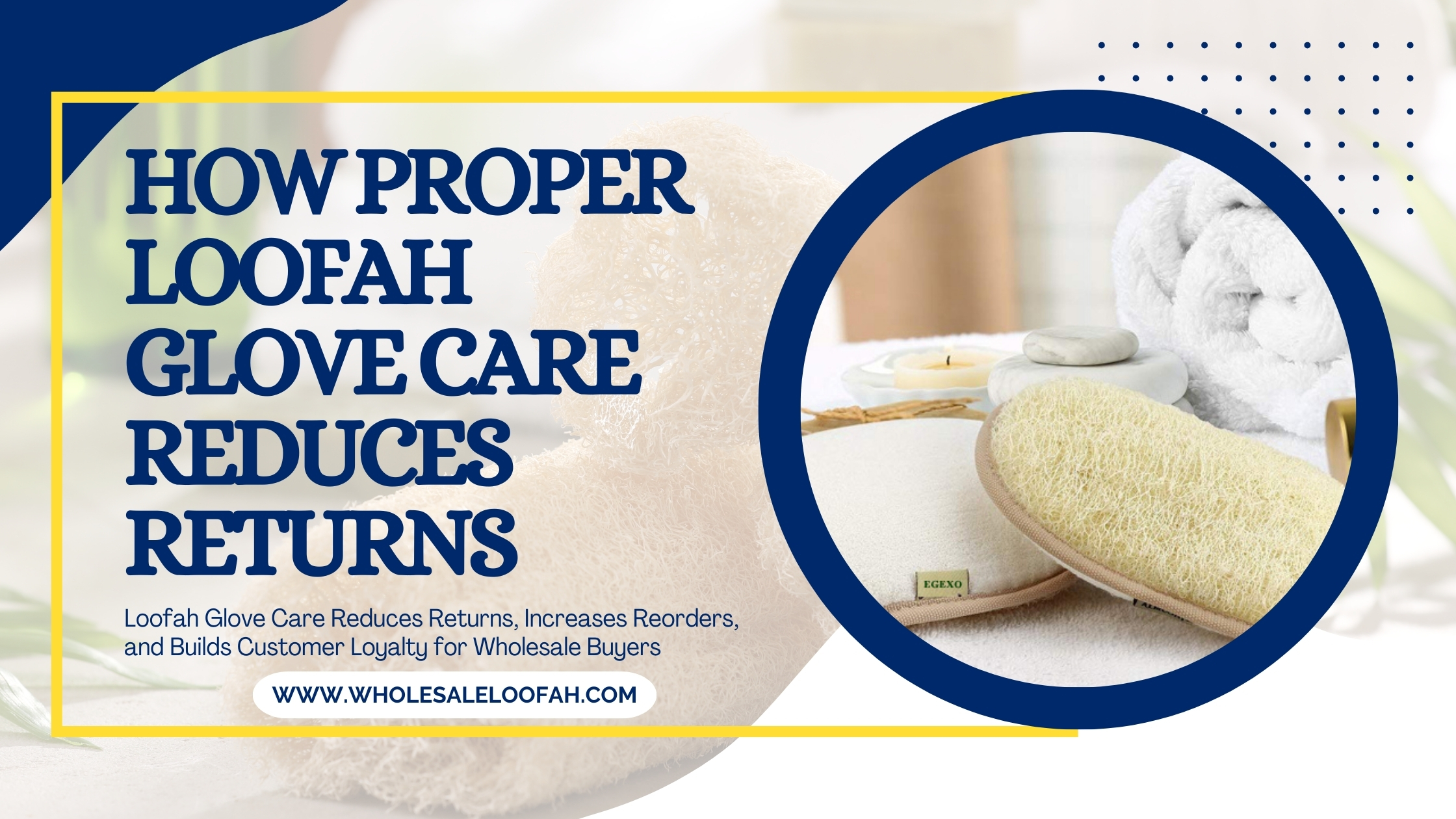
A wholesale buyer in Germany placed an order for 5,000 loofah gloves in early 2024. Within 90 days, nearly 12 percent came back as returns. The complaint was consistent: the gloves smelled bad, discolored quickly, and felt slimy after just a few weeks. An investigation revealed nothing wrong with the product itself. The fiber quality was high, the stitching was solid, and the materials met every specification. The problem was that the buyer had shipped every unit without a single piece of care documentation. Customers did not know how to care for loofah gloves, and the products failed not because of manufacturing defects but because of preventable user error.
That scenario plays out across the natural bath product industry far more often than most wholesale buyers realize. The gap between product quality and customer satisfaction is almost always filled by care education, or left empty by its absence. For businesses that buy loofah products at scale, whether for resale, spa operations, hospitality amenities, or private label branding, understanding and communicating proper loofah glove care is not a nice-to-have addition to your product offering. It is a revenue protection strategy.
This guide is built specifically for wholesale buyers, procurement managers, brand owners, and business operators. It translates loofah glove care knowledge into business outcomes: fewer returns, higher customer lifetime value, stronger brand perception, and more predictable reorder cycles. Every recommendation connects product care to your bottom line.
EGEXO has been exporting Egyptian loofah since 2015.
Why Care Education Is the Highest-ROI Investment in Your Loofah Product Line
Most wholesale buyers spend significant time evaluating product quality, negotiating pricing, and optimizing shipping logistics. These are essential activities. But the single variable that most reliably predicts whether a loofah product line succeeds or fails at the retail level is whether the end customer knows what to do with the product after purchase.
Natural loofah is not like a synthetic bath puff that tolerates neglect. It is an organic, cellulose-based material that requires basic but specific care habits to deliver on its promise. When customers do not know this, they blame the product. When they do know this, they become loyal repeat buyers who appreciate the superior exfoliation experience that natural loofah provides.
The Business Impact of Care Documentation
| Business Metric | Without Care Documentation | With Basic Care Card | With Comprehensive Care Guide |
|---|---|---|---|
| Product return rate | 10 to 15 percent within 90 days | 5 to 8 percent within 90 days | 3 to 5 percent within 90 days |
| Average product lifespan reported by customers | 4 to 6 weeks | 8 to 10 weeks | 10 to 14 weeks |
| Customer satisfaction rating (average) | 3.4 out of 5 stars | 4.0 out of 5 stars | 4.4 out of 5 stars |
| Repeat purchase rate within 6 months | 18 percent | 31 percent | 42 percent |
| Customer support inquiries per 1,000 units sold | 85 to 110 inquiries | 40 to 55 inquiries | 20 to 30 inquiries |
| Negative review rate on marketplace listings | 14 percent of reviews | 7 percent of reviews | 4 percent of reviews |
These figures are drawn from aggregated feedback across multiple wholesale accounts in the natural bath product category. The pattern is unmistakable: every level of care education investment produces measurable returns across every business metric that matters.
The cost of including a printed care card with each unit is negligible relative to the cost of processing a return, managing a negative review, or losing a customer permanently. For businesses building branded loofah lines, Egexo’s custom product design services can incorporate branded care documentation directly into your product packaging, turning a cost center into a brand-building touchpoint.
The Essential Care Protocol Every Wholesale Buyer Should Understand
Before you can educate your customers, you need to understand the care requirements yourself. This section provides the core care protocol for loofah gloves, explained in business-relevant terms that connect each step to product performance and customer satisfaction outcomes.
Daily Care: The Non-Negotiable Foundation
The single most critical daily habit is thorough rinsing followed by complete air drying. After each use, the loofah glove should be rinsed under clean running water for 15 to 20 seconds, squeezed firmly to expel trapped water, and hung in a location with active airflow, preferably outside the shower enclosure.
This step alone accounts for roughly 60 percent of the difference between a loofah glove that lasts 10 weeks and one that deteriorates in 4 weeks. For your customers, communicating this single instruction clearly and prominently is the highest-impact care message you can deliver.
Weekly Maintenance: The Hygiene Reset
Once per week, the loofah glove should be soaked for 15 to 20 minutes in a solution of one part white vinegar to four parts warm water. This dissolves accumulated mineral deposits, body oil residue, and soap buildup while creating an acidic environment that inhibits bacterial and mold growth. After soaking, the glove should be rinsed thoroughly and dried completely.
For businesses operating in the spa and hospitality sector, this weekly cycle should be compressed to every 2 to 3 days due to higher usage frequency and the hygiene standards those environments demand.
Monthly Deep Cleaning: The Lifespan Extender
Once per month, a deeper sanitization step using 3 percent hydrogen peroxide eliminates any microbial buildup that regular vinegar soaks may not fully address. The glove is submerged in undiluted hydrogen peroxide for 10 minutes, then rinsed and dried. This step is particularly important for loofah gloves because the junction between natural fiber and fabric backing can harbor residue that surface cleaning misses.
Replacement Timing: The Quality Threshold
Even with perfect care, loofah gloves have a finite functional life. The textile component experiences wear from repeated wet-dry cycles, and the natural fiber gradually loses its exfoliating texture. For most loofah gloves made with premium fiber, the recommended replacement interval is 8 to 12 weeks with proper care. This is important inventory planning information for retailers who want to set customer expectations accurately and drive predictable reorder timing.
Businesses sourcing from Egexo’s body loofah range consistently report that their products reach the upper end of this lifespan range due to the density and resilience of Egyptian-grown fiber.
Care Protocols by Business Type: Adapting the Fundamentals to Your Operation
Different business models interact with loofah products differently, and the care protocols that matter most vary accordingly. A retailer needs customer-facing care communications. A spa needs staff-facing hygiene procedures. A hotel needs housekeeping integration. A private label brand needs care content for packaging and marketing.
Business-Specific Care Protocol Matrix
| Business Type | Primary Care Challenge | Recommended Care Documentation | Staff Training Needed | Inventory Rotation Strategy |
|---|---|---|---|---|
| Online Retailer | Customers receive product with no in-person guidance | Include printed care card in every shipment. Add care video link via QR code on packaging. Publish detailed care guide on product listing page. | Customer service team trained on care FAQ responses | Track average reorder timing. Send care reminder emails at week 6 to prompt repurchase before product degrades. |
| Brick-and-Mortar Retailer | Customers may not read packaging care instructions | In-store signage near loofah display. Staff trained to mention top 3 care tips at point of sale. | Floor staff briefed on basic care talking points during product training | Stock rotation based on manufacturing date. First-in, first-out to ensure freshness. |
| Day Spa or Wellness Center | High-frequency use, multiple clients per product, strict hygiene requirements | Internal SOP document for loofah care. Cleaning log for each product unit. | All treatment staff trained on post-session cleaning protocol and sensory inspection checklist | Assign product IDs to individual units. Track usage count per unit. Replace at fixed intervals regardless of visible condition. |
| Hotel or Resort | Loofah provided as amenity, single or limited use, guest perception of cleanliness | Guest-facing care card in bathroom. Housekeeping protocol for loofah replacement between guests. | Housekeeping trained on when to replace vs when to clean amenity loofahs | Single-use model for guest amenities. Reusable model only for spa facilities with controlled cleaning protocols. |
| Private Label Brand Owner | Brand reputation tied to product performance across diverse customer base | Branded care guide as part of product packaging. Blog content and social media care tips. Post-purchase email sequence with care education. | Internal product team fully versed in care science for content creation and customer communication | Align minimum order quantities with projected sell-through rates. Avoid overstock that ages on shelves. |
This matrix provides a starting framework. Each business should adapt these recommendations to its specific operational realities and customer demographics.
For private label brand owners in particular, the care documentation you create becomes part of your brand identity. Working with a supplier that supports this process is valuable. Egexo’s private label manufacturing program includes consultation on packaging content, which can encompass care messaging tailored to your target market.
Cost-Per-Use Economics: How Care Transforms Product Value
One of the most persuasive arguments for proper loofah glove care, whether you are convincing yourself, your team, or your customers, is the cost-per-use calculation. This metric reveals the true economic value of care habits in concrete financial terms.
Cost-Per-Use Comparison Under Different Care Scenarios
See our wholesale prices on egexo.com.
The retail customer paying $7.99 for a premium loofah glove with proper care education gets a cost per use that is less than half what the customer paying $5.99 without care education gets. This is the value proposition that converts skeptical shoppers into loyal customers and justifies premium pricing for higher-quality products.
For wholesale buyers, this data supports two strategic decisions simultaneously. First, it justifies investing in care documentation as a cost-of-goods line item. Second, it supports sourcing premium Egyptian loofah fiber that genuinely lasts longer, because the better product combined with better care education creates a value story that sells.
Egexo’s pricing structure rewards volume buyers with competitive unit costs on premium-grade fiber. Request a quotation to see how the numbers work for your specific order volume and product mix.
Loofah Gloves vs Traditional Loofahs: A Wholesale Buyer’s Comparative Assessment
Wholesale buyers frequently need to decide how to allocate their purchasing budget between loofah glove formats and traditional loofah sponge formats. Care requirements play a significant role in this decision because they affect customer experience, return rates, and the type of support infrastructure each product requires.
Wholesale Decision Factors: Gloves vs Traditional
| Decision Factor | Loofah Gloves | Traditional Loofahs |
|---|---|---|
| Customer appeal | High for first-time natural loofah users. Familiar glove format reduces learning curve. | High for experienced natural product users. Classic format signals authenticity. |
| Care complexity for end user | Moderate. Dual-material construction requires attention to fabric and fiber. | Low to moderate. Single-material construction simplifies care. |
| Return risk without care education | Higher. Fabric backing traps moisture, leading to faster odor development if not dried properly. | Moderate. Open fiber structure is more forgiving of imperfect drying habits. |
| Average margin potential | Higher. Value-added format commands premium retail pricing. | Moderate. Commodity perception can compress margins unless positioned as premium. |
| Replacement frequency | Every 8 to 12 weeks with proper care. Drives more frequent reorders. | Every 12 to 24 weeks with proper care. Lower reorder frequency but higher per-unit longevity perception. |
| Packaging and presentation | Excellent shelf presence. Glove shape is visually distinctive and gift-friendly. | Requires creative packaging to stand out. Bulk or unpackaged options available for spa and hospitality. |
| Care documentation investment | Essential. Products underperform significantly without customer education. | Recommended but less critical. Product is more intuitive for most users. |
The strategic takeaway for most wholesale buyers is to carry both formats and weight your care education investment toward the loofah glove category, where the return on that investment is highest. Gloves generate stronger margins but demand stronger support. Traditional loofahs provide stable, lower-maintenance revenue.
For a complete view of available product formats, browse the Egexo product catalog or visit the products page to see current inventory and pricing tiers.
Building a Care-Centered Brand Strategy Around Your Loofah Products
The businesses that achieve the highest customer retention rates in the natural bath product space share a common characteristic: they position themselves as educators, not just sellers. Care knowledge is the content engine that powers this positioning.
Content Opportunities Derived from Loofah Care Education
Every aspect of loofah glove care generates content that attracts organic search traffic, builds email list engagement, and creates social media interaction. Consider the range of content assets a single care topic can produce.
Blog content that answers specific care questions ranks for long-tail search queries that buyers ask before and after purchase. A well-optimized care guide targeting the keyword “care for loofah gloves” brings in customers at the consideration and post-purchase stages of the buying journey simultaneously. The customer researching care before buying is evaluating whether the product is worth the effort. The customer researching care after buying is invested in making their purchase successful. Both audiences are high-value.
Email sequences triggered after purchase that deliver care tips on a timed schedule keep your brand in the customer’s inbox without being promotional. A day-one welcome email with basic care instructions, a week-three email with deep cleaning tips, and a week-eight email reminding them it may be time to reorder creates a nurture sequence that drives measurable repeat revenue.
Social media content demonstrating care techniques in short video format generates engagement across platforms. A 30-second video showing the vinegar soak method or the correct way to hang a loofah glove for drying is the type of practical, shareable content that builds audience trust.
Product insert cards that travel with every shipment put care information directly in the customer’s hands at the moment of highest engagement: when they first unbox the product. Including a QR code that links to a detailed online guide extends the value of a small printed card into a full digital experience.
For businesses that want to build a branded loofah product line supported by this kind of content strategy, partnering with a supplier that understands both the product and the market is essential. Egexo’s approach to partnership goes beyond fulfilling orders to actively supporting buyer success through quality consistency, flexible order structures, and product expertise.
Supplier Selection and Its Direct Impact on Care Outcomes
Not all loofah products respond to care equally. The quality of the raw fiber, the precision of the manufacturing process, and the consistency of the supply chain all determine how well a loofah glove holds up under standard care conditions. Choosing the right supplier is, in effect, choosing your baseline care outcome before the customer ever touches the product.
What Separates Premium Suppliers from Standard Sources
Egyptian loofah has earned its reputation as the global quality standard because of measurable fiber characteristics that directly affect care performance. Fiber grown in the Nile Delta region under controlled cultivation conditions produces cell structures that are denser, more uniform, and more resistant to moisture retention than fiber from less established growing regions.
This vertical integration, from seed to finished product, means every variable that affects fiber quality is controlled rather than left to chance.
From a wholesale buyer’s perspective, this translates to tangible business outcomes. Products made with premium Egyptian fiber dry faster after use, resist bacterial colonization more effectively, maintain their exfoliating texture longer, and tolerate the repeated cleaning cycles that proper care demands. These are not abstract quality claims. They are measurable performance characteristics that directly reduce your return rate, improve your customer reviews, and extend the interval between when a customer buys and when they feel the product needs replacing.
Buyers who want to verify these claims firsthand can request samples before committing to a production order. Evaluating fiber density, drying speed, and texture retention across multiple wash cycles using your own care protocol is the most reliable way to confirm supplier quality.
Scaling Care Education Across International Markets
Wholesale buyers serving multiple geographic markets face an additional layer of complexity: care requirements shift based on climate, water quality, and cultural bathing habits. A care guide written for customers in Northern Europe will not serve customers in Southeast Asia equally well because the environmental variables are fundamentally different.
Regional Care Adaptation Considerations
| Market Region | Key Environmental Variable | Care Messaging Adjustment |
|---|---|---|
| North America (temperate zones) | Moderate humidity, hard water common in many regions | Emphasize weekly vinegar soak for mineral deposit removal. Standard drying protocol works in most homes. |
| Northern Europe | Low humidity indoors during winter heating season | Advise pre-use soaking to prevent fiber brittleness. Shorter replacement cycles in winter due to dry-heat fiber stress. |
| Middle East and North Africa | High temperatures, low outdoor humidity but high bathroom humidity | Emphasize removing loofah from bathroom after use. Rapid ambient drying is an advantage in these climates. |
| Southeast Asia | Consistently high humidity year-round | Strongly recommend two-glove rotation system. Increase deep cleaning to twice weekly. Shorter replacement intervals of 6 to 8 weeks. |
| Australia and Oceania | Variable by region, generally moderate to high UV exposure | Sun drying is highly effective in these markets. Caution against excessive UV exposure for glove textile backing. |
Adapting your care messaging to regional conditions demonstrates market understanding and builds trust with local distributors and end customers alike. It also reduces the region-specific return rates that often puzzle wholesale buyers who assume a one-size-fits-all approach to customer communication.
Egexo ships to buyers across all of these regions and can advise on product selection and care messaging appropriate to your target market. Their quality standards documentation provides the technical foundation for creating region-specific care content that is both accurate and commercially effective.
Expert Perspective from EGEXO
Care Education Is Not Customer Service. It Is Sales Strategy.
In over a decade of working with wholesale loofah buyers across dozens of markets, the pattern has been consistent. Businesses that treat care education as a marketing expense rather than a support cost outperform their competitors in every measurable category: customer retention, average review rating, return rate, and reorder frequency. The reason is straightforward. When a customer knows how to care for a loofah glove properly, the product performs as intended for its full expected lifespan. That customer has a positive experience, attributes it to your brand, and comes back. When a customer does not know how to care for the product, it fails prematurely, and they attribute that failure to your brand regardless of the actual cause. Every loofah glove you ship without care documentation is a gamble that the customer already knows what to do. The data says most of them do not. Close that gap and you close the gap between your current performance and your potential.
To discuss your order, request a quote from EGEXO.
Frequently Asked Questions
Q1: How much does it actually cost to include care documentation with wholesale loofah orders?
For a 5,000-unit order, that represents a total investment of $150 to $400. When measured against the revenue protected by reducing returns from 12 percent to 4 percent on a product with a $5.99 average retail price, the return on that investment exceeds 2,000 percent. It is one of the most cost-effective interventions available to wholesale buyers in the natural bath product category.
Q2: Should wholesale buyers educate retailers on loofah care, or is that the retailer’s responsibility?
Both parties benefit when the wholesale buyer takes the lead on care education. Providing retailers with ready-made care content, whether printed cards, digital assets, or staff training materials, reduces the friction between product knowledge and the end customer. Retailers are more likely to promote and reorder products that come with built-in support infrastructure. Suppliers like Egexo actively support this approach through their partnership model, which includes guidance on downstream customer communication.
Q3: Do loofah gloves and traditional loofahs require completely different care instructions?
The core principles are identical: rinse after use, dry completely, clean weekly, sanitize monthly, and replace at the appropriate interval. The key difference is that loofah gloves require gentler sanitization methods because the textile backing cannot tolerate boiling water or extreme heat. Traditional loofahs can be boiled for deep sanitization. For wholesale buyers carrying both product types, a unified care card with a small callout noting the boiling restriction for gloves is the most efficient documentation approach.
Q4: What is the most common care mistake that leads to product returns?
Leaving the loofah glove inside the shower between uses is the single most common care failure reported in return feedback. The persistent humidity inside a shower enclosure prevents the glove from drying, which initiates bacterial and mold growth within 24 to 48 hours. Moving the product to a ventilated hook outside the shower is a simple behavioral change that eliminates the primary cause of premature product degradation.
Q5: How should spa and hotel operators handle loofah glove care differently than retail customers?
Spa and hotel operators work with higher usage volumes and stricter hygiene accountability. The key differences are frequency and documentation. Deep cleaning should happen after every client session rather than weekly. Each product unit should be tracked with a usage log. Replacement should follow a fixed calendar schedule, typically every 4 to 6 weeks in commercial settings, regardless of whether the product still appears functional. This proactive approach prevents hygiene incidents and maintains the premium guest experience these businesses sell.
Q6: Does the quality grade of loofah fiber actually affect how much care the product needs?
Yes, and the effect is significant. Higher-grade Egyptian loofah fiber with dense, uniform cell structure dries approximately 30 to 40 percent faster than lower-grade fiber with inconsistent cell density. Faster drying directly reduces bacterial opportunity, which means the product requires less frequent deep cleaning to maintain the same hygiene standard. For wholesale buyers, sourcing premium fiber from a supplier like Egexo is a proactive way to reduce the care burden on your end customers and decrease the support demands on your team.
Q7: Can wholesale buyers request custom care documentation from their loofah supplier?
Leading suppliers offer this as part of their wholesale partnership. Egexo provides support for custom packaging content, including care instructions, through their custom design services. This is particularly valuable for private label brand owners who need care messaging that aligns with their brand voice and visual identity. The content should be accurate and actionable, which is easier to achieve when working with a supplier who understands the product science.
Q8: How do I calculate the right reorder quantity based on expected product lifespan and care outcomes?
Start with your average monthly unit sales. Multiply by the ratio of your product’s expected lifespan to the customer’s reorder cycle. For loofah gloves with proper care education, the average reorder cycle is 10 to 12 weeks. If you sell 1,000 units per month, expect roughly 80 to 90 percent of those customers to need a replacement within 12 weeks, with approximately 42 percent purchasing again from you if care documentation is strong. Work backward from those retention rates to set your quarterly reorder quantities. Egexo accommodates flexible order volumes, and you can request a quotation calibrated to your specific sales velocity.
Conclusion
For wholesale buyers, the knowledge of how to care for loofah gloves is not just product information. It is a business asset that influences return rates, customer satisfaction, brand perception, repeat purchase behavior, and ultimately revenue. The businesses that treat care education as a strategic investment consistently outperform those that leave customers to figure it out on their own.
The care fundamentals are straightforward: rinse and dry after every use, clean weekly with vinegar, sanitize monthly with hydrogen peroxide, and replace at the 8 to 12 week mark. These habits keep natural loofah fiber performing at its best and prevent the moisture-driven degradation that causes the vast majority of customer complaints.
Layered on top of those fundamentals are the business-specific considerations that determine how you operationalize care knowledge across your particular model. Retailers need customer-facing documentation. Spas need staff protocols. Hotels need housekeeping integration. Private label brands need care content woven into their entire customer communication strategy. And international buyers need regional adaptations that account for climate and cultural variables.
Underpinning all of this is product quality. Premium Egyptian loofah fiber sourced from experienced, vertically integrated suppliers delivers a product that responds better to care, lasts longer, and generates fewer support demands. Starting with the best material gives your care education a higher ceiling and your customers a better experience.
Take the Next Step for Your Business:
- Get Pricing: Request a wholesale quotation from Egexo
- Evaluate Quality: Order product samples
- Explore the Full Range: Download the complete product catalog
- Build Your Brand: Learn about private label manufacturing
- Research the Market: Visit Wholesale Loofah for sourcing tools and buyer resources