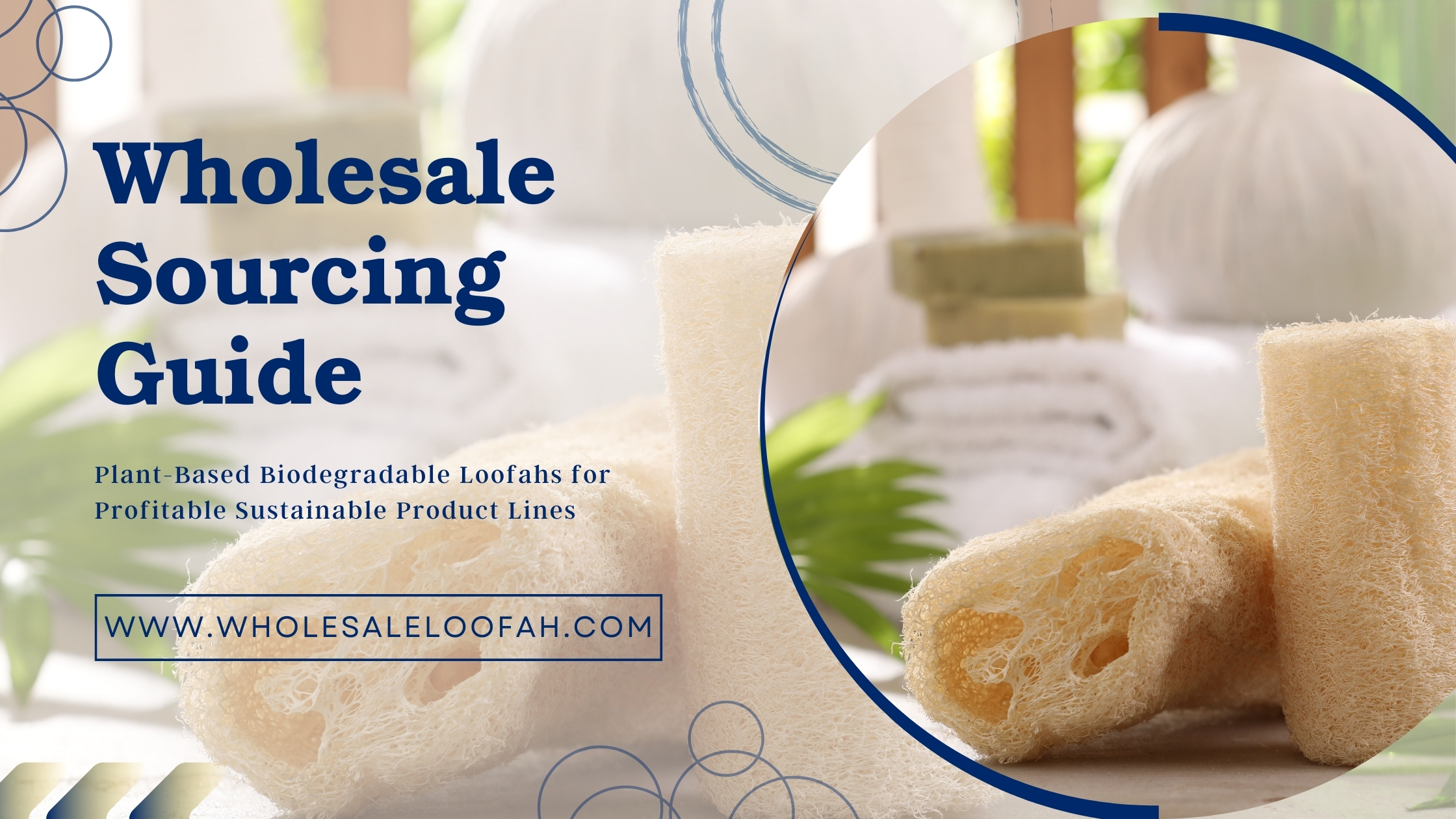
Wholesale buyers face a decisive moment in the personal care products market. Retailers report that sustainable product categories now generate 32 percent higher profit margins than conventional alternatives, yet many distributors remain locked into synthetic product lines with declining consumer appeal. Plant-based biodegradable loofahs represent one of the clearest opportunities to capture this margin advantage while positioning inventory for long-term market relevance.
The numbers demand attention from serious wholesale operators. Import data shows plant-based biodegradable loofah shipments to North American and European markets increased 47 percent year-over-year through 2024. Retail sell-through rates for natural bath products outpace synthetic categories by margins that make inventory turnover calculations compelling. Buyers who establish reliable supply chains now secure positioning advantages that late entrants will struggle to match.
This guide delivers the strategic intelligence wholesale buyers need to capitalize on the biodegradable loofah opportunity. From supplier evaluation frameworks to margin optimization strategies, the information ahead transforms market awareness into actionable procurement plans. Egyptian-origin products dominate the quality segment, and understanding why helps buyers source products that command premium positioning and generate repeat orders.
EGEXO has been exporting Egyptian loofah since 2015. Their comprehensive product catalog demonstrates the product range and specifications that professional buyers require for strategic inventory planning.
Market Intelligence for Strategic Buyers
Successful wholesale operations require market intelligence that transforms into competitive advantage. Understanding where demand originates, which segments show strongest growth, and how consumer preferences translate into purchasing patterns enables buyers to optimize inventory decisions and negotiate from positions of knowledge.
Demand Driver Analysis
Multiple converging forces propel demand for plant-based biodegradable loofahs beyond temporary trend status into sustained market restructuring:
Regulatory pressure continues mounting against synthetic personal care products. Microplastic restrictions now affect product formulations and packaging across European Union markets, with similar regulations advancing through North American legislative processes. Wholesale buyers anticipating these changes position inventory ahead of compliance deadlines rather than scrambling to replace restricted products.
Consumer awareness has crossed critical thresholds. More significantly, 43 percent report willingness to pay premium prices for verified sustainable products. This willingness translates directly into margin opportunity for buyers stocking appropriate inventory.
Retail channel evolution favors natural product categories. Major retail chains have expanded sustainable product shelf space by average 28 percent over three years while reducing conventional product allocations. Buyers supplying these channels must align inventory with merchandising direction or risk losing placement to competitors offering what retailers demand.
Segment Performance Comparison
The data reveals strategic implications. Natural loofah segments deliver superior margins while growing substantially faster than declining synthetic categories. Buyers maintaining synthetic-heavy inventory face margin compression and slowing turnover while missing growth in adjacent categories.
Channel-Specific Opportunities
Different retail and commercial channels present distinct opportunity profiles for plant-based biodegradable loofahs:
| Channel | Current Penetration | Growth Potential | Buyer Requirements | Margin Expectation |
|---|---|---|---|---|
| Natural product retailers | 85 percent | Moderate expansion | Established category | Standard wholesale |
| Mainstream grocery | 34 percent | High expansion | Certification documentation | Competitive pricing |
| Spa and wellness | 67 percent | Strong expansion | Premium quality and presentation | Premium pricing accepted |
| Hotel and hospitality | 41 percent | Very high expansion | Bulk and amenity formats | Volume pricing |
| E-commerce specialists | 52 percent | High expansion | Dropship capability | Flexible arrangements |
| Pet retail | 23 percent | Very high expansion | Pet-specific products | Standard wholesale |
Buyers targeting underpenetrated channels like hospitality and pet retail can establish supplier relationships and channel expertise before competition intensifies.
Product Category Deep Dive
Wholesale buyers benefit from comprehensive product knowledge that informs purchasing decisions and supports downstream sales efforts. Understanding what distinguishes product categories helps optimize assortment planning and margin management.
Body Care Product Range
The core body loofah category encompasses multiple product formats serving different consumer preferences and price points:
Standard body loofahs represent the volume foundation for most wholesale operations. These products range from economy grades suitable for mass market retail to premium selections commanding specialty store placement. Body loofah products from quality Egyptian sources support positioning across this spectrum.
Shaped and specialty body products including loofah pads, mitts, and ergonomic designs command premium pricing and attract consumers seeking differentiated bathing experiences. These formats typically generate 15 to 25 percent higher margins than standard products while appealing to gift and specialty retail channels.
Travel and sample sizes serve trial generation and travel retail channels. Smaller formats introduce consumers to natural loofah benefits while creating repeat purchase opportunities for full-size products.
Kitchen and Household Category
Kitchen applications represent a high-growth adjacent category that many wholesale buyers underserve:
Kitchen loofah products tap into consumer desire to extend sustainability practices beyond personal care into household routines. These products replace synthetic sponges and scrubbers with biodegradable alternatives that perform comparably or better for most cleaning tasks.
| Kitchen Product Type | Primary Application | Replacement Cycle | Margin Profile | Growth Trajectory |
|---|---|---|---|---|
| Dish cleaning loofahs | Daily dishwashing | 4 to 6 weeks | 40 to 48 percent | 31 percent annual |
| Scrubber pads | Pots and surfaces | 3 to 4 weeks | 38 to 45 percent | 28 percent annual |
| Vegetable brushes | Produce cleaning | 8 to 12 weeks | 42 to 50 percent | 35 percent annual |
| Multi-purpose blocks | General cleaning | 6 to 8 weeks | 36 to 42 percent | 26 percent annual |
The kitchen category offers wholesale buyers opportunity to expand natural loofah sales beyond bathroom placement into kitchen and cleaning aisles, multiplying potential shelf presence within retail accounts.
Raw Materials and Craft Supply
Wholesale buyers serving craft, soap-making, and specialty manufacturing markets find opportunity in raw loofah materials:
Raw loofah scrubbers supply soap makers who embed loofah sections within bar soap products. This growing artisan segment demands consistent quality raw materials in formats suitable for further processing.
Whole loofahs serve craft applications, educational uses, and specialty manufacturing. Buyers supplying craft retailers, educational suppliers, and small manufacturers can develop profitable niches with these products.
Custom cutting and processing services add value for buyers serving specialized applications. Egexo offers custom product design capabilities that enable creation of proprietary product formats for buyers developing differentiated offerings.
Supplier Evaluation Framework
Selecting wholesale suppliers for plant-based biodegradable loofahs requires systematic evaluation across multiple dimensions. The wrong supplier choice creates inventory problems, quality complaints, and margin erosion that damage buyer operations and retail relationships.
Critical Evaluation Criteria
Professional buyers should assess potential suppliers against comprehensive criteria:
| Evaluation Dimension | Key Assessment Questions | Documentation to Request | Red Flag Indicators |
|---|---|---|---|
| Production capability | What annual volume can supplier reliably deliver | Facility documentation and capacity data | Vague or inconsistent capacity claims |
| Quality systems | What inspection and grading processes exist | Quality control procedures and standards | No written quality documentation |
| Export experience | How many years exporting to your target market | Export licenses and shipping history | Limited or no verifiable export track record |
| Financial stability | Can supplier sustain operations through order cycles | Business registration and references | Reluctance to provide business documentation |
| Communication quality | Response time and clarity of communications | Sample correspondence review | Slow responses or unclear communication |
| Flexibility | Customization and special requirement accommodation | Examples of custom work completed | Rigid minimum requirements and no customization |
| Compliance capability | Ability to meet import and certification requirements | Relevant certificates and test results | Missing or outdated compliance documentation |
Egexo demonstrates strength across these evaluation dimensions. Their detailed supplier profile addresses professional buyer requirements directly, and their export documentation meets standards for major importing markets.
Geographic Sourcing Considerations
Plant-based biodegradable loofahs originate from multiple production regions, each presenting distinct characteristics for wholesale buyers:
| Origin Region | Quality Reputation | Price Position | Supply Reliability | Lead Time to North America | Lead Time to Europe |
|---|---|---|---|---|---|
| Egypt | Premium benchmark | Moderate premium | Very high | Confirmed with the quote | Confirmed with the quote |
| China | Variable by supplier | Economy to moderate | High | Confirmed with the quote | Confirmed with the quote |
| Vietnam | Developing quality | Economy | Moderate | Confirmed with the quote | Confirmed with the quote |
| India | Moderate quality | Economy | Moderate | Confirmed with the quote | Confirmed with the quote |
| Central America | Moderate to good | Moderate | Variable | Confirmed with the quote | Confirmed with the quote |
Egyptian origin commands premium positioning for documented reasons. The Nile Valley growing environment produces fiber density and consistency unmatched elsewhere. Buyers targeting quality-conscious retail channels and premium positioning benefit from Egyptian sourcing despite modest price premiums over economy origins.
Understanding the farm to export process that quality Egyptian suppliers maintain helps buyers appreciate quality factors that justify premium positioning.
Quality Grading Standards
Wholesale buyers must understand quality grading to specify requirements accurately and evaluate received shipments:
See our wholesale prices on egexo.com.
Egexo maintains detailed quality standards documentation that enables precise specification and consistent quality receipt. Buyers should request similar documentation from any supplier under consideration.
Procurement Process Optimization
Efficient procurement processes reduce costs, minimize supply disruptions, and strengthen supplier relationships. Wholesale buyers benefit from establishing systematic approaches to ordering, receiving, and managing loofah inventory.
Order Planning Strategy
Strategic order planning balances inventory investment against service level requirements:
| Planning Factor | Conservative Approach | Balanced Approach | Aggressive Approach |
|---|---|---|---|
| Safety stock level | 8 to 10 weeks supply | 5 to 7 weeks supply | 3 to 4 weeks supply |
| Order frequency | Quarterly | Bi-monthly | Monthly |
| Order quantity basis | Historical average plus 10 percent | Forecast based | Just-in-time calculation |
| Supplier diversification | Multiple suppliers per category | Primary plus backup | Single preferred supplier |
| Forward commitment | Minimal advance ordering | Moderate advance positions | Aggressive forward buying |
Most wholesale buyers find balanced approaches optimal, maintaining sufficient safety stock to prevent stockouts while avoiding excessive inventory carrying costs. Market growth rates for plant-based biodegradable loofahs support somewhat aggressive inventory positions given favorable sell-through trends.
Sample and Trial Order Process
Prudent buyers evaluate suppliers through structured sample and trial processes before committing to volume orders:
Initial samples allow quality assessment and product evaluation. Request samples from potential suppliers to physically evaluate products against specifications and compare offerings across suppliers.
Trial orders of 100 to 500 units test supplier performance on actual commercial transactions. Evaluate order processing, shipping performance, documentation accuracy, and product consistency before scaling volume.
Volume qualification orders of 1000 to 2000 units confirm supplier capability for larger scale operations. These orders reveal whether quality and service standards hold at commercial volumes.
Quotation and Negotiation
Professional buyers approach quotation and negotiation systematically:
| Negotiation Element | Buyer Leverage Points | Supplier Perspective | Optimal Outcome |
|---|---|---|---|
| Unit pricing | Volume commitment and payment terms | Production efficiency and margin | Fair price reflecting value exchange |
| Minimum order quantity | Relationship potential and growth trajectory | Production batch economics | MOQ aligned with buyer capabilities |
| Payment terms | Creditworthiness and order history | Cash flow management | Terms supporting both parties |
| Shipping arrangement | Destination flexibility | Logistics relationships | Cost-effective reliable shipping |
| Exclusivity | Market development commitment | Channel conflict avoidance | Appropriate territorial arrangements |
Request quotations with specific requirements to initiate supplier discussions. Detailed quotation requests demonstrate buyer seriousness and enable accurate supplier responses.
Margin Optimization Strategies
Wholesale profitability depends on margin management across the procurement and sales cycle. Plant-based biodegradable loofahs offer margin advantages that buyers can maximize through strategic approaches.
Cost Structure Analysis
Understanding cost components enables margin optimization:
Container-quantity orders offer the most significant cost optimization opportunity. Full container shipments reduce per-unit freight costs substantially compared to less-than-container shipments while qualifying for maximum supplier discounts.
Pricing Strategy Framework
Wholesale buyers must price products to capture margin while remaining competitive:
| Market Position | Margin Target | Pricing Basis | Supporting Requirements |
|---|---|---|---|
| Premium specialist | 48 to 58 percent | Value-based pricing | Premium sourcing and strong brand story |
| Quality mainstream | 38 to 45 percent | Market-based pricing | Consistent quality and reliable supply |
| Value competitor | 28 to 35 percent | Cost-plus pricing | Efficient operations and volume focus |
| Private label supplier | 22 to 30 percent | Negotiated pricing | Scale efficiency and customer retention |
Premium positioning for Egyptian-origin plant-based biodegradable loofahs supports margin targets at the higher end of ranges. Quality documentation and origin verification justify premium positioning to downstream customers.
Value-Added Service Margins
Wholesale buyers can enhance margins through value-added services:
Kitting and bundling combines multiple products into gift sets or variety packs commanding premium pricing. Loofah products bundle effectively with complementary natural personal care items.
Private label and custom branding services allow retailers to differentiate offerings while providing buyers with premium service margins. Egexo’s custom capabilities support private label programs requiring specific product formats or packaging.
Dropship fulfillment serves e-commerce retailers lacking warehouse capabilities. Buyers offering dropship generate service margins while expanding market reach without retail customer inventory requirements.
Supply Chain Risk Management
Wholesale operations face supply chain risks that prudent buyers actively manage. Plant-based biodegradable loofah supply chains present specific risk factors requiring attention.
Risk Identification and Mitigation
| Risk Category | Specific Risks | Probability Assessment | Impact Severity | Mitigation Strategies |
|---|---|---|---|---|
| Supply disruption | Crop failure or production problems | Low for established suppliers | High | Supplier diversification and safety stock |
| Quality variation | Inconsistent product quality | Moderate without qualification | Moderate to high | Supplier qualification and inspection protocols |
| Logistics delay | Shipping disruptions and port congestion | Moderate and cyclical | Moderate | Lead time buffers and flexible scheduling |
| Price volatility | Raw material and shipping cost changes | Moderate | Moderate | Forward contracts and pricing mechanisms |
| Regulatory change | Import requirements or product standards | Low to moderate | Variable | Compliance monitoring and supplier capability |
| Currency fluctuation | Exchange rate movements | Continuous | Moderate | Currency management and pricing adjustments |
Business Continuity Planning
Wholesale buyers should establish business continuity measures:
Supplier diversification maintains relationships with qualified backup suppliers who can fulfill orders if primary supplier experiences problems. Even buyers preferring single-supplier relationships benefit from qualified alternatives.
Inventory positioning places safety stock strategically to buffer against supply disruptions. Natural loofah products store well in appropriate conditions, making safety stock practical.
Communication protocols establish clear processes for identifying and responding to supply chain disruptions. Early warning indicators and escalation procedures minimize disruption impact.
Expert Perspective from EGEXO
Successful wholesale buyers visit production facilities, understand growing and processing operations, and build personal relationships with supplier teams. This investment pays returns when challenges arise. When shipping disruptions occur or special requirements emerge, strong relationships enable problem-solving that transactional arrangements cannot match.
We recommend wholesale buyers considering Egyptian loofah sourcing schedule facility visits as part of supplier qualification. Understanding the cultivation environment, processing methods, and quality control procedures provides knowledge that improves purchasing decisions and strengthens negotiating positions. Buyers who understand our operations recognize value that price-focused competitors miss.
The plant-based biodegradable loofah market rewards buyers who approach sourcing strategically rather than transactionally. Building supplier partnerships creates competitive advantages that purchasing-department mentalities cannot replicate.
To discuss your order, request a quote from EGEXO.
FAQ Section
Q: What minimum order quantities should wholesale buyers expect for plant-based biodegradable loofahs?
A: Minimum order quantities vary by supplier and product category. Sample orders may require minimums of 10 to 50 pieces. Trial orders typically start at 100 to 500 units. Standard wholesale minimums range from 500 to 1000 units per product line. Container quantity orders start at approximately 5000 units depending on product format. Established suppliers like Egexo offer flexibility for qualified buyers developing new business.
Q: How do wholesale buyers verify the biodegradability claims of loofah suppliers?
A: Professional buyers should request testing documentation demonstrating compliance with standards such as ASTM D6400, EN 13432, or ISO 14855. Legitimate suppliers maintain laboratory test results from accredited facilities. Additionally, buyers should confirm processing methods avoid synthetic additives that compromise biodegradability. Supplier facility audits and quality system documentation provide further verification.
Q: What profit margins can wholesale buyers realistically achieve with natural loofahs?
A: Margin achievement depends on market positioning, sourcing efficiency, and operational costs. Premium positioning with quality Egyptian products supports wholesale margins of 45 to 55 percent. Mainstream quality positioning typically achieves 35 to 42 percent margins. Value-oriented operations generate 25 to 32 percent margins. These figures exceed typical synthetic product margins of 22 to 35 percent while serving faster-growing market segments.
Q: How do lead times for Egyptian loofah imports compare to other origins?
A: Egyptian loofahs typically require 4 to 6 weeks lead time to North American destinations and 2 to 3 weeks to European markets via ocean freight. These lead times compare favorably with Asian origins while delivering superior quality. Buyers should factor lead times into order planning and maintain appropriate safety stock. Established suppliers like Egexo maintain production capability supporting consistent lead time performance.
Q: What certifications matter most for wholesale loofah buyers?
A: Import compliance requires phytosanitary certificates from origin countries. Quality assurance benefits from supplier quality management documentation. Buyers should identify certification requirements of their target channels and verify supplier capability to provide necessary documentation before committing to supply relationships.
Q: How should wholesale buyers handle quality complaints from retail customers?
A: Professional complaint handling begins with supplier qualification that minimizes quality issues. When complaints occur, document specific concerns with photographs and detailed descriptions. Communicate promptly with suppliers providing complete information. Quality suppliers like Egexo maintain responsive customer service and fair resolution policies. Track complaint patterns to identify systemic issues requiring supplier discussion or sourcing adjustments.
Q: What payment terms do Egyptian loofah suppliers typically offer?
A: Payment terms vary by supplier, order size, and relationship history. Initial orders commonly require advance payment or letter of credit. Established relationships may qualify for net 30 or net 60 terms. Large volume buyers sometimes negotiate extended terms or installment arrangements. Buyers should discuss payment terms during quotation processes and factor terms into total cost calculations.
Conclusion
The wholesale opportunity in plant-based biodegradable loofahs rewards buyers who combine market understanding with strategic supplier relationships. Demand growth exceeding 25 percent annually, margin advantages over synthetic alternatives, and favorable competitive dynamics create conditions for profitable market participation. Buyers establishing quality supply chains now position operations advantageously for sustained market development.
Egyptian-origin products command premium market positioning that supports margin objectives while meeting quality expectations of discerning retail channels. Systematic supplier evaluation, efficient procurement processes, and strategic inventory management transform market opportunity into operational results.
Strategic Priorities for Wholesale Buyers:
- Evaluate current inventory mix against market growth trends and margin potential
- Qualify suppliers systematically using documented evaluation criteria
- Establish sample and trial processes before volume commitment
- Develop pricing strategies supporting target margin achievement
- Build supply chain resilience through diversification and safety stock
- Invest in supplier relationships generating long-term competitive advantage
Take Action on Wholesale Sourcing:
Qualified wholesale buyers can advance their loofah sourcing through several pathways:
Request detailed quotations with specific volume and product requirements to initiate supplier discussions.
Order evaluation samples to assess product quality against specifications and market requirements.
Download the complete product catalog for comprehensive product specifications and range information.
Browse product categories to explore available formats across body care, kitchen, pet, and raw material segments.