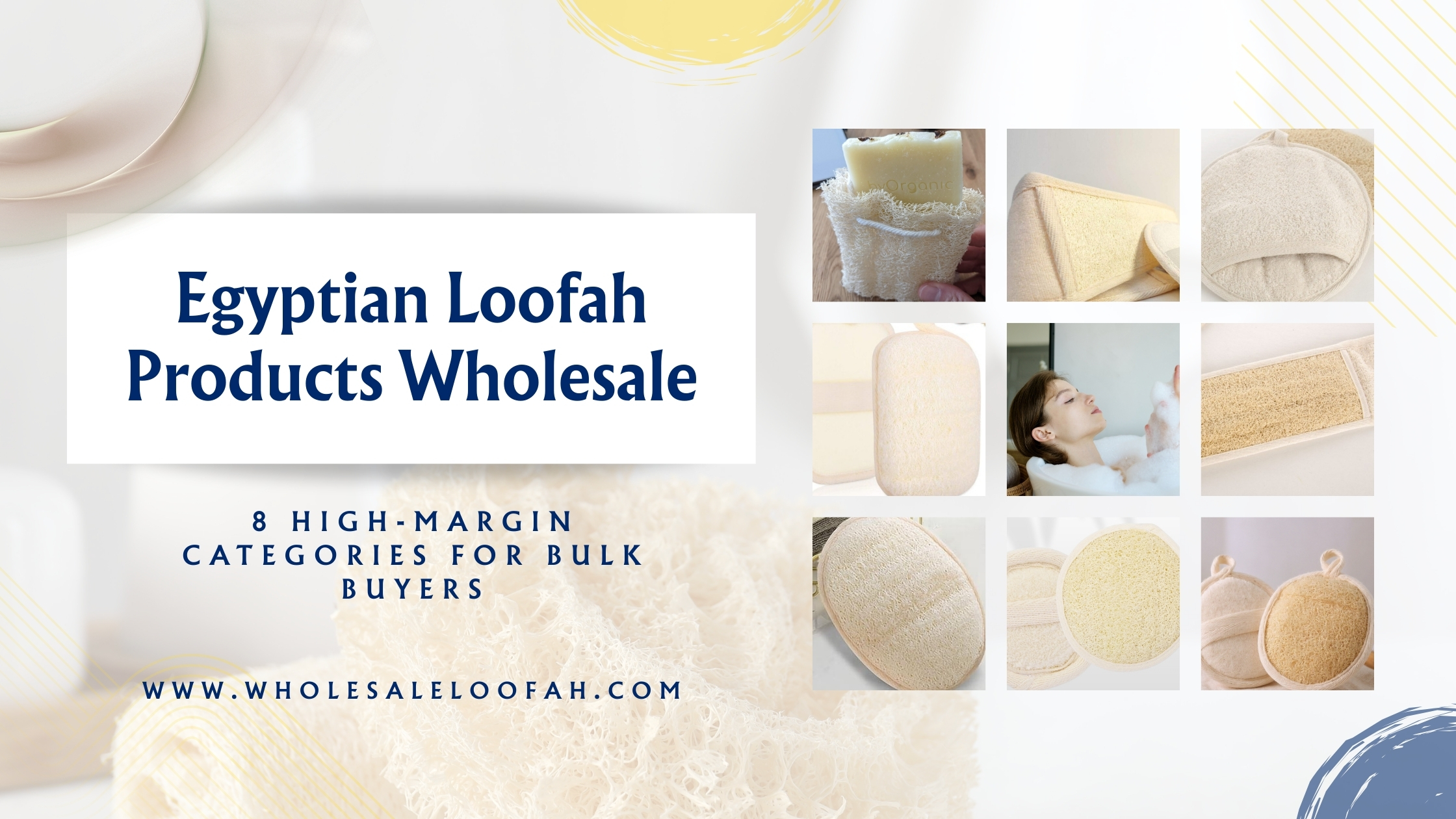
Bulk buyers sourcing authentic Egyptian loofahs access profit margins between 60 to 200 percent depending on product category, quality grade, and retail positioning. Understanding which categories perform strongest and how to evaluate supplier quality determines wholesale purchasing success.
Egypt dominates global premium loofah production, supplying approximately 60 percent of high-grade natural loofahs entering international trade. The Nile Delta cultivation region produces Luffa aegyptiaca specimens with fiber density and durability unmatched by competing origins. For wholesale buyers, this translates into products lasting 40 to 60 retail uses compared to 15 to 25 uses for Asian-grown alternatives, directly impacting customer satisfaction and repeat purchasing rates.
This comprehensive wholesale guide examines eight Egyptian loofah product categories offering strong B2B opportunities. You will discover specific quality grading criteria, typical minimum order quantities, pricing structures at various volume tiers, and strategic sourcing approaches maximizing procurement efficiency. EGEXO has been exporting Egyptian loofah since 2015.
Whether expanding existing natural products inventory or entering the sustainable personal care market, this guide provides actionable intelligence for informed purchasing decisions.
Wholesale Market Overview and Opportunity Analysis
Before examining specific product categories, understanding market dynamics establishes context for inventory investment decisions. Current trends favor Egyptian loofah products across multiple retail channels.
Consumer Demand Drivers
Several converging factors accelerate natural loofah demand in wholesale channels. Environmental consciousness among consumers continues strengthening, with 73 percent of millennials indicating willingness to pay premium prices for sustainable products. Microplastic pollution awareness specifically targets synthetic bath products, positioning natural loofahs as direct replacement solutions.
The wellness industry expansion creates complementary demand. Spa and salon operations increasingly incorporate natural exfoliation into service menus, requiring reliable wholesale supply. Home spa trend acceleration following recent years maintains elevated consumer interest in professional-grade personal care tools.
Retail channel diversification expands market access. Natural loofahs now appear in grocery chains, pharmacies, department stores, specialty boutiques, and e-commerce platforms. This channel breadth enables wholesalers to supply diverse buyer types from single product category inventory.
Competitive Landscape Assessment
| Origin | Market Share | Quality Grade | Price Position | Availability |
|---|---|---|---|---|
| Egypt | 60% premium | A/B grades dominant | Premium | Consistent |
| China | 25% total | C/D grades dominant | Budget | Abundant |
| Vietnam | 10% total | B/C grades mixed | Mid-range | Moderate |
| Other | 5% total | Variable | Variable | Limited |
Egyptian dominance in premium grades creates distinct wholesale positioning opportunity. Budget-focused retailers already source Chinese products extensively, leaving quality-differentiated market segments underserved. Wholesalers emphasizing Egyptian origin access customers prioritizing performance over lowest price.
Margin Structure Analysis
Wholesale loofah margins vary significantly by product category and retail channel served. Raw unprocessed loofahs yield lower percentage margins but higher volume throughput. Value-added products including mitts, back scrubbers, and specialty items command premium pricing with margins reaching 150 to 200 percent at retail.
Private label opportunities further enhance margin potential. Retailers increasingly seek custom-branded natural products supporting store brand strategies. Suppliers offering private label services capture additional margin while building customer dependency through switching cost creation.
Product Category 1: Raw Whole Loofah Gourds
Raw whole loofahs represent the foundational wholesale category, serving buyers requiring maximum flexibility for custom processing or direct resale to craft markets.
Quality Grading Standards
Professional grading evaluates multiple characteristics determining wholesale pricing and appropriate retail applications.
See our wholesale prices on egexo.com.
Grade selection depends on intended retail application. Premium A grades suit high-end spa retail and gift market positioning. Standard B grades balance quality with cost-effectiveness for general retail. Commercial C grades serve price-sensitive channels and craft supply markets. Utility D grades support industrial applications and budget craft supplies.
Minimum Order Quantities and Pricing Tiers
Typical MOQ structures for raw whole loofahs follow volume-based pricing progressions.
Container load quantities at 10,000+ units achieve optimal per-unit economics but require substantial capital commitment and storage capacity. Many wholesalers begin at 1,000 to 2,500 unit levels, scaling as market validation confirms demand projections.
Buyer Applications and Retail Channels
Raw whole loofahs serve diverse wholesale buyer types. Spa and wellness distributors supply treatment facilities requiring custom cutting specifications. Craft supply wholesalers serve DIY and handmade product markets. Natural product retailers offer whole loofahs for customers preferring unprocessed items. Private label manufacturers process whole loofahs into branded finished goods.
For quality raw loofahs with documented grading standards, Egexo provides wholesale raw loofah inventory with inspection certificates verifying grade specifications.
Product Category 2: Body Exfoliation Discs
Pre-cut body discs represent the highest-volume wholesale category due to immediate retail readiness and broad consumer appeal.
Size and Specification Options
| Size Category | Diameter | Thickness | Units Per Carton | Carton Weight | Primary Market |
|---|---|---|---|---|---|
| Compact | 6-7 cm | 1.5 cm | 200 | 4 kg | Budget retail, travel |
| Standard | 8-9 cm | 2 cm | 150 | 5 kg | General retail, primary SKU |
| Large | 10-11 cm | 2.5 cm | 100 | 5 kg | Premium retail, spa |
| Extra Large | 12+ cm | 3 cm | 75 | 5 kg | Specialty, professional |
Standard 8 to 9 centimeter discs account for approximately 65 percent of wholesale disc orders. This size balances manufacturing efficiency with consumer preference research indicating optimal usability. Retailers typically stock standard as primary SKU with compact and large as secondary options.
Volume Pricing Structure
Body disc wholesale pricing reflects processing labor and material efficiency at scale.
Packaging selection significantly impacts landed cost and retail presentation. Bulk packaging minimizes wholesale cost but requires retailer repackaging investment. Custom branded packaging requires artwork approval process extending lead times.
Retail Margin Calculations
Body discs consistently deliver strong retail margins across volume tiers. Even minimum order quantities enable competitive retail pricing while maintaining healthy profitability. Higher volume purchasing amplifies margin advantage for price-competitive positioning or promotional flexibility.
Product Category 3: Back Scrubber Assemblies
Back scrubbers combine loofah panels with handle systems, creating value-added products commanding premium wholesale and retail pricing.
Construction Specifications
| Component | Budget Version | Standard Version | Premium Version |
|---|---|---|---|
| Loofah panel | 12×8 cm, Grade C | 15×10 cm, Grade B | 18×12 cm, Grade A |
| Panel thickness | 1.5 cm | 2 cm | 3 cm |
| Handle material | Cotton cord | Bamboo dowels | Premium bamboo with finish |
| Handle length | 45 cm total | 55 cm total | 65 cm total |
| Attachment | Basic stitching | Reinforced stitching | Double-reinforced with grommets |
| Wholesale price | $1.20-1.80 | $2.50-3.50 | $4.50-6.50 |
Version selection matches target retail channel positioning. Budget versions suit discount retail and promotional applications. Standard versions serve general retail with balanced quality and cost. Premium versions target spa retail, gift markets, and specialty natural product stores.
Assembly and Sourcing Options
Wholesalers choose between pre-assembled imports and component sourcing for local assembly. Pre-assembled products minimize handling but limit customization. Component sourcing enables assembly flexibility but requires labor investment and quality control processes.
| Approach | Advantages | Disadvantages | Best For |
|---|---|---|---|
| Pre-assembled import | Turnkey, consistent | Limited customization | Volume retailers |
| Component import + local assembly | Customization, freshness | Labor intensive | Specialty distributors |
| Hybrid (panels imported, handles local) | Balance of both | Coordination complexity | Regional wholesalers |
Many successful wholesalers begin with pre-assembled products, transitioning to component approaches as volume justifies assembly investment.
Minimum Orders and Lead Times
Back scrubber MOQs typically run higher than simple disc products due to assembly complexity.
| Product Type | MOQ | Standard Lead Time | Rush Available |
|---|---|---|---|
| Budget back scrubber | No minimum order on standard products | 7 to 25 days from payment | +25% cost |
| Standard back scrubber | No minimum order on standard products | 7 to 25 days from payment | +30% cost |
| Premium back scrubber | No minimum order on standard products | 7 to 25 days from payment | +35% cost |
| Custom specification | Private label from 1,000 units | Confirmed with the quote | Limited |
Seasonal demand patterns affect lead times significantly. Q3 orders for Q4 holiday retail require early placement to ensure inventory availability during peak shipping periods.
Product Category 4: Loofah Mitt Products
Exfoliating mitts represent growing wholesale category with strong consumer adoption and premium price positioning.
Product Configuration Matrix
Full glove styles command highest retail prices but require larger wholesale investment. Half mitts balance accessibility with margin potential. Double-sided mitts appeal to consumers seeking versatility, supporting premium positioning despite moderate production complexity.
Quality Differentiation Factors
Mitt quality depends heavily on construction details beyond loofah grade. Seam integrity determines product lifespan under wet use conditions. Single-stitch seams fail within 15 to 20 uses while reinforced double-stitching extends durability to 50+ uses.
Elastic quality affects fit and repeated stretch recovery. Budget elastics lose tension after 20 to 30 cycles, causing loose fit complaints. Quality elastics maintain grip through 100+ cycles matching loofah panel lifespan.
Lining materials impact comfort and drying efficiency. Synthetic mesh linings dry quickly but feel less luxurious. Cotton terry linings provide comfort but retain moisture requiring extended drying. Bamboo fiber linings balance comfort with moisture management.
Request construction samples from potential suppliers, evaluating seam quality, elastic recovery, and lining characteristics before committing to volume orders.
Private Label Opportunities
Mitts suit private label programs exceptionally well due to visible branding surface area. Common customization options include embroidered logos on mitt backs, custom hang tag attachment, branded packaging with retailer identification, and custom color combinations for lining materials.
Private label MOQs typically require 500 to 1,000 units depending on customization complexity. Artwork approval adds 1 to 2 weeks to standard lead times. Color matching for linings or stitching may require sampling iterations extending development timelines.
Product Category 5: Facial Exfoliation Pads
Facial-specific products address distinct consumer segment with premium pricing potential and strong repeat purchase patterns.
Processing and Quality Requirements
Facial pads require additional processing beyond body products to achieve appropriate gentleness. Fiber selection targets innermost loofah sections with naturally finer structure. Enzyme treatments soften texture without compromising exfoliation effectiveness. Quality control inspection rates increase to ensure consistent gentleness across production runs.
These processing requirements elevate wholesale costs but support substantial retail premiums. Consumers readily pay 2 to 3 times body product prices for facial-specific items addressing skin sensitivity concerns.
Specification Standards
| Attribute | Standard Facial Pad | Premium Facial Pad |
|---|---|---|
| Diameter | 6-7 cm | 7-8 cm |
| Thickness | 0.5-0.8 cm | 0.8-1.0 cm |
| Fiber grade | Softened Grade B | Softened Grade A |
| Processing | Standard enzyme | Extended enzyme treatment |
| Packaging | Individual poly wrap | Premium pouch or box |
| Wholesale price | $0.65-0.90 | $1.20-1.80 |
Premium facial pad positioning suits specialty skincare retailers and spa channels. Standard versions serve broader retail distribution with accessible price points.
Market Positioning Strategy
Facial pads benefit from educational marketing emphasizing skin-specific design. Wholesale buyers should communicate differentiation clearly to retail partners.
Retail partners positioning facial pads within skincare departments rather than bath accessories capture higher price acceptance. Cross-merchandising with facial cleansers and serums reinforces premium positioning.
Product Category 6: Kitchen and Household Scrubbers
Kitchen loofah applications expand wholesale opportunity beyond personal care into household goods categories.
Product Format Options
Multi-pack configurations drive volume through consumer value perception. Three-pack bundles at $4.99 retail outperform single units at $2.49 on revenue per transaction while maintaining equivalent margin percentage.
Retail Channel Alignment
Kitchen loofahs access different retail channels than personal care products, enabling portfolio diversification.
| Channel | Product Fit | Pricing Sensitivity | Volume Potential |
|---|---|---|---|
| Natural grocery | Dish pads, multi-packs | Moderate | High |
| Kitchenware specialty | Handle scrubbers, blocks | Low | Moderate |
| Mass merchandise | Multi-packs, dish pads | High | Very high |
| E-commerce | All formats | Moderate | High |
| Hospitality supply | Bulk dish pads | High | Very high |
Mass merchandise and natural grocery channels offer highest volume potential but require competitive pricing. Specialty and hospitality channels accept premium pricing for appropriate quality grades.
Environmental Messaging Value
Kitchen applications leverage environmental positioning more directly than personal care. Consumers replacing synthetic sponges with natural loofahs eliminate ongoing microplastic pollution contribution. This tangible environmental benefit supports premium pricing justification and differentiates from commodity synthetic alternatives.
Wholesale buyers should ensure retail partners receive environmental messaging support including microplastic impact statistics, biodegradability comparisons, and sustainable cultivation practices information.
Explore kitchen loofah wholesale options at Egexo for household product category expansion.
Product Category 7: Pet Grooming Products
Pet care represents emerging wholesale category with substantial growth trajectory and limited current competition.
Product Adaptation Requirements
Pet grooming loofahs require modifications from human personal care products. Fiber softening ensures appropriate texture for animal skin beneath fur coverage. Larger surface areas enable efficient coat coverage during bathing. Ergonomic handle designs accommodate wet animal handling requirements. Durability enhancements withstand pet movement and potential chewing exposure.
Market Size and Growth Indicators
Natural pet product segments grow at 12 to 15 percent annually, outpacing overall category growth of 5 to 7 percent.
Current natural loofah penetration in pet grooming remains minimal, creating first-mover advantage for wholesalers establishing category presence. Limited competition enables premium positioning without immediate price pressure.
Distribution Channel Options
| Channel | Entry Complexity | Margin Potential | Volume Potential |
|---|---|---|---|
| Pet specialty retail | Moderate | High | Moderate |
| Veterinary supply | High | Very high | Low |
| Pet groomer supply | Moderate | Moderate | Moderate |
| E-commerce pet | Low | Moderate | High |
| Mass pet retail | High | Low | Very high |
E-commerce pet channels offer lowest entry barriers for market testing. Pet specialty retail provides margin optimization opportunity. Mass pet retail requires established relationships and volume capabilities but offers significant scale potential.
Discover pet grooming loofah products at Egexo featuring animal-appropriate specifications and wholesale pricing.
Product Category 8: Craft and Decorative Materials
Craft supply wholesale serves distinct customer base with unique purchasing patterns and margin characteristics.
Product Specifications for Craft Markets
Craft buyers prioritize different attributes than personal care customers. Size consistency enables project planning and material estimation. Cut surface quality affects finished craft appearance. Natural aesthetic preservation matters more than processed uniformity. Bulk packaging efficiency reduces handling for high-volume craft suppliers.
Craft slice wholesale offers high volume potential at attractive margins. Soap embedding applications alone consume substantial quantities as handmade soap popularity continues expanding.
Seasonal Demand Patterns
Craft supply purchasing exhibits pronounced seasonality. Q3 ordering supports holiday craft season inventory building. January through February sees elevated activity from craft show preparation. Summer months experience reduced demand as crafting activity declines.
Wholesale buyers should align inventory planning with seasonal patterns, potentially building craft inventory during slower Q2 production windows for Q3 delivery.
Cross-Category Bundling Opportunities
Craft-oriented wholesalers can bundle loofah materials with complementary natural products. Soap making supply bundles combining loofahs with essential oils, soap bases, and molds create value-added offerings. Spa gift basket components packages enable craft retailers to offer curated product combinations.
Supplier Evaluation Framework
Selecting reliable Egyptian loofah suppliers determines wholesale business success. Systematic evaluation prevents costly sourcing mistakes.
Essential Qualification Criteria
| Criterion | Verification Method | Red Flags |
|---|---|---|
| Egyptian origin | Export certificates, farm documentation | Vague origin claims, no documentation |
| Quality consistency | Sample evaluation, reference checks | High variability between samples |
| Production capacity | Facility information, order history | Inability to discuss capacity |
| Export experience | Shipping documentation, logistics capability | Domestic-only experience |
| Communication quality | Response timeliness, English proficiency | Delayed responses, unclear communication |
| Financial stability | Business references, payment terms offered | Unusual payment demands |
Request multiple samples across intended quality grades before volume commitment. Evaluate samples using the visual and tactile assessment criteria detailed in the quality grading sections above.
Documentation Requirements
Professional suppliers provide comprehensive documentation supporting import processes and quality verification.
Required documentation includes commercial invoice with accurate HS codes and product descriptions, packing list detailing carton contents and weights, certificate of origin confirming Egyptian sourcing, phytosanitary certificate for agricultural product import compliance, and quality inspection reports documenting grade specifications.
Optional but valuable documentation includes farm source identification, harvest date information, processing facility certification, and third-party quality testing results.
Sample Request Process
Before committing to volume orders, systematically evaluate potential suppliers through sample programs. Request samples across all grades you intend to purchase. Specify sample evaluation criteria you will apply. Establish clear timeline expectations for sample delivery. Document sample quality for comparison against volume order receipts.
Request samples through Egexo to evaluate product quality before wholesale commitment. Their sample program includes grade-specific specimens enabling direct comparison against stated specifications.
Import Logistics and Cost Considerations
Understanding landed cost components enables accurate margin calculations and competitive pricing strategies.
Cost Component Breakdown
| Component | Typical Range | Variables Affecting Cost |
|---|---|---|
| Product cost (FOB) | 40-55% of landed | Volume, grade, specifications |
| Ocean freight | 15-25% of landed | Origin port, destination, fuel |
| Import duties | 0-8% of value | HS code, trade agreements |
| Customs clearance | $150-400 fixed | Broker, documentation complexity |
| Inland freight | 5-12% of landed | Distance, handling requirements |
| Insurance | 0.5-1.5% of value | Coverage level, carrier |
Product cost as percentage of landed total increases with volume as fixed costs (clearance, inland freight) spread across more units. This scaling effect reinforces volume purchasing economics beyond unit price reductions.
Shipping Method Options
Full container load (FCL) shipping achieves optimal economics for established wholesale operations. Less than container load (LCL) suits smaller orders or testing phases, consolidating with other shippers. Air freight reserves for urgent restocking or time-sensitive promotional inventory.
Trade Compliance Considerations
Egyptian loofah imports typically classify under HS code 1404.90 (vegetable products not elsewhere specified) with duty rates varying by destination country. United States imports generally qualify for duty-free treatment under Generalized System of Preferences. European Union imports face minimal duties under trade agreements. Other destinations require specific tariff schedule consultation.
Phytosanitary requirements apply to natural plant products. Egyptian suppliers experienced in export provide compliant documentation, but importers should verify current requirements with destination country agricultural authorities.
Wholesale Pricing Strategy Development
Strategic pricing optimizes margin capture while maintaining competitive positioning.
Margin Target Guidelines
| Retail Channel | Typical Markup | Rationale |
|---|---|---|
| Spa and wellness | 100-150% | Premium positioning, service integration |
| Natural specialty retail | 80-120% | Quality-focused customers |
| General retail | 60-90% | Price-conscious but value-aware |
| Mass merchandise | 40-60% | Volume-driven, price-sensitive |
| E-commerce | 70-100% | Lower overhead, shipping factored |
Channel-specific pricing enables margin optimization across diverse customer bases. Avoid single-price approaches that leave margin on table in premium channels while losing competitiveness in price-sensitive segments.
Volume Discount Structures
Effective wholesale pricing rewards volume commitment while protecting margin on smaller orders.
Communicate tier structures clearly to buyers, enabling volume planning that benefits both parties. Transparent pricing builds trust and encourages upward tier migration.
Promotional Pricing Tactics
Strategic promotions drive volume without permanently eroding price expectations.
Seasonal promotions tied to retail demand peaks support buyer inventory building. New customer acquisition pricing encourages trial with clear standard pricing communication. Bundle promotions combining categories increase order size while providing buyer value. Overstock promotions move excess inventory without discounting current production.
Expert Sourcing Insights
Successful Egyptian loofah wholesale requires understanding factors beyond basic product specifications.
Egyptian loofah production remains largely artisanal, with farming families maintaining generational cultivation knowledge. Suppliers maintaining direct farm relationships access consistent quality sources and production priority during high-demand periods. Intermediary-based suppliers often face quality variability and supply disruptions during peak seasons.
Wholesale buyers should evaluate supplier farm relationships specifically. Questions about farm locations, harvest timing, and grower relationships reveal supply chain depth. Suppliers unable or unwilling to discuss farm-level details may lack direct sourcing control necessary for consistent quality.
Learn more about Egexo quality standards and farm-to-export processes demonstrating relationship-based sourcing advantages.
Frequently Asked Questions
Q1: What are the typical minimum order quantities for Egyptian loofah products wholesale?
A: Minimum order quantities vary by product category and supplier. Raw whole loofahs typically start at 500 units. Pre-cut body discs commonly require 1,000 unit minimums. Value-added products like back scrubbers and mitts often have lower MOQs of 200 to 500 units reflecting higher per-unit value. Private label orders generally require 500 to 1,000 units depending on customization complexity. Some suppliers offer mixed category orders meeting combined value thresholds rather than per-category minimums, providing flexibility for product line testing.
Q2: How do I verify that loofah products are genuinely Egyptian origin?
A: Authentic Egyptian origin verification requires documentation and supplier transparency. Request certificates of origin issued by Egyptian export authorities. Ask for farm source identification including region and grower information. Professional suppliers provide phytosanitary certificates documenting Egyptian agricultural inspection. Evaluate supplier knowledge of Egyptian cultivation including Nile Delta geography, harvest seasons (September through November), and traditional processing methods. Suppliers hesitant to discuss origin details or provide documentation may source from alternative origins marketed as Egyptian.
Q3: What quality grades are available for wholesale Egyptian loofah products?
A: Egyptian loofahs grade into four primary categories based on size, fiber density, color uniformity, and defect presence. Premium A grade features lengths of 45 to 60 centimeters, excellent fiber density, uniform golden color, and zero defects. Standard B grade measures 35 to 45 centimeters with good density and minor color variation. Commercial C grade ranges from 25 to 35 centimeters with acceptable density and moderate variation. Utility D grade includes undersized pieces with variable quality and multiple defects. Grade selection should match intended retail positioning and price points.
Q4: What profit margins can wholesalers expect on Egyptian loofah products?
A: Wholesale loofah margins range from 60 to 200 percent depending on product category, quality grade, and retail channel. Private label products typically add 10 to 20 percent margin premium through brand differentiation. Premium retail channels including spa and specialty natural accept higher price points improving margin capture.
Q5: How should wholesale loofah inventory be stored to maintain quality?
A: Proper storage preserves wholesale loofah inventory quality. Maintain cool, dry environments with temperatures between 15 to 25 degrees Celsius. Relative humidity should remain below 60 percent to prevent moisture absorption and potential mold development. Store in sealed cartons or containers protecting from dust and environmental contamination. Avoid direct sunlight exposure causing color fading and fiber degradation. Implement first-in-first-out inventory rotation. Properly stored loofahs maintain quality for 18 to 24 months. Conduct periodic inspection of stored inventory checking for moisture damage or pest presence.
Q6: What documentation is required for importing Egyptian loofah products?
A: Egyptian loofah imports require several documentation types. Commercial invoices must include accurate product descriptions, HS codes (typically 1404.90), quantities, and values. Packing lists detail carton contents and weights. Certificates of origin confirm Egyptian sourcing for trade preference qualification. Phytosanitary certificates document agricultural inspection compliance. Quality inspection reports verify grade specifications. Bill of lading or airway bill tracks shipment transport. Some destinations require additional permits or certifications, so verify current requirements with customs authorities or licensed brokers before shipment.
Q7: Can Egyptian loofah suppliers provide private label and custom branding services?
A: Many Egyptian loofah exporters offer private label services for wholesale buyers. Common customization options include custom packaging with buyer branding, embroidered or printed logos on applicable products, custom hang tags and retail packaging, color customization for components like elastic or lining materials, and custom size or specification production. Private label MOQs typically range from 500 to 1,000 units depending on customization complexity. Development lead times extend 1 to 3 weeks beyond standard production for artwork approval and sample confirmation. Discuss private label requirements early in supplier evaluation to confirm capabilities and pricing impacts.
Q8: What shipping methods are recommended for wholesale loofah imports?
A: Shipping method selection depends on order size, urgency, and cost sensitivity. Sea freight offers lowest cost for container quantities with 25 to 40 day transit times. Less than container load sea freight suits smaller orders at moderate cost with 30 to 50 day transit. Air freight provides 5 to 10 day delivery for urgent needs at substantially higher cost, typically reserved for emergency restocking or high-value orders. Express courier handles samples and small urgent shipments in 3 to 7 days. Most established wholesale operations utilize sea freight for regular inventory replenishment, reserving air options for exceptional circumstances.
Conclusion
Egyptian loofah products wholesale presents compelling opportunity for distributors and retailers serving growing sustainable product demand. The eight categories examined provide diverse market access from foundational raw materials through value-added finished goods and emerging specialty applications.
Success in wholesale loofah sourcing requires systematic approach to supplier evaluation, quality grading understanding, and logistics management. Egyptian origin verification ensures access to premium fiber density and durability commanding market premiums. Volume-based purchasing optimizes unit economics while strategic pricing across retail channels maximizes margin capture.
The natural personal care market trajectory favors continued Egyptian loofah demand growth. Environmental consciousness, wellness industry expansion, and retail channel diversification create favorable conditions for wholesale market entry and expansion. Early positioning in underserved categories including pet grooming and premium facial products offers differentiation opportunity.
Key Takeaways for Wholesale Buyers:
- Egyptian loofahs command 40 to 60 percent price premiums justified by 2 to 3 times durability versus alternatives
- Body disc category offers highest volume potential with margins of 85 to 95 percent at retail
- Value-added products including back scrubbers and mitts support 100 to 150 percent margins
- Private label services enable brand differentiation and enhanced margin capture
- Quality grading knowledge prevents costly inventory mistakes
- Supplier relationship depth determines supply reliability and quality consistency
Ready to Source Premium Egyptian Loofahs?
Request wholesale quotation from Egexo specifying product categories, volume requirements, and quality grade preferences.
Order samples for quality evaluation before committing to volume purchases.
Download the complete product catalog for detailed specifications and pricing structures.
Learn why experienced buyers choose Egexo for consistent quality and reliable supply partnership.