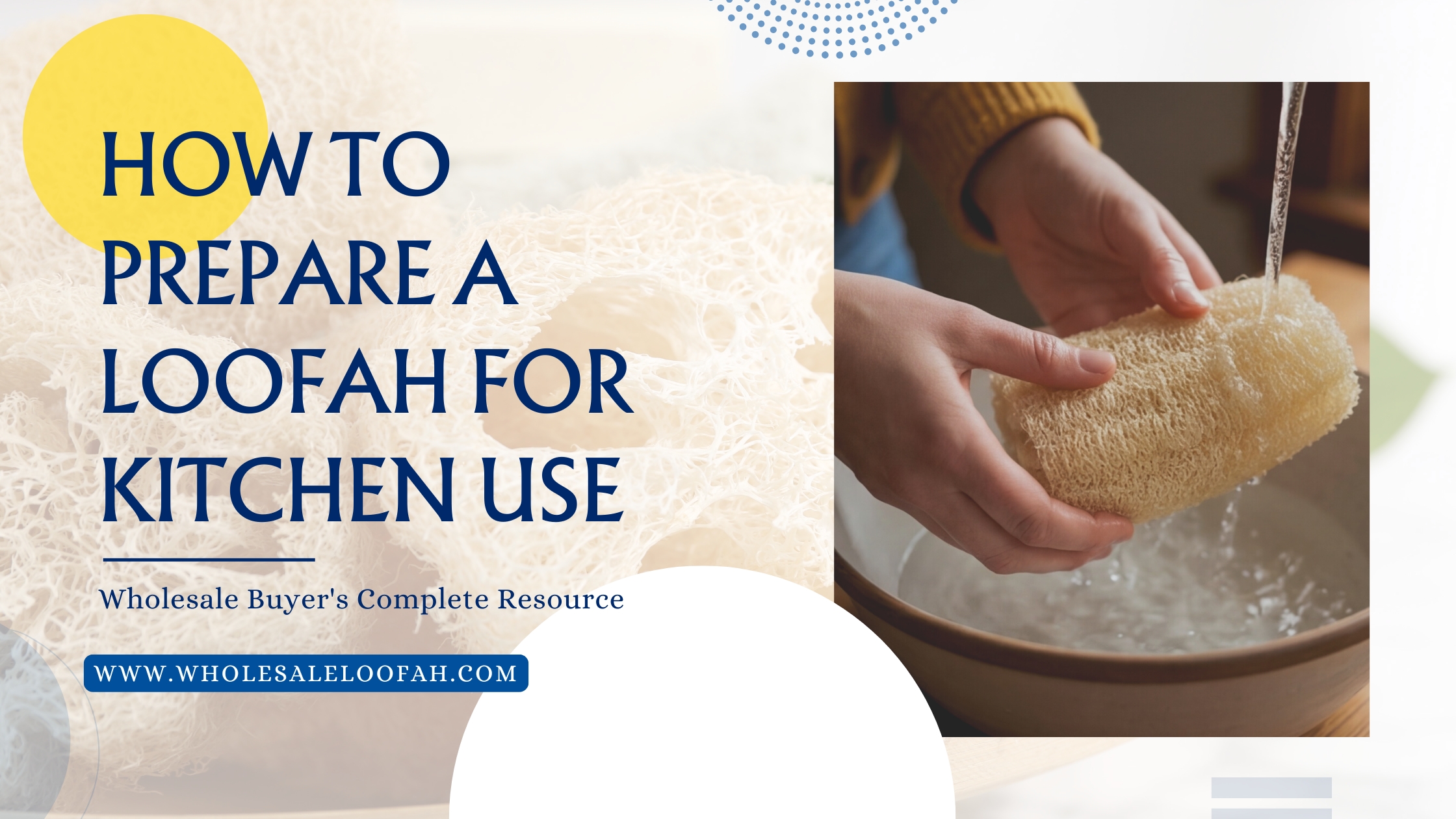
Short answer: A new kitchen loofah is soaked in water until it softens, then rinsed and dried before it is used on dishes. Wholesale buyers can ask a supplier whether pads ship ready to use or need preparing.
Wholesale buyers entering the natural kitchen products market face a critical knowledge gap that costs businesses thousands in returns and lost customers annually. Learning how to prepare a loofah for kitchen use represents essential operational knowledge for any business handling these products, whether selling raw materials or finished goods. Without this expertise, wholesalers cannot properly evaluate supplier quality, train retail partners, or develop effective customer education materials.
Success in this market requires understanding not just sourcing but the complete product lifecycle from raw material to consumer use.
Egyptian loofah is a good choice for kitchen use, thanks to its fibre and the growing conditions of the Nile Delta. Wholesale operations that partner with an established Egyptian supplier can plan their supply with more confidence. EGEXO has been exporting Egyptian loofah since 2015.
This resource provides wholesale buyers comprehensive preparation knowledge applicable across business models. Distributors will understand processing requirements affecting product specifications. Retailers will gain customer education content improving sales conversion. Private label developers will identify preparation variations enabling product differentiation. The information presented reflects commercial-scale considerations rather than household techniques alone.
Businesses ready to explore wholesale kitchen loofah opportunities can review available products at Egexo’s products page or examine the specialized kitchen loofah category for sourcing options.
Commercial Considerations for Kitchen Loofah Preparation
Understanding Preparation Economics
Preparation adds value but also adds cost. Wholesale buyers must understand this equation to make profitable sourcing and product development decisions. Raw unprepared loofahs cost significantly less than processed ready-to-use products, but the margin difference must cover preparation labor, equipment, facility costs, and quality control overhead.
Operations processing fewer than 500 units monthly face the highest per-unit costs due to setup inefficiencies. Mid-scale operations handling 2,000 to 10,000 units monthly achieve optimal cost efficiency. Larger operations see diminishing returns as quality control complexity increases.
The following breakdown illustrates typical preparation cost structures:
Wholesale buyers should evaluate whether in-house preparation or purchasing pre-processed products offers better economics for their specific volume and market positioning. Request quotations for both raw and processed options to compare landed costs accurately.
Supply Chain Position and Preparation Responsibility
Where preparation occurs in the supply chain affects quality, cost, and liability. Four primary models exist, each with distinct advantages:
Origin Processing places preparation responsibility with the exporter in the producing country. This model offers lowest cost but limits customization and extends lead times for specification changes. Egyptian suppliers like Egexo increasingly offer sophisticated processing capabilities that match destination market requirements.
Destination Processing brings raw loofahs to the wholesale buyer’s market for local preparation. This model enables rapid customization and quality control proximity to end markets but increases labor costs significantly in high-wage economies.
Hybrid Processing combines origin-based primary preparation with destination finishing. Loofahs arrive softened and sanitized but receive final cutting and packaging locally. This approach balances cost efficiency with customization flexibility.
Distributed Processing engages third-party processors in intermediate locations offering favorable cost structures. Southeast Asian processing hubs serve this function for some supply chains, though quality consistency requires careful partner selection.
Most wholesale operations find origin processing through qualified Egyptian suppliers offers a good balance of quality, cost, and reliability. The Egexo farm to export process shows how origin processing works.
Want to test a pad? Request paid samples from EGEXO For Export and try it in your own kitchen.
Bulk Preparation Methodology for Kitchen Loofahs
Pre-Processing Assessment and Sorting
Commercial preparation begins with systematic assessment that household methods skip entirely. Incoming raw loofahs require inspection and sorting before batch processing to ensure uniform results and prevent quality problems from propagating through finished inventory.
Establish receiving inspection protocols covering these parameters:
Dimensional Verification confirms loofahs meet purchased specifications.
Moisture meters designed for agricultural products provide accurate readings.
Fiber Density Evaluation through compression testing identifies units unsuitable for kitchen applications. Remove specimens that compress easily or feel hollow for alternative product streams or rejection.
Contamination Screening detects mold, insect damage, or foreign material requiring removal before processing. Establish clear reject criteria and track rejection rates by supplier lot for quality feedback.
Document inspection results systematically to identify supplier quality trends and support warranty claims when necessary. Quality suppliers welcome this feedback as it supports their continuous improvement processes.
Industrial Scale Softening Techniques
Preparing loofahs for kitchen use at commercial scale requires equipment and methods designed for throughput and consistency rather than individual optimization. Three primary approaches serve wholesale operations:
Batch Immersion Systems process 50 to 200 loofahs simultaneously in temperature-controlled tanks. Stainless steel construction prevents contamination and enables thorough sanitization between batches.
Industrial batch systems should include:
- Temperature monitoring with alarm thresholds
- Timer automation preventing over-processing
- Drainage systems enabling rapid tank turnover
- Water filtration maintaining bath cleanliness across multiple batches
Continuous Flow Systems suit high-volume operations exceeding 1,000 units daily. Loofahs travel through temperature zones on conveyor mechanisms, receiving progressive softening without batch handling. Capital investment is substantial but per-unit costs drop significantly at scale.
Steam Tunnel Processing offers the fastest throughput with excellent sanitization. Loofahs pass through steam exposure zones for 12 to 18 minutes, emerging softened and sanitized without water saturation.
Operations seeking supplier partnerships with processing capabilities should explore Egexo’s quality standards to understand available processing specifications.
Precision Cutting for Commercial Products
Kitchen loofah products require consistent dimensions that manual cutting struggles to achieve at scale. Investment in appropriate cutting equipment pays dividends through reduced waste, improved product presentation, and faster processing speeds.
Band Saw Systems provide the most versatile cutting capability for commercial operations. Variable speed control accommodates different loofah densities while guides ensure dimensional consistency. Blade selection matters significantly as fine-tooth blades designed for fibrous materials produce cleaner cuts than standard wood-cutting blades.
Die Cutting Presses excel for high-volume production of standardized shapes. Custom dies produce identical pieces rapidly with minimal operator skill required. Initial die fabrication costs amortize quickly across large production runs. This method works best for thin slices and pad-style products rather than thick cylindrical sections.
Automated Cutting Lines integrate measurement, positioning, and cutting into single systems requiring only loading and unloading labor. These systems justify investment only at high daily volumes but deliver consistent cuts and high throughput.
Regardless of cutting method, establish dimensional specifications and tolerance ranges for each product SKU. Kitchen loofahs typically target these dimensions:
| Product Type | Length | Diameter/Width | Thickness | Tolerance |
|---|---|---|---|---|
| Standard Scrubber | 8 to 10 cm | 6 to 8 cm | Full cylinder | Plus or minus 1 cm |
| Flat Pad | 10 to 12 cm | 8 to 10 cm | 2 to 3 cm | Plus or minus 0.5 cm |
| Dish Wand Insert | 6 to 8 cm | 4 to 5 cm | Full cylinder | Plus or minus 0.5 cm |
| Pot Scrubber | 10 to 12 cm | 8 to 10 cm | Full cylinder | Plus or minus 1 cm |
| Detail Scrubber | 4 to 6 cm | 3 to 4 cm | Full cylinder | Plus or minus 0.5 cm |
Quality Control Protocols for Prepared Kitchen Loofahs
Establishing Testing Standards
Wholesale operations require documented quality control protocols ensuring consistent product performance. Without standardized testing, quality varies between production batches, eroding customer confidence and generating costly returns.
Develop testing protocols addressing these critical parameters:
Softness Verification confirms adequate preparation. Standardized compression testing using a durometer or simplified squeeze-and-recover observation provides objective measurement. Establish acceptable ranges based on product positioning, as premium products target softer specifications than economy lines.
Dimensional Compliance requires measuring finished products against specifications. Document measurements and investigate patterns suggesting equipment wear or operator training needs.
Sanitization Validation becomes increasingly important as food safety awareness grows. Establish maximum acceptable ATP levels based on intended use and customer requirements.
Moisture meters enable rapid testing without destroying samples.
Structural Integrity Assessment identifies loofahs likely to fail prematurely during use.
Documentation and Traceability Systems
Professional wholesale operations maintain traceability from raw material receipt through finished goods shipment. This capability supports quality investigations, enables targeted recalls if necessary, and demonstrates operational sophistication to demanding retail partners.
Implement lot tracking that connects:
- Supplier shipment identification and receipt date
- Inspection results and any quality holds
- Processing batch assignments and parameters
- Finished goods inventory locations
- Customer shipment destinations
Digital systems streamline traceability while paper-based approaches remain viable for smaller operations. The investment in proper documentation pays dividends through faster problem resolution and stronger supplier relationships built on shared quality data.
Wholesale buyers should verify supplier traceability capabilities before committing to partnerships. Established suppliers maintain comprehensive records enabling investigation of any quality concerns. Egexo’s export documentation exemplifies the traceability professional buyers should expect.
Product Development Opportunities Through Preparation Variations
Differentiation Through Processing
How you prepare a loofah for kitchen use creates opportunities for product differentiation beyond raw material differences alone. Processing variations enable multiple product lines from identical raw materials, improving inventory efficiency while addressing diverse market segments.
Softness Levels represent the most accessible differentiation approach. Extended processing or enzyme-assisted methods produce noticeably softer loofahs suitable for delicate cookware and non-stick surfaces. Clearly communicate softness levels through packaging to guide consumer selection.
Infused Products incorporate beneficial compounds during the softening phase when fibers are most absorbent. Dish soap pre-loading creates convenience products requiring only water activation. Citrus or herb infusions provide pleasant scents differentiating products on retail shelves.
Shape Innovations enabled by sophisticated cutting create specialized products for specific kitchen tasks. Ergonomic contours, integrated hanging holes, and multi-surface designs address unmet consumer needs while commanding premium pricing.
For custom product development support, Egexo’s design services offer expertise translating market opportunities into manufacturable specifications.
Private Label Program Considerations
Retailers developing private label kitchen loofah lines must understand preparation specifications affecting product performance and customer satisfaction. Preparation choices become embedded in product identity and customer expectations.
Specify these preparation parameters when developing private label programs:
Softening Method and Duration affecting fiber pliability and cleaning performance
Cleaning Protocol covering how the loofah is cleaned before packing
Cutting Specifications defining product dimensions and tolerances
Post-Processing Treatments including any coatings or infusions
Drying Standards determining dryness at packaging
Quality Check Requirements specifying acceptance criteria and check frequency
Document specifications thoroughly in supplier agreements to ensure consistent production across orders. Request pre-production samples confirming specification compliance before authorizing full production runs.
The Egexo product catalog illustrates available product formats and customization options for private label development.
Retail Partner Education and Support Materials
Training Retail Staff on Kitchen Loofah Products
Wholesale success depends partly on retail partner success. Developing training materials helping retail staff understand how to prepare a loofah for kitchen use enables better customer service and increased sales conversion. Staff who can answer customer questions confidently sell more products.
Effective retail training covers:
Product Knowledge Fundamentals explaining what loofahs are, where they come from, and why Egyptian origin matters for quality. Staff should understand fiber structure basics enabling them to explain durability and cleaning effectiveness.
Preparation Guidance staff can share with customers purchasing raw or minimally processed loofahs. Simple explanation of hot water softening, appropriate cutting, and conditioning helps customers achieve good results.
Care and Maintenance Instructions extending product lifespan and ensuring customer satisfaction. Drying requirements, sanitization recommendations, and replacement timing guidance prevent common problems generating complaints.
Comparison Positioning articulating advantages over synthetic sponges including environmental benefits, cleaning effectiveness, and cost-per-use economics. Staff armed with compelling comparison points close sales more effectively.
Provide training materials in formats retailers can use efficiently. Single-page quick reference guides, short video tutorials, and FAQ documents all serve different training contexts. Make materials available digitally for easy distribution across retail locations.
Consumer Education Content for Retail Partners
Wholesale operations supporting retail partners with consumer-facing content strengthen relationships and drive sell-through. Prepared content enables retailers to educate customers without developing materials themselves.
Useful content formats include:
Product Insert Cards providing preparation and care instructions packaged with products. Professional printing on durable card stock reflects well on both wholesale and retail brands.
Point of Sale Materials including small signs explaining natural loofah benefits and usage guidance. Counter cards and shelf talkers attract attention and answer common questions.
Digital Content retailers can share through social media, email newsletters, and websites. Provide high-quality images, video clips, and written content with permission for retail use.
Customer FAQ Documents addressing common questions retail staff encounter. Compile questions from retail partner feedback and develop clear, accurate responses.
Supplier Evaluation for Kitchen Loofah Sourcing
Critical Supplier Assessment Criteria
Sourcing decisions significantly impact wholesale operation success. Thorough supplier evaluation before committing to partnerships prevents costly problems and establishes foundations for long-term relationships.
Evaluate potential suppliers across these dimensions:
Quality Consistency demonstrated through samples representing actual production rather than hand-selected specimens. Request samples from multiple production lots to assess variation. Suppliers confident in their quality welcome this scrutiny.
Processing Capabilities matching your product requirements. Verify suppliers can deliver loofahs prepared to your specifications, whether raw, partially processed, or fully finished. Tour facilities virtually or in person when possible.
Capacity and Reliability ensuring suppliers can meet your volume requirements with consistent lead times. Discuss seasonal variations, capacity constraints, and contingency plans for demand fluctuations.
Communication Responsiveness indicating partnership potential. Suppliers who respond promptly and thoroughly to inquiries typically maintain similar responsiveness throughout ongoing relationships.
Documentation and Compliance meeting your market requirements. Verify suppliers provide necessary certificates, test reports, and customs documentation. Food-contact applications may require specific safety certifications.
Financial Stability reducing supply disruption risk. Established suppliers with long operating histories present lower risk than newer operations without track records.
| Evaluation Factor | Questions to Ask | Red Flags |
|---|---|---|
| Quality Systems | What quality control processes exist? | No documented procedures |
| Traceability | Can you trace products to specific farms? | Inability to identify origin |
| Capacity | What is monthly production capacity? | Vague or inconsistent answers |
| Experience | How long have you exported? | Vague answers about export history |
| References | Can you provide customer references? | Unwillingness to share contacts |
| Samples | Can you send production samples? | Only perfect hand-picked samples |
Egexo’s supplier profile demonstrates the information professional wholesale buyers should expect from qualified suppliers.
Building Productive Supplier Relationships
Transactional supplier relationships yield adequate results while strategic partnerships unlock competitive advantages. Investing in relationship development pays dividends through preferential treatment, early access to innovations, and flexibility during supply challenges.
Relationship building practices include:
Clear Communication of requirements, expectations, and feedback. Suppliers cannot improve without understanding what matters to you. Share quality data, customer feedback, and market insights that help suppliers serve you better.
Fair Commercial Terms recognizing supplier needs alongside your own. Aggressive pricing pressure that threatens supplier viability ultimately harms your supply security. Seek mutually sustainable arrangements.
Volume Commitments enabling supplier planning and investment. Predictable demand allows suppliers to optimize production and prioritize your orders. Even informal forecasts help suppliers prepare.
Problem Resolution Approach treating issues as shared challenges rather than blame assignments. Collaborative problem-solving strengthens relationships while adversarial approaches damage them.
Long-Term Perspective valuing relationship continuity over short-term gains. Switching suppliers carries hidden costs in quality variation, learning curves, and relationship investment loss.
Request sample products from prospective suppliers to begin evaluation processes and relationship development.
A Note from EGEXO
Commercial Perspective from Industry Leaders
Wholesale buyers often underestimate how preparation knowledge affects their competitive position. At EGEXO, we ship to more than 40 countries and see that buyers who understand loofah preparation can judge suppliers better than buyers focused solely on price. This knowledge enables better supplier evaluation since you can assess whether processing meets appropriate standards. It enables better customer support since you can help retail partners and end consumers achieve good results. It enables better product development since you understand what preparation variations create meaningful differentiation. We encourage wholesale buyers to view preparation expertise as a strategic capability rather than an operational detail. When your organization understands the complete journey from raw loofah to satisfied kitchen user, every business decision improves. This guide provides the foundation, but ongoing learning through supplier partnership and market feedback builds the expertise that supports lasting success.
Explore partnership opportunities through EGEXO’s wholesale inquiry process.
Frequently Asked Questions
Q1: What minimum order quantities should wholesale buyers expect for prepared kitchen loofahs?
A: Minimum order quantities vary by supplier and processing level. At EGEXO there is no minimum order on standard products. Private label and custom packaging start from 1,000 units, and options cost extra. Discuss volume expectations openly during supplier evaluation to ensure alignment.
Q2: How do preparation requirements differ for foodservice versus consumer kitchen loofah products?
A: Foodservice applications may demand more rigorous cleaning protocols and documentation than consumer products. Durability requirements also increase since commercial kitchens subject loofahs to heavier use than households. Consumer products face less regulatory scrutiny but customer expectations for softness and immediate usability may be higher. Check the rules in your own market.
Q3: What preparation certifications should wholesale buyers require from suppliers?
A: Certification requirements depend on target markets and sales channels, and they vary by country. Some retailers ask for audits or certificates. Ask each supplier which papers it holds. EGEXO holds a Certificate of Origin or EUR.1, a phytosanitary certificate and an export license. Identify your market requirements before evaluating suppliers.
Q4: How should wholesale buyers handle customer complaints about kitchen loofah preparation quality?
A: Establish clear complaint handling procedures before issues arise. Document complaints thoroughly including product lot numbers enabling traceability investigation. Assess whether complaints indicate isolated defects or systematic problems requiring supplier engagement. Maintain replacement stock for prompt customer resolution while investigating root causes. Share complaint data with suppliers constructively to enable improvement. Track complaint rates by product and supplier lot to identify trends. Professional complaint handling protects customer relationships while generating quality improvement information.
Q5: What storage conditions do prepared kitchen loofahs require at wholesale facilities?
A: Prepared kitchen loofahs require dry storage to prevent mold growth. Temperature stability matters less than moisture control, though avoiding extreme heat preserves fiber integrity. Store products away from direct sunlight which can cause discoloration. Ensure adequate ventilation in storage areas preventing moisture accumulation. Products in sealed moisture-barrier packaging tolerate wider storage conditions than those in permeable packaging. Implement first-in-first-out inventory rotation so products do not sit in storage for long.
Q6: How can wholesale buyers verify supplier preparation claims without facility visits?
A: Multiple verification approaches substitute for direct facility observation. Request video documentation of preparation processes showing equipment, methods, and quality control activities. Purchase samples anonymously through alternate channels to compare against quoted samples. Check references with other wholesale buyers served by the supplier. Review export documentation for consistency with claimed capabilities. Combine multiple verification methods for comprehensive supplier assessment.
Q7: What preparation variations create the largest price premiums in kitchen loofah markets?
A: Premium preparation such as enzyme softening, custom shapes or pre-loaded soap products can support a higher price, but only when marketing communicates the value clearly to end consumers. Ask your supplier for a quote for each option.
Conclusion
Wholesale success in the kitchen loofah market requires understanding that extends beyond basic sourcing to encompass the complete preparation journey. Knowing how to prepare a loofah for kitchen use at commercial scale enables better supplier evaluation, improved quality control, stronger retail partnerships, and differentiated product development. This knowledge transforms wholesale buyers from commodity traders into value-adding partners within the natural products supply chain.
The preparation economics favor operations achieving appropriate scale while maintaining quality discipline. Mid-volume operations processing 2,000 to 10,000 units monthly typically achieve optimal cost efficiency, though specific circumstances may shift this calculation. Investment in proper equipment, documented procedures, and trained personnel distinguishes professional operations from unsustainable hobbyist approaches.
Egyptian loofah is a good choice for kitchen applications. The fiber developed through Nile Delta growing conditions makes a soft, loose-fibre product. Partnering with an established Egyptian supplier like Egexo gives you access to this fiber, backed by exporting experience since 2015.
Key Takeaways for Wholesale Buyers:
- Quality control protocols are essential for consistent customer satisfaction
- Supplier relationships built on transparency outperform transactional approaches
- Preparation variations create meaningful product differentiation opportunities
- Retail partner education drives sell-through and strengthens wholesale relationships
Ready to develop your kitchen loofah wholesale business?
- Request Pricing: Get a wholesale quotation
- Evaluate Quality: Order product samples
- Explore Products: Download the complete catalog
- Browse Options: Visit the kitchen loofah category
Keep reading: kitchen loofah scrubbers for greasy pans and kitchen loofah sponges.