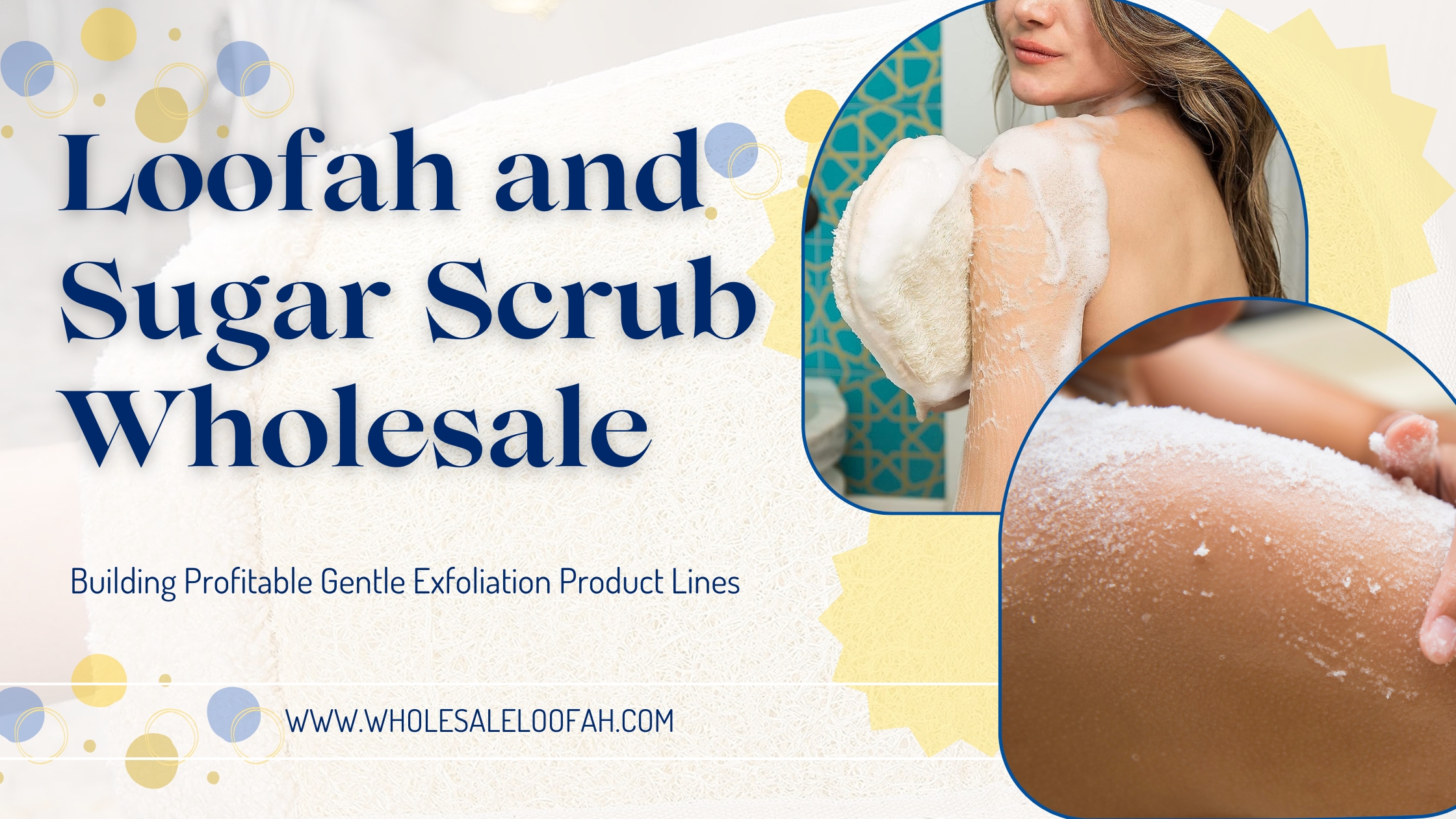
Commercial buyers seeking differentiation in crowded skincare markets find compelling opportunities in loofah and sugar scrub combinations. This pairing delivers gentle exfoliation results that synthetic alternatives cannot match while commanding premium positioning that protects profit margins from commodity price competition.
Wholesale sourcing decisions shape everything downstream. Material quality determines product performance, customer satisfaction, and repeat purchase rates. Origin selection impacts pricing structures, supply reliability, and brand storytelling potential. Understanding these relationships transforms procurement from cost management into strategic advantage.
The natural skincare segment reached 28 billion USD globally in 2024, with exfoliation products among categories showing strongest growth trajectories. Consumers actively reject microplastic-containing scrubs, creating demand gaps that businesses sourcing genuine natural loofah fill profitably. Market research indicates willingness to pay 40 to 60 percent premiums for verified sustainable alternatives.
This guide addresses wholesale buyers developing loofah and sugar scrub product lines or spa service offerings. We cover sourcing specifications, commercial formulation considerations, pricing strategies, and quality benchmarks that separate successful ventures from failed experiments. Whether launching new brands or expanding existing catalogs, these insights support informed purchasing decisions.
Egyptian loofah from the Nile Delta region establishes quality benchmarks other growing regions struggle to approach. Fiber density, consistency, and durability metrics favor Egyptian origin material, explaining its dominance among premium skincare brands worldwide. Wholesale buyers gain competitive advantages through direct relationships with established Egyptian suppliers maintaining rigorous quality standards.
Understanding Commercial Loofah Quality Specifications
Wholesale purchasing requires technical knowledge beyond retail consumer considerations. Specifications that seem minor affect manufacturing efficiency, product consistency, and ultimately profitability.
Fiber Density and Its Commercial Implications
Fiber density measures strand count per square centimeter of loofah surface. This metric directly predicts gentle exfoliation effectiveness and product durability under repeated use. Premium Egyptian loofah averages 2,500 to 3,200 strands per square centimeter, roughly double densities found in Asian or Central American sources.
Higher density creates more contact points during use, improving dead cell removal without requiring pressure that causes irritation. For sugar scrub applications specifically, dense fiber networks hold granules within the loofah structure rather than allowing immediate falloff. This retention extends working time and improves customer perception of product value.
Commercial implications extend beyond performance. Dense loofah withstands 45 to 60 use cycles compared to 20 to 30 for lower density alternatives. Products bundling loofah with scrub formulations benefit from matching component lifespans, preventing customer frustration when one element fails prematurely.
Moisture Content and Storage Stability
Properly processed loofah ships at 8 to 12 percent moisture content. Lower levels cause brittleness and fiber breakage during handling. Higher levels invite mold growth during storage and transit, potentially ruining entire shipments.
Wholesale buyers should verify moisture specifications before ordering and implement receiving inspection protocols. Simple squeeze tests reveal excess moisture through slow recovery or water expression. Overly dry material cracks audibly when flexed. Acceptable product feels pliable without dampness.
Storage facilities should maintain 40 to 60 percent relative humidity and temperatures between 15 and 25 degrees Celsius. Breathable packaging prevents moisture accumulation while protecting against dust contamination. Properly stored Egyptian loofah maintains commercial viability 18 to 24 months, enabling bulk purchasing without spoilage concerns.
Dimensional Consistency for Manufacturing
Production efficiency depends on predictable raw material dimensions. Loofah varying significantly in size, thickness, or shape disrupts automated processes and increases labor costs for manual operations.
Commercial Grade Dimensional Specifications
| Format | Length Range | Diameter Range | Thickness | Acceptable Variance |
|---|---|---|---|---|
| Whole cylinder | 25 to 40 cm | 7 to 10 cm | Natural | Plus minus 15 percent |
| Cut disc | 5 to 8 cm | 7 to 10 cm | 2 to 3 cm | Plus minus 10 percent |
| Body mitt | 20 to 25 cm | 12 to 15 cm | 1 to 2 cm | Plus minus 8 percent |
| Facial pad | 6 to 8 cm | 6 to 8 cm | 0.5 to 1 cm | Plus minus 5 percent |
| Kitchen scrubber | 10 to 12 cm | 8 to 10 cm | 2 to 3 cm | Plus minus 10 percent |
Tighter variances cost more but reduce waste and production problems. Buyers should balance precision requirements against budget constraints based on specific manufacturing processes.
Request samples to evaluate dimensional consistency before committing to volume orders. Sample assessment reveals supplier capability more reliably than specification documents alone.
Sugar Scrub Formulation for Commercial Production
Scaling kitchen recipes to commercial volumes introduces challenges absent from small batch preparation. Successful wholesale buyers understand formulation adjustments necessary for consistent, stable, marketable products.
Base Formula Ratios for Production
Commercial sugar scrub formulations balance effectiveness, stability, cost, and regulatory compliance. The following ratios provide starting points for product development, with adjustments based on testing and target market requirements.
Standard Commercial Sugar Scrub Base
| Ingredient | Percentage by Weight | Function | Cost Impact |
|---|---|---|---|
| Sugar granules | 55 to 65 percent | Primary exfoliant | Low |
| Carrier oils | 25 to 35 percent | Vehicle and moisturizer | Medium to high |
| Emulsifiers | 2 to 4 percent | Texture stabilization | Medium |
| Preservatives | 0.5 to 1.5 percent | Shelf life extension | Low |
| Fragrance | 1 to 3 percent | Sensory appeal | Variable |
| Active additives | 0 to 5 percent | Differentiation claims | Variable |
Sugar selection affects both performance and cost. White granulated sugar provides consistent dissolution rates at lowest cost per kilogram. Raw cane sugar adds visual appeal and mineral content at modest premiums. Specialty sugars like coconut or date sugar enable premium positioning but significantly increase production costs.
Loofah Integration Approaches
Commercial products incorporate loofah through several models, each with distinct manufacturing, packaging, and pricing implications.
Bundled Products
Packaging loofah alongside sugar scrub in unified presentation creates complete gentle exfoliation kits. This approach requires no manufacturing integration but demands packaging design accommodating both components. Margins improve through perceived value exceeding combined component costs.
Bundle configurations range from simple pouches containing scrub jar plus loofah disc to elaborate gift sets with multiple products and accessories. Market positioning determines appropriate complexity and price points.
Pre-loaded Loofah Products
Some manufacturers infuse dried loofah with solid or semi-solid scrub formulations. Customers wet the product to activate. This format offers convenience and novelty but requires specialized equipment and formulation expertise. Shelf stability presents challenges due to oil migration and crystal dissolution over time.
Separate Component Sales
Offering loofah and sugar scrub as individual products maximizes flexibility for customers while simplifying manufacturing. Cross-merchandising and bundle discounts encourage combined purchases. This model suits businesses entering the category before investing in integrated product development.
Preservation and Stability Considerations
Sugar scrubs present preservation challenges due to water introduced during use. While anhydrous formulations resist microbial growth during storage, contamination occurs readily once customers begin using products.
Commercial formulations require broad-spectrum preservatives effective against bacteria, yeast, and mold. Paraben alternatives including phenoxyethanol, sodium benzoate, and potassium sorbate satisfy clean beauty positioning while providing adequate protection.
Stability testing should verify six to twelve month shelf life under expected storage conditions. Accelerated testing at elevated temperatures predicts longer-term stability without waiting real-time durations.
Wholesale Pricing Structures and Volume Economics
Understanding pricing mechanics enables informed negotiation and accurate margin projections. Egyptian loofah pricing follows patterns common across agricultural commodities with modifications for processing complexity.
Price Determinants for Bulk Loofah
Raw Material Factors
Harvest yields vary annually based on weather, pest pressure, and agricultural inputs. Egyptian loofah benefits from relatively stable Nile Delta conditions, but prices still fluctuate 10 to 20 percent between seasons. Forward contracting locks pricing for buyers needing cost certainty.
Quality grades command different prices. Premium grade suitable for facial products and upscale body care costs 30 to 50 percent more than standard grades acceptable for kitchen or industrial applications. Specification requirements should match actual product needs rather than defaulting to highest available quality.
Processing Costs
Value-added processing increases per-piece costs but reduces buyer-side labor. Cutting to specific dimensions, shaping into mitts or pads, bleaching for color consistency, and packaging for retail all add cost while potentially adding more value.
Buyers manufacturing finished products may prefer minimally processed loofah at lower costs, handling final preparation internally. Retailers or distributors often benefit from fully processed, retail-ready formats despite higher unit costs.
Volume Considerations
Minimum orders typically start around 500 pieces, with sample quantities available for evaluation. Meaningful price breaks begin at 2,500 pieces, with significant discounts at 10,000 units and above. Container-load quantities of 20,000 plus pieces achieve lowest per-unit costs but require substantial inventory investment.
Indicative Volume Pricing Structure
| Order Size | Price Index | Lead Time | Payment Terms |
|---|---|---|---|
| Samples 10 to 50 | 150 to 200 | 5 to 7 days | Prepaid |
| Trial 500 to 1000 | 120 to 130 | 10 to 14 days | 50 percent deposit |
| Standard 2500 to 5000 | 100 to 110 | 14 to 21 days | 30 percent deposit |
| Volume 10000 to 20000 | 85 to 95 | 21 to 30 days | Net 30 available |
| Container 20000 plus | 75 to 85 | 30 to 45 days | Letter of credit |
Price index uses standard order as baseline 100. Actual pricing varies by product format, quality grade, and market conditions. Request quotation for current pricing specific to your requirements.
Margin Analysis for Finished Products
Wholesale buyers need margin visibility supporting sustainable business operations. The following analysis illustrates economics for a representative sugar scrub plus loofah bundle product.
Example Product Cost Breakdown
| Component | Unit Cost USD | Percentage of COGS |
|---|---|---|
| Egyptian loofah disc | 0.85 | 17 percent |
| Sugar scrub 200g | 1.40 | 28 percent |
| Primary packaging | 1.20 | 24 percent |
| Secondary packaging | 0.45 | 9 percent |
| Labels and inserts | 0.35 | 7 percent |
| Labor allocation | 0.55 | 11 percent |
| Overhead allocation | 0.20 | 4 percent |
| Total COGS | 5.00 | 100 percent |
At wholesale price of 12.00 USD, gross margin reaches 58 percent. Retail pricing at 24.00 USD provides retailer margins while maintaining premium positioning. Market testing should validate price acceptance before committing to production volumes.
Quality Assurance for Commercial Buyers
Wholesale relationships succeed through consistent quality meeting specifications. Establishing clear standards and verification procedures prevents costly disputes and customer complaints.
Incoming Inspection Protocols
Every shipment should undergo standardized inspection before acceptance into inventory or production. Document results systematically for supplier performance tracking and dispute resolution.
Inspection Checklist for Bulk Loofah Receipts
| Parameter | Method | Acceptable Range | Action if Failed |
|---|---|---|---|
| Piece count | Physical count | Minus 0 plus 2 percent of invoice | Adjust payment |
| Moisture content | Moisture meter | 8 to 12 percent | Quarantine pending review |
| Dimensional accuracy | Measurement sampling | Per specification | Sort or return |
| Color uniformity | Visual comparison | Match reference | Segregate or return |
| Fiber integrity | Flex testing | No cracking | Return |
| Contamination | Visual inspection | None visible | Return |
| Odor | Sensory evaluation | Clean plant only | Return |
Sample size for inspection should represent statistically valid portion of shipment. Industry standard suggests square root of total pieces or 2 percent minimum, whichever is greater.
Supplier Qualification Process
New supplier relationships warrant thorough evaluation before committing significant volumes. Initial orders should be treated as extended samples regardless of size, with full inspection and performance documentation.
Key qualification criteria include consistent achievement of specifications across multiple orders, responsive communication addressing issues promptly, documentation completeness including certificates and origin verification, and capacity confirmation supporting growth requirements.
Established suppliers like those in the Egyptian loofah export network maintain quality management systems and provide comprehensive documentation meeting international import requirements. Verification of these capabilities should precede significant purchasing commitments.
Handling Quality Issues
Despite best efforts, quality problems occasionally occur. Professional handling preserves relationships while protecting buyer interests.
Document issues thoroughly with photographs, measurements, and affected quantities. Contact suppliers promptly with specific, objective descriptions rather than emotional complaints. Propose reasonable resolutions including replacement, credit, or return depending on severity.
Most established suppliers prefer resolving issues fairly over losing customers. However, persistent problems despite clear communication warrant supplier replacement regardless of relationship history or price advantages.
Market Positioning and Competitive Strategy
Successful wholesale buying supports broader business strategy. Material selection and product development should align with target market positioning and competitive differentiation goals.
Premium Positioning Through Origin Story
Egyptian loofah carries inherent story potential that commodity materials lack. The Nile Delta growing region, centuries of cultivation expertise, and traditional processing methods create narrative foundations for premium brand positioning.
Marketing materials can emphasize mineral-rich Nile sediments nourishing plants, generations of farming families maintaining quality traditions, and sustainable agriculture practices predating modern organic standards. These authentic differentiators resist competitive copying.
Learn about Egyptian loofah heritage to develop compelling brand narratives distinguishing your products from generic alternatives.
Clean Beauty Alignment
The clean beauty movement prioritizes ingredient transparency, environmental sustainability, and ethical sourcing. Natural loofah and sugar scrub products align perfectly with these values when properly documented and communicated.
Certification programs including organic verification, fair trade endorsement, and sustainability audits add credibility supporting premium pricing. Certification costs represent investments in market access rather than mere expenses.
Documentation requirements for clean beauty claims continue tightening. Wholesale buyers should ensure suppliers provide complete traceability from farm through export. Egyptian suppliers accustomed to European Union import requirements typically maintain documentation systems exceeding requirements of other markets.
Private Label Opportunities
Many wholesale buyers develop private label products rather than creating new brands. This approach reduces marketing investment while leveraging retailer or distributor brand equity.
Private label success requires manufacturing flexibility accommodating customer specifications. Loofah formats, scrub formulations, packaging designs, and minimum quantities all require customization. Suppliers offering private label development support simplify the process for buyers lacking in-house product development resources.
Spa and Professional Service Applications
Wholesale loofah serves professional service providers alongside product manufacturers. Spas, wellness centers, and esthetic practices represent growing customer segments with distinct requirements.
Treatment Protocol Development
Spa treatments featuring loofah and sugar scrub gentle exfoliation differentiate service menus while delivering superior results. Signature treatments prevent direct price comparison with competitors offering commodity services.
Protocol elements requiring loofah specification decisions include format selection matching treatment areas, texture grades appropriate for service positioning, and consumption rates affecting per-treatment costs.
Spa Treatment Loofah Specifications
| Treatment Type | Recommended Format | Texture Grade | Uses Per Piece | Cost Per Treatment |
|---|---|---|---|---|
| Full body exfoliation | Body mitt | Medium | 1 single use | 1.20 to 1.80 USD |
| Back treatment | Large disc | Medium firm | 1 single use | 0.80 to 1.20 USD |
| Facial exfoliation | Facial pad | Soft | 1 single use | 0.60 to 0.90 USD |
| Hand and foot | Small disc | Medium | 1 single use | 0.40 to 0.60 USD |
| Retail with service | Packaged mitt | Medium soft | Client takes home | 2.50 to 4.00 USD |
Single-use protocols ensure hygiene while creating retail opportunities. Clients receiving treatments with quality loofah often purchase products for home maintenance, extending revenue per customer visit.
Staff Training Considerations
Treatment consistency depends on staff technique as much as material quality. Training programs should cover appropriate pressure application for gentle exfoliation, optimal working time based on scrub formulation, contraindication recognition and management, and product recommendation protocols.
Suppliers providing training resources add value beyond material supply. Technical documentation, video demonstrations, and occasional on-site training sessions support quality service delivery.
Inventory Management for Service Businesses
Spa inventory requirements differ from manufacturing or retail contexts. Smaller quantities purchased more frequently prevent storage challenges while ensuring freshness. However, shipping costs per piece rise at lower volumes.
Quarterly ordering at 500 to 1,000 piece volumes often balances these factors for medium-sized operations. Larger spa groups or chains benefit from centralized purchasing at volume discounts with internal distribution to locations.
Regulatory and Compliance Considerations
Commercial products face regulatory requirements varying by market. Wholesale buyers must understand obligations affecting purchased materials and finished products.
Import Documentation Requirements
International loofah trade requires specific documentation ensuring phytosanitary compliance and origin verification. Standard requirements include phytosanitary certificates confirming pest-free status, certificates of origin supporting trade preference claims, commercial invoices specifying quantities and values, and packing lists enabling customs verification.
Egyptian exporters experienced with international trade maintain documentation systems meeting requirements across major markets including United States, European Union, United Kingdom, Canada, and Australia. Buyers new to importing should verify supplier documentation capabilities before ordering.
Cosmetic Product Regulations
Finished products containing loofah and sugar scrub formulations fall under cosmetic regulations in most jurisdictions. Requirements typically include product registration or notification, ingredient disclosure using standardized nomenclature, safety assessment documentation, manufacturing facility compliance, and labeling requirements including warnings and usage instructions.
Regulatory requirements vary significantly by market. United States FDA oversight remains relatively permissive, while European Union regulations require substantial pre-market documentation. Professional regulatory guidance benefits buyers entering unfamiliar markets.
Sustainability Claims and Verification
Marketing claims regarding sustainability, organic status, or environmental benefits face increasing scrutiny. Unsubstantiated claims risk regulatory action and reputational damage.
Documentation supporting claims should include organic certification where applicable, sustainability audit results, supply chain traceability records, and environmental impact assessments.
Conservative claim language reduces risk. Statements like “made with natural loofah” require less documentation than claims like “100 percent sustainable” or “zero environmental impact.”
Building Long-Term Supplier Relationships
Wholesale success depends on reliable supply chains maintained through professional relationships. Transactional purchasing approaches miss opportunities that partnership mentalities capture.
Communication Best Practices
Regular communication prevents problems before they affect operations. Monthly or quarterly business reviews should cover quality performance trends, upcoming demand forecasts, specification changes in development, and market condition updates affecting pricing or availability.
Proactive sharing of demand forecasts enables suppliers to plan production and inventory accordingly. Surprise large orders or sudden cancellations strain relationships even when contractually permissible.
Growth Planning Together
Strategic suppliers become growth partners rather than mere vendors. Sharing business plans at appropriate levels enables suppliers to invest in capabilities supporting buyer growth.
Capacity expansions, new product format development, and quality improvement investments require supplier confidence in future business. Buyers demonstrating commitment through longer-term contracts or volume commitments earn priority access to limited production during tight supply periods.
Visiting Supplier Operations
On-site visits to Egyptian growing and processing operations build understanding impossible through remote communication alone. Seeing cultivation practices, meeting farming families, and observing quality control procedures deepens appreciation for product value while verifying supplier capabilities.
Arrange supplier visits through established exporters who facilitate meaningful tours rather than superficial facility walk-throughs. Investment in travel pays returns through relationship strength and sourcing confidence.
Frequently Asked Questions
Q: What minimum order quantities apply for wholesale loofah purchasing?
A: Standard minimums start around 500 pieces for initial orders, with samples available in smaller quantities for evaluation. Meaningful price breaks begin at 2,500 pieces. Container-load orders of 20,000 plus pieces achieve best pricing but require substantial inventory investment and storage capacity. Trial orders between minimums allow relationship building before larger commitments.
Q: How does Egyptian loofah compare to other origins for sugar scrub applications?
A: Egyptian Nile Delta loofah demonstrates measurably superior fiber density averaging 2,500 to 3,200 strands per square centimeter versus 1,200 to 1,800 for Asian sources. This density improves sugar scrub retention within loofah structure, extends product durability to 45 to 60 uses versus 20 to 30, and delivers more effective gentle exfoliation. Premium positioning justifies modest cost differences.
Q: What certifications should wholesale buyers require from loofah suppliers?
A: Essential documentation includes phytosanitary certificates confirming pest-free status required for import, certificates of origin supporting trade compliance, and organic certification where claimed. Valuable additional certifications include fair trade verification, sustainability audits, and quality management system certification. Comprehensive documentation protects buyer interests while enabling marketing claims.
Q: How should commercial buyers store bulk loofah inventory?
A: Maintain storage facilities at 40 to 60 percent relative humidity and temperatures between 15 and 25 degrees Celsius. Use breathable packaging or containers allowing air circulation while protecting against dust and pests. Avoid sealed plastic containers trapping moisture. Properly stored Egyptian loofah maintains quality 18 to 24 months. Implement first-in-first-out rotation preventing aged inventory.
Q: What shelf life should sugar scrub products achieve for commercial viability?
A: Target minimum 12 months shelf life for retail products, with 18 to 24 months preferred for distribution channel flexibility. Anhydrous formulations with appropriate preservative systems achieve these durations under normal storage conditions. Stability testing should verify claims before market launch. Products bundled with loofah should match component durabilities to prevent mismatched performance.
Q: Can suppliers support private label product development?
A: Established Egyptian exporters increasingly offer private label services including custom loofah formats, branded packaging, and formulation support. Capabilities vary significantly between suppliers. Evaluate private label experience, minimum quantities for custom work, and design support availability. Development timelines typically run 8 to 16 weeks for new product configurations.
Q: What quality issues most commonly affect bulk loofah shipments?
A: Moisture content outside specification causes most problems, leading to either mold growth when too high or brittleness and breakage when too low. Dimensional inconsistency affects manufacturing efficiency. Color variation within shipments complicates production of visually consistent products. Thorough incoming inspection catches issues before they affect operations. Document problems systematically for supplier feedback.
Conclusion
Wholesale loofah purchasing for sugar scrub and gentle exfoliation products demands attention to specifications, supplier relationships, and market positioning beyond simple price comparison. Quality differences between origins directly affect product performance, customer satisfaction, and brand reputation.
Egyptian loofah from the Nile Delta establishes benchmarks that commercial buyers seeking premium positioning should prioritize. Superior fiber density, proven durability, and authentic origin stories support differentiation strategies protecting margins from commodity competition.
Successful wholesale relationships combine technical specification rigor with partnership approaches developing supplier capabilities alongside buyer growth. Investment in understanding sourcing complexities pays returns through reliable supply, consistent quality, and competitive advantages resistant to imitation.
The gentle exfoliation market continues expanding as consumers reject synthetic alternatives containing microplastics. Businesses positioned with authentic natural products capture growth while contributing to sustainable commerce.
Key Takeaways for Wholesale Buyers:
- Egyptian loofah fiber density doubles that of alternative origins, improving performance and durability
- Volume purchasing at 2,500 plus pieces achieves meaningful price advantages over small orders
- Quality specifications and incoming inspection protocols prevent costly problems downstream
- Premium positioning through origin authentication protects margins against commodity competition
- Supplier partnership approaches yield better results than transactional purchasing mentalities
Next Steps:
Request wholesale pricing for current rates on your target formats and volumes
Order evaluation samples to assess quality before volume commitment
Download product catalog for complete format and specification reference
Contact sourcing specialists to discuss custom requirements or private label development