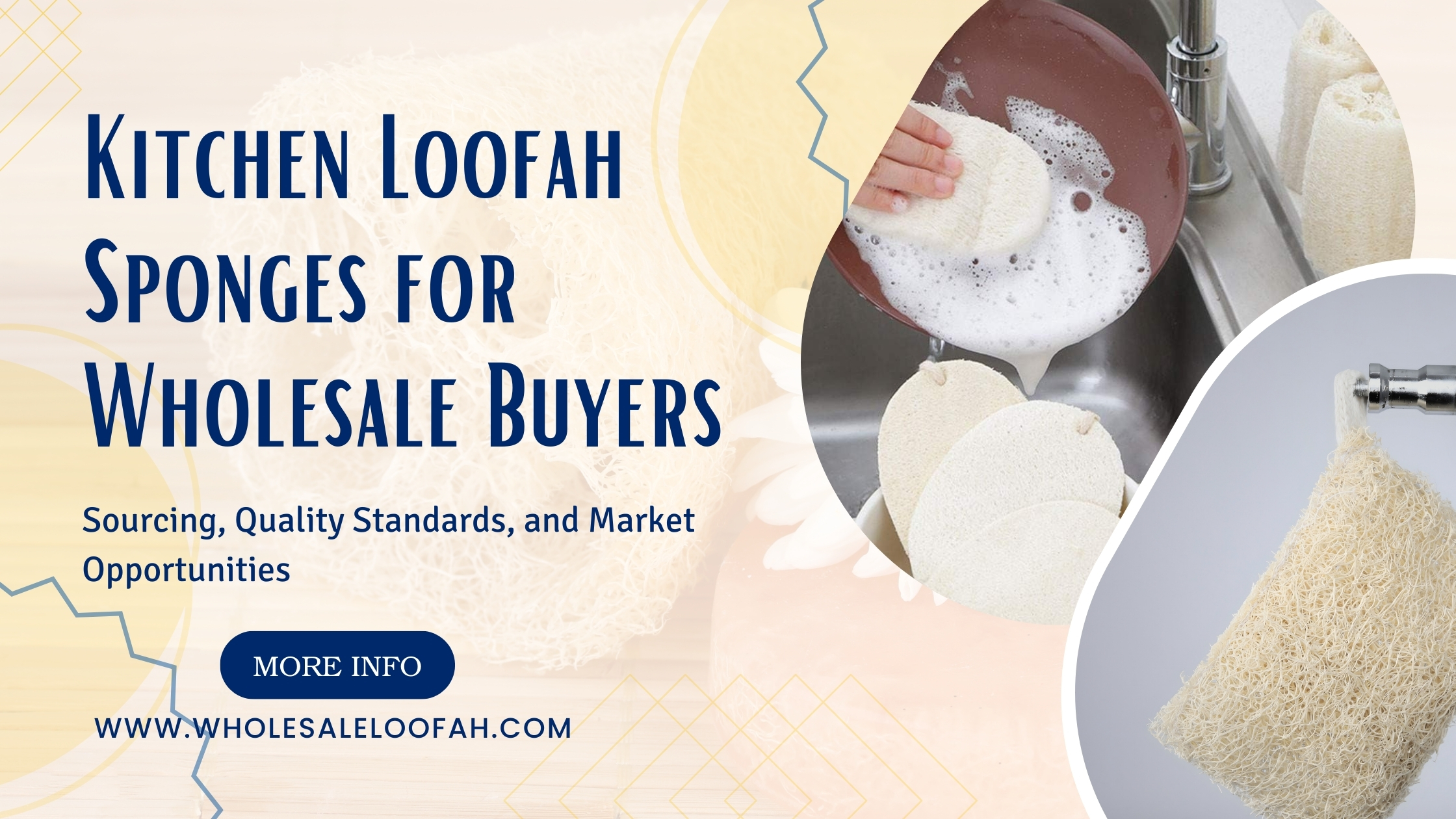
The wholesale market for kitchen loofah sponges has expanded by approximately 23 percent annually over the past three years as retailers respond to consumer demand for sustainable household products. Distributors and importers who establish reliable supply chains now position themselves advantageously in a market segment showing consistent growth across North America, Europe, and emerging economies throughout Asia Pacific regions.
Natural cleaning products represent one of the fastest-growing categories in home goods retail. Kitchen loofah sponges occupy a unique position within this category, offering genuine performance advantages alongside environmental credentials that resonate with contemporary consumers. Unlike many green products requiring consumers to accept compromised functionality, quality loofahs actually outperform synthetic alternatives in durability and cleaning effectiveness.
Wholesale buyers entering this market face important decisions regarding sourcing regions, quality specifications, supplier relationships, and inventory strategies. The difference between profitable operations and disappointing results often comes down to understanding product characteristics that casual observation misses. Egyptian-grown loofahs dominate premium market segments for reasons rooted in agricultural conditions and processing expertise accumulated over generations.
This comprehensive guide addresses the information wholesale buyers need for successful kitchen loofah sponge sourcing. Whether you operate an established distribution business exploring new product lines or launch a focused natural products venture, the following sections provide actionable intelligence for profitable operations.
Understanding the Kitchen Loofah Sponge Wholesale Market
Market dynamics for kitchen loofah sponges reflect broader consumer trends while exhibiting characteristics specific to natural cleaning products. Wholesale buyers benefit from understanding these dynamics when making sourcing and inventory decisions.
Consumer awareness of plastic pollution has driven significant retail interest in biodegradable alternatives to conventional cleaning tools. Kitchen sponges represent a particularly visible target for environmentally motivated consumers since these products require frequent replacement, accumulating substantial waste over time. Natural loofahs address this concern completely, decomposing within 30 to 60 days rather than persisting for centuries.
Retail channels carrying kitchen loofah sponges have expanded beyond specialty natural products stores. Major grocery chains now stock natural cleaning tools in dedicated eco-friendly sections. Home goods retailers feature loofahs prominently in kitchen departments. Online marketplaces report strong search volume growth for sustainable cleaning alternatives, indicating sustained consumer interest.
Market Segmentation and Pricing Tiers
The wholesale market for kitchen loofah sponges segments into distinct tiers based on quality, origin, and processing standards. Understanding these segments helps buyers position inventory appropriately.
See our wholesale prices on egexo.com.
Premium tier products command retail prices supporting healthy margins while economy products compete primarily on price. Most successful distributors maintain inventory across multiple tiers to serve diverse retail customers. However, quality consistency matters more than price positioning for building lasting retailer relationships.
The private label segment offers particularly attractive opportunities for distributors willing to develop branded product lines. Established manufacturers provide private labeling services that allow distributors to build brand equity around quality products. Explore private label manufacturing capabilities at https://egexo.com/private-label-loofah-manufacturing/ for detailed program information.
Growth Projections and Market Drivers
Several factors support continued market expansion for kitchen loofah sponges through the coming years. Wholesale buyers can evaluate these drivers when assessing inventory investment levels.
Regulatory pressure on single-use plastics continues intensifying across major markets. European Union directives restricting certain plastic products create direct opportunities for biodegradable alternatives. Similar regulations advancing through legislative processes in North American jurisdictions suggest expanding compliance-driven demand.
Generational shopping patterns favor natural products as younger consumers enter household formation years. Research consistently shows millennials and Generation Z consumers willing to pay premium prices for sustainable products. As these demographics assume larger shares of household goods purchasing, demand for natural alternatives should continue growing.
Corporate sustainability commitments from major retailers create pull-through demand. Retail chains making public commitments to reduce plastic in their supply chains actively seek suppliers offering compliant alternatives. Distributors positioned with quality natural products benefit from these corporate initiatives.
Sourcing Kitchen Loofah Sponges: Regional Analysis and Supplier Selection
Geographic origin significantly influences kitchen loofah sponge quality, making sourcing decisions among the most consequential for wholesale operations. Different growing regions produce loofahs with measurably different characteristics affecting performance and market positioning.
Egyptian loofahs consistently demonstrate superior fiber density and structural integrity compared to alternatives from other regions. The Nile Valley provides unique growing conditions combining rich alluvial soil, optimal temperature ranges, and humidity levels that produce exceptionally dense fiber networks. Generations of cultivation expertise further enhance quality through refined growing and harvesting practices.
Asian production, primarily from China and Vietnam, offers lower price points but typically lower quality specifications. These products suit economy market segments but rarely meet standards for premium positioning. Quality consistency presents challenges with Asian sourcing as production practices vary widely among farms and processors.
Egyptian Loofah Advantages for Wholesale Buyers
Wholesale buyers targeting premium market segments find Egyptian kitchen loofah sponges offer compelling advantages justifying modestly higher acquisition costs.
| Quality Factor | Egyptian Origin | Asian Origin | Impact on Wholesale Operations |
|---|---|---|---|
| Fiber Density | 40 to 60 percent higher | Baseline | Extended product lifespan, premium pricing support |
| Structural Uniformity | Highly consistent | Variable | Reduced quality complaints, easier grading |
| Processing Standards | Traditional, chemical-minimal | Variable, often bleach-heavy | Cleaner product claims, regulatory compliance |
| Supply Reliability | Established export infrastructure | Fragmented supply chains | Consistent inventory availability |
| Documentation | Export-ready certification | Often requires additional verification | Streamlined customs clearance |
The durability advantage of Egyptian loofahs translates directly into consumer satisfaction and repeat purchasing. Products lasting 40 to 60 percent longer than economy alternatives justify premium retail pricing while delivering genuine value to end users. This value proposition supports retailer relationships better than products competing solely on price.
Egyptian suppliers with established export operations provide documentation and logistics support that simplifies importing. Experienced suppliers understand regulatory requirements across major destination markets and prepare shipments accordingly. This expertise reduces customs delays and compliance complications that can disrupt inventory planning.
For comprehensive information about Egyptian loofah cultivation and export processes, review the detailed documentation at https://egexo.com/loofah-farm-to-export-process/ covering production methods and supply chain practices.
Supplier Evaluation Framework
Systematic supplier evaluation protects wholesale operations from quality inconsistencies and supply disruptions. Applying consistent evaluation criteria across potential suppliers reveals meaningful differences that casual assessment misses.
| Evaluation Criterion | Weight | Assessment Method | Red Flags |
|---|---|---|---|
| Product Quality Consistency | 30 percent | Multiple sample orders over time | Significant variation between samples |
| Communication Responsiveness | 15 percent | Response time tracking | Delays exceeding 48 hours routinely |
| Documentation Accuracy | 15 percent | Cross-reference specifications to delivered product | Discrepancies between specs and reality |
| Shipping Reliability | 15 percent | On-time delivery tracking | Frequent delays or damage |
| Pricing Stability | 10 percent | Historical price tracking | Unexpected increases, unclear pricing |
| Capacity Scalability | 10 percent | Inquiry about volume capabilities | Inability to discuss growth scenarios |
| Industry Reputation | 5 percent | Reference checks, online research | Unresolved complaints, legal issues |
Sample orders before committing to significant quantities allow direct quality assessment. Request samples representing the specific products and grades intended for ongoing orders rather than accepting showcase samples that may not represent typical production. Reputable suppliers accommodate sample requests and view them as normal business practice.
Request samples through established channels at https://egexo.com/request-loofah-samples/ to evaluate product quality before quantity commitments. Sample assessment should include visual inspection, physical testing, and comparison against specifications provided by the supplier.
Quality Grading Systems for Kitchen Loofah Sponges
Understanding quality grading enables wholesale buyers to specify requirements precisely and evaluate deliveries against expectations. While no universal grading standard exists, consistent frameworks help communicate requirements and assess supplier performance.
Fiber density serves as the primary quality determinant for kitchen loofah sponges. Dense fiber structures provide superior scrubbing performance and extended durability. Assessment involves both visual inspection and physical testing of representative samples.
Structural uniformity indicates processing quality and predicts product consistency across inventory. Premium loofahs display even fiber distribution without thin spots, holes, or irregular density variations. Uniformity affects both performance and retail presentation.
Establishing Product Specifications
Wholesale buyers should develop written specifications for each product they source. Clear specifications facilitate supplier communication, simplify receiving inspection, and provide basis for addressing quality disputes.
| Specification Element | Example Standard | Acceptable Variance | Measurement Method |
|---|---|---|---|
| Fiber Density Grade | Grade A, Premium | Plus or minus one grade | Visual and compression testing |
| Dimensions | 12 x 8 x 3 cm | Plus or minus 1 cm | Physical measurement |
| Weight per Unit | 45 grams dry | Plus or minus 5 grams | Scale measurement |
| Color | Natural cream to light tan | Consistent within shipment | Visual comparison to reference |
| Moisture Content | Maximum 12 percent | None above maximum | Moisture meter |
| Defect Rate | Maximum 3 percent | None above maximum | Sample inspection |
Share specifications with suppliers before ordering and reference them in purchase documentation. This practice establishes clear expectations and provides basis for addressing non-conforming deliveries. Suppliers accustomed to wholesale trade expect specification discussions and view them as professional practice.
Detailed quality standards documentation is available at https://egexo.com/loofah-quality-standards/ providing additional specification guidance and industry benchmarks for wholesale buyers establishing quality programs.
Receiving Inspection Procedures
Systematic receiving inspection catches quality issues before non-conforming inventory enters distribution channels. Establishing consistent procedures protects both buyer operations and downstream customer relationships.
Inspection should occur promptly upon delivery while supplier recourse remains available. Document inspection results including photographs of any defects or non-conformances. This documentation supports warranty claims and helps identify patterns suggesting supplier quality control issues.
Sample-based inspection provides practical quality assessment without examining every unit. Statistical sampling methods determine appropriate sample sizes based on shipment quantities and acceptable quality levels. For typical wholesale quantities, inspecting 5 to 10 percent of units provides reasonable confidence while remaining operationally practical.
Maintain inspection records correlating findings with suppliers, shipment dates, and specific product specifications. This historical data reveals quality trends and supports supplier performance discussions. Consistent record-keeping also demonstrates quality management practices that some retail customers require from distributors.
Margin Optimization Strategies for Kitchen Loofah Distribution
Profitable wholesale operations require attention to multiple margin factors beyond simple buy-sell calculations. Successful distributors optimize across sourcing, inventory management, and sales channel dimensions.
Volume consolidation with reliable suppliers typically yields meaningful price improvements. Suppliers offer better pricing for larger orders that improve their production efficiency and shipping economics. However, balance volume pricing against inventory carrying costs and demand uncertainty, particularly when entering new product categories.
Product mix optimization considers margin variation across different items. Kitchen loofah sponges in various configurations yield different margins based on sourcing costs, competitive dynamics, and customer price sensitivity. Analyzing margin contribution by product guides inventory investment decisions.
Cost Structure Analysis
Understanding complete cost structure reveals optimization opportunities beyond purchase price negotiation.
| Cost Element | Typical Range | Optimization Approach |
|---|---|---|
| Product Cost | 40 to 55 percent of selling price | Volume negotiation, supplier competition |
| Freight and Logistics | 8 to 15 percent | Consolidation, carrier negotiation, route optimization |
| Customs and Duties | 3 to 8 percent | Proper classification, trade agreement utilization |
| Warehousing | 5 to 10 percent | Inventory velocity improvement, space efficiency |
| Handling and Fulfillment | 3 to 7 percent | Process efficiency, automation where justified |
| Administrative | 2 to 5 percent | Systems investment, process standardization |
Freight optimization often yields significant savings for internationally sourced products. Consolidating orders to fill containers efficiently reduces per-unit shipping costs substantially compared to less-than-container shipments. Working with freight forwarders experienced in your trade lanes identifies additional optimization opportunities.
Customs classification affects duty rates applicable to imported loofahs. Proper Harmonized System classification ensures appropriate duty treatment while avoiding penalties for misclassification. Consult customs brokers or trade compliance specialists when establishing import programs for unfamiliar product categories.
Inventory Management Considerations
Kitchen loofah sponges present favorable inventory characteristics compared to many wholesale products. Understanding these characteristics supports efficient inventory investment.
Natural loofahs maintain quality during extended storage when kept in appropriate conditions. Unlike perishable goods requiring rapid turnover, properly stored loofahs remain saleable for 18 to 24 months or longer. This storage tolerance provides flexibility in order timing and quantity decisions.
Demand patterns for kitchen cleaning products show relative stability without extreme seasonality. Unlike holiday-driven categories requiring inventory buildup and liquidation cycles, loofah demand remains fairly consistent throughout the year. This stability simplifies inventory planning and reduces obsolescence risk.
However, avoid excessive inventory accumulation despite favorable storage characteristics. Capital tied up in excess inventory reduces operational flexibility and may indicate optimization opportunities in ordering patterns or supplier lead times.
Building Retail Relationships Around Kitchen Loofah Products
Sustainable wholesale operations depend on strong retail customer relationships rather than transactional selling. Kitchen loofah sponges provide foundation for value-added partnerships that benefit both distributors and retailers.
Category expertise differentiates wholesale distributors beyond price competition. Understanding natural products, sustainability trends, and consumer purchasing patterns enables consultative selling that retailers value. Position your organization as a category resource rather than simply an order-taker.
Product education supports retail sell-through and reduces returns. Provide retailers with accurate product information, suggested merchandising approaches, and consumer education materials. This support helps retailers succeed with your products, strengthening ongoing relationships.
Retail Channel Considerations
Different retail channels present distinct requirements and opportunities for kitchen loofah sponge distribution.
| Retail Channel | Buyer Priorities | Margin Expectations | Service Requirements |
|---|---|---|---|
| Natural Products Specialty | Quality credentials, sourcing transparency | Higher margin tolerance | Deep product knowledge, sustainability documentation |
| Mass Market Grocery | Competitive pricing, supply reliability | Aggressive margin targets | High volume capability, promotional support |
| Home Goods Retail | Presentation quality, trend alignment | Moderate margins | Merchandising support, new product pipeline |
| Online Marketplace | Price competitiveness, fulfillment speed | Variable by platform | Rapid shipping, accurate listings |
| Spa and Hospitality | Consistent quality, custom branding | Premium pricing acceptable | Private label capability, reliable supply |
Targeting appropriate channels based on your product positioning and operational capabilities improves success probability. Attempting to serve all channels simultaneously often results in serving none particularly well. Focus initially on channels aligning with your strengths, then expand as capabilities develop.
For comprehensive product information supporting retail relationships, access the complete product catalog at https://egexo.com/wp-content/uploads/2025/08/EGEXO-Loofah-Wholesale-Supplier-Product-Catalog.pdf which provides specifications, imagery, and product details suitable for sharing with retail buyers.
Private Label Program Development
Private label kitchen loofah products offer margin enhancement and competitive differentiation for distributors willing to invest in brand development. Established manufacturers support private label programs with various service levels.
Basic private labeling applies custom packaging and branding to standard products. This approach requires minimal investment while enabling branded product offerings. Suitable for distributors testing private label strategies before deeper commitment.
Custom product development creates differentiated products meeting specific requirements. Dimensions, configurations, packaging formats, and quality specifications can be customized for qualifying order volumes. This approach builds stronger brand differentiation but requires larger commitments.
Private label minimum quantities vary by manufacturer and customization level. Expect minimums ranging from several hundred units for basic labeling to several thousand for custom product development. Discuss program requirements and capabilities at https://egexo.com/private-label-loofah-manufacturing/ to understand available options.
Consumer Trends Informing Wholesale Strategy
Successful wholesale operations anticipate consumer trends rather than simply reacting to current demand. Understanding what drives consumer interest in kitchen loofah sponges helps wholesalers position inventory and marketing appropriately.
Environmental consciousness extends beyond niche demographics into mainstream consumer populations. Surveys consistently show majority consumer preference for sustainable products when quality and price remain reasonable. Kitchen loofahs satisfy this preference without requiring significant behavior change or price premium acceptance.
Health and chemical avoidance concerns motivate some consumer interest in natural products. Consumers questioning synthetic materials in products contacting food preparation surfaces find natural loofahs appealing. Marketing emphasizing natural origin and minimal processing resonates with these consumers.
Emerging Application Opportunities
Kitchen loofah sponge applications continue expanding as consumers and businesses discover new uses. Wholesale buyers can position for emerging opportunities by understanding these trends.
Commercial food service adoption is accelerating as restaurants and institutional kitchens seek sustainable alternatives. Health regulations in some jurisdictions now favor natural materials over synthetic in food contact applications. This commercial segment offers volume opportunities for distributors capable of serving food service channels.
Craft and DIY applications create niche demand for raw and semi-processed loofahs. Makers incorporate loofah material into soap, bath products, and decorative items. While volumes remain modest compared to finished product sales, these applications command premium pricing and connect with engaged consumer communities.
Zero-waste retail concepts built around package-free and sustainable products continue expanding. These retailers seek suppliers aligned with their environmental positioning and capable of providing appropriate packaging or bulk formats. The shop collection at our products page includes various formats suitable for zero-waste retail applications.
Frequently Asked Questions About Wholesale Kitchen Loofah Sponges
Q1: What minimum order quantities should wholesale buyers expect for kitchen loofah sponges?
A: Minimum order quantities for kitchen loofah sponges vary based on supplier scale and product type. Established Egyptian exporters typically accommodate orders starting from 500 to 1,000 units for standard products, with container-load quantities of 10,000 or more units available for volume buyers. Private label orders generally require higher minimums of 2,000 to 5,000 units depending on customization level. Request specific MOQ information during supplier evaluation.
Q2: How do wholesale buyers verify quality consistency across loofah shipments?
A: Implement systematic receiving inspection examining 5 to 10 percent of units against written specifications. Track quality metrics over multiple shipments to identify trends. Request certificates of quality from suppliers and verify documentation matches delivered product. Maintain photographic records of any non-conformances for supplier communication. Established suppliers welcome quality discussions and provide consistent products meeting agreed specifications.
Q3: What profit margins can distributors expect on kitchen loofah sponges?
A: Wholesale margins on kitchen loofah sponges typically range from 25 to 45 percent depending on sourcing efficiency, channel positioning, and value-added services. Premium Egyptian products support higher margins due to quality differentiation. Private label products can achieve 40 to 60 percent margins with successful brand development. Economy products compete on thinner margins but offer volume potential. Overall profitability depends on cost structure optimization beyond gross margin.
Q4: How should imported kitchen loofahs be classified for customs purposes?
A: Kitchen loofah sponges generally classify under Harmonized System codes for vegetable sponges or prepared vegetable materials. Specific classification depends on processing level and country-specific tariff schedules. Consult a licensed customs broker to determine appropriate classification for your destination market. Proper classification avoids duty assessment errors and potential penalties while ensuring any applicable trade preferences are captured.
Q5: What documentation should wholesale buyers request from loofah suppliers?
A: Request product specifications sheets with dimensions, weights, and quality grade definitions. Obtain certificates of origin for customs purposes and quality certifications relevant to your market. For food contact applications, request food safety compliance documentation. Phytosanitary certificates may be required depending on destination country regulations. Established exporters maintain standard documentation packages for major markets.
Q6: How do wholesale buyers evaluate Egyptian versus Asian loofah suppliers?
A: Evaluate suppliers on quality consistency, communication responsiveness, documentation accuracy, and pricing competitiveness. Egyptian suppliers typically offer superior product quality with denser fibers and better structural uniformity. Asian suppliers offer lower prices suitable for economy market segments. Request samples from multiple sources and conduct side-by-side quality comparisons. Consider total cost including freight, duties, and potential quality-related costs rather than unit price alone.
Q7: What storage conditions maintain kitchen loofah quality during warehousing?
A: Store kitchen loofah sponges in dry conditions with relative humidity below 60 percent. Avoid direct sunlight which may cause discoloration over time. Maintain temperatures between 15 and 30 degrees Celsius. Keep products in original packaging until distribution to protect from dust and handling damage. Under proper conditions, natural loofahs maintain quality for 18 to 24 months or longer, providing inventory management flexibility.
Expert Insight from EGEXO
Wholesale buyers often underestimate how growing conditions affect kitchen loofah sponge performance in ways that matter to end consumers. EGEXO has been exporting Egyptian loofah since 2015. Products grown quickly in suboptimal conditions may look similar initially but fail faster under daily kitchen demands. We recommend wholesale buyers request durability testing data alongside visual quality grades when evaluating suppliers. Compression recovery testing reveals structural differences invisible to casual inspection. Products maintaining 85 percent or better compression recovery after testing typically deliver the extended lifespan that justifies premium positioning. Contact our wholesale team through https://egexo.com/get-quotation-loofah-wholesale/ for detailed quality specifications and testing protocols that differentiate commodity sourcing from premium supply partnerships.
Conclusion
The wholesale market for kitchen loofah sponges presents genuine opportunity for distributors recognizing growing consumer demand for sustainable household products. Success requires attention to sourcing quality, supplier relationships, and market positioning rather than competing solely on price in commodity fashion.
Egyptian-origin loofahs consistently deliver the quality characteristics supporting premium market positioning. Superior fiber density translates into extended product lifespan that justifies higher retail prices while delivering genuine consumer value. Wholesale buyers establishing reliable Egyptian supply relationships position themselves advantageously in growing market segments.
Systematic approaches to supplier evaluation, quality specification, and receiving inspection protect wholesale operations from inconsistencies that damage retailer relationships. Investment in quality management practices yields returns through reduced complaints, stronger customer retention, and margin protection.
Key Takeaways:
- Kitchen loofah sponge market growth of approximately 23 percent annually creates expanding wholesale opportunities
- Egyptian loofahs command premium positioning due to 40 to 60 percent higher fiber density than alternatives
- Wholesale margins ranging from 25 to 45 percent support profitable distribution operations
- Systematic supplier evaluation and quality management protect operational performance
- Private label programs offer margin enhancement and competitive differentiation opportunities
Ready to establish your kitchen loofah supply chain?
- For Wholesale Quotations: Request custom pricing at https://egexo.com/get-quotation-loofah-wholesale/ with volume requirements and specifications
- For Product Evaluation: Order samples at https://egexo.com/request-loofah-samples/ to assess quality before quantity commitments
- For Complete Information: Download the product catalog at https://egexo.com/wp-content/uploads/2025/08/EGEXO-Loofah-Wholesale-Supplier-Product-Catalog.pdf