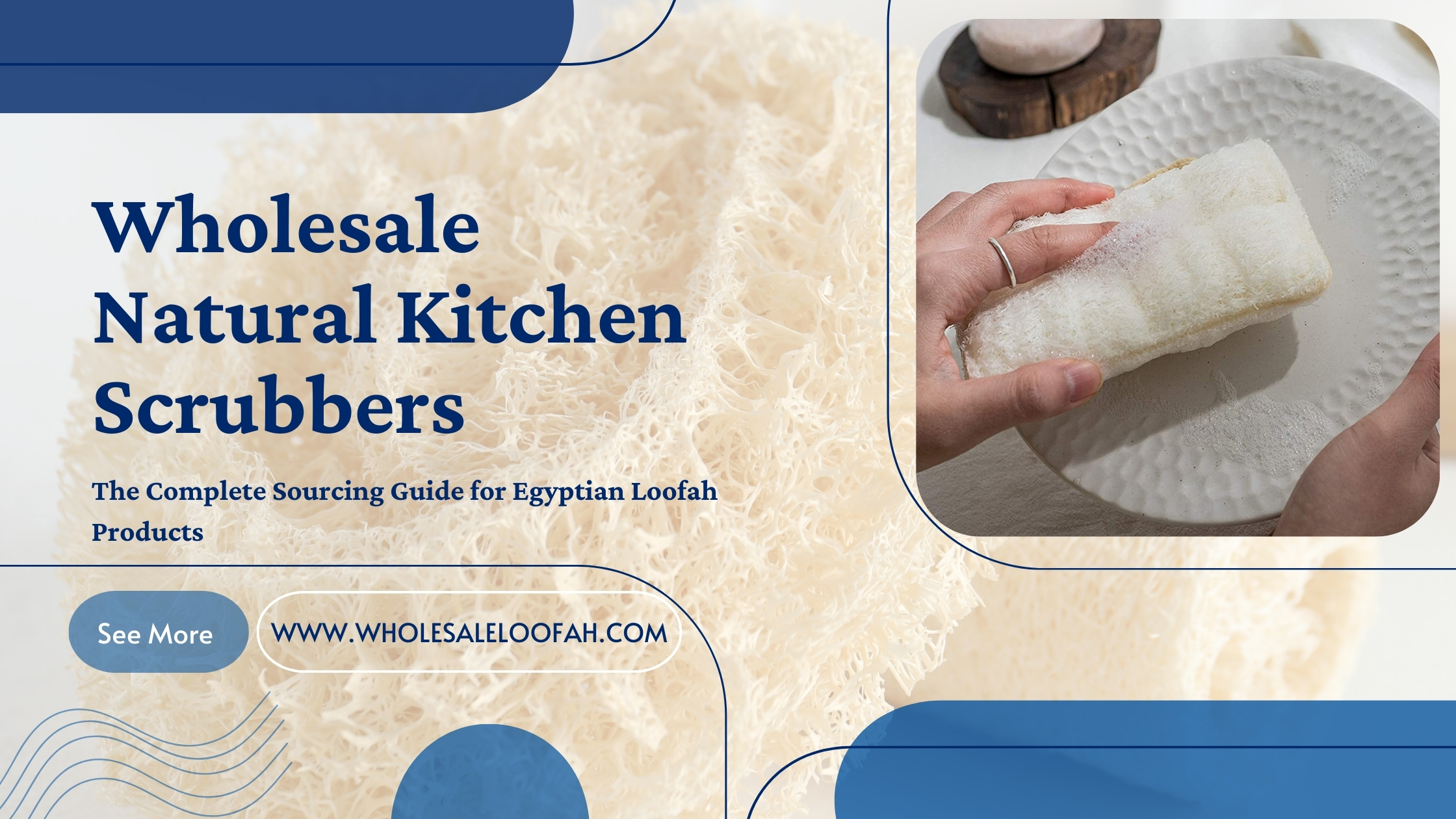
The sustainable cleaning products market has entered a period of accelerated growth, with natural kitchen scrubbers emerging as a standout category for retailers and distributors seeking profitable inventory additions. Consumer demand for plastic-free alternatives continues climbing, creating consistent purchasing patterns that savvy businesses are capturing through strategic wholesale relationships with quality suppliers.
Egyptian loofahs provide a superior cleaning experience that differentiates them from competing natural products and synthetic alternatives alike. For wholesale buyers, this quality distinction translates directly into customer satisfaction, repeat purchases, and sustainable margin performance. Understanding the wholesale landscape for these products enables informed sourcing decisions that support long-term business success.
This comprehensive guide addresses the specific needs of wholesale buyers evaluating natural kitchen scrubber opportunities. From supplier qualification criteria to inventory planning strategies, the information presented here supports procurement professionals, retail buyers, and distributors in developing effective sourcing approaches for Egyptian loofah products.
Understanding the Wholesale Natural Scrubber Market Opportunity
Before committing procurement resources to any product category, business buyers require clear understanding of market dynamics, demand drivers, and competitive positioning. The natural kitchen scrubber segment offers compelling fundamentals that justify serious evaluation by growth-oriented businesses.
Market Size and Growth Trajectory
The global market for natural and sustainable cleaning products has expanded consistently over the past decade, with acceleration occurring as environmental awareness reaches mainstream consumer consciousness. Natural scrubbers and sponges represent a particularly dynamic segment within this broader category, driven by the combination of environmental benefits and functional superiority.
Market research indicates double-digit annual growth rates for natural cleaning tool categories in major retail markets. This expansion reflects shifting consumer preferences rather than temporary trends, suggesting sustained demand that supports long-term inventory investments. Businesses establishing supplier relationships and customer bases now position themselves advantageously for continued market development.
The following table summarizes key market indicators relevant to wholesale buying decisions:
| Market Indicator | Current Status | Trend Direction | Business Implication |
|---|---|---|---|
| Consumer awareness of plastic pollution | High and increasing | Upward | Growing demand for alternatives |
| Willingness to pay premium for sustainable products | 15 to 30 percent above conventional | Stable to increasing | Supports healthy margins |
| Retail channel adoption | Mainstream penetration occurring | Expanding | Broader distribution opportunities |
| Competitive intensity | Moderate | Increasing gradually | First-mover advantages available |
| Supply chain maturity | Developing | Improving | Quality suppliers emerging |
| Regulatory environment | Increasingly favorable | Strengthening | Tailwinds for natural products |
These indicators collectively suggest favorable conditions for businesses entering or expanding in the natural kitchen scrubber category. The combination of strong demand, acceptable margins, and manageable competition creates opportunity for well-executed wholesale strategies.
Consumer Segments Driving Demand
Wholesale buyers benefit from understanding end-consumer profiles to inform inventory selection, marketing approaches, and retail partner targeting. Natural kitchen scrubber demand spans multiple consumer segments with distinct characteristics and purchasing behaviors.
Environmentally motivated consumers represent the core demand driver, actively seeking plastic-free alternatives across household categories. This segment demonstrates strong brand loyalty, willingness to pay premium prices, and tendency to expand purchases across product lines from trusted suppliers. Reaching this segment requires authentic sustainability credentials and transparent sourcing.
Health-conscious households increasingly recognize connections between product materials and family wellbeing. Concerns about chemical residues from synthetic products and microplastic contamination drive interest in natural alternatives. This segment values product purity and responds to messaging emphasizing chemical-free, natural composition.
Quality-seeking consumers discover natural loofahs through performance rather than environmental motivation. Egyptian loofahs provide a superior cleaning experience that converts skeptics through direct use. Once experienced, the functional advantages create ongoing preference regardless of environmental considerations.
Premium lifestyle consumers incorporate sustainable products into broader lifestyle choices that emphasize quality, authenticity, and conscious consumption. This segment frequents specialty retailers, responds to premium positioning, and provides higher margin opportunities.
Understanding these segments helps wholesale buyers select appropriate product assortments, identify promising retail partners, and develop effective positioning strategies for different market channels.
Why Egyptian Origin Matters for Wholesale Buyers
Geographic origin significantly impacts natural loofah quality, and this quality differential carries meaningful implications for wholesale purchasing decisions. Egyptian loofahs consistently outperform alternatives from other cultivation regions, creating competitive advantages for businesses that source appropriately.
Cultivation Advantages of the Nile Delta Region
The Nile Delta provides uniquely favorable conditions for loofah cultivation that cannot be replicated elsewhere. Centuries of agricultural refinement combined with ideal environmental factors produce loofahs with characteristics that distinguish them from products grown in other regions.
Soil composition in the Nile Delta reflects millennia of sediment deposition carrying mineral-rich material from throughout the Nile watershed. These nutrients support robust plant development and dense cellular structures that translate into superior fiber characteristics in finished loofahs.
Climate consistency throughout the growing season allows uniform maturation across entire crops. Temperature fluctuations stress plants and create fiber irregularities that compromise product quality. The stable conditions in Egyptian growing regions prevent these quality issues.
Traditional cultivation knowledge passed through generations of farming families ensures optimal practices at every stage from planting through harvest. This expertise addresses timing, technique, and quality selection in ways that newer cultivation regions have not developed.
The farm to export process maintained by established Egyptian suppliers preserves these cultivation advantages through careful post-harvest handling. Proper drying, processing, and storage procedures ensure that quality developed in the field reaches wholesale buyers intact.
Quality Differential Impact on Business Performance
The quality advantages of Egyptian loofahs translate directly into business performance metrics that matter for wholesale operations.
| Business Metric | Egyptian Loofah Impact | Alternative Product Impact | Net Advantage |
|---|---|---|---|
| Customer satisfaction ratings | Higher due to performance | Moderate, variable quality | Positive |
| Return and complaint rates | Lower | Higher | Cost savings |
| Repeat purchase rates | Higher | Lower | Revenue stability |
| Word-of-mouth referrals | More frequent | Less frequent | Marketing value |
| Margin sustainability | Premium pricing justified | Price pressure | Profitability |
| Inventory turnover | Consistent | Variable | Cash flow |
| Supplier reliability | Established chains | Less developed | Operational |
These advantages compound over time as customer relationships develop and reputation builds. Businesses that establish themselves as sources for quality Egyptian products create competitive positions that resist price-based competition from inferior alternatives.
For retailers evaluating supplier options, requesting specific information about Egyptian origin, cultivation practices, and quality control procedures identifies suppliers committed to authentic quality rather than simply claiming premium positioning.
Evaluating Wholesale Suppliers: Critical Selection Criteria
Successful wholesale relationships depend on identifying suppliers capable of consistent quality, reliable delivery, competitive pricing, and responsive service. Applying systematic evaluation criteria to potential suppliers prevents costly mistakes and identifies partners worthy of long-term commitment.
Quality Assurance and Consistency Standards
Quality consistency across orders represents perhaps the most critical supplier capability for wholesale buyers building customer relationships based on product performance. Variable quality frustrates customers, generates complaints, and undermines the premium positioning that justifies healthy margins.
Qualified suppliers demonstrate documented quality control procedures applied consistently to all shipments. These procedures should address raw material selection, processing standards, inspection protocols, and packaging requirements. Requesting documentation of these procedures during supplier evaluation reveals operational sophistication and commitment to consistency.
Sample evaluation before committing to significant orders provides direct evidence of quality levels. Reputable suppliers readily provide samples that accurately represent standard production quality rather than cherry-picked exceptional examples. The sample request process offered by established suppliers facilitates this evaluation step.
Physical quality indicators that wholesale buyers should assess include fiber density throughout the loofah body, structural integrity under compression testing, color consistency within acceptable natural variation, absence of damage or deterioration, and appropriate moisture content indicating proper drying and storage.
Supply Chain Reliability and Capacity
Inventory availability when customer demand requires represents a fundamental supplier capability. Stockouts frustrate customers, damage retailer relationships, and create revenue losses that exceed the cost of maintaining appropriate inventory levels.
Established suppliers with direct relationships to cultivation sources provide more reliable supply chains than intermediaries dependent on third-party sourcing. Ask potential suppliers about their sourcing relationships, inventory management practices, and capacity to fulfill orders during peak demand periods.
Geographic considerations affect lead times and shipping costs. Suppliers with warehouse facilities in destination markets or efficient logistics arrangements provide faster fulfillment and potentially lower delivered costs. Understanding the complete supply chain from farm to delivery helps evaluate total cost and reliability.
The following framework guides supply chain evaluation:
| Evaluation Factor | Questions to Ask | Favorable Indicators |
|---|---|---|
| Sourcing relationships | Direct farm partnerships or intermediaries? | Direct relationships, long-term contracts |
| Inventory practices | Stock levels, reorder triggers, safety stock? | Adequate buffers, systematic management |
| Capacity constraints | Maximum order size, lead time for large orders? | Scalable capacity, reasonable lead times |
| Logistics arrangements | Shipping methods, carrier relationships, tracking? | Multiple options, established carriers |
| Contingency planning | Backup sources, disruption response procedures? | Documented alternatives, clear protocols |
| Communication practices | Order status updates, issue notification? | Proactive communication, responsive contact |
Suppliers who cannot provide clear, confident answers to these questions may lack the operational maturity necessary for reliable wholesale partnerships.
Pricing Structure and Total Cost Analysis
Wholesale pricing evaluation extends beyond simple unit cost comparison to encompass all factors affecting total cost of goods and margin performance. Sophisticated buyers analyze complete cost structures when evaluating supplier options.
Unit pricing typically follows volume-based tiers with better rates for larger orders. Understanding tier breakpoints helps optimize order quantities to capture favorable pricing without overcommitting inventory investment. Request complete pricing schedules showing all volume levels and any minimum order requirements.
Shipping costs vary significantly based on supplier location, shipping method, and order size. Some suppliers include shipping in quoted prices while others add these costs separately. Ensure pricing comparisons use consistent delivered cost calculations rather than potentially misleading FOB or ex-works quotations.
Payment terms affect cash flow and financing costs. Standard terms range from prepayment requirements for new accounts to net-30 or longer for established relationships. Negotiating favorable terms as relationships develop improves working capital efficiency.
Quality-related costs including returns, replacements, and customer service time should factor into supplier comparisons even though they do not appear in quoted prices. Lower-priced suppliers with higher quality variability may prove more expensive after accounting for these hidden costs.
The quotation request process enables detailed pricing discussions that address all relevant cost factors for accurate supplier comparison.
Product Assortment Strategy for Wholesale Buyers
Effective wholesale purchasing requires strategic assortment decisions that balance breadth of offering against inventory investment efficiency. Understanding product categories, sizing options, and customization possibilities informs these decisions.
Core Product Categories
Natural loofah products span multiple categories suitable for different retail channels and consumer applications. Wholesale buyers should evaluate which categories align with their market positioning and customer expectations.
| Product Category | Primary Applications | Retail Channel Fit | Margin Profile |
|---|---|---|---|
| Kitchen scrubbers | Dishwashing, surface cleaning | Mass, specialty, online | Moderate to good |
| Bath and body loofahs | Personal care, exfoliation | Bath, beauty, spa | Good to excellent |
| Pet grooming products | Animal bathing, coat care | Pet specialty, general | Good |
| Spa and wellness items | Professional treatments | Spa supply, wellness | Excellent |
| Raw loofah materials | Custom product creation | Craft, manufacturing | Variable |
| Gift sets and bundles | Gifting, trial introduction | Gift, specialty | Excellent |
The kitchen loofah category represents the highest volume opportunity for most wholesale buyers, with consistent repeat purchase patterns and broad retail channel applicability. Starting with kitchen products and expanding into adjacent categories as customer relationships develop provides a logical growth path.
Specialty categories including natural pet loofah products and spa items offer higher margins but smaller market sizes. These categories suit specialty retailers targeting specific customer segments rather than mass-market distribution.
Size and Format Options
Within each product category, multiple size and format options address different consumer preferences and use cases. Offering appropriate variety improves customer satisfaction while avoiding excessive SKU proliferation that complicates inventory management.
Kitchen scrubbers typically range from small units around three to four inches suitable for detail work, through medium sizes of four to six inches appropriate for general use, to large formats of six to eight inches preferred for commercial applications or consumers with larger hands. Medium sizes serve most consumer needs and should anchor kitchen scrubber assortments.
Format variations include whole loofah pieces, cut slices, shaped products, and combination items incorporating loofah with other materials. Simpler formats typically offer better margins while specialty formats command premium prices but require more inventory investment per unit.
Understanding target customer preferences guides assortment decisions. Specialty eco-retailers may benefit from broader variety showcasing the range of natural loofah applications, while mass-market channels typically perform best with focused assortments of highest-velocity items.
Private Label and Customization Opportunities
Wholesale buyers seeking brand differentiation rather than commodity competition should explore private label and customization capabilities offered by quality suppliers.
Private label manufacturing enables businesses to market Egyptian loofah products under their own brand identity rather than supplier brands. This approach supports brand building, customer loyalty development, and protection against supplier switching by competitors. Private label arrangements typically require minimum order commitments but provide significant strategic advantages for businesses prioritizing long-term market position.
Custom product design services allow development of unique product configurations tailored to specific market needs or brand positioning. Custom shapes, sizes, packaging, and bundled offerings differentiate wholesale buyers from competitors offering only standard products. These options suit businesses with clearly defined customer needs that standard products do not fully address.
Customization typically requires larger minimum orders and longer lead times than standard products. Evaluate customization opportunities against volume projections and strategic priorities before committing to custom development programs.
Building Effective Wholesale Relationships
Beyond initial supplier selection, developing productive long-term relationships optimizes value from wholesale partnerships. Understanding relationship dynamics and best practices supports ongoing success.
Communication and Coordination Practices
Effective communication prevents problems, resolves issues efficiently, and identifies opportunities for mutual benefit. Establishing clear communication patterns early in supplier relationships creates foundations for productive ongoing partnership.
Designate specific contacts for different interaction types including order placement, quality issues, billing questions, and strategic discussions. Clear responsibility assignment prevents confusion and ensures appropriate expertise addresses each situation.
Regular business reviews with key suppliers assess relationship performance, discuss market developments, and identify improvement opportunities. Quarterly reviews suit most wholesale relationships, with more frequent contact during initial relationship establishment or when addressing specific issues.
Proactive information sharing benefits both parties. Wholesale buyers should communicate demand forecasts, promotional plans, and market feedback to suppliers. Suppliers should share production schedules, quality improvements, and new product developments with customers. This mutual transparency supports planning and strengthens partnerships.
Order Management Optimization
Systematic order management practices improve efficiency, reduce errors, and optimize inventory investment. Developing consistent procedures for order planning, placement, and receipt creates operational advantages.
Demand forecasting provides the foundation for order planning. Analyze historical sales patterns, promotional calendars, and market trends to project future requirements. More accurate forecasts enable better order timing and quantity decisions that balance availability against inventory carrying costs.
Order timing should consider lead times, shipping schedules, and seasonal demand patterns. Placing orders to arrive before anticipated demand increases ensures availability while avoiding rush shipping costs. Regular ordering schedules simplify planning for both buyer and supplier.
Receiving procedures should include quantity verification, quality inspection, and documentation completion. Identifying issues immediately upon receipt enables timely resolution and maintains supplier accountability for quality and accuracy.
The following table outlines recommended order management practices:
| Practice Area | Recommended Approach | Benefit |
|---|---|---|
| Demand forecasting | Monthly projections, quarterly reviews | Improved order accuracy |
| Safety stock levels | 2 to 4 weeks coverage depending on lead time | Stockout prevention |
| Order frequency | Regular schedule matching demand velocity | Planning efficiency |
| Minimum order optimization | Consolidate to capture volume discounts | Cost reduction |
| Quality inspection | Sample checking on receipt | Issue identification |
| Documentation | Complete records of all orders and receipts | Dispute resolution, analysis |
Performance Monitoring and Supplier Accountability
Ongoing supplier performance monitoring ensures continued quality and identifies issues requiring attention before they significantly impact business operations.
Key performance indicators for supplier monitoring include order accuracy rate, on-time delivery percentage, quality acceptance rate, issue resolution time, and communication responsiveness. Tracking these metrics provides objective basis for performance discussions and supplier comparisons.
Quality tracking should document any defects or inconsistencies identified during receiving inspection or through customer feedback. Patterns in quality issues indicate systemic problems requiring supplier attention. Share quality data with suppliers regularly to support their improvement efforts.
Address performance issues promptly and directly. Most issues result from operational lapses rather than supplier disregard and respond well to clear communication and collaborative problem-solving. Persistent issues despite good-faith resolution efforts may indicate need to evaluate alternative suppliers.
Financial Planning for Wholesale Loofah Inventory
Sound financial planning supports profitable wholesale operations. Understanding margin structures, inventory investment requirements, and cash flow implications enables informed business decisions.
Margin Analysis and Pricing Strategy
Wholesale natural kitchen scrubbers support attractive margin structures when properly positioned and sourced. Understanding cost components and pricing dynamics guides profitable strategy development.
Cost of goods includes product cost, shipping, duties if applicable, and any quality-related costs such as returns or replacements. Calculate complete landed cost per unit for accurate margin analysis rather than relying on supplier quoted prices alone.
Retail pricing for natural loofah products varies significantly based on channel, positioning, and competitive environment. Specialty eco-retailers successfully command premium prices reflecting quality and values alignment. Mass-market channels require more competitive pricing but benefit from higher volume potential.
The following table illustrates typical margin structures across different scenarios:
| Scenario | Wholesale Cost Range | Typical Retail Price | Gross Margin Range |
|---|---|---|---|
| Premium specialty retail | $1.50 to $3.00 | $6.00 to $12.00 | 50 to 75 percent |
| Mid-market retail | $1.00 to $2.00 | $4.00 to $7.00 | 45 to 65 percent |
| Mass market retail | $0.75 to $1.50 | $3.00 to $5.00 | 40 to 55 percent |
| Online direct | $1.25 to $2.50 | $5.00 to $10.00 | 50 to 70 percent |
| Wholesale distribution | $0.50 to $1.25 | $1.50 to $3.00 | 30 to 45 percent |
These ranges indicate healthy margin potential across distribution models. Actual margins depend on specific sourcing costs, volume levels, and competitive positioning.
Inventory Investment and Turnover Optimization
Inventory investment represents significant working capital commitment requiring careful management. Balancing adequate stock availability against excessive inventory carrying costs optimizes financial performance.
Calculate inventory investment requirements by multiplying average inventory quantity by landed cost per unit. Target inventory levels should consider sales velocity, lead times, and acceptable stockout risk. Higher-velocity items justify larger inventory investments while slower-moving specialty items warrant more conservative stocking.
Inventory turnover measures how efficiently inventory investment generates sales. Calculate turnover by dividing annual cost of goods sold by average inventory value. Higher turnover indicates more efficient inventory utilization and better return on inventory investment.
Industry benchmarks suggest 6 to 12 annual inventory turns as reasonable targets for consumer products distribution. Natural loofah products with stable demand and reasonable shelf life should achieve turnover within or above this range with proper inventory management.
Strategies for improving inventory turnover include more accurate demand forecasting, optimized order quantities and timing, promotion of slow-moving items, and discontinuation of persistently slow sellers. Regular inventory analysis identifies opportunities for turnover improvement.
Getting Started with Wholesale Loofah Sourcing
Businesses ready to explore wholesale natural kitchen scrubber opportunities benefit from systematic approach to initial supplier engagement and relationship development.
Initial Supplier Engagement Steps
Begin supplier evaluation by researching potential partners and gathering preliminary information. Review supplier websites, product catalogs, and available documentation to assess apparent capabilities and fit with your requirements.
The product catalog available from established Egyptian suppliers provides detailed product information supporting initial evaluation. Review catalog contents to understand product range, specifications, and presentation quality.
Request samples from promising suppliers to evaluate product quality directly. Sample assessment should apply the quality criteria discussed earlier including fiber density, structural integrity, and overall condition. Compare samples from multiple suppliers to calibrate quality expectations.
Obtain detailed quotations addressing complete cost structure including unit pricing at various volume levels, shipping options and costs, payment terms, and minimum order requirements. The quotation request process facilitates obtaining comprehensive pricing information.
Building from Initial Orders to Ongoing Partnership
Initial orders should balance meaningful quantity against appropriate risk limitation while relationship develops. Order sufficient volume to evaluate supplier performance across multiple quality and service dimensions while limiting financial exposure during the learning period.
Document supplier performance systematically from the first order. Track delivery timing, order accuracy, product quality, and communication responsiveness. This documentation supports informed decisions about relationship expansion or supplier alternatives.
Provide feedback to suppliers about their performance and your market experience. Suppliers value customer input for their own improvement efforts and recognize engaged customers as priority relationships worthy of enhanced service and attention.
Expand order volumes as supplier performance confirms capabilities and market demand validates product potential. Gradual scaling allows operational adjustment and limits risk exposure during relationship development.
Expert Insight from WholesaleLoofah
Our experience supporting wholesale buyers across diverse retail channels confirms the viability of natural kitchen scrubbers as a profitable inventory category. Businesses that approach this market with quality-focused sourcing and appropriate positioning consistently achieve satisfactory results.
The key success factor we observe is commitment to authentic Egyptian quality rather than pursuit of lowest cost sourcing. Egyptian loofahs provide a superior cleaning experience that customers recognize and reward with repeat purchases and referrals. This quality foundation supports premium positioning and healthy margins that lower-cost alternatives cannot sustain.
For businesses new to natural product sourcing, we recommend starting with core kitchen scrubber products in medium sizes that serve broad customer needs. Establish supplier relationships, validate market response, and develop operational capabilities before expanding into specialty categories or custom products.
The resources available through WholesaleLoofah.com and Egexo.com support wholesale buyers throughout their sourcing journey from initial evaluation through ongoing partnership optimization.
Frequently Asked Questions
What minimum order quantities apply for wholesale natural kitchen scrubbers?
Minimum order quantities vary by supplier and product type but typically range from 100 to 500 units for standard products. Some suppliers offer lower minimums for sample orders or initial evaluation purchases. Custom and private label products generally require higher minimums, often 1,000 units or more, to justify setup costs. Discuss specific requirements with potential suppliers during the quotation process to understand minimums for your intended product mix.
How do Egyptian loofahs provide a superior cleaning experience compared to alternatives?
Egyptian loofahs provide a superior cleaning experience through fiber characteristics developed under ideal Nile Delta cultivation conditions. The combination of mineral-rich soil, consistent climate, and generations of farming expertise produces uniquely dense fiber structures with exceptional durability and optimal scrubbing texture. These fibers adapt to surface contours, remove stubborn residues effectively, and maintain cleaning performance through months of use rather than degrading quickly like lower-quality alternatives or synthetic products.
What quality certifications should wholesale buyers look for?
Quality certifications relevant to natural loofah products include organic certification for pesticide-free cultivation, fair trade certification for ethical sourcing practices, and various environmental certifications indicating sustainable production. However, certifications vary in rigor and relevance. Direct quality assessment through sample evaluation often provides more meaningful quality assurance than relying solely on certifications. Ask suppliers about their quality standards and verification procedures regardless of formal certification status.
How should wholesale buyers handle quality issues with supplier shipments?
Address quality issues promptly through established communication channels with your supplier. Document issues thoroughly with photographs and detailed descriptions. Quality-focused suppliers typically respond constructively to legitimate quality concerns and offer appropriate remedies including replacements, credits, or refunds depending on issue severity. Patterns of recurring quality issues despite good-faith resolution efforts may indicate need to evaluate alternative suppliers. Systematic quality tracking supports both immediate issue resolution and long-term supplier performance assessment.
What lead times should wholesale buyers expect for Egyptian loofah orders?
Lead times depend on order size, product availability, and shipping method selected. Standard orders from stocked inventory typically ship within one to two weeks with transit times varying by destination. Larger orders requiring production scheduling may require four to eight weeks total lead time. Custom and private label orders require additional time for design, approval, and production setup. Discuss specific lead time expectations during supplier evaluation and build appropriate buffers into your ordering schedule to maintain inventory availability.
Can wholesale buyers request custom packaging or private labeling?
Yes, many Egyptian loofah suppliers offer private label manufacturing and custom packaging services for wholesale buyers seeking brand differentiation. These services typically require minimum order commitments to justify setup costs but provide significant benefits for brand building and competitive positioning. Discuss customization capabilities and requirements during supplier evaluation to understand options available and associated terms.
How do wholesale buyers assess potential demand for natural kitchen scrubbers?
Demand assessment should consider multiple factors including target market characteristics, competitive environment, and distribution channel dynamics. Research consumer trends in your market regarding sustainability preferences and natural product adoption. Evaluate competitor offerings and positioning to identify market gaps or differentiation opportunities. Consider test marketing through limited initial orders to gauge actual customer response before committing to larger inventory investments. Market data from industry associations and trade publications provides additional context for demand estimation.
Conclusion
Wholesale natural kitchen scrubbers represent a compelling business opportunity supported by strong consumer demand trends, favorable margin structures, and available quality supply from Egyptian sources. Success in this category requires thoughtful supplier selection, strategic assortment decisions, and systematic relationship management that ensures consistent quality and reliable availability.
Egyptian loofahs provide a superior cleaning experience that justifies premium positioning and supports sustainable margin performance. For wholesale buyers committed to quality sourcing, this product category offers attractive returns with manageable operational complexity.
Key Takeaways:
- Market fundamentals favor continued growth in natural cleaning product demand
- Egyptian origin provides meaningful quality advantages that impact business performance
- Systematic supplier evaluation prevents costly sourcing mistakes
- Strategic assortment balances variety against inventory efficiency
- Effective relationship management optimizes long-term partnership value
Ready to explore wholesale natural kitchen scrubber opportunities?
- Request a detailed quotation for your specific requirements
- Order samples to evaluate product quality directly
- Download the product catalog for complete product information
- Browse the full product range to explore available options
Contact our wholesale team at WholesaleLoofah.com to discuss your specific sourcing needs and begin developing a productive supplier partnership.