That growth is driven by one simple reality: consumers across every market segment are moving toward natural, sustainable skincare tools, and the loofah is leading that shift.
At the center of the consumer experience is a question that determines whether a customer becomes loyal or dissatisfied: does this loofah remove dead skin effectively without causing irritation? The answer depends almost entirely on product quality and user technique, two factors that wholesale buyers and individual consumers need to understand from different angles but toward the same outcome.
This guide bridges both perspectives. Consumers get a complete, science-backed technique guide for gentle, effective dead skin removal. Wholesale buyers get quality specification data, supplier evaluation criteria, and market insight that helps them stock the right products with confidence.
Egyptian loofah, particularly the variety cultivated in the Nile Delta and exported by specialists like Egexo, sets the global benchmark for natural loofah quality. Understanding what makes it superior shapes better decisions at every level of the supply chain.
The Biology of Dead Skin: Why Removal Matters
Human skin regenerates on a cycle of approximately 28 days in young adults, extending to 40 to 60 days as the body ages. During this cycle, new skin cells form in the deepest epidermal layer and gradually migrate outward, becoming progressively flatter and more keratinized until they reach the surface as dead cells in the stratum corneum.
Under ideal conditions, those dead cells shed naturally. Under real conditions, they accumulate. Dry air, UV exposure, hormonal fluctuation, and the simple slowdown that comes with age all reduce the rate of natural shedding. The result is a thickened outer layer that blocks moisturizer absorption, dulls skin tone, and contributes to clogged follicles.
Loofah exfoliation, done correctly, restores the natural rate of surface turnover without the chemical load of AHA or BHA treatments.
When Exfoliation Helps Most
| Skin Concern | How Loofah Exfoliation Helps | Recommended Frequency |
|---|---|---|
| Dull, uneven skin tone | Removes light-scattering dead cell layer | 2-3 times weekly |
| Clogged pores / body acne | Clears follicle openings, reduces bacterial load | 2-3 times weekly |
| Keratosis pilaris | Breaks up keratin plugs in follicles | 2-3 times weekly |
| Ingrown hairs | Lifts trapped hair ends above skin surface | 3 times weekly, around hair removal |
| Dry, flaky patches | Removes flaking layer, improves moisturizer absorption | 1-2 times weekly |
| Pre-self-tan preparation | Ensures even tanning agent absorption | 24-48 hours before application |
| General circulation support | Mechanical action stimulates surface blood flow | 2-4 times weekly |
Understanding which skin concerns loofah exfoliation addresses, and how often, is useful both for consumer education and for retail product positioning.
Sourcing the Right Loofah: What Quality Really Means
For buyers sourcing loofah for retail, spa supply, or private label production, quality is not a vague concept. It is a set of measurable specifications that directly predict end-user satisfaction rates and return rates.
Egyptian Loofah vs Other Origins
| Quality Factor | Egyptian Loofah (Nile Delta) | Southeast Asian Loofah | Latin American Loofah |
|---|---|---|---|
| Fiber Density | 120-150 per cm2 | 70-100 per cm2 | 80-110 per cm2 |
| Fiber Uniformity | High (consistent distribution) | Low-Moderate | Moderate |
| Natural Color | Pale ivory to light yellow | Varies, often darker | Varies |
| Growing Season Length | 9-10 months | 6-7 months | 7-8 months |
| Fiber Resilience | High, durable | Lower, more brittle | Moderate |
| Export Volume (annual) | Highest globally | Significant | Moderate |
| Premium Grade Availability | Readily available | Limited | Limited |
Egypt’s dominance in premium loofah production is a function of geography and climate. The Nile Delta provides the warm temperatures, consistent sunlight, and mineral-rich alluvial soil that Luffa aegyptiaca plants require to develop dense, resilient fiber networks. This is not replicable in regions with shorter growing seasons or less mineral-rich soil.
Egexo operates directly on Nile Delta farms, which eliminates brokers and maintains direct quality control from planting through export. Their loofah quality standards documentation provides full specifications for each grade level.
Loofah Product Specification Table for Wholesale Buyers
| Specification | Grade A Premium | Grade A Standard | Grade B | Grade C |
|---|---|---|---|---|
| Color | Pale ivory | Light yellow | Light tan | Medium brown |
| Fiber Density (per cm2) | 135-150 | 120-135 | 100-120 | Below 100 |
| Moisture at Export | Below 10% | Below 12% | Below 14% | Below 16% |
| Fiber Shedding (first use) | Minimal | Minimal | Moderate | High |
| Body Loofah Length | 28-35 cm | 22-30 cm | 18-25 cm | 12-20 cm |
| MOQ (pieces) | 500 | 500 | 1,000 | 2,000 |
| Primary Market | Luxury spa, premium retail | Mid-premium retail | Standard retail | Industrial |
| Private Label Available | Yes | Yes | Yes | No |
Buyers evaluating suppliers for the first time should always request physical samples and confirm that sample quality matches bulk delivery quality. Egexo offers sample ordering before any volume commitment.
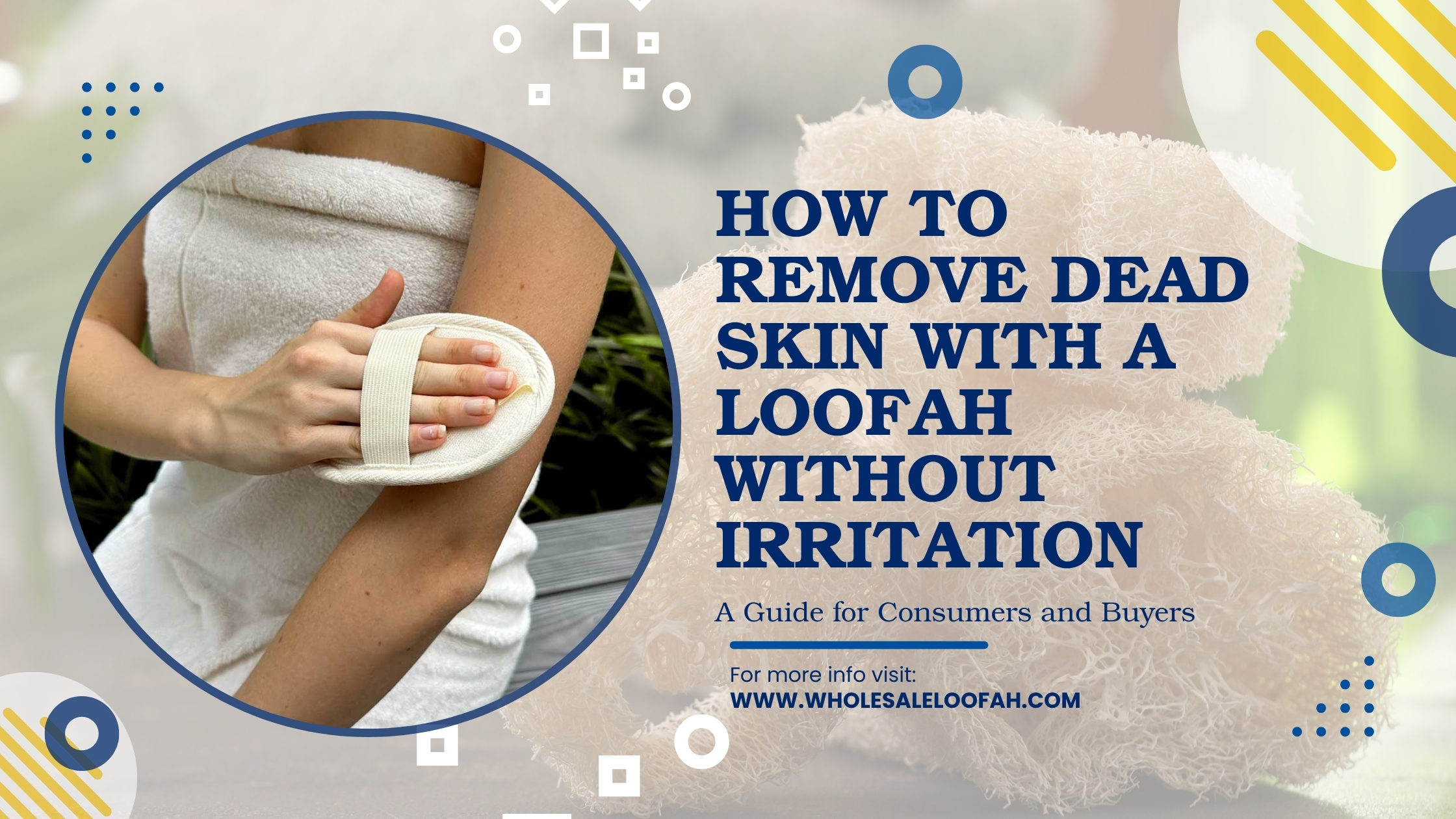
How to Remove Dead Skin with a Loofah Without Irritation: The Technique
This section covers the exact process for effective, irritation-free loofah exfoliation. These guidelines apply equally to individual consumers and to spa professionals incorporating loofah into treatment protocols.
Pre-Session Setup
Two elements must be in place before the loofah touches skin.
Skin must be warmed and hydrated. A minimum of 5 minutes in a warm shower or bath softens the stratum corneum, reducing the friction required to remove dead cells. Hot water should be avoided, as it inflames skin before exfoliation even begins.
The loofah must be fully saturated. Immerse it in warm water and squeeze repeatedly for 60 to 90 seconds. Dry loofah fiber has an abrasiveness level significantly higher than saturated fiber, and using it dry on sensitive areas is a primary cause of redness and micro-tears.
The Exfoliation Process Step by Step
Step 1: Apply a gentle, sulfate-free body wash to the soaked loofah. The cleanser adds slip, reduces drag, and assists in carrying away loosened dead cells.
Step 2: Begin at the feet and lower legs. This approach serves two purposes: it starts with the skin areas that typically have the thickest dead cell accumulation, and it allows you to calibrate pressure before reaching more sensitive zones.
Step 3: Use slow, circular motions approximately 4 centimeters in diameter. Move methodically upward along the body. Never scrub back and forth rapidly, as this creates directional friction that is more likely to cause abrasion.
Step 4: Adjust pressure by zone. Shins, elbows, and knees benefit from slightly more pressure. Inner arms, chest, and the sides of the torso require a noticeably lighter touch.
Step 5: Avoid the face entirely. Body loofah fiber, even at Grade A fineness, is not appropriate for facial skin. Direct consumers to a dedicated facial exfoliant for that purpose.
Step 6: Limit total session time to 8 to 10 minutes for full body. Longer sessions do not improve outcomes and increase cumulative irritation risk.
Post-Session Protocol
| Step | Action | Timing | Why |
|---|---|---|---|
| 1 | Rinse body with cool water | Immediately after exfoliation | Closes pores, calms surface heat |
| 2 | Rinse loofah under running water | During body rinse | Removes all debris and soap |
| 3 | Pat skin dry gently | Within 1 minute | Prevents friction damage to fresh skin |
| 4 | Apply moisturizer | Within 3 minutes of drying | Maximizes absorption while barrier is open |
| 5 | Squeeze and hang loofah | Before leaving bathroom | Initiates drying to prevent bacteria |
Building a Retail Loofah Line: What Buyers Need to Know
For distributors, spa supply companies, and health and wellness retailers, the loofah category offers strong margin potential and high repeat purchase rates. Consumers who find a loofah product they trust will repurchase it on a 3 to 4 week cycle indefinitely.
Market Segment Analysis
| Retail Segment | Best Loofah Grade | Key Selling Points | Typical Margin Range |
|---|---|---|---|
| Luxury spa and hotel | Grade A Premium | Consistent performance, gentle, premium feel | 55-70% |
| Health and wellness retail | Grade A Standard | Natural origin, sustainability, effective | 45-60% |
| Mass market retail | Grade B | Affordable, accessible, wide availability | 35-50% |
| Private label brand | Grade A or B | Custom branding, exclusive positioning | 50-70% |
| Eco-specialty stores | Grade A | Biodegradable, natural, sustainable supply chain | 50-65% |
The private label opportunity is particularly strong for retailers who want to differentiate from commodity loofah products. Egexo’s private label loofah manufacturing service provides custom branding, packaging design, and product specification support for buyers ready to build their own brand on Egyptian quality.
For businesses interested in fully customized shapes, sizes, or product configurations, the custom loofah product design service extends beyond standard catalog options.
Supplier Evaluation Process
Before committing to a loofah supplier, wholesale buyers should complete a structured evaluation. The table below outlines the key criteria and what to look for at each stage.
| Evaluation Stage | Key Questions | Green Flags | Red Flags |
|---|---|---|---|
| Initial Research | Does the supplier grow or just trade? | Direct farm ownership | Broker-only, no farm access |
| Documentation | Are export and quality certifications current? | ISO, export compliance docs | No documentation available |
| Sample Request | Does sample quality match claims? | Matches grade specs exactly | Darker color, rough texture |
| MOQ Negotiation | Are MOQs flexible for new relationships? | Flexible starting from 500 | Rigid 10,000+ MOQs only |
| Communication | Response speed and technical knowledge? | Same-day, detailed answers | Slow, vague responses |
| References | Can they provide verified buyer references? | References from known brands | No references offered |
| Payment Terms | Are terms reasonable for first orders? | 30% deposit, balance on shipping | 100% prepayment required |
Egexo meets every green flag criterion in this table. EGEXO has been exporting Egyptian loofah since 2015. Visit Why Choose Egexo for a full overview of their qualifications and client support process.
Buyers ready to begin the process can request a wholesale quotation or download the complete Egexo product catalog to review all specifications before initiating contact.
Loofah Sustainability: Why It Matters for Modern Buyers
The environmental dimension of loofah is a growing factor in purchasing decisions, both for individual consumers and for brands positioning themselves in the wellness and natural products space.
Natural loofah is made from the fibrous interior of a fully plant-based, renewable crop. When properly processed and sourced, it generates no microplastic waste, decomposes fully in 30 to 60 days, and leaves no toxic residue in soil or water systems. Compared to synthetic mesh alternatives, the lifecycle environmental impact of a natural loofah is dramatically lower.
For brands, this is a marketable differentiator. Consumers increasingly research product sustainability before purchasing, and certifying a natural loofah supply chain as plastic-free and biodegradable can meaningfully improve conversion rates in eco-conscious retail channels.
Egexo’s farming operations follow sustainable cultivation practices across their Nile Delta facilities. The farm-to-export process overview details the environmental practices built into every stage of their supply chain.
For a broader view of available raw loofah scrubbers or specialty categories including pet and spa grooming loofahs, Egexo’s full product range offers solutions across multiple commercial applications.
Expert Insight from EGEXO
One of the most consistent patterns we see across our international wholesale clients is the correlation between loofah grade selection and customer retention rates. Retailers who start with Grade B to reduce cost often experience higher return rates and lower repeat purchases than those who begin with Grade A. The initial per-unit cost difference, typically between 20 and 35 percent depending on volume, is recovered within the first repurchase cycle when customer satisfaction is high enough to drive repeat buying.
For spa operators specifically, the grade of loofah used in body treatments directly affects treatment outcome reviews. We have worked with spa brands across the USA, Europe, Canada, Australia, the Gulf and every other country we can ship to who have documented measurable improvements in treatment satisfaction scores after switching to Grade A Egyptian loofah from lower-quality alternatives.
Our recommendation to any new wholesale buyer is always the same: sample Grade A first. The quality difference is immediately tangible, and the business case for stocking it becomes obvious. Visit our Browse page to explore available configurations, or speak with EGEXO through the quotation request form.
FAQ Section
Q1: What makes Egyptian loofah better for removing dead skin without irritation compared to other origins? A: Egyptian loofah grown in the Nile Delta develops a fiber density of 120 to 150 fibers per square centimeter, significantly higher than Southeast Asian or Latin American varieties. This density creates more even pressure distribution across the skin surface, which means more effective dead cell removal with less friction per contact point. The result is consistently gentler exfoliation with better outcomes, which is why Egyptian loofah commands premium positioning in global markets.
Q2: How should businesses educate retail customers on correct loofah use to reduce complaints? A: The three most impactful instructions to pass to customers are: soak the loofah for 60 seconds before use, use only light circular pressure on warm skin, and hang the loofah to dry after every use. These three habits address the majority of complaint causes, which are dryness-related abrasion, pressure-related irritation, and hygiene-related bacterial issues respectively. Including a care instruction card with retail products significantly reduces post-purchase dissatisfaction.
Q3: What is the shelf life of natural loofah for wholesale storage? A: Properly stored natural loofah has a shelf life of 18 to 24 months in bulk. Storage conditions are critical: loofahs must be kept in dry, ventilated environments at humidity levels below 65% and away from direct heat sources above 35 degrees Celsius. Vacuum-sealed or moisture-barrier packaging extends shelf life at the retail unit level. Egexo prepares all export shipments with moisture content below 12% to maximize storage stability at destination.
Q4: Can loofah exfoliation help with back acne and body breakouts? A: Yes. The follicle-clearing action of regular loofah exfoliation reduces the accumulation of dead cells and sebum in pores, which are the primary preconditions for body acne. Use a clean loofah 2 to 3 times weekly on affected areas with a gentle antibacterial body wash. Never use the same loofah on face and body, and replace it every 3 to 4 weeks to prevent reintroducing bacteria to freshly opened pores.
Q5: What MOQ should new wholesale buyers expect when ordering from Egexo? No minimum order on standard products. Private label from 1,000 units. Grade B starts at 1,000 pieces and Grade C at 2,000 pieces. MOQs for private label orders that include custom packaging or branding may vary based on design complexity and packaging materials. Egexo recommends new clients begin with a sample order before committing to their first full volume order.
Q6: Is there a difference in loofah technique for men versus women? A: The fundamental technique, circular motions on soaked skin with light pressure, is the same regardless of gender. Men with thicker body hair may benefit from slightly more deliberate circular motions to ensure the loofah reaches the skin surface rather than just moving through hair. Men with coarser skin on the back, heels, or elbows may tolerate a Grade B loofah where women might prefer Grade A fine. Frequency recommendations remain consistent: 2 to 4 times per week based on skin type, not gender.
Q7: How does loofah exfoliation improve the effectiveness of body moisturizers? A: The outermost dead skin layer acts as a physical barrier that reduces absorption of topical products. Removing it through loofah exfoliation increases the surface area of living skin in contact with the moisturizer and reduces the depth the product needs to penetrate to reach its target cells. Most users report that moisturizers applied within 3 minutes of loofah exfoliation feel noticeably more effective, which is consistent with the increased absorption rate that fresh, barrier-clear skin provides.
Q8: What range of loofah products does Egexo offer beyond standard body loofahs? A: Egexo’s catalog includes body bath loofahs in multiple sizes and grades, kitchen loofahs for eco-friendly household use, raw loofah scrubbers for industrial and bulk applications, and pet and spa grooming products. The company also offers full private label and custom product design services. Buyers can explore the full range at the Egexo products page or download the complete product catalog for detailed specifications.
Conclusion
Understanding how to remove dead skin with a loofah without irritation is the foundation of a successful loofah experience, whether that experience happens in a consumer’s bathroom or a spa treatment room. The principles are consistent across both contexts: premium product quality, correct technique, adequate preparation, and diligent post-use care.
For wholesale buyers, the data in this guide makes a clear case for sourcing Grade A Egyptian loofah from a direct-farm supplier. The fiber density advantage, consistent quality, sustainability credentials, and repeat-purchase potential create a compelling business case that transcends simple per-unit cost comparison.
For consumers, the takeaway is equally clear. A natural Egyptian loofah, used with the right technique, is one of the most effective and skin-friendly exfoliation tools available, provided it is sourced from a quality producer and maintained properly.
Key Takeaways:
- Egyptian loofah has measurably higher fiber density than alternatives, producing better and gentler exfoliation outcomes
- Proper technique involves soaked skin, soaked loofah, circular light-pressure motions, and immediate post-session moisturizing
- Wholesale buyers should evaluate fiber density, moisture content, color grade, and farm origin before committing to a supplier
- Natural loofah outperforms synthetic alternatives in sustainability, hygiene, and skin compatibility
- Grade A Egyptian loofah from Egexo delivers consistently across luxury, premium retail, and private label applications
Ready to experience Egyptian loofah quality?
- For Wholesale Buyers: Request a quote or download our catalog
- For Individual Orders: Browse our collection or order samples