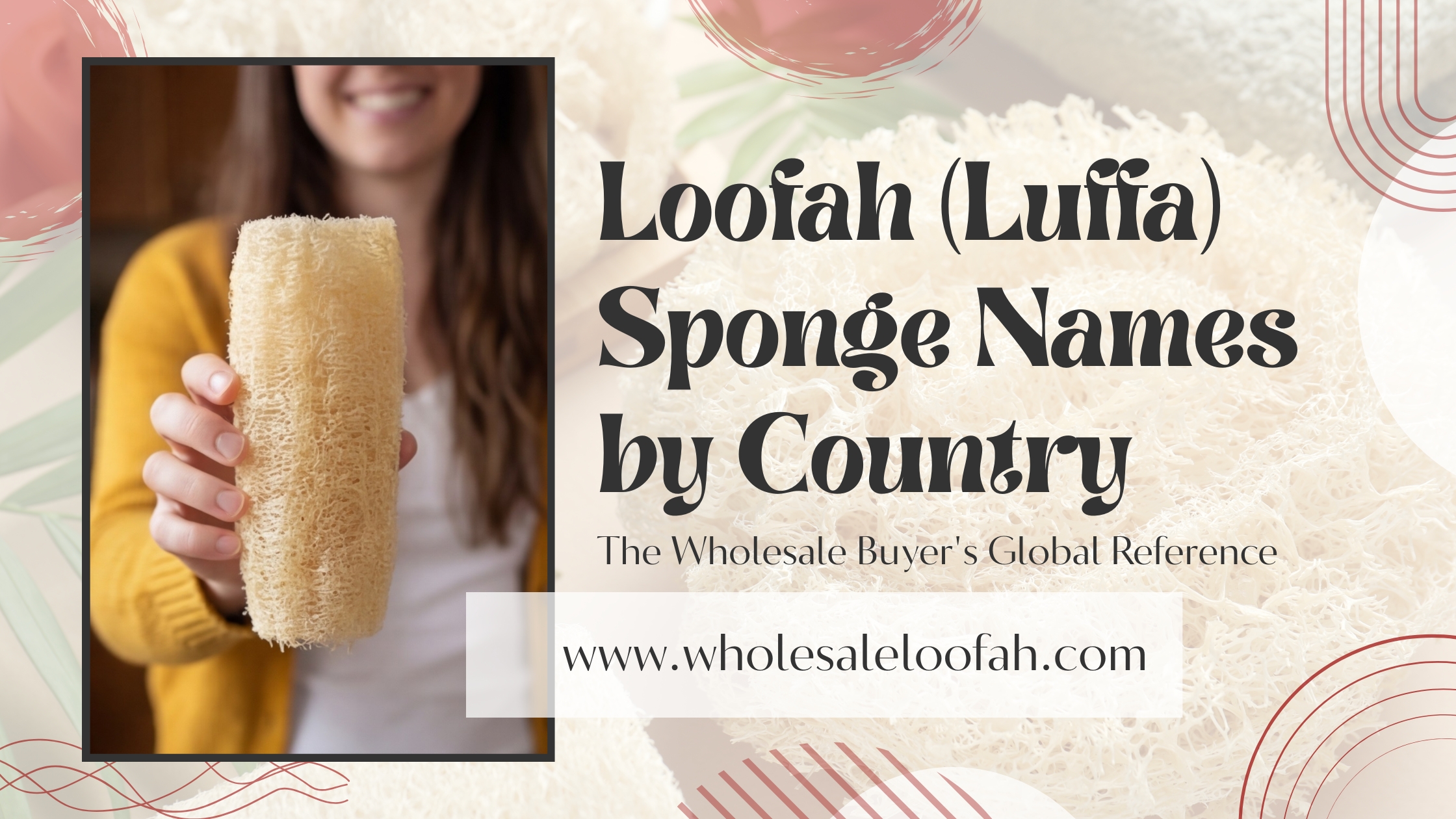
Before you print a single label, design a product page, or draft a customs document for loofah sponges destined for a new market, you need to know what your target customers call this product. in more than 40 countries, the same plant-based sponge carries entirely different names. Getting that name right on your packaging can double your shelf conversion. Getting it wrong means your product sits behind competitors who simply knew the local word.
The question of how loofah (luffa) sponges are called in your country is genuinely important for wholesale buyers, importers, and distributors navigating international markets. This reference guide compiles naming data from more than 40 countries, pairs it with quality sourcing guidance, and gives you the practical tools you need to localize product presentation without sacrificing the quality standards that make Egyptian loofah the global benchmark.
EGEXO has been exporting Egyptian loofah since 2015. That experience feeds directly into this guide: the naming insights, quality specifications, and market observations here come from working with real buyers in real markets, not from theoretical research. Whether you are sourcing loofah for a European spa chain, a Latin American pharmacy network, or a North American natural beauty retailer, this guide helps you arrive at the market knowing the language, the quality standards, and the sourcing strategy that fits.
Why Naming Knowledge Is a Wholesale Competitive Advantage
Most wholesale buyers focus exclusively on price, quality, and lead time when evaluating suppliers. Those three factors matter enormously. But there is a fourth factor that separates buyers who capture market share from those who struggle with slow inventory: product language alignment.
The Commercial Impact of Getting the Name Right
Consider two importers entering the Brazilian natural beauty market simultaneously. Both source the same quality Egyptian loofah from the same supplier. Importer A labels the product “Natural Loofah Sponge.” Importer B labels it “Bucha Vegetal Natural.” In Brazilian Portuguese retail, bucha vegetal is the established consumer term. Importer B sells through three times faster, not because the product is better, but because the consumer can identify it immediately.
This plays out identically across markets. In Germany, a product labeled Naturschwamm or Luffaschwamm will convert better than one labeled with the English word. In Turkey, kabak lifi resonates with a consumer who might not connect with the imported term loofah on a plain package.
For buyers using Egexo’s private label loofah manufacturing service, this knowledge is built into the label consultation process. The team reviews target market naming conventions before any print run to ensure the product lands correctly.
The Customs and Trade Documentation Angle
Beyond retail labeling, naming conventions affect how you classify and describe products in customs and import documentation. Harmonized system codes for luffa products fall under categories related to vegetable plaiting materials, and different countries may classify the same product under slightly different headings depending on whether it is labeled as a bath product, a cleaning tool, or a natural fiber material.
Understanding that your Egyptian loofah may be called “bucha vegetal” by your Brazilian buyer, “leefa” in Gulf customs documents, and “hechima spa product” in a Japanese retail application helps you prepare documentation that moves efficiently through customs in each jurisdiction. Egexo’s export documentation team, described in the farm to export process, handles this complexity as a standard part of every export order.
The Complete Wholesale Naming Reference by Region
The table below organizes global naming data into the regional groupings most relevant to wholesale market entry strategies. Each entry includes the primary retail name and secondary or trade-specific terms where they differ.
Americas: Loofah Naming Guide for Wholesale Buyers
| Market | Primary Retail Name | Trade or Secondary Name | Key Application Context |
|---|---|---|---|
| United States | Loofah | Luffa | Bath, spa, natural beauty retail |
| Canada | Loofah | Luffa, Loofah sponge | Bath and eco-cleaning retail |
| Brazil | Bucha vegetal | Luffa, Esfregao | Both bath and kitchen categories |
| Mexico | Estropajo | Zacate, Lufa | Kitchen dominant; bath growing |
| Argentina | Lufa | Esponja vegetal | Natural beauty positioning |
| Colombia | Lufa, Estropajo | Esponja de luffa | Pharmacy and natural market |
| Chile | Lufa | Esponja vegetal | Wellness and natural beauty |
| Peru | Lufa, Estropajo | Esponja vegetal | Traditional and wellness markets |
Europe: Loofah Naming Guide for Wholesale Buyers
| Market | Primary Retail Name | Trade or Secondary Name | Key Application Context |
|---|---|---|---|
| United Kingdom | Loofah | Luffa sponge, Luffa | Bath, spa, wellness |
| Germany | Luffa, Luffaschwamm | Naturschwamm | – |
| France | Luffa | Eponge luffa, Eponge vegetale | – |
| Italy | Luffa | Spugna vegetale | Farmacia, natural wellness |
| Spain | Lufa | Estropajo, Esponja vegetal | Both kitchen and bath markets |
| Netherlands | Luffa | Sponskomkommer | – |
| Belgium | Luffa | Eponge vegetale | French and Dutch regional labels |
| Poland | Luffa | Naturalny Scrub | Natural beauty growth market |
| Portugal | Bucha vegetal | Luffa | Bath and kitchen markets |
| Sweden and Norway | Luffa | Naturlig skrubba | – |
Middle East and Africa: Loofah Naming Guide for Wholesale Buyers
| Market | Primary Retail Name | Trade or Secondary Name | Key Application Context |
|---|---|---|---|
| Egypt | Leefa | Lifa, Liffa | Hammam, personal care, export |
| Saudi Arabia | Leefa | Lifa al-hammam | Hammam spa, personal hygiene |
| UAE and Gulf | Leefa | Lifa, Loofah | Luxury spa, hotel amenities |
| Morocco | Leefa, Kissa | Luffa | Hammam treatments |
| Turkey | Kabak Lifi | Lifli Kabak | Traditional bath, hammam |
| South Africa | Loofah | Luffa sponge | Natural beauty retail |
| Nigeria | Kpakpo | Sifon, Luffa | Varies by region |
Asia Pacific: Loofah Naming Guide for Wholesale Buyers
| Market | Primary Retail Name | Trade or Secondary Name | Key Application Context |
|---|---|---|---|
| Japan | Hechima | Hechima sponge | Traditional beauty, spa |
| China | Si Gua Luo | Si Gua, Tianluosi | TCM, natural beauty |
| South Korea | Susebak | Loopa | Bath products, K-beauty |
| India | Turai, Torai | Ghosavela, Neti, Peerkangai | Both culinary and bath |
| Indonesia | Oyong, Gambas | Petola, Luffah | Culinary and household |
| Malaysia | Petola | Oyong | Culinary and household |
| Philippines | Patola | Kabatiti | Culinary and household |
| Vietnam | Muop | Muop huong | Primarily culinary |
| Australia | Loofah | Luffa | Natural beauty, eco cleaning |
Market Entry Strategies: Using Naming Data to Accelerate Sales
Knowing the right name is the starting point. Building a market entry strategy around that knowledge is where the commercial advantage is created.
Strategy 1: Lead With the Local Name, Support With the Global Term
In markets where a local name dominates, lead with that term on primary packaging. Include the international equivalents as secondary text for educated consumers who may be familiar with the product from other markets. This approach works well in Brazil (bucha vegetal / natural luffa), Japan (hechima / natural loofah), and Turkey (kabak lifi / loofah).
Strategy 2: Position the Origin to Add Premium Value
In markets where the local name is simply “loofah” or “luffa” and no distinct local tradition exists, the origin story becomes the differentiating factor. “Egyptian Loofah” or “Premium Egyptian Luffa” carries significant weight with consumers who associate Egyptian origin with quality, which is well-supported by Egypt’s actual position as the global benchmark producer.
Egexo’s why choose Egexo page provides documentation, certifications, and background that wholesale buyers can reference in their own marketing to substantiate this Egyptian quality claim.
Strategy 3: Build Category Education Into Your Launch
In markets where luffa is primarily known as a food ingredient (Vietnam, Philippines, parts of India) and you are introducing it as a bath or kitchen cleaning product, education is a prerequisite for sales. Content that explains the difference between the young culinary fruit and the dried mature sponge, and demonstrates the bath or cleaning use case, must accompany product launch.
Product Specifications for Wholesale Buyers
Quality specifications must be understood alongside naming conventions. Here is a comprehensive reference covering the specifications buyers need to evaluate before committing to an order.
Product Specification Reference Table
| Specification | Bath and Body Sponge | Kitchen Scrubber | Raw Scrubber | Spa Grade |
|---|---|---|---|---|
| Length range | 10 to 30 cm | 8 to 15 cm | 20 to 45 cm | 12 to 25 cm |
| Diameter range | 6 to 12 cm | 5 to 8 cm | 8 to 15 cm | 7 to 12 cm |
| Fiber density | 85 percent plus (premium) | 70 to 80 percent | 90 percent plus (raw) | 90 percent plus |
| Moisture content at shipping | Less than 12 percent | Less than 12 percent | Less than 10 percent | Less than 12 percent |
| Available grades | Premium, Standard | Standard, Economy | Premium, Raw | Premium only |
| MOQ | 500 units | 1,000 units | 200 units | 300 units |
| Lead time | 2 to 4 weeks | 2 to 3 weeks | 1 to 2 weeks | 3 to 5 weeks |
| Private label available | Yes | Yes | Limited | Yes |
| Custom sizing available | Yes | Yes | No | Yes |
For complete product specifications across all 40 plus SKUs in the Egexo range, download the product catalog or request a quotation with your specific requirements.
Quality Grading Definitions
Understanding what grade labels mean in practice helps buyers select the right product for their market positioning.
Premium Export Grade: Maximum fiber density, uniform sizing within each batch, neutral color with no visible browning, neutral scent, packaged and protected for export shipment. Suitable for luxury spa chains, premium natural beauty retailers, and private label programs targeting upscale consumers.
Standard Commercial Grade: Good fiber density, reasonable sizing consistency, minimal color variation acceptable, suitable for mid-market retail, hospitality supply, and general natural beauty product lines.
Economy Grade: Lower fiber density, greater size variation within batches, some color variation acceptable, appropriate for budget retail, promotional products, or markets where price is the primary buying criterion.
Raw Grade: Unprocessed or minimally processed, maximum fiber density potential, requires buyer-side processing or sold as-is for industrial or DIY applications.
Supplier Evaluation: What Separates Reliable Sources From Risky Ones
For wholesale buyers comparing suppliers, the naming guide above is also an indirect quality signal. Suppliers who understand the global naming landscape, the regional use traditions, and the labeling requirements of different markets are suppliers who have genuine export experience, not intermediaries with limited product knowledge.
Supplier Evaluation Checklist for Loofah Wholesale
| Evaluation Criterion | What to Ask | Egexo Position |
|---|---|---|
| Farm origin | Does supplier own or directly source from farms? | Direct farm operation in Nile Delta |
| Processing control | Does supplier control drying and processing? | Full in-house processing |
| Quality grading | Does supplier grade product with documented standards? | Published quality standards |
| Export experience | How many years of international export? | Exporting since 2015 |
| Documentation | Can supplier provide phytosanitary and origin certificates? | Full documentation provided |
| Sample policy | Can you get product samples before bulk order? | Samples are paid; the buyer pays shipping |
| MOQ flexibility | Can supplier work with your order size? | Flexible MOQ for new buyers |
| Private label | Can supplier produce under your brand? | Full private label capability |
| Custom design | Can supplier create custom product formats? | Custom design service available |
| Market knowledge | Does supplier understand your target market? | Active in 40 plus export markets |
For a detailed assessment of Egexo’s credentials and process, review the why choose Egexo page and the quality standards documentation.
The Business Case for Egyptian Loofah in Your Product Line
Beyond naming and quality, wholesale buyers need a commercial justification for adding natural loofah to their product mix or expanding their loofah sourcing from Egypt specifically.
Market Opportunity: Natural Sponge Growth Trends
The global natural sponge and loofah market has been growing consistently as consumer preference shifts away from synthetic cleaning and personal care products. Key drivers include the microplastic awareness movement, which has created genuine consumer concern about synthetic bath products, and the broader sustainability shift in retail that rewards plastic-free, biodegradable products with premium shelf positioning and strong repeat purchase rates.
For retailers and distributors, natural loofah occupies a unique position: it is genuinely better for the environment, genuinely more effective than cheap synthetic alternatives when sourced at premium grade, and genuinely connected to centuries of cultural tradition in bath and wellness practice. That combination of sustainability, performance, and heritage is rare in a single product category.
Profit Margin Consideration
Premium-grade Egyptian loofah commands a significant retail price premium over basic synthetic sponges. The raw material cost difference between synthetic and natural sponges narrows considerably when you account for the 3 to 6 month replacement cycle of quality loofah versus the 2 to 4 week cycle of synthetic alternatives. For retailers, this creates an opportunity to communicate value clearly: more expensive per unit, but dramatically better cost-per-day of use for the consumer.
For wholesale buyers, the margin structure of premium natural loofah is more attractive than commodity synthetic sponges. The product supports premium positioning and premium pricing in nearly every market where it is sold correctly.
Explore the complete product range and pricing structure at our products page or access wholesale-specific resources at wholesaleloofah.com for further market and commercial guidance.
Sustainability Claims You Can Substantiate
One of the most valuable aspects of Egyptian loofah from a wholesale perspective is the genuine, verifiable sustainability narrative that can be attached to every product. In a market increasingly skeptical of greenwashing, having real evidence behind your claims is a commercial differentiator, not just a marketing talking point.
Sustainability Credentials of Natural Egyptian Loofah
| Sustainability Claim | Supporting Evidence | Verification |
|---|---|---|
| Fully biodegradable | Cellulose fiber structure, no synthetic binders | Lab testing available |
| Zero microplastic emissions | No petroleum-derived materials | Material composition documentation |
| Renewable resource | Annual agricultural crop | Farm origin documentation |
| Low carbon production | Solar drying, minimal industrial processing | Process documentation |
| Compostable | Degrades in home compost within weeks | Testing data available |
| Chemical-free option | Traditional cultivation methods available | Farming practice documentation |
| Supports agricultural communities | Direct farm sourcing in Egypt | Supply chain transparency |
Each of these claims can be substantiated with documentation from Egexo. For buyers building eco-friendly product lines, the ability to show real documentation behind sustainability claims is increasingly required by both consumers and retail buyers. Request samples and supporting documentation from EGEXO.
FAQ Section
Q1: What name should I use on product packaging when selling loofah in multiple countries?
The optimal approach is to use the locally recognized name as the primary label text and include secondary international terms for cross-market clarity. In the UK and North America, loofah is dominant. In Brazil and Portugal, bucha vegetal is the established consumer term. In Germany, luffaschwamm or naturschwamm will outperform the English word. In Japan, hechima is far more recognizable than loofah. Egexo’s private label service includes market-specific naming consultation to ensure your packaging connects with local consumers wherever you sell.
Q2: What is the standard MOQ for wholesale loofah orders from Egypt?
No minimum order on standard products. Private label from 1,000 units. For buyers entering a new category or testing a new market, the sample program allows quality evaluation before any bulk commitment. For large-volume buyers with consistent demand, Egexo offers flexible terms and volume-based pricing structures. Submit your requirements through the quotation request page for a customized commercial proposal.
Q3: How are loofah sponges classified for import and customs purposes?
Luffa sponge products are typically classified under harmonized system codes relating to vegetable plaiting materials, vegetable sponges, or natural bath products depending on the importing country. The specific HS code can vary depending on whether the product is classified as a cleaning tool, a personal care product, or a natural fiber material. Egexo provides full export documentation including phytosanitary certificates, certificates of origin, and product classification guidance as standard components of every export order.
Q4: Can I get loofah products under my own brand from an Egyptian supplier?
Yes. Egexo offers a complete private label manufacturing service that covers custom sizing, branded packaging, multilingual labels, and market-specific naming adaptations. The minimum quantities for private label orders are negotiable depending on the product type and packaging specification. The service includes product design consultation, label review, and sample approval before any full production run begins. This is the most efficient route for wholesale buyers who want premium Egyptian quality presented under their own brand in their target market. Visit the custom loofah product design page for full details.
Q5: How does Egyptian loofah quality compare to luffa from other producing countries?
Egyptian luffa consistently grades higher on fiber density, uniformity, and durability than luffa from Southeast Asian producers including Vietnam and China, and from Latin American sources including Brazil and Mexico. Premium Egyptian loofah shows fiber density above 85 percent of internal volume, compared to 60 to 70 percent for average Southeast Asian product, and significantly lower variability in sizing within batches.
Q6: What documentation do I need to import Egyptian loofah sponges?
Required documentation varies by destination country but typically includes a commercial invoice, packing list, certificate of origin, phytosanitary certificate, and bill of lading or airway bill. Some markets require additional documentation such as an import permit for natural plant materials, a CITES declaration where applicable, or a food safety certificate for products classified as natural fibers. Egexo’s export documentation team prepares all standard documentation as part of every export order and can advise on specific additional requirements for your target market.
Q7: How do I evaluate loofah quality before placing a large wholesale order?
Request a sample pack from your supplier before any bulk commitment. Evaluate each sample across these criteria: fiber density by weight and compression test, color and visual uniformity across the batch, scent neutrality, behavior when wet (softening rate, shape retention), and structural integrity after multiple wet-dry cycles. Egexo’s sample order program provides graded samples from multiple product categories, allowing direct comparison before purchase. The quality standards documentation gives you the benchmarks to measure your evaluation against.
Q8: Is there growing consumer demand for natural loofah products in Western markets?
Yes, and the growth is meaningful and sustained. Consumer demand for plastic-free, biodegradable personal care and cleaning products has been growing across North American and European markets throughout the 2020s, driven by microplastic awareness, eco-labeling programs in retail, and genuine consumer behavioral change among younger demographics. Natural loofah is one of the cleaner and more compelling product stories in the space: it is genuinely what it claims to be, has cultural and historical authenticity, and performs well against synthetic alternatives at premium grade. For wholesale buyers, this is a category with favorable positioning for the foreseeable future.
Expert Insight from EGEXO
Knowing that your Brazilian customer calls it bucha vegetal, your Japanese spa partner calls it hechima, and your German retail buyer expects to see luffaschwamm on the label is not a detail. It is the difference between a product that moves and one that sits. When you work with EGEXO for private label manufacturing or custom product design, you are not just getting Egyptian quality fiber. That is worth more than any single order.
Conclusion
The global patchwork of names for loofah (luffa) sponges is not an obstacle for wholesale buyers. It is a map of market opportunity. Every region that calls this product by a different name is a distinct market with its own consumer expectations, quality benchmarks, and commercial potential. The buyer who understands those differences and sources the right quality product from the right origin to meet them is the buyer who wins market share.
Egyptian luffa from Egexo is the global quality standard. Combining that product quality with the naming knowledge and market insight in this guide gives wholesale buyers a genuine competitive advantage in any market they choose to enter.
Key Takeaways:
- Loofah sponges carry 20 plus distinct names across global markets, each with direct implications for product labeling and marketing effectiveness
- Naming alignment with local consumer terminology can significantly improve shelf conversion rates in new markets
- Egyptian-origin luffa from Egexo leads the global market in fiber density, uniformity, and export documentation capability
- Premium-grade Egyptian loofah supports strong margin positioning in natural beauty and wellness retail globally
- Sustainability claims attached to natural loofah are genuine and fully documentable, providing competitive advantage in eco-conscious markets
Ready to source premium Egyptian loofah for your market?
- For Wholesale Buyers: Request a bulk quote or download the complete product catalog
- To Test Before Committing: Order samples from the Egexo sample program Samples are paid and the buyer pays shipping. The sample cost is credited to your first order of $1,000 or more, placed within 60 days.