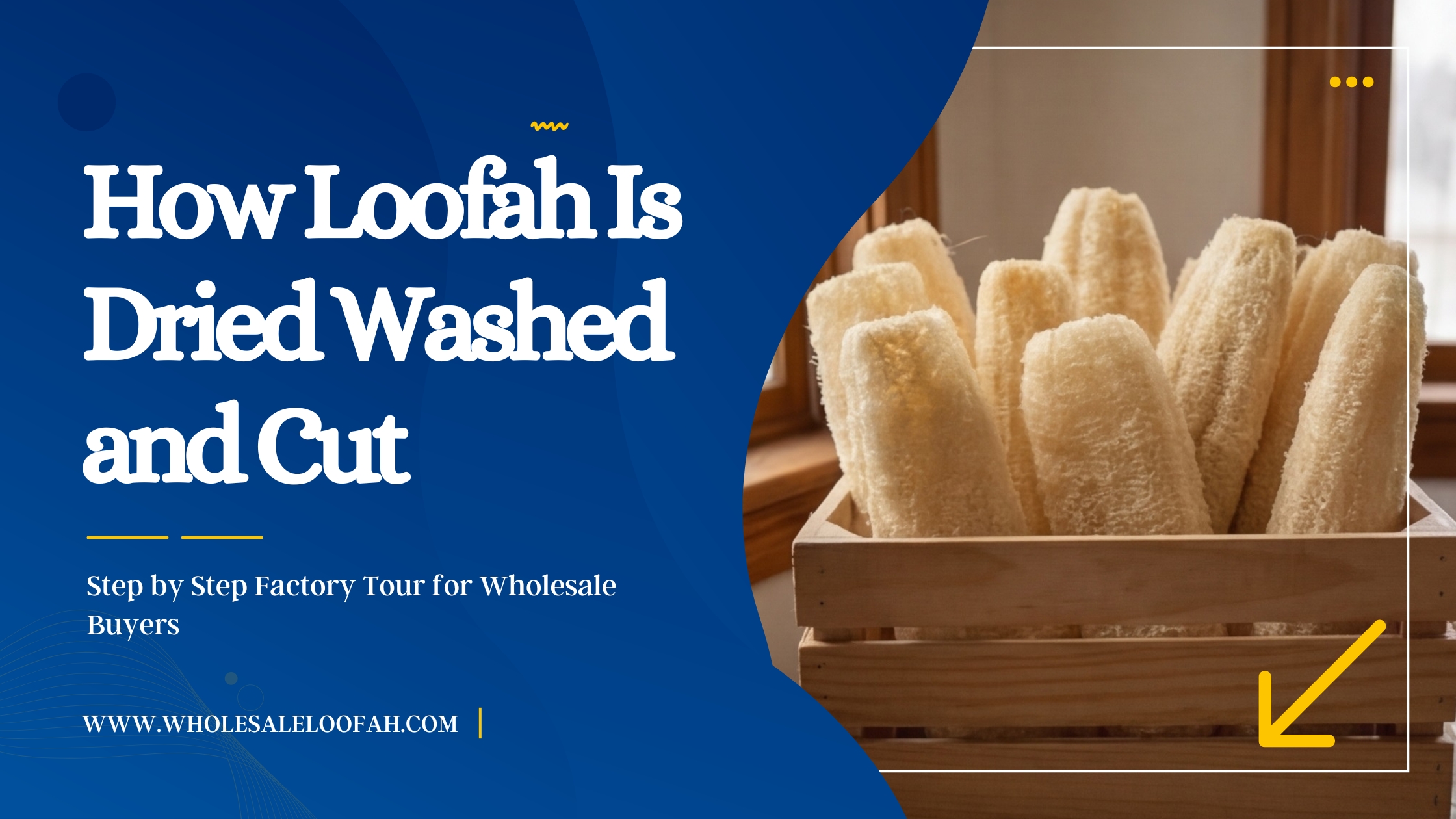
Processing Knowledge That Separates Profitable Importers from Frustrated Ones
Wholesale loofah buyers who understand processing make better purchasing decisions. Those who treat loofah as a commodity product without investigating production methods frequently encounter quality inconsistencies, customer complaints, and margin erosion from returns. This factory tour explains exactly how loofah is dried, washed, and cut, providing the technical foundation you need for supplier negotiations, quality specifications, and competitive differentiation.
The gap between premium Egyptian loofah and budget alternatives from other sources originates primarily in processing rather than raw material differences. Identical looking gourds produce dramatically different finished products depending on drying protocols, washing thoroughness, and cutting precision. Wholesale buyers armed with processing knowledge recognize quality indicators invisible to competitors focused solely on landed cost calculations.
Egyptian facilities process approximately 65 percent of global loofah supply, with leading exporters like Egexo operating vertically integrated operations controlling every stage from cultivation through international shipping. This integration enables quality consistency impossible for traders purchasing from fragmented small scale processors. Understanding what happens inside these facilities transforms your supplier evaluation from price comparison into informed partnership assessment.
This comprehensive guide covers each processing stage in detail, explaining technical specifications, quality implications, and evaluation criteria relevant to wholesale purchasing decisions. Whether you manage procurement for hospitality chains, distribute to retail networks, or develop private label product lines, this knowledge directly impacts your business success.
Ready to source from processors who meet these quality standards? Request wholesale pricing from Egexo or continue reading for complete processing insights.
Why Processing Quality Determines Your Customer Satisfaction Rates
Before examining specific stages, wholesale buyers should understand how processing decisions cascade through supply chains affecting end customer experiences. Products failing to meet expectations generate returns, negative reviews, and lost repeat business regardless of your marketing effectiveness or pricing strategy.
The Hidden Cost of Processing Shortcuts
Budget suppliers achieve lower prices primarily through processing shortcuts rather than operational efficiency. These shortcuts create products that pass initial inspection but fail during actual use. Rushed drying produces loofahs retaining moisture that promotes mold growth in customer bathrooms. Inadequate washing leaves residues causing odor development or skin irritation. Careless cutting wastes material, creates inconsistent products, and damages fiber networks reducing durability.
The arithmetic appears attractive when comparing quoted prices. A supplier offering 30 percent below market rates seems like a margin opportunity. However, factoring return rates, customer service costs, reputational damage, and lost repeat business typically reverses apparent savings. Experienced importers learn this lesson expensively before prioritizing processing quality over unit cost minimization.
Quality as Competitive Advantage
Conversely, wholesale buyers sourcing properly processed products build sustainable competitive advantages. Retailers receiving consistent quality develop supplier loyalty. Hospitality clients renew contracts when guest satisfaction remains high. Private label products with genuine quality differentiation command premium positioning rather than competing solely on price.
Understanding how loofah is dried, washed, and cut enables specification of quality parameters that protect your market position. Rather than accepting whatever suppliers ship, informed buyers define requirements ensuring products meet customer expectations consistently across orders.
Explore why quality focused importers choose Egexo through the detailed supplier capabilities overview, or continue learning about specific processing stages below.
Stage One: Drying Protocols That Determine Product Longevity
How loofah is dried represents the single most consequential processing decision affecting wholesale buyer outcomes. Moisture content at processing completion determines shelf stability during warehousing, mold resistance during retail display, and product longevity during customer use. Suppliers cutting corners on drying create products destined to disappoint regardless of initial appearance.
Understanding Moisture Dynamics
Fresh harvested loofah gourds contain approximately 85 percent moisture by weight. Finished products suitable for wholesale distribution require moisture content between 8 and 12 percent depending on intended application and storage conditions. Achieving this dramatic reduction while preserving fiber integrity demands patience, proper conditions, and verification testing that distinguish professional processors from casual operators.
Moisture removal occurs through evaporation driven by temperature differential between product interior and surrounding air, combined with humidity differential enabling released moisture to disperse rather than recondense. Egyptian production regions offer ideal natural conditions including intense solar radiation, low ambient humidity typically below 40 percent, and consistent temperatures enabling reliable outdoor processing impossible in more variable climates.
Primary Field Drying Phase
Processing begins immediately after harvest with field drying reducing initial moisture to intermediate levels suitable for transport to processing facilities. Workers arrange harvested gourds in configurations maximizing airflow and sun exposure while protecting against ground moisture and overnight dew accumulation.
Field Drying Parameters
| Parameter | Specification | Purpose |
|---|---|---|
| Duration | 7 to 14 days typical | Initial moisture reduction to 35 to 45 percent |
| Arrangement | Single layer elevated or ground cloth | Uniform exposure airflow optimization |
| Rotation | Daily minimum | Even drying prevention of ground contact moisture |
| Covering | Overnight and rain protection | Prevention of moisture reabsorption |
| Inspection | Daily sorting | Removal of damaged or mold initiated specimens |
Field drying triggers biochemical changes within fiber networks that contribute to finished product durability. Controlled moisture loss initiates lignin hardening processes that strengthen fibers against mechanical stress during use. Rushing this stage through artificial acceleration sacrifices these natural strengthening processes.
Secondary Precision Drying
Following skin removal and washing, loofahs enter critical secondary drying targeting specific moisture specifications. This stage transforms processed fibers into shelf stable products capable of extended storage without quality degradation.
Target Moisture Specifications for Wholesale Applications
| Distribution Channel | Target Moisture | Rationale |
|---|---|---|
| Extended warehousing over 6 months | 8 to 9 percent | Maximum stability for long storage cycles |
| Standard distribution 2 to 6 months | 9 to 11 percent | Balance between stability and flexibility |
| Quick turnover under 2 months | 11 to 12 percent | Acceptable for rapid inventory rotation |
| Humid climate destinations | 8 to 10 percent | Additional margin for challenging conditions |
Professional facilities verify moisture content using calibrated meters providing objective readings rather than relying on subjective assessment. Wholesale buyers should request moisture documentation for significant orders, as this data confirms processing adequacy and establishes accountability for specification compliance.
Drying Method Evaluation for Supplier Assessment
| Method | Characteristics | Wholesale Buyer Considerations |
|---|---|---|
| Traditional sun drying | Weather dependent 4 to 7 days variable results | Lowest cost but inconsistent specifications |
| Climate controlled chambers | Consistent 24 to 36 hours fixed cycle | Higher cost but reliable specifications |
| Hybrid approach | Sun primary with controlled finishing | Optimal balance of cost and consistency |
Suppliers unable to articulate their drying methodology or provide moisture specifications likely lack quality systems ensuring consistent results. This information gap represents significant risk for wholesale buyers dependent on product reliability.
Learn more about Egexo’s quality systems including moisture verification protocols through the quality standards documentation.
Stage Two: Washing Processes Creating Commercial Grade Products
Multiple washing stages transform dried agricultural material into hygienic products meeting commercial distribution requirements. How loofah is washed affects appearance, safety, odor profile, and regulatory compliance for various destination markets.
Retting for Skin Separation
The washing process begins with retting, controlled water immersion loosening connections between outer gourd skin and interior fiber networks. Dried gourds submerge in temperature controlled tanks for 24 to 72 hours depending on skin thickness and desired processing speed.
Water temperature significantly influences retting effectiveness and fiber preservation. Optimal temperatures between 25 and 35 degrees Celsius accelerate skin loosening without softening fibers excessively. Temperatures above 40 degrees risk fiber damage affecting finished product durability. Professional facilities monitor and control water conditions throughout retting cycles.
Following adequate soaking, workers remove loosened skins through manual peeling or gentle mechanical processing. Skill matters considerably during skin removal, as aggressive handling damages fiber networks while insufficient effort leaves skin fragments creating surface defects on finished products.
Multi Stage Debris Removal
Exposed fiber networks contain various residues requiring removal through dedicated washing cycles. Seeds lodged within fiber matrices, plant sap concentrated during growth, and general agricultural debris accumulated during cultivation all require thorough flushing.
Standard Washing Cycle Sequence
| Cycle | Purpose | Method | Duration |
|---|---|---|---|
| Initial rinse | Loose debris removal | Flowing water agitation | 15 to 30 minutes |
| Seed extraction | Complete seed removal | Manual inspection mechanical tumbling | 30 to 60 minutes |
| Deep cleaning | Sap and residue dissolution | Warm water extended soak | 2 to 4 hours |
| Clarity rinse | Dissolved residue removal | Fresh water multiple changes | 30 to 60 minutes |
| Final inspection | Quality verification | Individual piece examination | Variable |
Quality facilities employ three to five complete washing cycles with water changes between stages. Workers inspect individual pieces between cycles, routing those requiring additional treatment for extended processing. This labor intensive approach explains price differences between carefully processed products and budget alternatives rushed through minimal washing.
Sanitization Methods for Commercial Requirements
Final washing stages address hygiene requirements for products contacting human skin in commercial applications. Different sanitization approaches suit different market requirements and buyer preferences.
Sanitization Method Comparison for Wholesale Buyers
| Method | Process | Advantages | Market Suitability |
|---|---|---|---|
| Extended UV exposure | Multiple day sun exposure between rinses | Chemical free natural antimicrobial | Organic natural product markets |
| Hydrogen peroxide | Food grade concentration with thorough rinsing | Effective no residue when properly executed | General commercial distribution |
| Ozone treatment | Gaseous ozone in sealed chambers | Excellent effectiveness no residue | Premium hospitality medical adjacent |
| Thermal processing | Extended elevated temperature exposure | Simple effective widely available | Standard commercial applications |
Wholesale buyers should specify sanitization requirements based on destination market expectations and regulatory requirements. Products destined for natural product retailers require different approaches than those entering conventional distribution channels.
For detailed information about processing methods and certifications, review the complete production process documentation.
Stage Three: Cutting Operations Creating Marketable Products
The final major processing stage involves cutting and shaping operations transforming processed fiber cylinders into specific product forms. How loofah is cut determines product dimensions, functional characteristics, and suitability for various market applications.
Cutting Method Selection
Professional facilities employ both manual and mechanical cutting methods, selecting approaches based on product requirements and order specifications.
Manual Hand Cutting
Skilled workers examine each loofah individually, making cuts optimized for specific piece characteristics. Hand cutting excels at adaptive decision making including routing around damage, maximizing usable material from irregular shapes, and creating custom products meeting specific buyer requirements.
Hand cutting remains essential for premium grade products, custom orders, and irregular materials. Workers evaluate fiber density patterns, identify optimal cutting angles, and adjust dimensions based on individual characteristics rather than forcing uniform processing regardless of material variations.
Mechanical Cutting Systems
Automated equipment delivers consistent results at throughput rates impossible for manual operations. Mechanical systems excel at producing standardized products meeting specific dimensional requirements for retail packaging or hospitality applications demanding uniformity.
Modern facilities integrate both approaches strategically. Standard product lines flow through mechanical systems maximizing efficiency. Premium products, custom orders, and irregular materials route to skilled cutters whose judgment optimizes outcomes impossible for automated systems to achieve.
Product Form Specifications for Wholesale Orders
| Product Category | Standard Dimensions | MOQ Typical | Lead Time | Customization Available |
|---|---|---|---|---|
| Body scrubbing slices | 4 to 10 cm thickness full diameter | 500 to 1000 | 14 to 21 days | Thickness diameter grade |
| Facial cleansing pads | 5 to 8 cm diameter 2 to 3 cm thick | 1000 to 2000 | 14 to 21 days | Diameter thickness shape |
| Kitchen scrubbers | 8 to 12 cm diameter variable thickness | 500 to 1000 | 14 to 21 days | Size core configuration |
| Whole natural loofahs | 15 to 45 cm length natural diameter | 300 to 500 | 14 to 21 days | Length selection grade |
| Back scrubbers | 35 to 50 cm length narrow profile | 500 to 1000 | 21 to 28 days | Length width attachment |
| Custom specifications | Per buyer requirement | 1500 to 3000 | 28 to 42 days | Full specification control |
Wholesale buyers seeking specific product forms beyond standard offerings should explore custom product design services enabling unique specifications tailored to market positioning and customer requirements.
Cutting Quality Indicators
Quality cutting produces clean edges without frayed or torn fibers, consistent dimensions within specified tolerances, and efficient material utilization minimizing waste. Poor cutting creates irregular products, damages fiber networks reducing durability, and increases per unit costs through material waste.
Wholesale buyers evaluating samples should examine cut surfaces for clean fiber termination versus torn or crushed edges. Dimensional consistency across sample sets indicates processing control, while significant variation suggests inadequate quality systems.
Quality Grading Systems for Wholesale Specification
Processed loofahs receive quality classifications determining market positioning and pricing. Understanding grading criteria enables wholesale buyers to specify requirements accurately and evaluate whether delivered products match contracted specifications.
Grade Definition Standards
| Grade | Visual Standards | Structural Standards | Recommended Applications |
|---|---|---|---|
| Premium Select | Uniform coloration zero visible defects | Optimal density consistent throughout | Luxury retail gift sets high end spa |
| Standard A | Minor color variation minimal defects | Good density slight variation acceptable | General retail mid tier hospitality |
| Commercial B | Noticeable variation acceptable defects | Adequate density some inconsistency | Budget retail economy hospitality |
| Industrial C | Significant variation multiple defects | Variable density structural irregularities | Non consumer craft industrial |
Specification Documentation Requirements
Professional suppliers provide grade specifications in written quotations and confirm grade compliance in shipping documentation. Wholesale buyers should establish clear grade requirements during negotiation and include grade specifications in purchase orders to ensure accountability.
Request the complete product catalog for detailed grade specifications across all product categories, or request samples to evaluate grade quality before committing to volume orders.
Supplier Evaluation Framework Using Processing Knowledge
Processing knowledge transforms supplier evaluation from price comparison into informed capability assessment. Wholesale buyers applying systematic evaluation identify partners supporting long term business success rather than vendors creating ongoing quality problems.
Processing Capability Assessment Questions
Document supplier responses to these inquiries during evaluation:
Drying and Moisture Control
- What drying methods ensure consistent moisture content
- What target moisture specifications apply to different products
- How is moisture content verified and documented
- What happens when products fail moisture specifications
Washing and Sanitization
- How many washing cycles occur during standard processing
- What sanitization methods are available for different market requirements
- Can processing accommodate specific buyer sanitization preferences
- What quality checks verify washing adequacy
Cutting and Quality Control
- What cutting methods are employed for different product types
- How are dimensional specifications verified
- What grade definitions and inspection criteria apply
- Can batch specific quality documentation accompany shipments
Red Flags Indicating Processing Inadequacy
Experienced wholesale buyers recognize warning signs suggesting suppliers sacrifice quality for cost reduction:
- Prices significantly below market without clear operational justification
- Reluctance to discuss processing methods or facility capabilities
- Inability to provide moisture content specifications or testing documentation
- Sample quality inconsistent with bulk order experience
- Rapid mold development in storage testing of received samples
- Strong odors indicating washing inadequacy
- Defensive responses to processing related questions
Supplier Capability Comparison Matrix
| Capability Area | Budget Suppliers Typically | Professional Suppliers Typically |
|---|---|---|
| Drying verification | Subjective assessment only | Calibrated meter documentation |
| Washing cycles | 1 to 2 minimum | 3 to 5 thorough |
| Sanitization options | Single method fixed | Multiple methods buyer selectable |
| Quality grading | Informal inconsistent | Defined documented verified |
| Moisture specifications | Vague or unavailable | Precise with tolerance ranges |
| Custom capabilities | Limited or none | Extensive with clear parameters |
| Documentation | Minimal | Comprehensive batch traceable |
Discover why quality focused importers choose Egexo through the detailed supplier selection guide.
Order Planning and Logistics Considerations
Understanding processing timelines and requirements enables realistic order planning supporting inventory management and customer commitments.
Production Timeline Components
| Phase | Duration | Variables |
|---|---|---|
| Order confirmation and scheduling | 1 to 3 days | Payment terms order complexity |
| Raw material allocation | 1 to 5 days | Inventory availability grade requirements |
| Processing completion | 7 to 14 days | Product type customization level |
| Quality inspection and packing | 2 to 4 days | Order size inspection requirements |
| Export documentation | 2 to 5 days | Destination requirements certification needs |
| Transit to destination | 14 to 45 days | Shipping method destination location |
Minimum Order Quantity Guidelines
| Product Category | Standard MOQ | Custom Product MOQ | Private Label MOQ |
|---|---|---|---|
| Body loofah slices | 500 units | 1500 units | 2500 units |
| Facial pads | 1000 units | 2000 units | 3000 units |
| Kitchen scrubbers | 500 units | 1500 units | 2500 units |
| Whole loofahs | 300 units | 1000 units | 2000 units |
| Specialty shapes | 1500 units | 2500 units | 4000 units |
Payment and Documentation Standards
Professional suppliers offer structured payment terms supporting buyer cash flow while protecting supplier interests. Common arrangements include 30 percent deposit with balance against shipping documents, letter of credit for larger orders, and established account terms for repeat buyers with payment history.
Export documentation typically includes commercial invoice, packing list, certificate of origin, phytosanitary certificate for agricultural products, and any destination specific certifications required for customs clearance.
Explore private label manufacturing opportunities for branded product development, or request quotation for standard product pricing.
Market Application Strategies
Processing knowledge informs market positioning and product selection strategies for different distribution channels and customer segments.
Channel Specific Product Recommendations
Natural and Organic Retail
Premium grade products with sun and water only sanitization suit retailers emphasizing natural credentials. Whole loofahs and minimally processed forms appeal to customers valuing authenticity. Certification documentation supports marketing claims and retailer requirements.
Conventional Mass Retail
Standard grade products with consistent specifications suit high volume channels prioritizing uniformity and price competitiveness. Standardized dimensions enable efficient packaging and display systems. Reliable supply capabilities support promotional planning.
Hospitality and Spa
Premium grade facial pads and body slices suit guest amenity applications where quality directly affects satisfaction ratings. Bulk packaging reduces per unit handling costs. Consistent sizing enables standardized presentation across properties.
Private Label Development
Custom specifications enable differentiated products supporting brand positioning beyond commodity competition. Processing customization including specific sizes, grades, and sanitization methods creates products unavailable from standard catalogs.
For consumer focused educational content supporting retail marketing, visit our partner site Loofah Guide.
Expert Perspective from Egexo
After 25 years supplying wholesale buyers across global markets, we observe that successful importers share common characteristics in their approach to supplier relationships. They invest time understanding processing before negotiating prices. They specify quality requirements precisely rather than assuming suppliers share their standards. They verify specifications through sample evaluation and documentation review rather than trusting claims without evidence.
The wholesale buyers who struggle typically focus exclusively on unit cost, treating loofah as an undifferentiated commodity where lowest price wins. This approach works briefly until quality problems generate customer complaints, returns, and reputational damage exceeding any savings achieved through aggressive price negotiation.
Our recommendation for wholesale buyers evaluating suppliers involves requesting processing documentation before discussing pricing. Suppliers who readily provide moisture specifications, sanitization method details, and quality grade definitions demonstrate the systematic approach producing consistent results. Those who deflect processing questions or provide vague responses likely lack the quality systems supporting reliable supply.
Processing knowledge also enables productive conversations about customization possibilities. Understanding how changes to drying, washing, or cutting affect outcomes enables specification of modifications creating differentiated products rather than accepting standard offerings identical to competitor inventory.
Frequently Asked Questions
Q: What moisture content should I specify for wholesale loofah orders?
A: Specify 8 to 10 percent moisture for orders involving extended warehousing or humid climate destinations. Standard distribution with 2 to 6 month turnover suits 9 to 11 percent specifications. Quick turnover situations may accept up to 12 percent. Request calibrated meter readings documenting compliance with your specifications.
Q: How can I verify supplier processing claims without visiting facilities?
A: Request specific documentation including moisture content reports, sanitization method certificates, and quality grade definitions. Evaluate samples under storage conditions replicating your distribution environment, monitoring for mold development or odor changes over 30 to 60 days. Suppliers maintaining professional quality systems readily provide documentation supporting their claims.
Q: What processing differences explain price variations between suppliers?
A: Significant price differences typically reflect processing shortcuts rather than operational efficiency. Lower cost suppliers often reduce drying time increasing moisture content, minimize washing cycles leaving residues, or eliminate quality sorting shipping mixed grade products. Understanding processing enables evaluation of whether price differences reflect quality tradeoffs versus genuine cost advantages.
Q: How should I specify sanitization methods for different markets?
A: Natural product markets typically prefer sun and water only processing avoiding chemical contact. Conventional retail accepts hydrogen peroxide or ozone treatment providing effective sanitization without residue. Hospitality applications often specify ozone treatment for premium hygiene credentials. Discuss destination market requirements with suppliers to ensure appropriate method selection.
Q: What quality documentation should accompany wholesale shipments?
A: Professional shipments include moisture content certification, grade classification confirmation, sanitization method documentation, and batch identification enabling traceability. Phytosanitary certificates confirm agricultural product compliance for customs clearance. Specification sheets confirming dimensional and quality parameters enable receiving inspection against contracted requirements.
Q: How do I evaluate cutting quality in product samples?
A: Examine cut surfaces for clean fiber termination versus torn or crushed edges indicating blade quality and technique. Measure dimensional consistency across sample sets, expecting variation under 5 percent for professional operations. Check for fiber damage at cut edges that may accelerate unraveling during customer use. Compare samples against specification sheets confirming compliance with stated dimensions.
Q: What lead times should I expect for different order types?
A: Standard catalog products typically ship within 14 to 21 days of confirmed order. Custom specifications require 28 to 42 days for production setup and processing. Private label orders involving packaging customization need 35 to 56 days. Add transit time based on shipping method and destination, typically 14 to 21 days for sea freight to major markets.
Conclusion
This detailed examination of how loofah is dried, washed, and cut provides wholesale buyers with technical knowledge essential for informed supplier evaluation and quality specification. Each processing stage directly influences product performance, shelf stability, and customer satisfaction rates that determine business success in loofah distribution.
Drying protocols establish moisture content determining mold resistance and storage stability. Washing thoroughness affects hygiene, odor profiles, and regulatory compliance. Cutting precision creates marketable products meeting dimensional specifications and functional requirements. Quality grading systems enable accurate specification and accountability for delivered products.
Armed with this processing knowledge, wholesale buyers can evaluate suppliers based on capability rather than price alone, specify requirements protecting customer satisfaction, and identify partners supporting sustainable business growth. The investment in understanding processing pays returns through reduced quality problems, stronger supplier relationships, and differentiated market positioning.
Egyptian loofah processing, exemplified by Egexo’s 25 years of export expertise, establishes quality benchmarks that informed buyers use as evaluation standards. Suppliers meeting these standards deliver products supporting business success, while those cutting corners create ongoing problems exceeding any apparent cost savings.
Summary of Key Specifications:
- Target moisture content 8 to 12 percent depending on application
- Minimum 3 to 5 washing cycles for commercial quality
- Sanitization method matched to destination market requirements
- Grade specifications documented in purchase agreements
- Processing documentation accompanying shipments for verification
Ready to source quality processed Egyptian loofah?
Request detailed wholesale quotation with processing specifications
Download complete product catalog with grade and dimension details
Request evaluation samples to verify quality before volume commitment
Explore private label manufacturing for branded product development