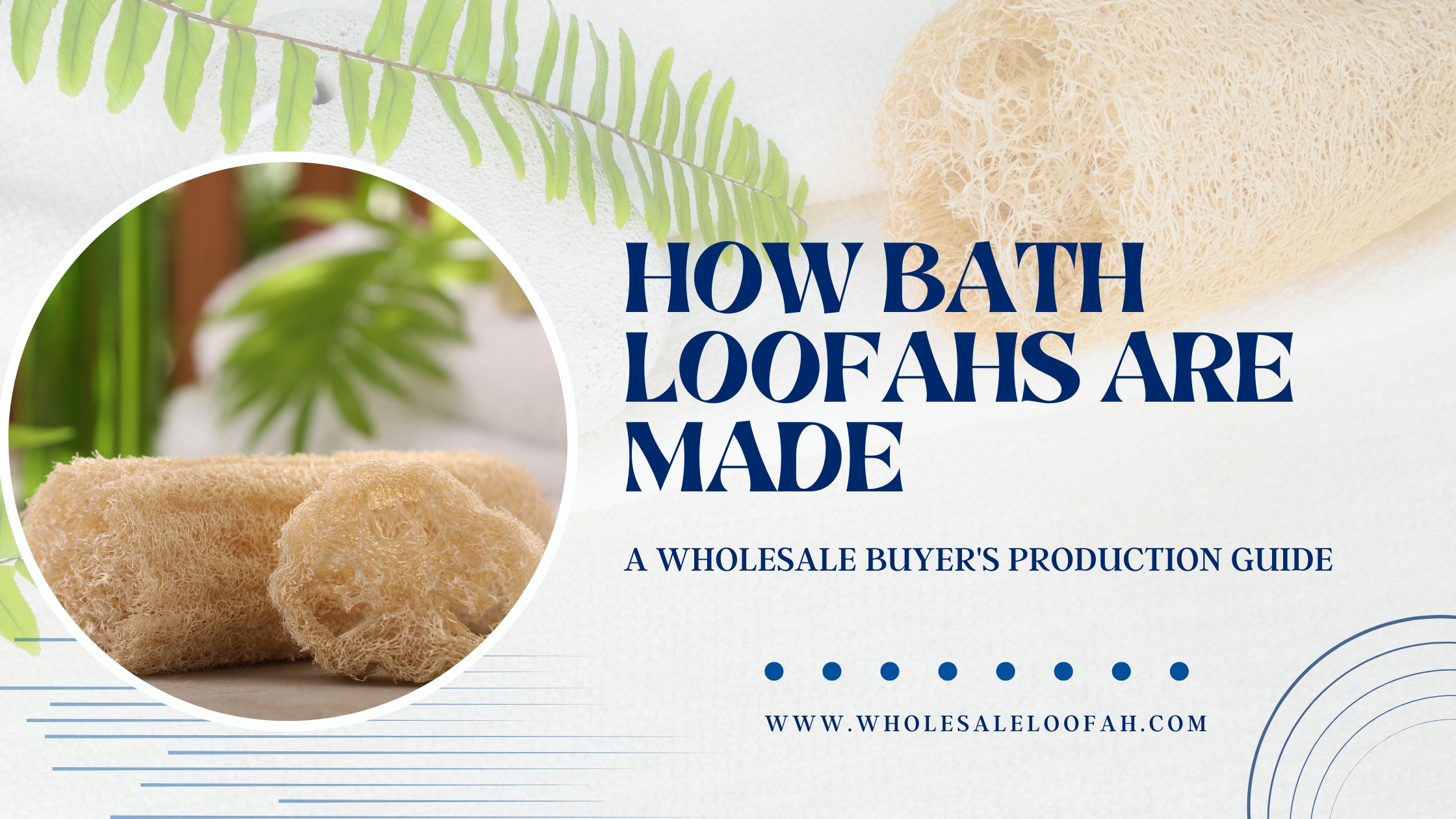
Wholesale buyers who understand how bath loofahs are made negotiate better deals, identify quality issues before they become customer complaints, and build supplier relationships that deliver consistent results year after year.
Production knowledge separates sophisticated buyers from those who purchase on price alone and discover quality problems only after customer returns start piling up. The difference between a reliable product line and a sourcing headache often traces back to manufacturing decisions made months before goods ever ship.
Natural loofah production involves agricultural timelines, processing variables, and quality control points that directly impact what arrives at your warehouse. Each stage presents opportunities for excellence or shortcuts that affect durability, appearance, and customer satisfaction with your products.
This guide examines loofah manufacturing from the wholesale buyer’s perspective. You will learn what happens at each production stage, which factors most significantly impact quality outcomes, and how to evaluate suppliers based on their production capabilities and practices.
For buyers ready to source from a supplier with proven production expertise, Egexo brings over 25 years of Egyptian loofah manufacturing experience to wholesale partnerships worldwide.
Why Production Knowledge Matters for Wholesale Buyers
Purchasing decisions based solely on samples and pricing overlook critical factors that determine long-term sourcing success. Understanding production provides advantages at every stage of the buyer-supplier relationship.
Negotiation Leverage Through Technical Understanding
Buyers who speak knowledgeably about harvest timing, fiber density, and processing methods command respect from suppliers. This expertise signals serious intent and discourages attempts to substitute inferior products or inflate pricing based on buyer ignorance.
When you understand production costs and constraints, you recognize realistic pricing versus inflated margins. You know which quality specifications are achievable and which represent wishful thinking. Negotiations proceed more efficiently when both parties share technical vocabulary and realistic expectations.
Quality Assurance Before Problems Reach Customers
Production knowledge enables proactive quality management rather than reactive complaint handling. Buyers who understand manufacturing can specify meaningful quality parameters, evaluate incoming shipments effectively, and identify problems before products reach retail shelves.
Quality issues in natural products often trace to specific production stages. Knowing these connections helps diagnose problems and communicate effectively with suppliers about corrections. A buyer who identifies fiber density problems as harvest timing issues demonstrates expertise that motivates supplier responsiveness.
Supply Chain Risk Management
Agricultural products face weather, seasonal, and capacity constraints that sophisticated buyers anticipate and plan around. Understanding production timelines helps forecast availability, plan inventory, and avoid the scramble for product during peak demand periods.
Production knowledge also reveals supplier capacity limitations. A manufacturer processing 50,000 units monthly cannot reliably deliver 100,000 units regardless of what sales representatives promise. Realistic capacity assessment prevents commitments that suppliers cannot fulfill.
Production Knowledge Application Matrix
| Business Function | How Production Knowledge Helps | Risk of Knowledge Gap |
|---|---|---|
| Supplier selection | Evaluate capabilities accurately | Partner with incapable suppliers |
| Price negotiation | Recognize fair pricing vs. margin inflation | Overpay or accept unrealistic low bids |
| Quality specification | Set achievable, meaningful standards | Specify impossible or meaningless parameters |
| Incoming inspection | Identify defects and their causes | Accept substandard goods unknowingly |
| Inventory planning | Anticipate seasonal constraints | Stockouts during demand peaks |
| Problem resolution | Diagnose issues and communicate solutions | Blame games without resolution |
The Loofah Production Cycle: Timeline and Business Implications
Learning how bath loofahs are made requires understanding the agricultural calendar that governs supply availability. Unlike manufactured goods with continuous production, natural loofahs follow seasonal patterns that wholesale buyers must accommodate.
Agricultural Timeline Overview
Loofah production spans approximately seven to eight months from planting through harvest-ready gourds. Post-harvest processing adds another four to eight weeks before products are export-ready. This extended timeline creates lead time requirements that catch inexperienced buyers off guard.
Annual Production Calendar for Egyptian Loofahs
| Month | Production Activity | Business Implications |
|---|---|---|
| February to March | Field preparation, planting | Supplier capacity committed for season |
| April to May | Vine establishment, early growth | Limited ability to increase orders |
| June to July | Flowering, fruit set | Yield estimates become clearer |
| August to September | Gourd development, maturation | Quality projections possible |
| October to November | Primary harvest window | Fresh inventory available |
| December to January | Secondary harvest, processing peak | Maximum availability, best selection |
| Year-round | Processing, shipping | Lead times vary by season |
Buyers placing orders in January for March delivery during processing peak face different lead times than those ordering in July when processing capacity exceeds available inventory. Understanding this calendar enables realistic planning.
Harvest Timing: The Critical Quality Determinant
No single factor impacts loofah quality more than harvest timing. Gourds harvested during the optimal one to two week window develop maximum fiber density and durability. Early or late harvest produces inferior products regardless of other factors.
For wholesale buyers, this reality has several implications. First, premium quality commands premium pricing because optimal harvest requires expertise and accepts lower yields than harvesting everything at once. Second, suppliers with experienced harvest crews deliver more consistent quality than those relying on untrained labor.
Quality variation within shipments often reflects harvest timing inconsistency. Suppliers managing large volumes sometimes expand harvest windows to meet quantity commitments, sacrificing quality uniformity. Buyers specifying premium grades should confirm supplier harvest practices support those specifications.
Detailed harvest and quality information is available on the Egexo Quality Standards page.
Processing Stages and Quality Control Points
Post-harvest processing transforms raw gourds into finished products. Each stage presents quality control opportunities that distinguish premium suppliers from commodity processors.
Stage One: Initial Processing and Cleaning
Freshly harvested loofahs contain outer skin, seeds, and residual plant material requiring removal. Processing methods vary in thoroughness, gentleness, and contamination control.
Initial Processing Method Comparison
| Method | Description | Quality Impact | Cost Factor |
|---|---|---|---|
| Traditional water soak | Extended soaking softens skin for manual removal | Gentle but variable results | Low |
| Mechanical peeling | Equipment removes skin with controlled pressure | Consistent but potential fiber damage | Medium |
| Hybrid approach | Soaking followed by light mechanical assistance | Balance of gentleness and consistency | Medium-high |
| Dry processing | Mature gourds processed without soaking | Limited application, specific products only | Variable |
Seed removal thoroughness affects finished product appearance. Retained seeds create dark spots that customers interpret as quality defects. Premium processing includes careful seed extraction and inspection for completeness.
Cleaning removes field soil, plant debris, and potential contaminants. Water quality, temperature control, and rinse cycles all influence cleanliness outcomes. Suppliers cutting corners on cleaning create products that may carry residues or develop odors during storage.
Stage Two: Sanitization and Safety Processing
Hygiene processing ensures products meet safety standards for skin contact applications. Methods range from minimal to comprehensive depending on supplier practices and destination market requirements.
Food-grade hydrogen peroxide treatment provides effective sanitization without chemical residues. UV exposure offers non-chemical sanitization but requires proper equipment and protocols. Heat treatment can sanitize but risks fiber damage if temperatures exceed safe thresholds.
Wholesale buyers should verify sanitization methods match their market requirements. Products destined for EU markets face different regulatory expectations than those for less regulated destinations. Supplier documentation of sanitization practices supports compliance and customer assurance.
Stage Three: Drying and Moisture Control
Proper drying prevents mold growth and stabilizes products for storage and shipping. Target moisture content typically ranges from 8 to 12 percent, measured objectively rather than estimated.
Drying Method Characteristics
| Drying Approach | Advantages | Disadvantages | Supplier Implications |
|---|---|---|---|
| Natural sun drying | Low cost, works well in suitable climates | Weather dependent, inconsistent timing | Limited to favorable locations |
| Covered air drying | Weather protection, natural airflow | Slower than heated methods | Moderate facility investment |
| Climate-controlled drying | Consistent results regardless of weather | Higher operating costs | Significant infrastructure required |
| Accelerated heated drying | Fast throughput | Risk of over-drying, energy intensive | Requires careful process control |
Buyers receiving product with moisture problems face mold risk in storage and potential customer complaints. Verifying supplier drying capabilities and moisture testing practices prevents these issues.
Curing following initial drying allows moisture equilibration before packaging. Rushed curing results in moisture migration after packaging, creating conditions for mold growth even in products that tested acceptable at packing.
Stage Four: Cutting, Shaping, and Finishing
Raw processed loofahs rarely sell in natural form. Cutting and shaping create product configurations serving different market segments and applications.
Cutting accuracy affects product consistency and material utilization. Precise cutting produces uniform products and minimizes waste. Sloppy cutting creates inconsistent sizing and excessive trim loss that suppliers pass along through higher pricing.
Edge finishing affects product appearance and durability. Clean cuts with properly sealed edges resist unraveling. Rough cuts with loose fibers look inferior and shed during use, generating customer complaints.
Finishing treatments may include softening, bleaching, or other processes depending on product specifications. Buyers should understand what treatments their products receive and verify compatibility with their market positioning and customer expectations.
Visit Egexo Farm to Export Process for comprehensive information about their complete production workflow.
Quality Grading Systems for Wholesale Buyers
Grading systems categorize finished products by quality characteristics. Understanding grades enables accurate specification and fair pricing evaluation.
Standard Industry Grades
Most quality-focused suppliers use grading terminology distinguishing premium products from standard and economy alternatives. While exact definitions vary, general patterns apply across the industry.
Wholesale Grade Specifications
| Grade | Fiber Density | Color Standards | Defect Limits | Sizing Tolerance | Typical Price Index |
|---|---|---|---|---|---|
| Premium / A | Very high, tight uniform weave | Consistent cream to light tan | Under 5% minor only | Plus/minus 5% | 100 (baseline) |
| Standard / B | High, consistent weave | Minor natural variation | Under 10% minor | Plus/minus 10% | 70 to 80 |
| Economy / C | Moderate, some variation | Natural variation accepted | Under 20% | Plus/minus 15% | 50 to 60 |
| Utility | Functional minimum | Not specified | Functional only | Not specified | 30 to 40 |
Price indices represent relative wholesale pricing with Premium as the baseline. Actual pricing varies by supplier, volume, and market conditions, but relationships between grades remain relatively consistent.
Grade Selection Strategy
Matching grade to market segment optimizes cost while meeting customer expectations. Premium grades suit luxury retail and professional spa applications where customers expect and pay for superior quality. Economy grades serve price-sensitive channels where cost matters more than longevity.
Grade Selection by Market Channel
| Market Channel | Recommended Grade | Rationale |
|---|---|---|
| Luxury retail and department stores | Premium / A | Customer expectations match pricing |
| Natural product specialty retail | Premium or Standard | Quality-conscious customers |
| General mass retail | Standard / B | Balance of quality and price |
| Dollar and discount stores | Economy / C | Price-driven purchasing |
| Hotel amenity programs | Standard or Economy | Single-use or limited-use application |
| Spa and professional | Premium / A | Reputation and repeat customer value |
| Private label premium | Premium / A | Brand reputation at stake |
| Private label value | Standard or Economy | Cost optimization priority |
Mixing grades within product lines lets buyers serve multiple channels from single supplier relationships. A retailer might stock Premium for specialty locations and Standard for mainstream channels, sourcing both from one supplier with simplified logistics.
Explore grade options across the Egexo product categories to understand available quality tiers.
Supplier Evaluation Based on Production Capabilities
Evaluating suppliers requires assessing production capabilities that determine consistent quality delivery. Site visits provide ideal evaluation opportunities, but informed questioning reveals much even remotely.
Production Facility Assessment Criteria
Facility Evaluation Checklist
| Assessment Area | What to Verify | Red Flags |
|---|---|---|
| Growing operations | Own farms or contracted, acreage, irrigation | Vague sourcing, no farm access |
| Harvest management | Crew training, timing protocols, quality sorting | Rushed harvest, untrained labor |
| Processing facilities | Equipment condition, cleanliness, capacity | Outdated equipment, hygiene issues |
| Quality control | Testing equipment, inspection protocols, documentation | No testing, verbal-only quality claims |
| Storage conditions | Climate control, pest management, inventory rotation | Exposed storage, pest evidence |
| Packing capabilities | Materials quality, labeling accuracy, consistency | Inconsistent packaging, labeling errors |
Suppliers welcoming facility visits demonstrate confidence in their operations. Reluctance to accommodate buyer visits suggests potential issues worth investigating through other means.
Capacity Verification
Stated capacity claims require verification. Ask specific questions about production volume history, current commitments, and realistic availability for new buyers.
Questions to ask suppliers:
- What was your total production volume last season?
- What percentage of capacity is currently committed to existing customers?
- What is realistic additional capacity available for new partnerships?
- How do you handle demand exceeding available supply?
- What lead times should I expect for orders of various sizes?
Answers revealing capacity constraints help set realistic expectations. Suppliers claiming unlimited capacity likely either overstate capabilities or sacrifice quality to meet volume commitments.
Documentation and Certification Review
Professional suppliers maintain documentation supporting quality claims and regulatory compliance. Request and verify relevant certifications before committing to partnerships.
Common Documentation to Request
| Document Type | Purpose | Verification Method |
|---|---|---|
| Quality certifications | Third-party quality verification | Contact certifying body |
| Export licenses | Legal export authority | Government database check |
| Phytosanitary certificates | Plant health verification | Agriculture department records |
| Test reports | Specific quality measurements | Request lab contact for verification |
| Insurance certificates | Shipment and liability coverage | Contact insurer directly |
Missing documentation may indicate informal operations that struggle with consistency and compliance. While smaller suppliers may lack extensive certifications, professional operations maintain appropriate documentation for their scale.
Learn about Egexo’s qualifications and capabilities on the Why Choose Egexo page.
Geographic Sourcing Considerations
Where loofahs grow significantly impacts quality characteristics. Regional differences affect fiber development, processing capabilities, and supply reliability.
Egyptian Production Advantages
Egyptian loofahs command premium positioning for measurable quality reasons. The Nile Delta growing region provides optimal conditions including consistent temperatures, appropriate humidity, mineral-rich soil, and established agricultural infrastructure.
Egyptian Loofah Quality Metrics
| Quality Measure | Egyptian Average | Global Average | Advantage |
|---|---|---|---|
| Fiber density | 85 to 95 fibers per square cm | 60 to 75 fibers per square cm | 30 to 40% higher |
| Product longevity | 8 to 12 weeks typical use | 4 to 6 weeks typical use | 2x durability |
| Color consistency | 90%+ uniform | 70 to 80% uniform | Better appearance |
| Sizing accuracy | Plus/minus 5% standard | Plus/minus 10 to 15% common | More consistent |
These advantages translate to customer satisfaction, reduced complaints, and brand reputation protection. Premium pricing for Egyptian origin reflects genuine quality differences rather than arbitrary positioning.
Alternative Sourcing Regions
Buyers seeking lower cost points or supply diversification may consider alternative origins. Each presents tradeoffs requiring evaluation against specific business requirements.
Regional Sourcing Comparison
| Region | Strengths | Limitations | Best Applications |
|---|---|---|---|
| Egypt | Quality leadership, established infrastructure | Premium pricing | Quality-focused buyers |
| China | High volume, competitive pricing | Inconsistent quality, variable suppliers | Cost-driven, careful supplier selection |
| India | Growing capabilities, moderate pricing | Limited premium grades | Mid-market applications |
| Colombia | Emerging quality, sustainability focus | Smaller scale, less established | Specialty and sustainability positioning |
| Mexico | Geographic proximity to North America | Limited scale, developing | Regional supply, reduced shipping |
Multi-origin sourcing strategies provide supply security but require managing multiple supplier relationships and potential quality variation across sources.
For comprehensive regional analysis, explore resources at Loofah Guide covering sourcing considerations in depth.
Product Categories and Manufacturing Considerations
Different product types require specific manufacturing capabilities. Understanding these requirements helps match supplier capabilities to product needs.
Bath and Body Products
Bath loofahs represent the largest product category with diverse configuration options. Manufacturing considerations include cutting precision, edge finishing, and any handle or strap attachment.
The Bath and Body Loofah category encompasses products from simple slices to elaborate configurations with handles, straps, and combined materials.
Bath Product Manufacturing Requirements
| Product Type | Manufacturing Complexity | Typical MOQ Range | Lead Time |
|---|---|---|---|
| Whole loofahs | Low, minimal processing | 500 to 1,000 units | 2 to 3 weeks |
| Sliced rounds | Medium, precision cutting | 1,000 to 2,500 units | 3 to 4 weeks |
| Back scrubbers | Medium-high, handle attachment | 500 to 1,500 units | 4 to 6 weeks |
| Loofah mitts | High, textile integration | 1,000 to 3,000 units | 6 to 8 weeks |
Kitchen and Household Products
Kitchen applications use loofah’s gentle abrasiveness for non-scratch cleaning. Products may emphasize firmer texture and different sizing than bath items.
The Kitchen Loofah selection includes products designed specifically for household cleaning applications.
Specialty and Custom Products
Beyond standard categories, loofah material supports diverse specialty applications. Pet grooming, spa treatments, craft supplies, and industrial applications each present opportunities for differentiated product offerings.
Custom Loofah Product Design services enable development of unique products serving specific market opportunities.
Private Label Manufacturing
Buyers seeking branded products benefit from private label manufacturing services. These programs provide finished goods with buyer branding, ready for retail distribution.
Private Label Program Considerations
| Program Element | Standard Offering | Premium Offering |
|---|---|---|
| Minimum order quantity | 2,000 to 5,000 units | 500 to 1,000 units |
| Branding options | Hang tag, basic labeling | Custom packaging, premium presentation |
| Product customization | Standard products only | Custom configurations available |
| Lead time | 6 to 8 weeks | 4 to 6 weeks priority processing |
| Design support | Basic templates provided | Custom design assistance |
Private Label Loofah Manufacturing details available programs and requirements for branded product partnerships.
Ordering Process and Logistics
Wholesale purchasing involves processes and logistics considerations beyond simple product selection. Understanding these elements facilitates smooth transactions.
Sample Evaluation Protocol
Professional buyers evaluate samples before committing to volume orders. Effective sample evaluation prevents costly mistakes with production orders.
Sample Evaluation Framework
| Evaluation Criteria | Assessment Method | Acceptance Standard |
|---|---|---|
| Fiber density | Compression test, visual inspection | Springs back immediately, tight weave |
| Color consistency | Visual comparison across samples | Minimal variation within batch |
| Sizing accuracy | Physical measurement | Within specified tolerance |
| Edge quality | Visual and tactile inspection | Clean cuts, no loose fibers |
| Odor | Direct smell test | Neutral, no mustiness or chemicals |
| Moisture | Moisture meter if available | Under 12% moisture content |
Request samples from Egexo to evaluate quality before volume commitments.
Order Quantities and Pricing Structure
Wholesale pricing follows volume-based structures with significant discounts for larger commitments. Understanding these structures enables optimization of purchasing economics.
Typical Wholesale Pricing Tiers
| Order Volume | Typical Discount from Retail | Lead Time | Payment Terms |
|---|---|---|---|
| Sample orders | Retail or slight discount | 1 to 2 weeks | Prepaid |
| 100 to 500 units | 25 to 35% discount | 2 to 3 weeks | Prepaid or 50% deposit |
| 500 to 2,000 units | 35 to 45% discount | 3 to 4 weeks | 30 to 50% deposit |
| 2,000 to 5,000 units | 45 to 55% discount | 4 to 6 weeks | Net 30 available |
| 5,000+ units | 55%+ discount, negotiated | 6 to 8 weeks | Negotiated terms |
Buyers balancing inventory costs against volume discounts should consider total cost including carrying costs, storage, and obsolescence risk alongside per-unit pricing.
Shipping and Import Considerations
International sourcing involves shipping logistics and import compliance requirements. Professional suppliers handle export documentation while buyers manage import responsibilities.
Key logistics considerations include shipping method selection between air freight for speed versus sea freight for cost, import duty rates for your destination country, customs clearance requirements and documentation, and storage and handling requirements during transit.
Most loofah shipments travel by sea freight, with transit times from Egypt to North American and European ports ranging from two to four weeks depending on routing. Air freight reduces transit to days but increases shipping cost significantly, typically justified only for urgent requirements or high-value specialty products.
Download the Egexo product catalog for comprehensive product and ordering information.
Building Successful Supplier Partnerships
Long-term supplier relationships deliver advantages beyond transactional purchasing. Investment in partnership development pays returns through priority treatment, collaborative problem solving, and supply security.
Partnership Development Approach
Successful partnerships develop through progressive commitment and demonstrated reliability on both sides. Initial transactions test compatibility before deeper integration.
Partnership Development Stages
| Stage | Buyer Actions | Supplier Expectations | Relationship Indicators |
|---|---|---|---|
| Trial | Sample evaluation, small test order | Serious intent, fair evaluation | Responsive communication |
| Establishment | Repeat orders, feedback sharing | Consistent ordering, timely payment | Priority allocation begins |
| Growth | Volume increases, forecast sharing | Commitment signals, planning cooperation | Dedicated support assigned |
| Strategic | Joint planning, exclusive arrangements | Long-term commitment, volume guarantees | Partnership pricing, priority treatment |
Buyers treating suppliers as transactional vendors receive transactional treatment. Those investing in relationships earn partnership benefits including priority during supply constraints, early access to new products, and collaborative problem resolution.
Communication Best Practices
Clear, professional communication prevents misunderstandings and builds trust. Effective supplier communication includes several key practices.
Provide specific, written specifications rather than verbal approximations. Document agreements and confirm understanding in writing. Share forecasts and planning information to enable supplier preparation. Communicate problems promptly with factual description rather than accusatory tone. Acknowledge good performance, not just problems.
Cultural communication considerations matter in international relationships. Egyptian business culture values relationship development and personal connection alongside commercial transactions. Patience with relationship building and respect for cultural norms facilitates smoother partnerships.
Frequently Asked Questions for Wholesale Buyers
What minimum order quantities should wholesale buyers expect for natural loofahs?
Minimum order quantities vary by supplier and product type. Sample orders typically have no minimum, allowing quality evaluation. Initial wholesale orders commonly start at 100 to 500 units depending on product complexity. Established relationships may access lower minimums for specialty items. Volume commitments of 2,000 units or more typically access best pricing tiers.
How far in advance should wholesale orders be placed to ensure availability?
Lead times range from two to three weeks for in-stock standard products to eight weeks or more for custom items or peak season orders. Seasonal production cycles mean ordering during processing peak in December through February typically offers best availability and selection. Buyers planning major promotions or seasonal inventory should place orders three to four months in advance.
What documentation should buyers request from loofah suppliers?
Request quality certifications, export licenses, phytosanitary certificates for plant products, and test reports for specific quality claims. Professional suppliers provide documentation readily. Additionally request references from existing customers in similar markets and verify certifications directly with issuing organizations when possible.
How can buyers verify supplier quality claims without visiting facilities?
Request samples from multiple production lots rather than single best-case samples. Ask detailed questions about production processes and evaluate response specificity. Check references with existing customers. Request photos or videos of facilities and processes. Consider third-party inspection services for significant orders.
What recourse do buyers have for quality problems with received shipments?
Professional suppliers maintain quality guarantee policies addressing defective products. Understand these policies before ordering. Document problems with photographs and measurements immediately upon receipt. Communicate factually and promptly. Most quality-focused suppliers resolve legitimate complaints through replacement, credit, or refund depending on circumstances and relationship.
How do natural loofah prices compare to synthetic alternatives?
Natural loofahs typically cost more per unit than basic synthetic mesh poufs but offer differentiation value supporting premium positioning. Quality natural loofahs last significantly longer than cheap synthetics, potentially offering better cost-per-use economics. Sustainability positioning and customer preference for natural products often justify price premiums in appropriate market segments.
What shipping methods work best for international loofah orders?
Sea freight suits most wholesale orders, offering substantial cost savings versus air transport. Transit times of two to four weeks from Egypt to major ports are acceptable for planned inventory. Air freight makes sense for urgent requirements, sample shipments, or very high-value specialty items where speed justifies additional cost.
Conclusion
Understanding how bath loofahs are made transforms wholesale purchasing from commodity transactions into strategic sourcing that protects margins, ensures quality, and builds competitive advantage.
Production knowledge enables informed supplier evaluation, realistic specification development, and effective quality management. The seven to eight month agricultural cycle, critical harvest timing windows, and multiple processing stages each create quality implications that sophisticated buyers leverage in their sourcing strategies.
Egyptian production maintains quality leadership through optimal growing conditions and established expertise. Buyers prioritizing quality consistently find Egyptian sourcing delivers superior products despite premium positioning. Cost-focused strategies may consider alternative origins with careful supplier vetting.
Key Takeaways for Wholesale Buyers:
- Production knowledge provides negotiation leverage and quality assurance capabilities
- Harvest timing is the single most important quality determinant
- Grade specifications should match market channel requirements and customer expectations
- Supplier evaluation should assess production capabilities, not just samples and pricing
- Partnership investment delivers priority treatment and collaborative problem resolution
- Lead time planning must account for agricultural seasonality and processing cycles
Ready to Source Quality Loofahs?