Wholesale loofah buyers face a critical sourcing decision that directly impacts profit margins, customer retention, and brand reputation. The choice between Egyptian loofah vs Asian loofah suppliers determines whether your business builds a loyal customer base or battles constant quality complaints and returns.
This supplier comparison guide examines the fundamental differences between Egyptian and Asian wholesale loofah from a procurement perspective. Understanding fiber characteristics, quality consistency, total cost of ownership, and supplier reliability enables informed sourcing decisions that protect your bottom line.
The wholesale loofah market divides clearly between Egyptian premium production and Asian volume manufacturing. Each sourcing region presents distinct advantages and trade-offs that align with different business models and customer expectations. Distributors serving luxury spas require different product characteristics than discount retailers targeting price-conscious consumers.
Whether you source for hospitality chains, retail distribution, e-commerce fulfillment, or specialty bath product lines, this comparison provides the evaluation framework needed for strategic supplier selection. The analysis covers fiber quality metrics, production standards, minimum order requirements, and long-term value calculations that professional buyers use when selecting wholesale loofah partners.
Understanding Wholesale Loofah Quality Fundamentals
Natural loofah quality varies dramatically based on growing conditions, cultivation practices, and processing methods. These variations create measurable differences in product performance that affect end-user satisfaction and return rates.
Fiber Structure Analysis
Loofah fiber structure determines softness, durability, and exfoliation effectiveness. Egyptian loofah develops under Nile Valley growing conditions that produce naturally open, pliable fiber networks. The extended growing season and optimal climate create fibers that feel comfortable against skin from first use without requiring conditioning periods.
Asian loofah, primarily from Chinese and Vietnamese production, grows under accelerated monsoon conditions that produce denser, more tightly woven fiber structures. This density creates initial harshness that requires extended break-in periods before comfortable use on sensitive skin areas. Some Asian producers market this density as durability, but the practical result is customer complaints during initial use.
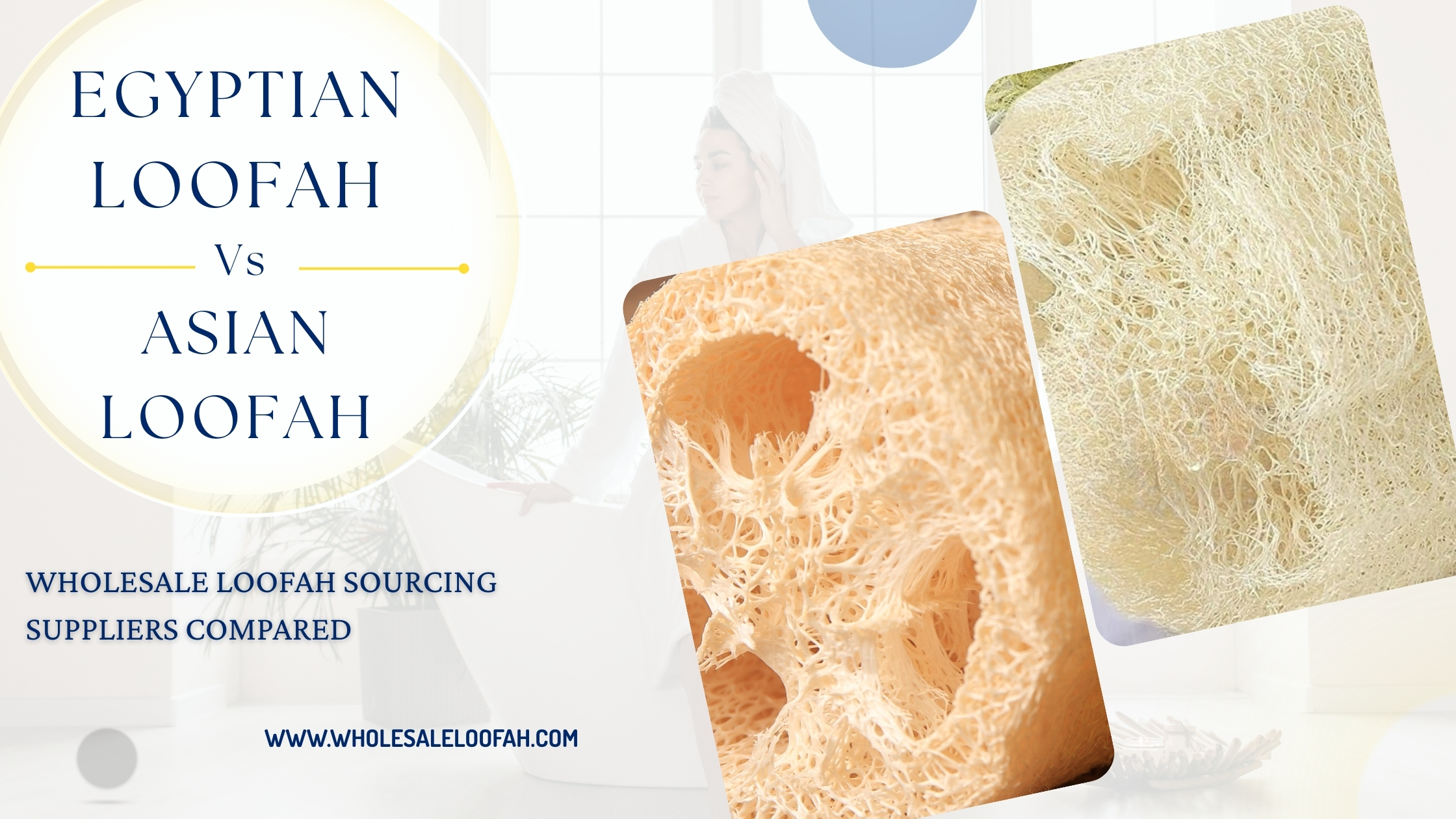
The fiber structure difference appears clearly under magnification. Egyptian loofah shows consistent spacing between fibers with visible air pockets throughout the matrix. Asian loofah displays compressed fiber patterns with minimal air space, creating the characteristic hardness that users notice immediately.
Geographic Quality Influences
Growing region fundamentally shapes loofah characteristics in ways that processing cannot alter. The Nile River Valley provides ideal conditions including consistent water supply, moderate temperatures, and mineral-rich soil that produces premium fiber quality. Egyptian farmers have cultivated loofah for generations, developing expertise in harvest timing and processing techniques that maximize quality.
Chinese production centers in provinces with monsoon climates where rapid growth cycles prioritize volume over fiber quality. Vietnamese production follows similar patterns with additional challenges from variable growing conditions across production regions.
Understanding these geographic influences helps buyers evaluate supplier claims about quality. No processing technique transforms dense Asian fibers into soft Egyptian-quality products. Origin determines baseline quality that only degrades through poor handling.
Wholesale Quality Comparison Framework
Professional buyers need objective comparison criteria rather than subjective quality descriptions. This framework provides measurable evaluation points for comparing Egyptian vs Asian loofah wholesale offerings.
Fiber Density and Softness Metrics
| Quality Metric | Premium Egyptian | Standard Asian | Impact on End User |
|---|---|---|---|
| Fiber density rating | Low to medium | High to very high | Immediate comfort vs break-in required |
| Initial softness score | 8-10 scale | 3-5 scale | First use satisfaction determines reviews |
| Break-in period | None to minimal | 2-8 weeks typical | Customer complaint probability |
| Air pocket percentage | 35-45 percent | 15-25 percent | Lather production and drainage |
| Fiber flexibility | High | Low to medium | Skin adaptation requirements |
Durability and Lifespan Comparison
Asian suppliers often emphasize durability as a selling point, claiming products last one to two years or longer. This claim requires context that reveals the marketing strategy behind it.
Egyptian loofah provides six to twelve months of comfortable daily use depending on care practices. The softer fiber structure eventually breaks down from regular use, which represents normal product lifecycle for consumable bath items.
Asian loofah may physically survive longer because users often abandon it in frustration before fibers soften adequately. A product that sits unused in a shower caddy for months technically survives but delivers zero value to the customer. The durability claim obscures the reality that extended lifespan results from limited use rather than superior construction.
For wholesale buyers, this distinction matters enormously. Products that customers actually use generate repeat purchases and positive reviews. Products that disappoint users create returns, negative reviews, and lost future sales. True business value comes from customer satisfaction, not physical product survival.
Quality Grade Classification System
| Grade Level | Egyptian Characteristics | Asian Characteristics | Wholesale Applications |
|---|---|---|---|
| Premium A | Immediately soft, consistent sizing, pristine appearance | Rarely available, requires extensive sorting | Luxury spa, premium retail, hospitality amenities |
| Standard B | Soft with minimal variation, minor imperfections acceptable | Moderately dense, requires some break-in | Quality retail, mid-market distribution |
| Economy C | Softer than Asian premium, variable sizing | Dense fibers, extended break-in, visible variation | Discount retail, promotional items |
| Bulk industrial | Still usable for body care | Too harsh for comfortable skin contact | Cleaning applications, craft supplies |
Supplier Evaluation Criteria for Wholesale Buyers
Beyond product quality, supplier capabilities determine whether procurement relationships support business growth or create operational headaches. Evaluate potential suppliers across these critical dimensions.
Production Capacity and Consistency
Egyptian production operates on smaller scale than Asian manufacturing but maintains higher consistency standards. Family farms and established cooperatives produce loofah following traditional methods that prioritize quality. Production volume limitations mean advance ordering and relationship development matter for securing reliable supply.
Asian production offers higher volume capacity with larger factory operations capable of fulfilling substantial orders quickly. However, consistency varies significantly between shipments as factories source from multiple farms with different quality levels. What arrives may not match approved samples.
For wholesale buyers, the capacity question connects directly to business model. High-volume discount operations may accept Asian variability for lower costs. Quality-focused businesses need Egyptian consistency even with volume constraints.
Quality Control Infrastructure
| QC Capability | Egyptian Suppliers | Asian Suppliers | Buyer Implications |
|---|---|---|---|
| Incoming material inspection | Standard practice | Variable by factory | Affects raw material quality |
| In-process monitoring | Consistent application | Often limited | Catches problems during production |
| Final inspection rigor | High, reject rates 5-15 percent | Low, accept most production | Determines shipped quality |
| Grading accuracy | Reliable grade matching | Grades often optimistic | What you order vs what arrives |
| Documentation quality | Detailed records available | Limited traceability | Issue resolution capability |
Communication and Responsiveness
Supplier communication patterns predict relationship quality and problem resolution effectiveness. Egyptian suppliers typically provide personalized service with direct access to decision-makers. Language barriers exist but professional export operations employ English-speaking staff familiar with international trade practices.
Asian suppliers range from responsive professional operations to difficult communication experiences depending on company size and export focus. Large factories may assign account representatives while smaller operations create communication challenges that complicate order management.
Evaluate communication during the evaluation phase as indicator of ongoing relationship quality. Suppliers who respond slowly or unclearly before winning business rarely improve afterward.
Total Cost Analysis for Procurement Decisions
Unit price comparisons mislead wholesale buyers by ignoring costs that accumulate throughout the supply chain and sales cycle. Total cost of ownership analysis reveals true procurement economics.
Landed Cost Calculation Components
| Cost Element | Egyptian Sourcing | Asian Sourcing | Notes |
|---|---|---|---|
| Base product cost | Higher per unit | Lower per unit | Starting point only |
| International freight | Similar rates | Similar rates | Distance differences minimal |
| Import duties | Varies by classification | Varies by classification | Check current rates |
| Quality inspection | Lower need | Higher recommended | Third-party verification costs |
| Sorting and grading | Minimal required | Often necessary | Labor cost for incoming QC |
| Packaging upgrades | Usually unnecessary | Sometimes needed | Presentation protection |
Hidden Cost Factors
Beyond direct procurement costs, product quality creates downstream expenses that rarely appear in supplier evaluations.
Return and complaint handling generates significant costs for lower quality products. Each return requires customer service time, shipping costs, replacement product, and potential refund processing. Asian loofah return rates of eight to fifteen percent common for products sold without adequate quality warnings. Egyptian loofah return rates typically under three percent when properly represented.
Negative review impact damages long-term sales beyond individual transactions. One-star reviews mentioning harshness or discomfort suppress future conversion rates. E-commerce sellers particularly vulnerable to review impact on search ranking and buy box eligibility.
Customer lifetime value reduction occurs when disappointing products prevent repeat purchases. Loofah represents consumable category where satisfied customers return regularly. Lost repeat business from quality disappointment represents largest hidden cost of budget sourcing.
ROI Comparison Framework
| Business Scenario | Egyptian ROI Factors | Asian ROI Factors |
|---|---|---|
| Premium positioning | Higher margins support premium cost, low returns | Quality mismatch damages brand, high returns |
| Mid-market retail | Quality differentiation justifies pricing | Adequate with proper customer expectations |
| Discount channel | May exceed price point requirements | Appropriate when customers expect budget quality |
| E-commerce | Reviews justify premium, repeat purchases | Review risk significant, one-time purchases |
| Spa and hospitality | Client satisfaction essential, premium required | Complaints damage service reputation |
Minimum Order Requirements and Terms
Order minimums and payment terms significantly affect working capital requirements and inventory risk. Understanding supplier expectations enables better negotiation and planning.
MOQ Comparison by Supplier Type
| Supplier Category | Typical MOQ Range | Lead Time | Payment Terms |
|---|---|---|---|
| Egyptian farm direct | 500-2,000 units | 4-8 weeks | Deposit plus balance |
| Egyptian export company | 200-1,000 units | 3-6 weeks | Flexible with relationship |
| Asian factory direct | 1,000-10,000 units | 6-12 weeks | Often full prepayment |
| Asian trading company | 500-5,000 units | 4-8 weeks | Variable by company |
| Domestic distributor | 50-200 units | 1-2 weeks | Net 30 common |
Negotiation Strategies for Better Terms
Professional buyers can often improve terms through strategic negotiation approaches.
Volume commitments enable lower per-order minimums when buyers guarantee annual volumes. Suppliers accept smaller individual orders knowing total business justifies relationship investment.
Mixed product orders combine MOQs across product varieties. Instead of meeting minimums for each size or style separately, negotiate combined minimums that provide flexibility.
Relationship building through consistent orders and clear communication opens better terms over time. Suppliers reward reliable buyers with preferential treatment including lower minimums and extended payment terms.
Sample order pathways allow smaller initial quantities for product testing before volume commitment. Most suppliers accommodate sample orders at higher per-unit costs that convert to standard pricing at volume.
Quality Assurance for International Sourcing
Importing loofah products requires quality assurance protocols that protect against shipment disappointments. Establishing verification procedures before ordering prevents costly surprises.
Pre-Shipment Inspection Protocols
| Inspection Point | What to Verify | Acceptable Standards |
|---|---|---|
| Fiber softness | Hand feel assessment | Match approved samples |
| Size consistency | Measure representative units | Within 10 percent of specification |
| Visual appearance | Surface condition, color | Clean, uniform, no debris |
| Structural integrity | Compression testing | Returns to shape, no crumbling |
| Packaging condition | Protection adequacy | Sufficient for transit protection |
| Quantity verification | Count or weight check | Matches order documentation |
Supplier Qualification Process
Systematic supplier qualification reduces risk and identifies reliable partners before committing to volume purchases.
Sample evaluation represents essential first step. Request samples representing actual production quality rather than specially selected premium units. Evaluate at least ten units to assess consistency within production. Test samples through actual use including wetting, lathering, and skin contact assessment.
Documentation review verifies supplier capabilities and business legitimacy. Request business registration, export licenses, quality certifications, and customer references. Professional suppliers provide documentation readily while questionable operations resist transparency.
Trial order placement tests fulfillment capabilities before larger commitments. Order smaller quantities at the start of relationships to verify quality matching samples, order accuracy, packaging adequacy, and shipping reliability.
Reference checking confirms supplier reputation with existing customers. Contact provided references and seek independent feedback through industry connections. Suppliers who resist reference requests may have satisfaction issues to hide.
Sourcing Strategy Development
Effective wholesale loofah sourcing requires strategic approach rather than opportunistic purchasing. Develop sourcing strategy aligned with business model and customer expectations.
Single Source vs Multi-Source Strategies
Single source advantages include relationship depth, volume leverage, and simplified operations. Concentrating purchases with one qualified supplier enables preferential treatment, better pricing, and streamlined procurement processes.
Single source risks create vulnerability to supplier disruptions, quality deterioration, or business changes. Without alternatives, any supplier problem becomes a business crisis.
Multi-source benefits provide backup options, competitive pressure, and quality benchmarking. Maintaining relationships with multiple qualified suppliers protects against disruptions and enables performance comparisons.
Multi-source challenges include split volumes reducing leverage, increased management complexity, and potential inconsistency across sources.
Most wholesale buyers benefit from primary supplier relationships with qualified backup options. Concentrate volume with preferred suppliers while maintaining smaller relationships that could scale if needed.
Market Positioning Alignment
Sourcing decisions should align with market positioning and customer expectations.
Premium market positioning requires Egyptian sourcing for quality consistency and customer satisfaction. The cost differential represents small percentage of premium retail pricing while quality directly affects customer experience and reviews.
Value market positioning may accommodate Asian sourcing with appropriate customer expectation management. Clear product descriptions setting realistic quality expectations reduce disappointment and returns.
Mixed positioning with tiered product lines can leverage both sources appropriately. Premium lines source Egyptian quality while economy lines use Asian products clearly differentiated in marketing and pricing.
Risk Assessment and Mitigation
International sourcing involves inherent risks that require proactive management. Identify potential problems and establish mitigation strategies before they affect operations.
Supply Chain Risk Factors
| Risk Category | Egyptian Sourcing | Asian Sourcing | Mitigation Approaches |
|---|---|---|---|
| Quality variation | Low risk | Higher risk | Inspection protocols, supplier qualification |
| Supply disruption | Moderate, smaller scale | Lower, more sources | Backup supplier relationships |
| Lead time delays | Moderate | Moderate to high | Safety stock, advance ordering |
| Communication issues | Low with established suppliers | Variable | Clear specifications, written confirmations |
| Currency fluctuation | Affects pricing | Affects pricing | Forward contracts, pricing agreements |
Contingency Planning
Establish contingency plans for common supply chain disruptions.
Quality rejection contingencies specify responses when shipments fail inspection. Negotiate return policies, credit terms, and replacement timelines before issues occur. Clear agreements expedite resolution when problems arise.
Supply shortage contingencies identify alternative sources and customer communication plans. Maintain relationships with backup suppliers who could fulfill emergency orders. Prepare customer communication templates for potential delays.
Cost increase contingencies plan responses to unexpected pricing changes. Build supplier agreements with advance notice requirements for price changes. Maintain margin buffers that absorb moderate increases without immediate customer price adjustments.
Making the Right Wholesale Decision
Choosing between Egyptian and Asian loofah suppliers depends on business model, customer expectations, and quality requirements. Neither option universally superior because different business contexts favor different approaches.
Decision Framework by Business Type
Spa and wellness distributors should prioritize Egyptian sourcing almost exclusively. Client satisfaction depends on immediate product comfort. The relatively small cost difference becomes negligible within professional service pricing. Quality complaints damage spa reputations far more than product cost savings justify.
Premium retail operations benefit from Egyptian quality that supports premium pricing and generates positive reviews. Customers paying premium prices expect premium quality. Quality disappointment creates lasting negative reviews that damage long-term sales.
Mid-market retailers can evaluate both options based on specific customer base and positioning. Quality Egyptian loofah may differentiate offerings while Asian products compete on price. Market testing both approaches can identify optimal fit.
Discount and promotional channels represent appropriate applications for Asian sourcing when customer expectations align with product characteristics. Clear communication about product features manages expectations and reduces complaints.
E-commerce sellers face particular review sensitivity that favors quality sourcing. Negative reviews accumulate permanently and affect all future customers. The long-term cost of quality complaints often exceeds short-term procurement savings.
Quality Investment Justification
Professional buyers sometimes struggle to justify premium pricing for seemingly simple products. Consider these factors when evaluating quality investment.
Customer acquisition cost perspective puts product cost in context. If acquiring a customer costs fifteen to fifty dollars through marketing, losing that customer over a two to five dollar product cost difference represents poor economics.
Repeat purchase value multiplies over customer lifetime. Loofah represents consumable product where satisfied customers return every six to twelve months. Lifetime customer value far exceeds individual transaction margins.
Review and reputation impact affects all future customers. Each negative review reduces conversion rate for all subsequent visitors. Reputation damage from quality complaints costs more than product savings generate.
FAQ Section
Q1: What minimum order quantities should I expect for Egyptian vs Asian loofah wholesale?
A: Egyptian suppliers typically require 200-2,000 units depending on whether you source from export companies or direct from farms. Asian factories often require 1,000-10,000 units for direct orders, though trading companies may work with 500-5,000 units. Domestic distributors offer lowest minimums at 50-200 units but at higher per-unit costs. Volume commitments and relationship building can reduce minimums over time with established suppliers.
Q2: How do return rates compare between Egyptian and Asian wholesale loofah?
A: Egyptian loofah typically generates return rates under three percent when products are properly represented to customers. Asian loofah commonly experiences eight to fifteen percent return rates, primarily from customer complaints about initial harshness and extended break-in requirements. These return rate differences significantly impact total cost of ownership and should factor into procurement decisions beyond unit price comparisons.
Q3: What quality certifications should wholesale loofah suppliers provide?
A: Professional suppliers should provide business registration, export licenses, and quality management documentation. Organic certifications require verified chain of custody documentation. Phytosanitary certificates may be required for import compliance. Request documentation of grading standards, inspection procedures, and defect handling policies. Reluctance to provide documentation suggests potential quality or legitimacy concerns.
Q4: How should I evaluate wholesale loofah samples before placing volume orders?
A: Request representative samples reflecting actual production quality rather than specially selected premium specimens. Evaluate at least ten units to assess consistency. Test through actual use including wetting, lather production, and skin contact on various body areas. Document findings using standardized criteria for objective supplier comparison. Compare samples from multiple suppliers under identical conditions.
Q5: What factors contribute to total landed cost beyond unit price?
A: Total landed cost includes international freight at typically eight to fifteen percent of product value, import duties varying by product classification, customs brokerage fees of 150-400 USD per shipment, domestic transportation, and banking fees for international payments. Additional hidden costs include quality inspection, sorting requirements for inconsistent products, return handling, and customer service for quality complaints.
Q6: How do I assess wholesale loofah supplier reliability before committing?
A: Evaluate communication responsiveness during initial contact, request and verify customer references, review business documentation and export history, place trial orders to test fulfillment quality, and establish clear quality specifications in writing. Professional suppliers welcome verification processes while unreliable operations resist transparency. Long-term relationships should develop gradually with increasing order volumes as trust builds.
Q7: What lead times should I plan for Egyptian vs Asian wholesale loofah?
A: Egyptian suppliers typically require three to eight weeks depending on order size and shipping method. Asian suppliers may require six to twelve weeks for factory-direct orders due to production scheduling and longer ocean freight routes. Domestic distributors offer one to two week fulfillment. Build safety stock appropriate for lead time variability and seasonal demand patterns.
Q8: How does wholesale loofah quality affect e-commerce business performance?
A: E-commerce sellers face particular sensitivity to product quality because negative reviews accumulate permanently and affect all future customers. Products generating customer complaints receive one and two-star reviews that suppress search ranking and conversion rates. The long-term revenue impact of negative reviews typically exceeds short-term savings from lower quality sourcing. Premium quality products generate positive reviews that compound business value over time.
Expert Insight from Wholesale Loofah
Procurement professionals often underestimate how fiber quality differences between Egyptian and Asian loofah translate into measurable business outcomes. The unit price difference between premium Egyptian and budget Asian sourcing typically ranges from 30-50 percent, but this comparison ignores the cascading effects of customer experience on business performance. Return processing costs, negative review impact, and lost repeat purchases can easily exceed the apparent savings from lower-cost sourcing. Smart wholesale buyers calculate total cost of ownership including downstream effects rather than comparing invoice prices alone. For any business where customer satisfaction drives growth, quality sourcing pays for itself through reduced returns and increased customer lifetime value.
Conclusion
The wholesale loofah sourcing decision between Egyptian and Asian suppliers extends far beyond unit price comparison. Fiber quality differences create measurable impacts on customer satisfaction, return rates, and long-term business performance that professional buyers must factor into procurement decisions.
Egyptian loofah delivers immediate softness, consistent quality, and customer satisfaction that supports premium positioning and repeat purchases. Asian loofah offers lower unit costs with trade-offs in initial comfort and quality consistency that may suit specific market applications.
Key Takeaways:
- Fiber density differences between origins are fundamental and processing cannot alter them
- Return rates vary significantly with Egyptian under 3 percent vs Asian at 8-15 percent typical
- Total cost analysis including hidden costs often favors quality sourcing
- Business model and customer expectations should drive sourcing strategy
- Supplier qualification processes protect against costly procurement mistakes
Continue Your Wholesale Loofah Research:
- Explore comprehensive loofah sourcing guides at Loofah Guide
- Learn about quality standards at Loofah Guide Quality Standards
- Discover premium Egyptian loofah products at Egexo Shop
- Request wholesale samples for quality evaluation at Egexo Samples
- Download the complete product catalog at Egexo Catalog