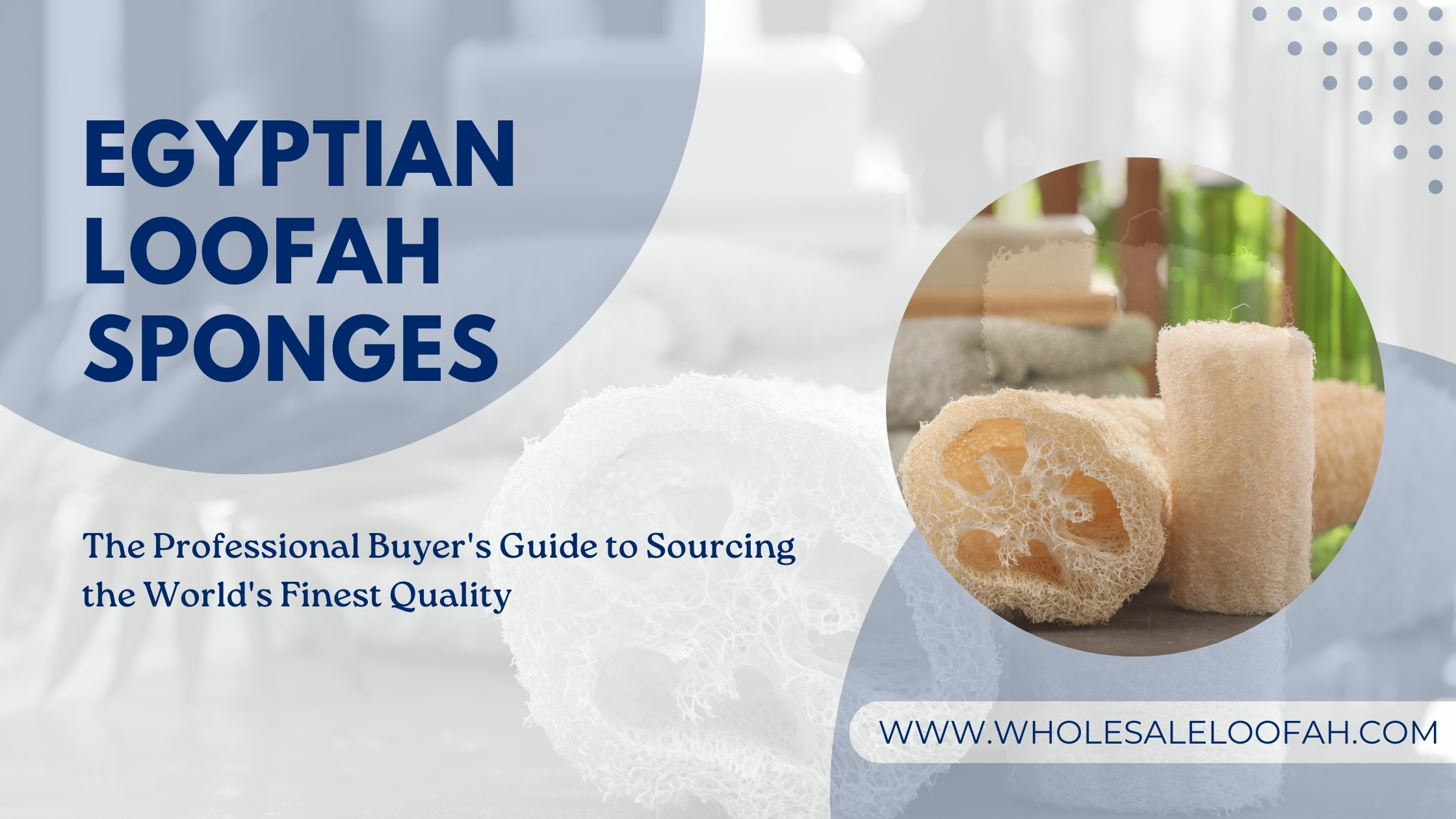
Global trade in natural bath accessories exceeds 4.7 billion USD annually, with demand for authentic plant-based products growing at roughly nine percent year over year. Within this expanding market, Egyptian loofah sponges command premium positioning because informed buyers recognize quality differences that directly impact product performance, customer satisfaction, and business profitability.
This professional guide provides the comprehensive information needed to source Egyptian loofah effectively, whether you operate a retail store seeking inventory, manage a spa requiring treatment supplies, run a distribution business importing natural products, or simply want to understand what separates genuinely superior products from marketing claims. The quality markers, evaluation criteria, and sourcing strategies presented here represent knowledge developed through decades of industry experience.
Egexo brings over 25 years of direct involvement in Egyptian loofah cultivation, processing, and export to partners across international markets. This expertise informs the practical guidance throughout this article, ensuring you receive actionable information rather than superficial overviews. Understanding why Egyptian loofah represents the gold standard transforms purchasing from guesswork into strategic decision-making that benefits your business or personal needs.
The Technical Case for Egyptian Loofah Superiority
Professional buyers require substantive reasons for sourcing decisions, not just assertions of quality. The Egyptian loofah advantage rests on measurable characteristics that laboratory analysis confirms and practical experience validates.
Quantified Quality Differences by Production Region
Independent testing of loofah samples from major global production regions demonstrates consistent quality hierarchies that explain market positioning and pricing differentials.
| Quality Metric | Egyptian Origin | Chinese Origin | Vietnamese Origin | Indian Origin | Industry Average |
|---|---|---|---|---|---|
| Fiber Density Index | 87 | 66 | 58 | 71 | 64 |
| Tensile Strength Rating | 94 | 72 | 68 | 75 | 71 |
| Color Consistency Score | 91 | 63 | 59 | 74 | 67 |
| Typical Product Lifespan | 4 to 6 months | 2 to 3 months | 2 to 3 months | 2 to 4 months | 2.5 months |
| Mold Incidence Rate | Under 2 percent | 8 to 15 percent | 12 to 20 percent | 6 to 12 percent | 10 percent |
| Chemical Treatment Frequency | Rare | Common | Common | Occasional | Varies |
| Premium Grade Yield | 35 percent | 12 percent | 8 percent | 18 percent | 15 percent |
Index scores represent normalized values from laboratory assessments conducted between 2022 and 2024. These metrics translate directly into product characteristics that end users experience and professional buyers can leverage for competitive positioning.
For retailers and distributors, the fiber density and tensile strength advantages mean fewer customer complaints about premature product failure. The low mold incidence rates reduce inventory loss and quality control costs. Higher premium grade yields enable better assortment strategies with authentic quality differentiation between product tiers.
Agricultural and Processing Factors Creating Quality Differences
Understanding the factors producing Egyptian loofah superiority enables buyers to evaluate supplier claims critically and recognize genuine quality indicators.
Egypt’s Nile Valley provides growing conditions optimized for loofah fiber development through natural factors no other region replicates. Alluvial soil accumulated over millennia delivers mineral profiles supporting robust plant growth. Annual sunshine exceeding 3,800 hours enables complete fruit maturation producing maximum fiber development. Characteristically low humidity during harvest and processing seasons allows natural drying without the chemical treatments required in more humid regions.
Processing methods matter equally to growing conditions. The traditional Egyptian approach involves extended sun-drying periods that reduce moisture content gradually without fiber damage. This patience produces stable products resistant to mold development during shipping and storage. Rushed processing common in high-volume, low-cost operations compromises fiber integrity and creates mold susceptibility that manifests after products reach buyers.
Generational knowledge within Egyptian farming families has refined both cultivation and processing across hundreds of growing seasons. This accumulated expertise produces consistent quality that newer production regions, lacking equivalent knowledge depth, struggle to match regardless of growing condition advantages they might possess.
Professional Quality Grading Standards for Loofah Sponges
Wholesale buyers must understand grading systems to evaluate supplier offerings accurately and specify requirements clearly.
Industry Grading Framework and Characteristics
| Grade Designation | Defining Characteristics | Quality Yield | Primary Markets | Typical Applications |
|---|---|---|---|---|
| Premium A Plus | Exceptional density, perfect uniformity, immaculate appearance | Top 10 percent | Luxury retail, high-end hospitality, premium gift | Flagship products, VIP services |
| Premium A | Very dense uniform fibers, excellent appearance, no defects | Next 25 percent | Quality retail, professional spas, export markets | Core premium offerings |
| Standard B Plus | Dense fibers, minor variations acceptable, clean appearance | Next 25 percent | Mid-range retail, hospitality, professional use | Volume products with quality positioning |
| Standard B | Good density, some variation, functional appearance | Next 20 percent | Value retail, promotional applications | Price-sensitive quality requirements |
| Commercial C | Adequate density, visible variations, functional quality | Next 15 percent | Budget retail, industrial applications, crafting | Cost-priority applications |
| Utility Grade | Variable quality, cosmetic irregularities, functional use | Remaining 5 percent | Processing into components, pet products, industrial | Non-appearance applications |
Buyers should specify grade requirements clearly in communications with suppliers and verify grade consistency through sample evaluation before production orders. The quality standards documentation from Egexo provides detailed grade specifications that enable precise requirement communication.
Grade Selection Strategy by Business Application
Matching grade selection to intended application optimizes value by avoiding both overpaying for unnecessary quality and underspecifying for demanding applications.
| Business Application | Recommended Grade | Rationale |
|---|---|---|
| Luxury spa treatments | Premium A Plus or A | Client expectations demand flawless quality |
| Premium retail positioning | Premium A | Supports premium pricing and brand reputation |
| Mid-market retail | Standard B Plus | Balances quality perception with margin requirements |
| Promotional or gift with purchase | Standard B | Adequate quality for non-primary product positioning |
| Hospitality amenity programs | Standard B Plus | Volume pricing with acceptable quality for guest use |
| Private label premium lines | Premium A | Quality must support brand positioning claims |
| Private label value lines | Standard B Plus or B | Cost structure drives selection within acceptable quality |
| Craft supply wholesale | Commercial C | End user application tolerates variation |
| Pet grooming products | Standard B or Commercial C | Functional quality sufficient for application |
Professional buyers often maintain inventory across multiple grades to serve different customer segments or application requirements. Working with suppliers capable of consistent quality across grades simplifies procurement compared to managing multiple supplier relationships.
Supplier Evaluation Framework for Professional Buyers
Selecting the right loofah supplier determines both product quality and procurement efficiency. This systematic evaluation framework enables confident supplier assessment.
Critical Evaluation Criteria and Assessment Methods
| Evaluation Area | Assessment Questions | Positive Indicators | Warning Signs |
|---|---|---|---|
| Production Capability | What is annual capacity? Own farms or broker model? | Vertically integrated operations, documented capacity | Vague answers, inability to specify capacity |
| Quality Control Systems | What inspection points exist? How is grading performed? | Documented QC protocols, willingness to share process | No formal QC system, defensive about methodology |
| Export Documentation | What certifications provided? Experience with your market? | Complete documentation, familiarity with destination requirements | Missing documents, unfamiliar with regulations |
| Customization Flexibility | Private labeling available? Custom specifications possible? | Clear capability description, reasonable development terms | Rigid offerings, excessive custom pricing |
| Sample Policy | Samples available? Process for evaluation orders? | Ready sample provision, evaluation order options | Sample reluctance, charges for evaluation quantities |
| Communication Quality | Response timeliness? Technical question capability? | Prompt responses, knowledgeable answers | Slow replies, evasive technical responses |
| Reference Availability | Customer references available? Relationship longevity? | Ready references, long-term relationships documented | Reference refusal, only recent relationships |
| Financial Stability | Payment terms offered? Business history length? | Standard trade terms, established operations | Cash only demands, recent market entry |
Egexo welcomes rigorous evaluation from prospective partners because transparency strengthens business relationships. Our comprehensive supplier information addresses evaluation criteria directly while our team responds promptly to specific assessment questions.
Sample Evaluation Protocol for Quality Verification
Professional buyers should never commit to production quantities without physical sample evaluation. This protocol ensures systematic assessment.
| Evaluation Step | Action | What to Assess |
|---|---|---|
| Visual Inspection | Examine samples in good lighting | Color uniformity, fiber density visibility, surface cleanliness |
| Light Test | Hold samples against light source | Fiber density consistency, identification of thin spots |
| Compression Test | Gently compress and release | Recovery speed indicating fiber integrity |
| Flexibility Test | Bend samples gently | Fiber suppleness without cracking or breaking |
| Water Absorption | Submerge and observe | Absorption speed and capacity |
| Drying Test | Dry samples and monitor | Drying time and appearance after drying |
| Scent Check | Smell samples dry and wet | Absence of mold, chemical, or off odors |
| Measurement Verification | Measure dimensions | Consistency with specifications |
| Quantity Check | Count samples against invoice | Accuracy of shipped quantities |
Request samples representing multiple grades if your business will utilize different quality tiers. Evaluate samples across multiple days including wet and dry states to simulate actual use conditions. The sample request process from Egexo enables comprehensive evaluation before purchase commitment.
Procurement Strategy and Order Planning
Strategic procurement approaches optimize both product quality and operational efficiency.
Minimum Order Quantity Considerations
MOQ structures vary by supplier, product type, and customization requirements. Understanding these variables enables effective negotiation and planning.
| Product Category | Typical MOQ Range | MOQ Drivers | Negotiation Potential |
|---|---|---|---|
| Standard body loofah | 500 to 2000 units | Grade, size, packaging | Moderate flexibility possible |
| Kitchen loofah | 1000 to 3000 units | Size variations, packaging | Good flexibility |
| Raw loofah material | 100 to 500 kg | Processing requirements | Limited, processing dependent |
| Private label products | 1000 to 5000 units | Packaging development costs | Higher MOQ but negotiable structure |
| Custom shapes or sizes | 2000 to 5000 units | Tooling and setup costs | MOQ tied to development amortization |
| Mixed grade orders | Variable | Complexity management | Often favorable combined MOQ |
New buyer relationships typically start at standard MOQ levels, with reduction potential as relationships develop and ordering patterns become predictable. Demonstrating order consistency and growth potential often enables MOQ flexibility that benefits both parties.
For detailed MOQ information tailored to specific requirements, request a quotation from Egexo specifying your product interests and anticipated volumes.
Pricing Structure Analysis for Budget Planning
Understanding typical pricing structures enables realistic budget development and informed negotiation.
Loofah pricing follows tiered structures where unit costs decrease as order volumes increase. Typical tier break points occur at MOQ, double MOQ, container load quantity, and multiple container volumes. Price reductions between tiers commonly range from 10 to 25 percent depending on supplier cost structures and market conditions.
Base pricing varies significantly by grade, with premium grades commanding 40 to 60 percent premiums over commercial grades. Size variations within grades create additional pricing dimensions, with larger formats typically costing less per unit weight than smaller processed sizes.
Customization adds costs that partially offset volume discounts. Private label packaging, custom shapes, and special processing requirements each contribute cost elements. However, these costs amortize across production runs, meaning subsequent orders after initial development benefit from reduced per-unit pricing.
Shipping and logistics represent significant cost components for international buyers. FOB pricing excludes freight, insurance, and import duties that can add 15 to 30 percent to landed costs depending on destination. CIF pricing includes freight and insurance but still excludes import duties and local handling. Understanding your total landed cost rather than just product pricing enables accurate margin calculations.
Market Opportunity Analysis for Loofah Products
Professional buyers benefit from understanding market dynamics that inform inventory planning and product development decisions.
Consumer Trend Analysis Driving Demand
| Trend Category | Specific Development | Impact on Loofah Demand | Business Implications |
|---|---|---|---|
| Sustainability Consciousness | Plastic alternative seeking | Strong positive, natural loofah directly addresses | Position sustainability messaging prominently |
| Natural Personal Care Growth | Movement away from synthetic products | Strong positive, authentic natural credentials | Emphasize plant origin and processing purity |
| Experience Economy | Consumers seeking elevated daily rituals | Moderate positive, premium bathing experiences | Quality positioning supports premium pricing |
| Zero Waste Movement | Consumers eliminating disposable products | Strong positive, biodegradability advantage | Market compostability and lifespan advantages |
| Wellness Integration | Self-care emphasis in daily routines | Moderate positive, bathing as wellness practice | Connect to broader wellness narratives |
| Transparency Demands | Sourcing and supply chain interest | Positive for documented origins | Traceable sourcing becomes competitive advantage |
These trends support sustained demand growth for quality natural loofah products across consumer segments. Retailers and distributors positioned with authentic Egyptian loofah inventory benefit as consumer preferences continue shifting toward natural alternatives.
Product Category Opportunities
Beyond traditional body loofah, adjacent product categories offer expansion opportunities for distributors and retailers.
The kitchen loofah category addresses growing demand for natural cleaning alternatives in household applications. These products appeal to the same sustainability-conscious consumers purchasing natural bath products, enabling cross-category selling and basket building.
The pet and spa grooming segment represents an emerging opportunity as pet owners increasingly apply the same natural product preferences to animal care. Pet specialty retailers and grooming service providers represent distinct customer segments for loofah suppliers and their distribution partners.
The raw loofah materials category serves craft suppliers, soap makers, and manufacturers incorporating loofah components into their own products. This B2B segment offers volume opportunities distinct from finished product distribution.
Consumer Education Supporting Wholesale Success
While wholesale buyers focus on procurement, understanding end consumer needs informs product selection and supports retail partner success.
End User Benefits Communication Points
Retailers selling loofah products benefit when staff and marketing materials communicate benefits effectively to consumers.
| Benefit Category | Consumer-Relevant Points | Supporting Details |
|---|---|---|
| Skin Health | Effective exfoliation removing dead skin cells | Supports cell turnover, improves product absorption |
| Circulation | Gentle stimulation increases surface blood flow | Promotes healthy skin appearance |
| Sustainability | Completely biodegradable, compostable at end of life | Eliminates contribution to microplastic pollution |
| Value | Extended lifespan compared to plastic alternatives | Four to six month lifespan provides superior cost per use |
| Natural Origin | 100 percent plant-based, no synthetic materials | Appeals to natural product preference |
| Sensory Experience | Satisfying texture, natural lathering properties | Elevates daily bathing routine |
For comprehensive consumer education resources, LoofahGuide.com provides detailed information that retailers can reference or direct consumers toward.
Care Instructions for Retail Partners
Providing care guidance to retail customers reduces complaints and returns while building loyalty through helpful service.
| Care Requirement | Consumer Instruction | Rationale |
|---|---|---|
| Post-Use Rinsing | Rinse thoroughly after each use | Removes residue preventing bacterial growth |
| Drying Location | Hang outside shower in ventilated area | Prevents moisture retention enabling bacteria |
| Weekly Sanitization | Soak in diluted vinegar solution five minutes | Eliminates bacterial accumulation |
| Replacement Timing | Replace when fibers detach or odors persist | Maintains hygiene and effectiveness |
| Initial Softening | Soak 10 to 15 minutes before first use if too firm | Allows fiber relaxation for sensitive skin |
Including printed care instructions with retail products reduces customer service demands while improving product satisfaction and lifespan.
Private Label Development Opportunities
Developing proprietary branded loofah product lines enables retailers and distributors to capture margins currently flowing to branded manufacturers while building distinctive market positioning.
Private Label Development Process
| Development Phase | Activities | Timeline | Key Considerations |
|---|---|---|---|
| Concept Development | Define target market, positioning, product specifications | 2 to 4 weeks | Align with brand strategy and market opportunity |
| Supplier Engagement | Identify capable suppliers, request capabilities, evaluate options | 2 to 4 weeks | Technical capability and reliability assessment |
| Sample Development | Request custom samples matching specifications | 3 to 6 weeks | Iterate until quality and specifications satisfy |
| Packaging Design | Develop brand packaging, labeling, marketing materials | 4 to 8 weeks | Coordinate with supplier printing capabilities |
| Production Order | Place initial production order at negotiated terms | 6 to 12 weeks | MOQ tied to development cost amortization |
| Quality Verification | Inspect production samples before shipment | 1 to 2 weeks | Confirm consistency with approved samples |
| Market Launch | Deploy inventory with marketing support | Ongoing | Monitor sell-through and customer feedback |
Egexo offers comprehensive private label manufacturing services supporting brands from concept through production. Our capabilities include custom product development, packaging design coordination, and flexible production runs accommodating various brand scales.
The custom loofah product design services enable development of distinctive product formats beyond standard offerings.
Logistics and Import Considerations
International buyers must navigate logistics and regulatory requirements efficiently.
Shipping and Delivery Framework
| Shipping Element | Considerations | Impact on Planning |
|---|---|---|
| Lead Time | Order processing plus production plus shipping transit | Plan orders 8 to 16 weeks ahead for international |
| Incoterms Selection | FOB, CIF, or DDP options affect responsibility and cost | Clarify terms before ordering to enable accurate costing |
| Container Optimization | Full container load versus less than container load | FCL pricing significantly better for large orders |
| Documentation Requirements | Commercial invoice, packing list, certificate of origin, phytosanitary | Verify supplier documentation capabilities |
| Customs Classification | HS code determination affects duties | Confirm classification before importing |
| Insurance Coverage | Marine cargo insurance for transit protection | Include in landed cost calculations |
Egexo provides complete export documentation and has extensive experience shipping to markets across North America, Europe, Asia, and Oceania. Our farm to export process ensures documentation accuracy and regulatory compliance for smooth customs clearance.
FAQ Section
Q1: What minimum order quantities should new wholesale buyers expect when sourcing Egyptian loofah?
A: Minimum order quantities for standard Egyptian loofah products typically range from 500 to 2000 units depending on product type, grade, and supplier. Private label or custom products often require 1000 to 5000 unit minimums to justify setup and packaging development costs. Reputable suppliers offer flexibility as relationships develop and ordering patterns become predictable.
Q2: How do Egyptian loofah prices compare to alternatives from other production regions?
A: Egyptian loofah commands premiums of 20 to 40 percent over Chinese or Vietnamese alternatives at equivalent volume levels. However, the extended lifespan of four to six months versus two to three months, combined with lower defect rates and customer complaints, often delivers superior total value despite higher unit costs.
Q3: What quality certifications should buyers look for when evaluating loofah suppliers?
A: Key certifications include phytosanitary certificates confirming pest-free status, certificates of origin documenting Egyptian production, and quality management documentation such as ISO certification where applicable. Organic certifications are available from some suppliers for buyers requiring documented organic sourcing for their markets.
Q4: How can retailers effectively communicate Egyptian loofah value to consumers?
A: Focus messaging on extended product lifespan delivering better value, complete biodegradability addressing environmental concerns, superior fiber quality producing better exfoliation results, and authentic origin story connecting to traditional cultivation. Providing care instructions helps customers achieve maximum product lifespan, reinforcing value positioning.
Q5: What lead times should buyers plan for when ordering Egyptian loofah internationally?
A: Plan for 8 to 16 weeks total lead time encompassing order processing, production, quality verification, and shipping transit. Sea freight to North America typically requires 4 to 6 weeks transit, while European destinations require 2 to 4 weeks. Air freight reduces transit time but significantly increases shipping costs.
Q6: Can suppliers accommodate custom product specifications and private labeling?
A: Established suppliers like Egexo offer comprehensive customization including private label packaging, custom shapes and sizes, special processing requirements, and branded materials. Development timelines typically add 4 to 8 weeks to initial orders while subsequent orders proceed at standard lead times.
Q7: What inspection procedures should buyers implement for incoming loofah shipments?
A: Implement systematic inspection including visual assessment of fiber density and color uniformity, compression testing for fiber integrity, scent checking for mold or chemical odors, dimension verification against specifications, and quantity confirmation against invoices. Document findings photographically for any quality discussions with suppliers.
Q8: How do seasonal factors affect Egyptian loofah availability and pricing?
A: Egyptian loofah harvest occurs primarily from September through November, with processing extending through winter months. Pricing tends to be most competitive shortly after harvest when supply is freshest. Planning orders to align with post-harvest availability can provide both quality and pricing advantages.
Expert Insight from Egexo
After more than two decades exporting Egyptian loofah to professional buyers worldwide, the single factor we observe most strongly correlating with buyer satisfaction is thorough supplier evaluation before initial orders. Buyers who request samples, ask detailed questions about quality control processes, and verify documentation capabilities almost universally develop successful long-term sourcing relationships.
Conversely, buyers who prioritize lowest price quotations without quality verification frequently encounter problems that cost far more than the initial savings. Quality issues generate customer complaints, returns, and reputation damage. Supply inconsistency disrupts operations and disappoints customers. Documentation problems create customs delays and compliance risks.
We encourage prospective partners to evaluate Egexo thoroughly before ordering. Request samples across product categories and grades you might purchase. Ask questions about our processes and expect detailed answers. Verify our capabilities with existing customer references. This investment in supplier evaluation pays dividends throughout the partnership duration.
Conclusion
Egyptian loofah sponges represent the gold standard in natural bath accessories because measurable quality advantages translate into superior product performance, extended lifespan, and enhanced customer satisfaction. Professional buyers who understand quality grading, supplier evaluation criteria, and procurement strategies position their businesses to benefit from growing consumer demand for authentic natural products.
The comprehensive information in this guide enables informed sourcing decisions that optimize both product quality and procurement efficiency. Whether you operate retail locations, manage spa operations, run distribution businesses, or seek personal understanding of quality loofah, applying these evaluation frameworks and sourcing strategies delivers tangible benefits.
Key Takeaways:
- Egyptian loofah demonstrates quantifiably superior fiber density, tensile strength, and product lifespan compared to alternatives from other regions
- Systematic supplier evaluation using documented criteria prevents quality and reliability problems that cost more than apparent price savings
- Grade selection should match intended application, avoiding both overpaying for unnecessary quality and underspecifying for demanding uses
- Private label development captures margins while building distinctive market positioning when executed with capable manufacturing partners
- Complete landed cost analysis including shipping, duties, and potential quality issues provides more accurate comparison than unit pricing alone
Ready to source premium Egyptian loofah for your business?
For Quotations: Request detailed pricing tailored to your specific product requirements and anticipated volumes.
For Product Information: Download the complete Egexo product catalog covering the full range of available products and specifications.
For Quality Evaluation: Request samples to assess quality firsthand before committing to production quantities.
For Consumer Resources: Visit LoofahGuide.com for comprehensive information supporting retail customer education.