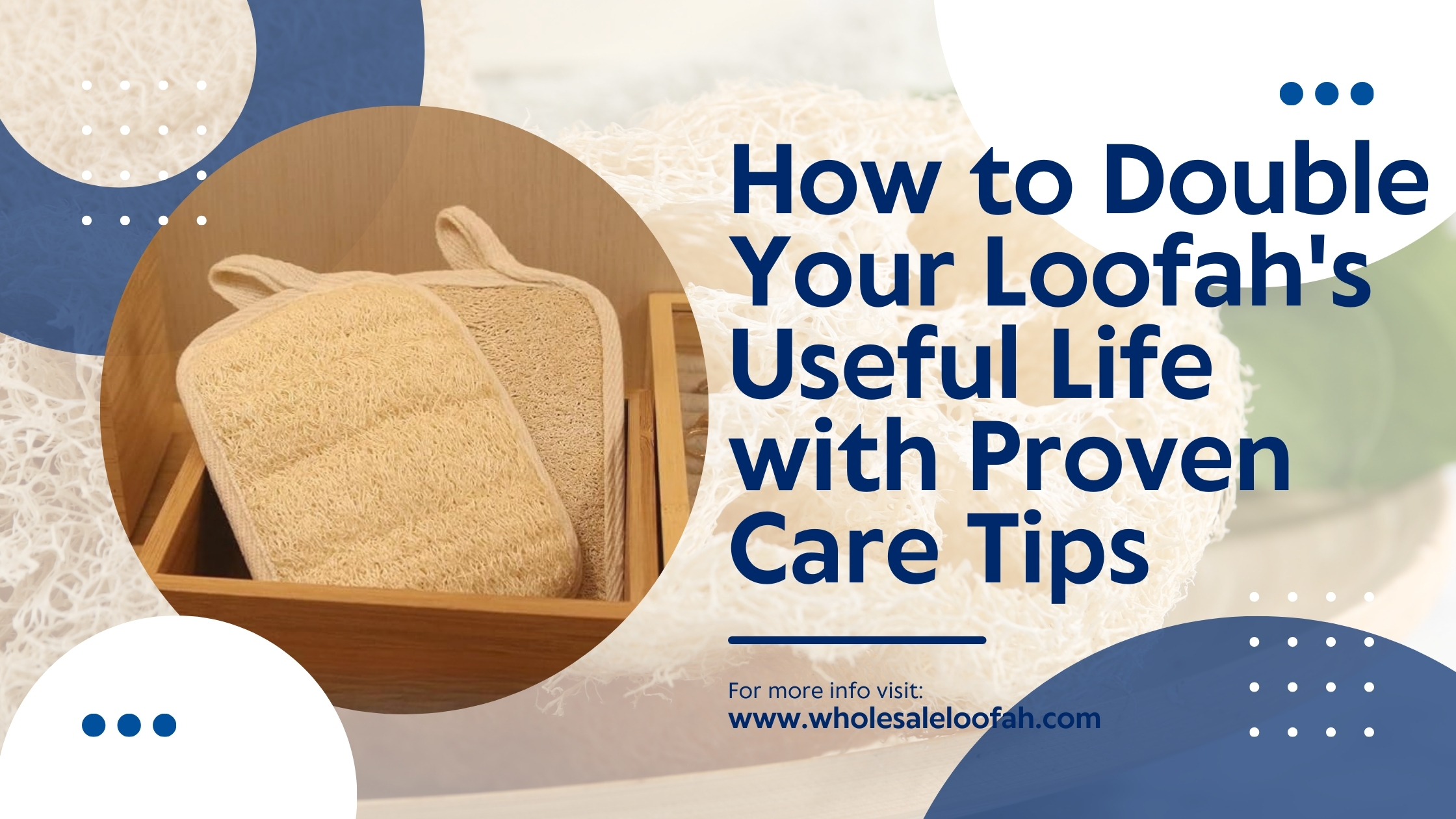
Every natural loofah has a built-in expiration point, but where that point falls depends almost entirely on what happens after the loofah leaves the production facility. A premium Egyptian loofah handled carelessly might last five or six weeks. That same loofah, treated with a basic maintenance routine, can perform reliably for four to six months. The difference is not genetics or grade. It is care.
For wholesale buyers, distributors, and private label brands, this gap between potential lifespan and actual lifespan represents both a problem and an opportunity. The problem is obvious: customers who do not maintain their loofahs blame the product when it falls apart early, which leads to returns, negative reviews, and eroded brand trust. The opportunity is equally clear. Businesses that teach their customers how to double your loofah’s useful life with care tips gain a measurable competitive advantage through higher satisfaction rates, stronger retention, and fewer support headaches.
This article delivers a comprehensive care framework designed to serve two audiences simultaneously. If you are an individual consumer, you will find everything you need to keep your loofah fresh, firm, and effective far longer than you expected. If you are a wholesale buyer, distributor, or brand owner, you will find protocols, data, and packaging strategies that you can pass directly to your customers and retail partners.
The sourcing and production knowledge referenced throughout this guide comes from Egexo, an Egyptian loofah supplier with over 25 years of direct cultivation and export experience. Their products serve as the quality benchmark against which all care recommendations here were developed and tested.
Why Loofah Lifespan Is a Wholesale Business Metric
Before diving into care techniques, it is worth framing why lifespan matters at the business level. Individual consumers think about loofah longevity in terms of personal value. Wholesale buyers need to think about it in terms of unit economics, brand positioning, and channel reputation.
A loofah that lasts twice as long does not mean the customer buys half as many. It means the customer trusts the product, trusts the brand that sold it, and becomes a repeat buyer who does not need convincing. In subscription and replenishment models, predictable product lifespan is what makes fulfillment timing accurate and churn rates manageable. When a wholesale buyer can tell a retail partner that their loofah will last four to six months with proper care and that claim holds true, the retail partner stocks with confidence and reorders on schedule.
Conversely, when loofahs underperform because end users do not know how to maintain them, the entire supply chain absorbs the damage. Retailers push back on suppliers. Distributors question sourcing decisions. And brands spend money on customer service that could have been avoided with a one-page care insert in the packaging.
This is why the most successful loofah brands in the natural body care space treat care education as a core part of their product offering, not an afterthought. Egexo’s private label manufacturing service supports this approach by allowing brands to include customized care documentation directly in their product packaging.
The Science Behind Loofah Deterioration
Understanding the mechanisms that break down loofah fiber is essential for building a care routine that actually works. Natural loofah is composed of cellulose-rich vascular bundles from the mature fruit of the Luffa aegyptiaca plant. These fibers are remarkably strong when dry but become vulnerable to degradation through three primary pathways.
Microbial Colonization
Bacteria, mold, and fungi thrive in warm, moist environments. A loofah used in a shower or bath provides exactly those conditions. Research published in the Journal of Clinical Microbiology documented bacterial colonization on improperly stored bath sponges within 24 to 48 hours of a single use. These microbial colonies do not just create hygiene concerns. They actively digest cellulose fibers, weakening the structural integrity of the loofah from the inside out. The visible signs are familiar to anyone who has kept a loofah too long: darkening color, mushy texture, and a sour or musty smell.
Mechanical Abrasion
Every scrubbing motion loosens individual fibers from the main network. This is expected and is part of how exfoliation works. However, excessive pressure, abrasive surfaces, and aggressive wringing accelerate fiber loss dramatically. A loofah used with moderate, consistent pressure on skin will maintain its structure roughly twice as long as one subjected to heavy scrubbing on hard cookware or rough surfaces.
Chemical Degradation
Soap residue, hard water minerals, and cleaning chemicals accumulate inside the fiber mesh over time. Mild bath products cause minimal harm, but harsh sulfates, bleach-based cleaners, and alcohol-heavy formulations strip natural oils from the plant fibers, leading to brittleness and premature cracking. For wholesale buyers sourcing loofahs intended for kitchen or industrial cleaning applications, this factor is critical when advising end users on product care. Denser fiber products like raw loofah scrubbers tolerate chemical exposure better than lighter bath-grade products.
Loofah Lifespan by Product Category: What the Data Shows
Different loofah products have different structural characteristics, which means care routines need to account for the specific product type in use. The following table compares common loofah product categories and their expected lifespans under two conditions: no dedicated care routine versus the full maintenance protocol outlined in this guide.
| Product Category | Fiber Profile | Primary Application | Lifespan Without Care | Lifespan With Full Care Protocol | Lifespan Improvement |
|---|---|---|---|---|---|
| Whole Natural Bath Loofah | Thick, multi-layered cylindrical | Body exfoliation, daily shower use | 6 to 10 weeks | 16 to 24 weeks | 2x to 2.5x |
| Loofah Slices and Discs | Medium thickness, single cross-section | Facial exfoliation, targeted treatment | 5 to 7 weeks | 10 to 16 weeks | 2x to 2.3x |
| Kitchen Cleaning Loofah | Dense, compact core | Pots, pans, countertop scrubbing | 3 to 6 weeks | 8 to 12 weeks | 2x to 2.7x |
| Unprocessed Raw Loofah | Very thick, full gourd intact | Crafts, heavy-duty scrubbing, industrial | 10 to 16 weeks | 22 to 30 weeks | 1.9x to 2.2x |
| Pet and Spa Grooming Loofah | Medium to thick, shaped for grip | Professional grooming, spa treatments | 5 to 8 weeks | 12 to 18 weeks | 2x to 2.4x |
Across every category, proper maintenance approximately doubles useful life. For wholesale buyers calculating cost-per-use metrics to present to retail partners, these numbers transform the value proposition of premium Egyptian loofah. A product that costs modestly more at purchase but lasts twice as long costs significantly less per month of use.
Browse the full product range at Egexo’s online shop or download the wholesale product catalog for detailed specifications and bulk pricing tiers.
The Complete Care Protocol: Daily, Weekly, and Monthly
This protocol was developed based on agricultural handling practices used in Egyptian loofah production, adapted for consumer-level maintenance. It requires no specialty products and adds less than two minutes of effort per day.
Daily: The Three-Step Post-Use Routine
The single most impactful habit in loofah maintenance happens immediately after each use. These three steps account for approximately 70 percent of the total lifespan benefit delivered by the full care protocol.
Step one: Flush thoroughly. Hold the loofah under clean running water and squeeze it firmly three to five times. The goal is to push trapped dead skin cells, soap residue, and organic debris out of the interior fiber network. A quick rinse of the exterior surface is not sufficient. Water needs to move through the sponge, not just over it.
Step two: Remove standing water. Shake the loofah vigorously or gently wring it by hand. Eliminating as much water as possible before the drying phase begins cuts total drying time roughly in half, which directly reduces the window of vulnerability for bacterial colonization.
Step three: Position for maximum airflow. Hang the loofah on a hook, suction mount, towel bar, or any fixture that allows air to circulate around the entire surface. The loofah should not rest against a wall, sit in a soap dish, or remain inside an enclosed shower caddy. If the bathroom stays humid after showers, move the loofah to a drier room until fully dry.
Wholesale buyers who include these three steps as a printed card inside their product packaging give their customers the single most valuable piece of information for protecting the product. This small addition to the unboxing experience pays for itself many times over in reduced complaints and returns.
Weekly: Vinegar Sanitizing Soak
Once per week, submerge the loofah in a solution of one part distilled white vinegar to four parts warm water for 15 to 20 minutes. Vinegar is mildly acidic, which makes it effective at eliminating common bacteria and dissolving hard water mineral deposits without degrading natural plant fibers. After soaking, rinse the loofah under clean water, shake out excess moisture, and hang to dry as usual.
For environments where documentation of sanitation practices is required, such as spas, wellness centers, and hospitality operations, a three percent hydrogen peroxide soak for 10 minutes is an alternative that is easy to log and verify. Both methods achieve comparable sanitizing results.
The critical point is consistency. A weekly soak prevents the gradual microbial buildup that causes fiber softening and odor development. Skipping even two or three weeks in a row allows colonies to establish deep enough in the fiber structure that surface rinsing no longer reaches them.
Monthly: UV Sunlight Exposure
Natural ultraviolet light is a powerful and free disinfectant. Once per month, place the fully wrung-out loofah in direct sunlight for two to four hours. A windowsill, balcony, or outdoor clothesline all work well. UV exposure kills surface microorganisms that survive the vinegar soak and also helps restore some firmness to fibers that have softened through repeated wet-dry cycling.
This practice mirrors the sun-drying phase used in Egyptian loofah processing, where harvested gourds are laid out in open fields under the Nile Delta sun before peeling and grading. Egexo’s farm to export documentation details this process and explains how sun exposure during production contributes to the durability of the finished product.
Maintenance Calendar: Quick Reference for Consumers and Retailers
The following calendar consolidates the full care protocol into a format suitable for product packaging inserts, retail signage, or customer-facing digital content.
| When | What to Do | What You Need | Time Required | Why It Matters |
|---|---|---|---|---|
| After every use | Rinse through, squeeze out water, hang in ventilated area | Running water, hook or hanger | 1 to 2 minutes | Prevents 70 percent of all deterioration, eliminates trapped debris |
| Once per week | Soak in 1:4 vinegar to warm water solution | White vinegar, warm water, bowl | 15 to 20 minutes | Kills bacteria, dissolves mineral deposits, prevents odor |
| Every two weeks | Visual and tactile inspection for wear signs | None | 2 minutes | Catches fraying, discoloration, or softening before it spreads |
| Once per month | Sun-dry in direct sunlight | Sunlight, outdoor or window access | 2 to 4 hours passive | Deep disinfection, fiber firmness restoration |
| Every three months | Full replacement assessment | None | 5 minutes | Ensures hygiene standards are maintained, timely retirement |
Retailers who make this calendar available digitally, whether on their website, via QR code on packaging, or as part of a post-purchase email, create a touchpoint that keeps customers engaged with the brand long after the initial sale. Egexo’s custom product design services can incorporate this type of educational material into branded packaging at the production stage.
The Five Most Damaging Care Mistakes
Knowing what to avoid is just as important as knowing what to do. These five errors are the most common reasons loofahs fail prematurely, and each one is entirely preventable.
Storing in a Sealed or Humid Enclosure
Shower caddies with solid walls, closed bathroom cabinets, and plastic bags all trap moisture around the loofah and dramatically slow drying time. A loofah that takes eight hours to dry instead of two spends six additional hours in the moisture range where bacterial growth is most aggressive. Always store in open air with active circulation.
Boiling as a Sanitizing Method
Boiling water kills bacteria effectively, but it also damages cellulose fibers through thermal shock. Repeated boiling causes the fiber network to lose elasticity, resulting in a mushy, limp loofah that no longer exfoliates effectively. Studies of repeated boiling on natural plant sponges show a 30 to 40 percent reduction in useful lifespan compared to vinegar-soaked loofahs. The weekly vinegar protocol achieves equivalent sanitization without any thermal fiber damage.
Using Harsh Chemical Cleaners
Bleach, ammonia-based products, and industrial-strength degreasers strip natural protective oils from loofah fibers and cause irreversible brittleness. If your application requires contact with strong chemicals, use a product specifically graded for that purpose, such as a dense kitchen loofah or industrial-grade raw scrubber, and expect a shorter lifespan regardless of care.
Applying Excessive Scrubbing Pressure
More pressure does not mean better cleaning. It means faster fiber destruction. Moderate, consistent pressure allows the loofah’s natural texture to do the exfoliation work. Pressing hard enough to compress the fiber network flat defeats the purpose and accelerates mechanical wear dramatically.
Starting with a Low-Quality Product
No care routine can compensate for poor raw material. Loofahs grown in suboptimal climates, harvested before full maturity, or processed with harsh bleaching agents begin their life with compromised fiber integrity. The care protocol in this guide was designed around premium Egyptian loofah with dense, mature fibers. Starting with quality is the prerequisite for everything else. Egexo’s quality standards page explains the grading criteria that separate premium product from commodity-grade material.
Pre-Purchase Quality Evaluation Checklist
Whether you are a consumer selecting a single loofah at a retail shelf or a wholesale buyer evaluating supplier samples before placing a bulk order, these criteria help you identify products with the structural foundation to deliver maximum lifespan.
| Quality Indicator | What Premium Looks Like | What to Avoid |
|---|---|---|
| Fiber density | Tightly packed, substantial weight relative to size | Loose, airy, thin-walled structure |
| Structural uniformity | Consistent thickness throughout, no thin spots or holes | Uneven walls, visible gaps, irregular shape |
| Color consistency | Even light tan, cream, or natural golden hue | Blotchy patches, gray or dark brown discoloration |
| Flexibility and resilience | Bends without cracking, springs back to original shape | Stiff and brittle, or excessively soft and limp |
| Odor | Mild natural scent or no detectable smell | Musty, chemical, sour, or moldy odor |
| Interior cleanliness | Seeds fully removed, clean internal channels | Loose seeds, debris, or residue inside |
| Supplier transparency | Origin documented, grading system explained, certifications available | No traceability, vague or missing product information |
For wholesale buyers, evaluating physical samples before committing to volume is standard practice and strongly recommended. Request free sample kits from Egexo to assess fiber quality, density, and overall construction firsthand.
Egyptian Loofah: Why Origin Determines the Ceiling for Lifespan
The Luffa aegyptiaca plant grows across tropical and subtropical regions worldwide, but the quality of the finished fiber varies enormously depending on where and how it is cultivated. Egypt’s Nile Delta has produced the world’s most sought-after loofah for generations, and the reasons are rooted in geography, soil science, and accumulated agricultural expertise.
The alluvial soil deposited by the Nile over thousands of years is exceptionally rich in the minerals that promote dense vascular fiber development in the loofah gourd. Consistent warm temperatures throughout the growing season allow fruit to reach full maturity on the vine, which is the single most important factor in fiber strength. Harvesting too early, a common practice in regions where growing seasons are shorter or market pressure forces premature picking, produces loofahs with thinner, weaker fibers that no amount of post-harvest processing can improve.
Egyptian loofah farmers, many of whom have worked the same land for decades, understand the precise timing, irrigation patterns, and vine management techniques that produce the densest possible fiber. This generational knowledge is not easily replicated. Egexo, operating in this region for over 25 years, has refined the process from planting through grading and export into a system that consistently delivers what the global market recognizes as the best loofah available. Learn more about their full production chain on the farm to export process page.
For wholesale buyers comparing suppliers across different origins, the practical implication is straightforward. Egyptian loofah provides the highest possible ceiling for product lifespan, and the care protocol in this guide is calibrated to help end users reach that ceiling consistently.
Natural Loofah vs. Synthetic Alternatives: Durability and Sustainability
The comparison between natural and synthetic sponges comes up frequently in wholesale buying decisions and consumer purchasing behavior. This side-by-side evaluation addresses the factors most relevant to lifespan, performance, and environmental impact.
| Factor | Natural Egyptian Loofah | Synthetic Nylon or Polyester Puff |
|---|---|---|
| Material origin | Renewable agricultural crop | Petroleum-derived plastics |
| Effective lifespan with care | 16 to 24 weeks for bath use | 4 to 8 weeks before mesh stretching |
| Exfoliation consistency | Maintains firm, even texture throughout useful life | Degrades quickly as mesh loosens |
| Sanitization responsiveness | Vinegar and UV treatments restore hygiene effectively | Dense layered mesh resists thorough disinfection |
| End of life | Fully biodegradable, home compostable within weeks | Landfill disposal, sheds microplastics during use |
| Carbon footprint | Low, minimal processing from farm to shelf | High, fossil fuel extraction and manufacturing |
| Wholesale positioning | Premium, eco-conscious, wellness market segments | Budget, mass market, disposable positioning |
| Cost per month of use | Lower due to longer lifespan | Higher due to frequent replacement |
For wholesale buyers and brand owners targeting the sustainability-conscious consumer segment, natural Egyptian loofah is the strongest product foundation available. The combination of superior lifespan, genuine biodegradability, and premium market positioning creates a compelling value story at every level of the supply chain.
Explore body loofah options and kitchen loofah alternatives to see how Egexo’s product range supports diverse market positioning strategies.
Turning Care Education into a Wholesale Competitive Advantage
The information in this guide is not just practical advice for end users. For wholesale buyers, distributors, and brand owners, it is a strategic tool that can be deployed across multiple business functions.
Packaging Inserts and Branded Care Cards
Including a printed care guide inside product packaging is the highest-impact, lowest-cost way to improve customer outcomes. A well-designed card that covers the daily three-step routine and the weekly vinegar soak gives the customer everything they need in a format they will see at the moment they first use the product. Egexo supports this through their private label manufacturing and custom product design services, which allow brands to integrate care education directly into their product presentation.
Post-Purchase Email Sequences
An automated email sent three to five days after purchase with a link to a care guide or video tutorial reinforces the message at the moment the customer is forming their usage habits. Brands that implement this approach report measurable reductions in early-life complaints and returns.
Retail Partner Education
Wholesale buyers who provide their retail partners with care education materials, whether as shelf talkers, display cards, or digital assets, make it easier for those partners to sell the product confidently. A retailer who can tell a customer that the loofah will last four to six months with simple care has a much stronger sales conversation than one selling a product with no lifespan guidance.
Subscription and Replenishment Timing
When care education extends average product lifespan to a predictable range, subscription and auto-replenishment programs become viable and accurate. A brand that ships a replacement loofah every four months based on documented average lifespan with care delivers a seamless customer experience that drives long-term revenue.
For businesses ready to build these strategies around a reliable supply of premium Egyptian loofah, requesting a wholesale quotation from Egexo is the logical first step.
Expert Perspective from the Wholesale Loofah Team
After years of working with loofah products across dozens of markets and applications, we have observed one consistent pattern at Wholesale Loofah. The single factor that separates a satisfied customer from a disappointed one is not product quality alone. It is whether that customer received even basic guidance on post-purchase care. The three-step daily routine described in this guide, rinsing thoroughly, removing water, and hanging in open air, takes less than two minutes and prevents the vast majority of premature product failures. When we pair this message with premium Egyptian loofah from suppliers like Egexo, the result is a product experience that consistently exceeds expectations. If you are sourcing loofah for resale, whether as a retailer, distributor, or private label brand, we strongly encourage you to make care education a non-negotiable part of your customer experience strategy. For more loofah industry insights and buying guides, visit us at Wholesale Loofah.
Frequently Asked Questions
Q1: How does proper care actually double a loofah’s lifespan?
A: The majority of loofah deterioration comes from bacterial growth in trapped moisture and accumulated soap and skin debris inside the fiber network. The daily rinse-squeeze-dry routine eliminates these conditions before they can cause damage. The weekly vinegar soak addresses whatever residual microbial buildup occurs despite daily care. Together, these habits keep the fiber network clean, dry, and structurally sound for roughly twice as long as an unmaintained loofah. The effect has been observed consistently across all product categories, from bath loofahs to kitchen scrubbers to spa and grooming products.
Q2: Can I use bleach instead of vinegar to sanitize my loofah?
A: Bleach is an effective disinfectant but is too harsh for regular use on natural plant fibers. Even diluted bleach solutions strip natural oils from cellulose fibers and cause progressive brittleness with repeated exposure. White vinegar at a one-to-four dilution provides comparable antimicrobial action without any fiber damage. For situations requiring stronger disinfection, a three percent hydrogen peroxide soak for 10 minutes is the recommended alternative.
Q3: How should wholesale buyers store bulk loofah inventory before sale?
A: Dry natural loofah stored in a cool, well-ventilated environment has an effectively indefinite shelf life before first use. The key risk factor is moisture intrusion during storage. Avoid sealed plastic containers or bags without ventilation, as temperature fluctuations during warehousing and transit can cause condensation inside sealed packaging. If packaging requires a sealed format for retail presentation, include small ventilation perforations or desiccant packets. Egexo’s quality standards documentation provides detailed storage and handling guidelines for wholesale inventory.
Q4: When should I replace my loofah even if I am following the full care protocol?
A: Three signs indicate it is time for replacement regardless of maintenance history. A persistent odor that does not resolve after a vinegar soak means microbial colonization has penetrated too deeply into the fiber structure. Visible dark spots or widespread discoloration suggest mold growth that cleaning cannot fully address. Fibers that tear with minimal pressure or feel consistently slimy after rinsing have lost their structural integrity. As a general guideline, even well-maintained bath loofahs should be retired after approximately six months.
Q5: Does the type of soap or body wash affect how long my loofah lasts?
A: Yes. Mild, plant-based soaps and gentle body washes are least damaging to natural loofah fibers. Products containing sodium lauryl sulfate, high concentrations of alcohol, or strong synthetic fragrances contribute to fiber drying and brittleness over time. For kitchen loofahs used with dish soap, the chemical exposure is typically higher, which is why denser fiber products like kitchen-grade loofahs are recommended for those applications.
Q6: How can retailers use loofah care information to reduce returns?
A: A significant percentage of loofah returns stem from premature deterioration caused by improper care rather than product defects. Retailers who include clear care instructions, whether as packaging inserts, shelf signage, product page content, or post-purchase emails, set accurate expectations and give customers the tools to get full value from the product. This approach consistently reduces return rates and increases repeat purchase rates. Egexo’s custom product design services allow brands to build care education into branded packaging at the production level.
Q7: Are pet and spa grooming loofahs maintained differently?
A: Pet grooming loofahs collect animal dander, hair, and skin oils that accelerate microbial growth more quickly than typical bath use. The daily rinse routine should be especially thorough for these products, and the vinegar soak should be performed twice per week rather than once. Full drying between grooming sessions is essential. For spa environments with hygiene compliance requirements, maintaining a documented replacement log alongside the standard care protocol is recommended. Explore purpose-built options in the pet and spa grooming loofah category.
Conclusion
The gap between a loofah that disappoints in six weeks and one that delivers consistent performance for six months comes down to a handful of simple, repeatable habits. The daily flush-squeeze-dry routine, the weekly vinegar soak, and the monthly sunlight treatment require minimal effort but deliver transformative results across every loofah product category.
Key Takeaways for Every Reader:
- Rapid, complete drying after each use is the single highest-impact maintenance habit, responsible for approximately 70 percent of total lifespan benefit.
- A weekly soak in one part white vinegar to four parts warm water eliminates bacterial colonies and mineral buildup without harming natural fibers.
- Monthly UV sunlight exposure provides deep disinfection and helps restore fiber firmness.
- Avoiding boiling, bleach, sealed storage, and excessive scrubbing pressure prevents the most common causes of premature failure.
- Starting with premium Egyptian loofah from a trusted source like Egexo provides the strongest possible fiber foundation for long product life.
Key Takeaways for Wholesale Buyers and Brand Owners:
- Care education reduces returns, strengthens retailer relationships, and enables accurate subscription timing.
- Packaging inserts, post-purchase emails, and retail partner materials are high-leverage touchpoints for delivering care guidance.
- Premium Egyptian loofah combined with documented care protocols creates a product story that supports premium pricing and brand differentiation.
- The ability to double your loofah’s useful life with care tips is a verifiable claim that builds consumer trust.
Ready to Source or Learn More?
- Wholesale Quotations: Request pricing from Egexo
- Product Catalog: Download the full catalog
- Free Samples: Order a sample kit
- Full Product Range: Browse the shop
- Industry Resources: Visit Wholesale Loofah