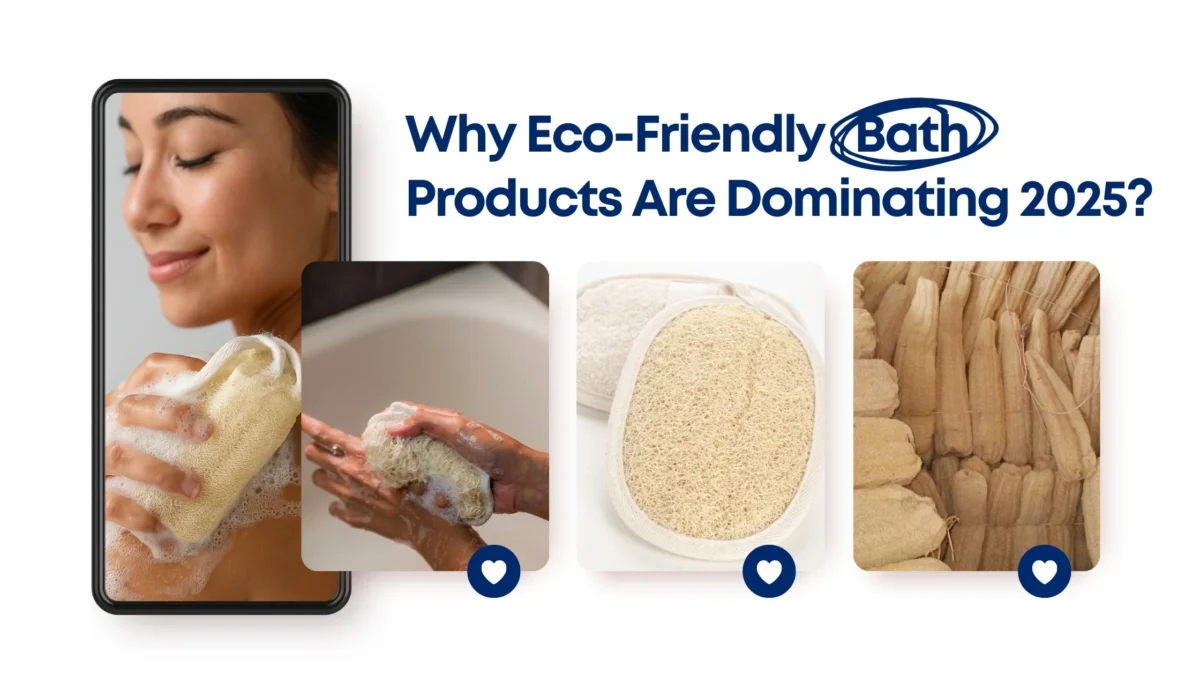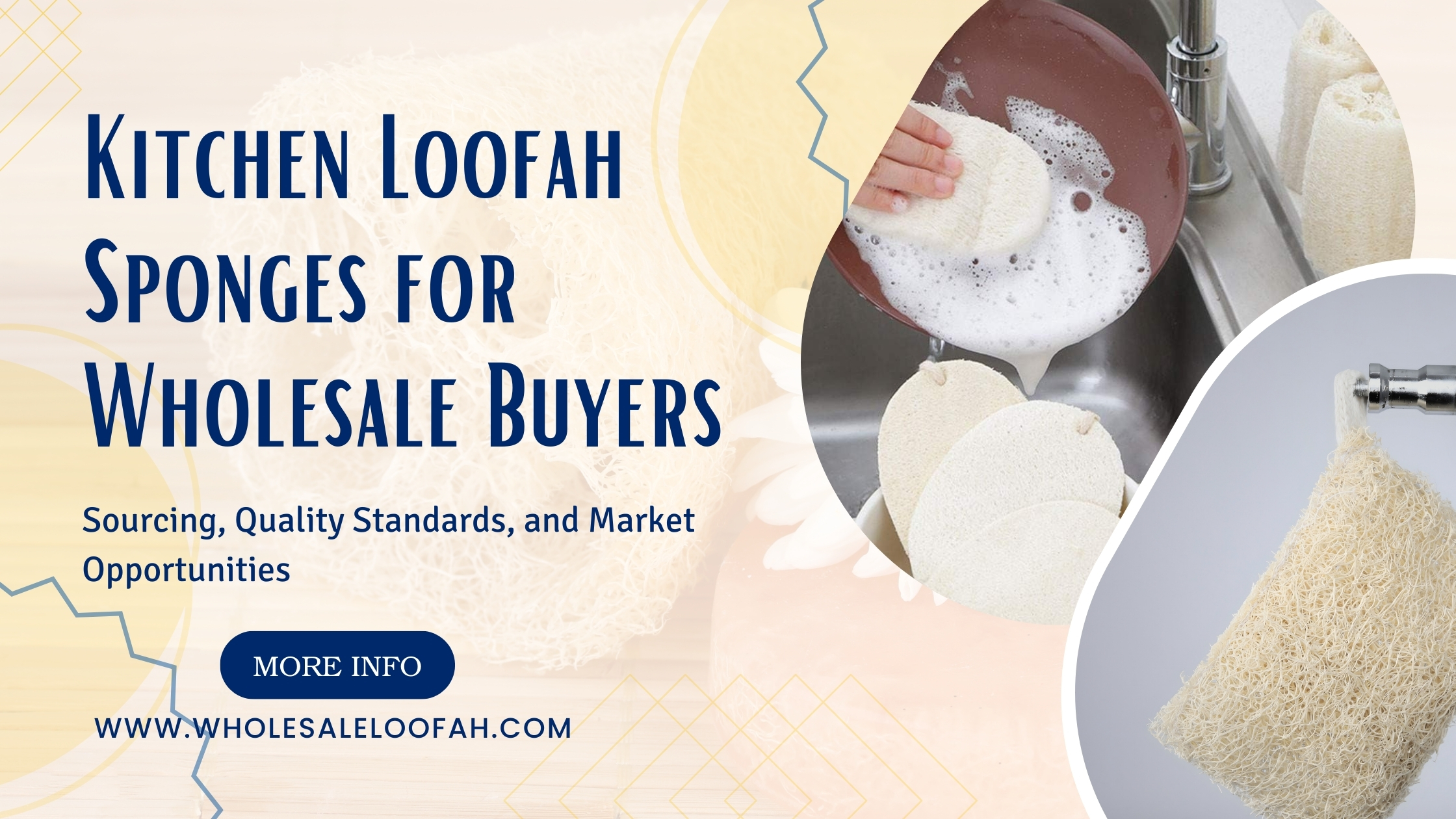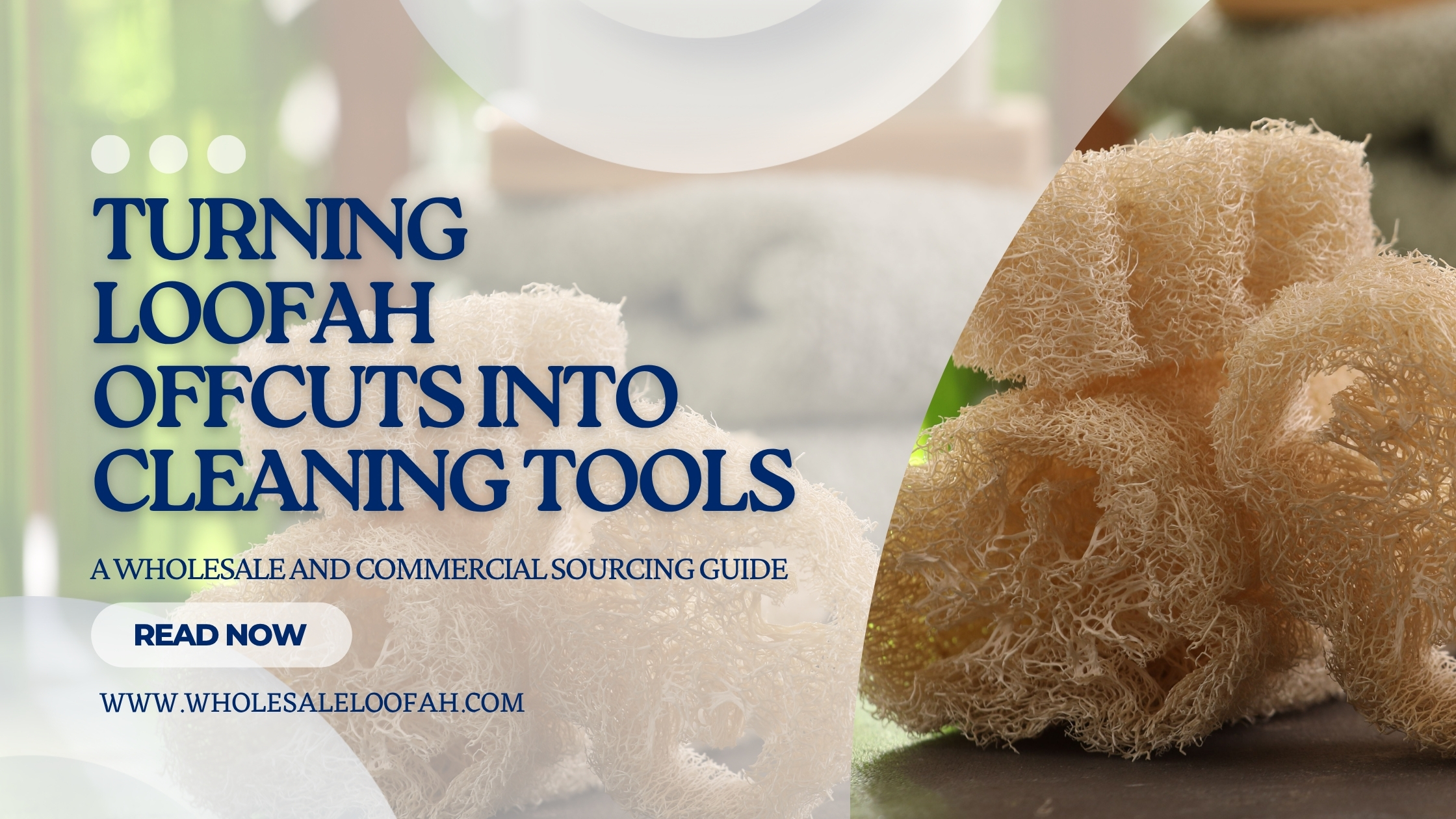
In wholesale loofah trade, the conversation almost always focuses on finished products: cylindrical bath scrubbers, kitchen sponges, round body pads. What rarely gets discussed is the material that exists between those finished cuts, the offcuts, trimmings, and irregular pieces that make up 15 to 30 percent of every processed loofah batch.
The ability to transform loofah offcuts into useful cleaning tools is a commercial opportunity that forward-thinking importers, retailers, and brand owners are beginning to take seriously. The raw material cost is lower than finished product. The fiber quality from Egyptian loofah is as high in offcuts as it is in standard retail pieces. And the market demand for eco cleaning tools continues to grow at a measurable pace year over year.
This guide is written primarily for wholesale buyers: importers, distributors, spa product brands, health and wellness retailers, and private label operators looking to evaluate loofah offcuts as a sourcing category. It covers the trade economics, product development opportunities, supplier evaluation standards, and practical processing steps that make a loofah offcut program commercially viable.
The Commercial Anatomy of Loofah Offcuts
Where Offcuts Come From in the Supply Chain
Understanding where offcuts originate helps buyers evaluate their commercial value accurately. The loofah processing chain begins with harvested dried loofah fruits, which are peeled, cleaned, and cut to standard dimensional specifications. The cutting stage generates the offcut volume.
At a processing facility operating at commercial scale, the offcut output from a single harvest season is substantial. A mid-size Egyptian loofah processing operation handling 50,000 kilograms of dried loofah per season might generate between 7,500 and 15,000 kilograms of offcut material, depending on the range of standard product sizes in production.
This material has traditionally been composted, used as packing material, or discarded. As the natural cleaning product market has expanded, however, more processors are beginning to sort, clean, and grade their offcuts for commercial sale. EGEXO has been exporting Egyptian loofah since 2015.
The Trade Classification of Loofah Offcuts
For importers, understanding how loofah offcuts are classified for customs and trade documentation is useful. Natural loofah products, including offcuts, typically fall under HS Code 1404.90, covering vegetable products not elsewhere specified. Offcuts do not require different trade documentation from standard loofah products, which simplifies import logistics.
| Trade Characteristic | Loofah Offcuts |
|---|---|
| HS Code (typical) | 1404.90 |
| Origin (premium grade) | Egypt |
| Export form | Compressed cartons or loose-packed cartons |
| Minimum shelf life | 24 months if stored dry |
| Moisture content at export | Less than 12% |
| Standard carton weight | 5 to 15 kg depending on grade and density |
| Lead time from Egypt | 2 to 4 weeks |
These specifications apply to Egexo’s export operations. Full technical documentation is available in the Egexo product catalog.
Commercial Grading Standards for Loofah Offcuts
How Offcuts Are Graded at Source
Commercial buyers need consistent material to build reliable product lines. This requires that their loofah offcut supplier applies and communicates clear grading standards.
Egexo grades loofah offcuts across four categories based on size, fiber integrity, and intended end use.
| Grade | Dimension Range | Fiber Quality | Recommended Application | MOQ (Typical) |
|---|---|---|---|---|
| Grade A | 6 to 12 cm (largest dimension) | Intact, high density, no fraying | Retail kitchen scrubbers, body pads | No minimum order on standard products |
| Grade B | 3 to 6 cm (largest dimension) | Intact, medium density | Tile scrubbers, soap pouches, cleaning sets | No minimum order on standard products |
| Grade C | 1 to 3 cm (largest dimension) | Minor fraying acceptable | Fiber filler, compressed scrubber blocks | No minimum order on standard products |
| Grade D | Under 1 cm | Variable | Compost, mulch, industrial use only | No minimum order on standard products |
Most retail cleaning product applications use Grade A and Grade B offcuts. Grade C material has specialized applications in compressed or molded scrubber formats.
Quality Specifications Per Grade
Beyond size, consistent quality requires that offcuts meet specific performance characteristics. Buyers should request and verify these specifications before committing to bulk volumes.
Grade A Offcut Specifications:
| Parameter | Specification |
|---|---|
| Maximum moisture content | 12% |
| Minimum fiber tensile strength | 8 N/mm2 (comparative) |
| Seed or foreign matter presence | Zero tolerance |
| Fiber uniformity | High, consistent pore diameter throughout |
| Color range | Natural tan to light brown, no dark discoloration |
| Odor | Neutral, no chemical or musty notes |
| Post-wash shape retention | Minimum 85% dimensional retention after 10 wash cycles |
Requesting loofah samples for lab or field testing before a purchase commitment is strongly recommended.
Business Development: Building a Product Line from Loofah Offcuts
The Market Opportunity in Numbers
Within this market, natural scrubbers and sponge alternatives represent a high-growth subcategory, driven by consumer rejection of single-use plastic and petroleum-derived cleaning tools.
Loofah offcuts are positioned ideally within this growth dynamic. They are plant-derived, fully biodegradable, and available at a cost basis substantially below finished loofah products. For wholesale buyers building eco product lines, this cost structure allows for competitive retail pricing while maintaining healthy margins.
Product Development Concepts by Channel
Different retail channels create different product development opportunities for loofah offcut cleaning tools.
| Retail Channel | Product Concept | Offcut Grade | Packaging Format | Retail Price Range |
|---|---|---|---|---|
| Zero-waste stores | Kitchen scrubber 3-pack | Grade A | Unbleached kraft paper band | 8 to 14 USD |
| Health food retail | Exfoliating bath pad | Grade A (large) | Mesh bag with recycled hang tag | 6 to 10 USD |
| Hardware and home stores | Tile and surface cleaning kit | Grade B | Cardboard tray, 4-piece set | 10 to 16 USD |
| Specialty e-commerce | Zero waste starter kit | A and B mix | Kraft box, curated 5-piece set | 18 to 28 USD |
| Subscription boxes | Cleaning tool monthly refill | Grade A | Simple kraft sleeve | 4 to 8 USD each |
| Pet specialty | Pet grooming scrubber | Grade B (soft) | Natural drawstring bag | 7 to 12 USD |
Note: Prices listed are approximate retail ranges in USD for reference only.
The margin structure across these categories is consistently strong because the raw material cost of offcuts is meaningfully lower than finished loofah products. A Grade A offcut sourced at bulk pricing and packaged as part of a branded eco kitchen scrubber set carries a retail-to-cost ratio that compares favorably to most natural personal care product categories.
Private Label Development for Offcut Products
Creating a branded loofah offcut cleaning product line does not require operating a manufacturing facility. Egexo offers complete private label loofah manufacturing services that cover sourcing, sizing, cleaning, packaging, branding, and export-ready fulfillment.
A typical private label offcut product program with Egexo includes:
- Product specification discussion (grade, size, application)
- Sample development and testing
- Packaging design consultation (via custom product design services)
- MOQ confirmation and pricing agreement
- Production and quality control
- Export documentation and fulfillment
This end-to-end capability means that a buyer with a brand concept and a retail channel can bring a loofah offcut cleaning product to market without building supply chain infrastructure from scratch.
Step-by-Step Commercial Processing of Loofah Offcuts
For buyers who receive raw unprocessed offcuts and want to handle final preparation in-house, the following process applies at small to medium commercial scale.
Commercial Processing Protocol
Stage 1 – Receiving and Inspection Upon receipt, inspect the carton or bulk shipment against the agreed grading specification. Check moisture content with a handheld moisture meter. Target less than 12 percent. Inspect for foreign matter, seed remnants, and any signs of mold or pest activity.
Stage 2 – Sorting Even well-graded offcuts benefit from a secondary sort before processing. Remove any pieces that fall outside the size specification and separate by intended application.
Stage 3 – Cleaning Submerge offcuts in clean warm water at 50 to 60 degrees Celsius for 15 to 20 minutes. For food-contact or premium consumer products, a brief treatment with food-grade hydrogen peroxide solution (3%) can be applied after initial water soak. Rinse thoroughly with clean water.
Stage 4 – Drying Spread cleaned offcuts on clean drying racks in a well-ventilated facility. Target moisture content after drying: less than 10 percent. Commercial drying can be accelerated with low-heat forced-air systems. Do not use high heat as this can damage fiber structure.
Stage 5 – Shaping (if required) If the product specification requires consistent sizing or shaping, this is done after drying. Trimming with rotary cutters or die-cut systems can produce consistent retail-ready dimensions from irregular offcut input.
Stage 6 – Quality Control Inspect finished pieces against the quality checklist before packaging.
Ensure packaging is dry before sealing and that airflow is not completely blocked, especially for retail formats where the product may sit in storage for several months before consumer use.
Commercial Quality Control Table
| QC Parameter | Acceptable Range | Rejection Criteria |
|---|---|---|
| Moisture content | 8 to 12% | Above 14% |
| Fiber integrity | Intact mesh, no tearing | Fraying more than 5mm at edges |
| Foreign matter | None visible | Any seed, plant matter, or debris |
| Color | Tan to light brown | Dark patches or discoloration greater than 10% of surface |
| Odor | Neutral | Any musty, chemical, or off-odor |
| Shape retention (wet-dry cycle) | Minimum 85% | Less than 75% |
Supplier Evaluation: Why Egyptian Loofah from EGEXO Sets the Standard
The Geographic and Quality Case for Egypt
Wholesale buyers sourcing loofah offcuts for commercial product development should prioritize origin as a primary selection criterion. Egyptian loofah, specifically from the Nile Delta growing region, consistently produces fiber with superior characteristics compared to loofah grown in Vietnam, China, India, or Latin America.
The factors behind this quality difference include soil mineral content from alluvial Nile deposits, extended growing seasons that allow full fiber maturation, traditional cultivation knowledge refined over generations, and processing infrastructure that maintains fiber integrity from harvest to export.
These factors mean that Egyptian loofah offcuts, even from processing byproduct, perform at a level that finished products from other origins struggle to match.
Evaluating a Loofah Offcut Supplier
Before committing to a wholesale relationship for loofah offcuts, apply this evaluation framework:
| Evaluation Area | Key Questions | What Good Looks Like |
|---|---|---|
| Origin verification | Can the supplier document farm origin? | Egyptian Nile Delta, with documentation |
| Processing standards | What cleaning and drying process is used? | Food-grade cleaning, controlled drying |
| Grading consistency | How are offcuts graded and sorted? | Defined grade system with size tolerances |
| Sample policy | Can samples be ordered before bulk commitment? | Yes, with no large minimum |
| Certification | – | Available on request |
| Export experience | How many years of export experience? | 10 or more preferred |
| Custom packaging | Can supplier support branded or custom pack? | Yes for medium and large volumes |
| Communication | Response time and export team access? | Clear point of contact, fast response |
Egexo satisfies every criterion in this framework. Visit the Why Choose Egexo page for a full overview of our credentials and capabilities.
To begin a sourcing relationship, request a bulk quotation or download the product catalog for specifications and pricing structures.
Sustainability Positioning for Loofah Offcut Products
The ESG and Consumer Trust Angle
Sustainability positioning has moved from marketing option to purchasing criterion in most developed retail markets. Buyers presenting loofah offcut cleaning products to retailers need to be able to substantiate their environmental claims with supply chain documentation.
The sustainability case for Egyptian loofah offcuts is genuine and documentable:
Carbon footprint: Loofah is a fast-growing annual plant that sequesters carbon during its growing season. Processing requires minimal energy compared to synthetic sponge manufacture. Export from Egypt to European and US markets via sea freight has a lower per-unit carbon footprint than air-freighted synthetic alternatives.
Plastic elimination: Every loofah offcut cleaning tool that replaces a synthetic kitchen sponge removes one petroleum-derived product from the waste stream. At scale, this is a measurable and marketable impact.
Zero microplastic output: Unlike synthetic sponges or scrubbing pads with nylon or polyester surfaces, loofah offcuts shed only cellulose fibers during use. These are biodegradable and do not accumulate as microplastic in waterways.
Complete composability: Every loofah cleaning tool reaches full biodegradation in a home compost environment within three to six months. This is a closed-loop lifecycle that no synthetic alternative can credibly claim.
For brands building ESG-aligned product lines, this profile is both authentic and commercially compelling. Egexo can provide supply chain documentation to support sustainability claims for retailers and certification bodies.
Expert Insight from EGEXO
The wholesale market for loofah offcuts is at an early but clearly defined inflection point. Five years ago, barely a handful of our international buyers asked about offcut availability. Today, we regularly field inquiries from brands across the USA, Europe, Canada, Australia, the Gulf and every other country we can ship to who are building dedicated eco cleaning product lines around offcut material.
What has changed is not the material. Loofah offcuts have always carried the same fiber quality as finished product. What has changed is market awareness and consumer willingness to pay for authentic sustainability. A product that is made from natural fiber, eliminates plastic, biodegrades completely, and costs less at source than conventional alternatives is not a difficult sell to the right retail audience.
Our recommendation for new buyers considering an offcut program: start with one product concept, order samples in the Grade A range, and test in your target retail or direct-to-consumer channel before scaling. The material performs. The economics work. The challenge is always in the positioning and packaging, not the product itself.
Contact EGEXO through the EGEXO quotation page to begin a conversation about offcut sourcing volumes and specifications. Order samples to verify quality before any volume commitment.
FAQ Section
Q1: How do loofah offcuts differ from standard loofah slices in terms of trade value and use?
A: In trade terms, loofah offcuts are priced below standard slices because of their dimensional irregularity, not because of lower fiber quality. For buyers building cleaning product lines, this creates a cost advantage without a performance compromise. Standard slices are used for bath and body products where consistent appearance matters. Offcuts are ideal for cleaning tools, eco product kits, and any application where scrubbing performance rather than visual consistency is the primary requirement.
Q2: What is the typical lead time for a loofah offcut bulk order from Egypt?
Standard products are ready in 7 to 25 days from payment. Custom time is confirmed with the quote. Adding sea freight time, most buyers in Europe receive their order within five to seven weeks from order date. North American buyers should allow six to nine weeks door-to-door. Rush orders may be accommodated depending on stock availability. Contact the EGEXO for current stock levels and lead time confirmation.
Q3: Can loofah offcuts be used in custom compressed or molded scrubber products?
A: Yes. Grade B and Grade C loofah offcuts can be used as raw input for compressed or molded scrubber blocks. The fiber is flexible and can be compressed under pressure into defined shapes, then bound with natural adhesives or net materials. This is an advanced product development application that Egexo’s custom product design team can support from concept through to production-ready specification.
Q4: Are there any import restrictions on Egyptian loofah offcuts in key markets?
A: Egyptian loofah offcuts are a natural vegetable product classified under HS Code 1404.90. In the United States, European Union, and Gulf markets, they are generally unrestricted for import provided standard phytosanitary documentation is in order. Egexo provides full export documentation including phytosanitary certificates and certificates of origin for all export orders. Buyers should verify specific import requirements with their customs broker before placing orders.
Q5: What is the minimum order quantity for loofah offcuts from Egexo, and how does pricing scale with volume?
A: Egexo accommodates buyers at multiple volume levels. Sample orders are available in small quantities for product testing. Commercial MOQ typically begins at one carton for Grade A and Grade B offcuts. Pricing scales favorably at pallet quantities and becomes most competitive at full container volumes. For current MOQ, pricing tiers, and volume-based pricing structure, request a quotation directly from EGEXO or download the product catalog.
Q6: How should wholesale buyers present the sustainability claims of loofah offcut products to retail buyers?
A: Retail buyers will want specific, verifiable claims, not general sustainability language. The strongest claims for loofah offcut cleaning tools are: made from 100 percent natural plant fiber with no synthetic components, free from microplastic shedding during use, fully compostable at end of life with no toxic residue, and sourced from a traceable agricultural supply chain in Egypt. Egexo can provide supply chain documentation to support all of these claims. Buyers can also reference Egexo’s farm to export process documentation as part of their supplier credential package.
Q7: What packaging formats work best for loofah offcut cleaning products in retail?
A: The packaging format that performs best depends on the retail channel. In zero-waste and specialty eco stores, minimal packaging (a simple kraft paper band or recycled cotton bag) aligns with shopper values and reduces material cost. In mainstream health food or household retail, a more structured presentation (kraft paper box or tray with clear messaging) helps the product communicate its benefits on shelf. For e-commerce, durable packaging that protects the loofah during shipping while communicating eco values through recycled materials works well. Egexo’s custom product design services can support packaging development for any of these channels.
Q8: Can loofah offcut cleaning products be positioned in the spa and wellness B2B market?
A: Yes, and this is a growing segment. Spas and wellness facilities that have committed to plastic-free operations are actively seeking natural loofah alternatives for guest amenities and treatment tools. Loofah offcut pads and scrubbers can be offered as single-use or multi-use amenity products with full compostable end-of-life credentials. For spa-focused product development, explore the Egexo pet and spa loofah category as a starting point, and contact EGEXO about spa-specific sizing and packaging.
Conclusion
For wholesale buyers, the commercial case for loofah offcuts as a cleaning product raw material is clear. Lower sourcing cost, identical fiber quality to finished product, proven retail demand in eco and natural cleaning categories, and a sustainability profile that retail buyers and end consumers find genuinely compelling.
The critical success factors are consistent grading from a quality supplier, appropriate product development for the target retail channel, and accurate sustainability positioning backed by supply chain documentation.
Key Takeaways:
- Loofah offcuts represent 15 to 30 percent of processed loofah volume and can be sourced at cost below finished products
- Egyptian loofah offcuts from the Nile Delta produce superior fiber quality compared to other growing origins
- Private label and custom product development for offcut-based cleaning lines is available through Egexo
- The sustainability credentials of loofah offcuts are genuine, documentable, and commercially valuable in current retail markets
Ready to experience Egyptian loofah quality?
- For Wholesale Buyers: Request a quote or download our catalog
- For Individual Orders: Browse our collection or order samples