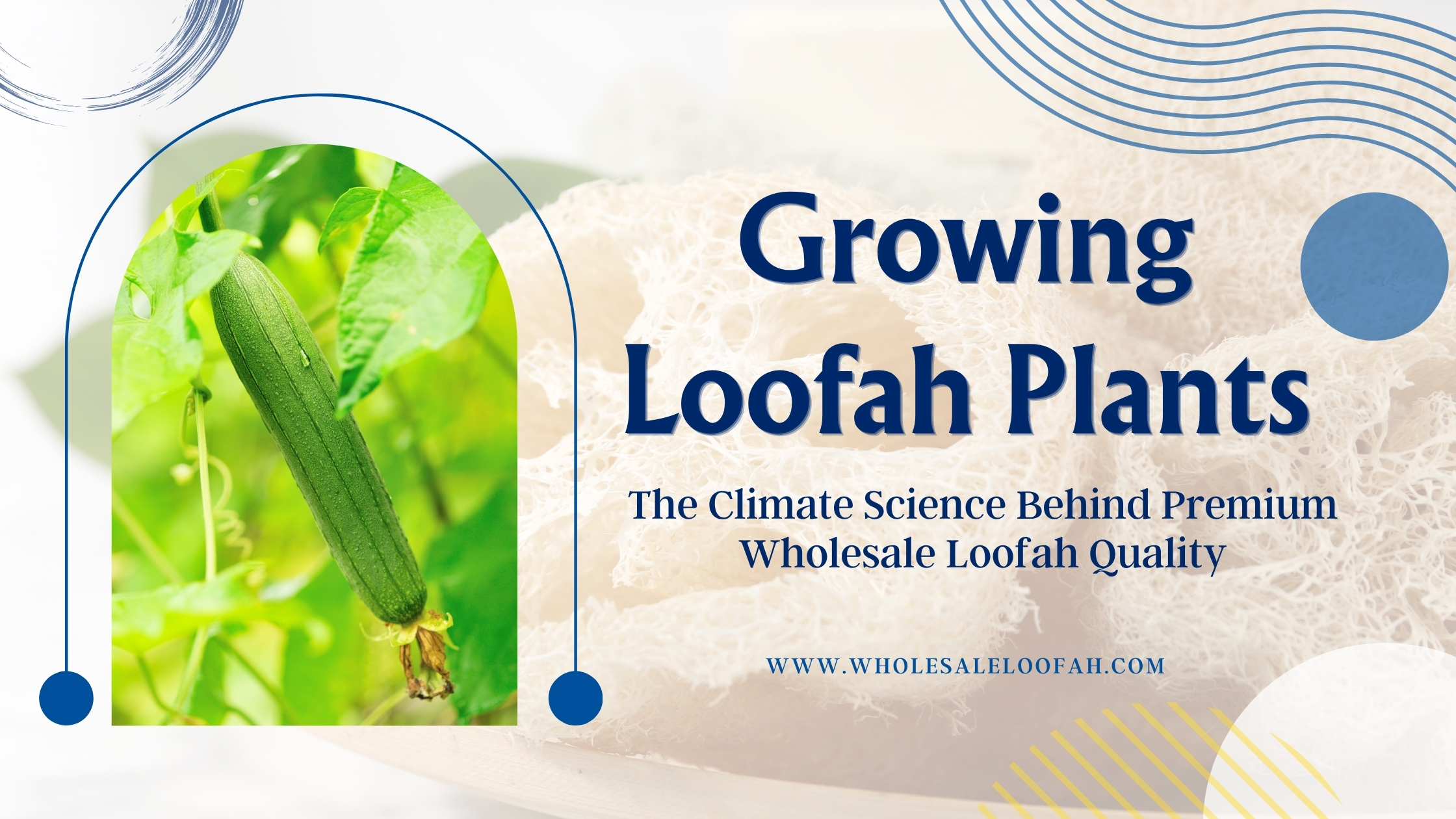
Every decision a wholesale loofah buyer makes, from minimum order quantities to supplier selection to quality grading requirements, traces back to a single origin point: the loofah plant itself and the conditions under which it was grown. The loofah is not a sea creature or a manufactured product. It is the dried fiber skeleton of a tropical gourd, and the quality of that fiber is determined almost entirely by the agricultural environment in which the plant spent its 150 to 200-day growth cycle.
For importers, spa operators, distributors, and retail buyers, understanding the basics of growing loofah plants is not a hobby interest. It is practical due diligence. The supplier who controls their own growing environment can guarantee consistency across shipments. The supplier who sources from multiple third-party farms cannot make the same assurance. This article explains the climate science behind loofah cultivation, what it means for fiber quality, and why Egypt, and specifically the Nile Delta, remains the world’s benchmark for premium loofah production.
EGEXO has been exporting Egyptian loofah since 2015.
The Agricultural Reality of Loofah: What Wholesale Buyers Need to Understand
Loofah comes from the plant genus Luffa, part of the Cucurbitaceae family. Two species dominate commercial production: Luffa cylindrica for bath and personal care applications, and Luffa acutangula for kitchen and industrial scrubbing products. Both are annual vines in temperate climates and can behave as perennials in true tropical zones.
The fiber that becomes the commercial sponge is not the fruit itself but the internal vascular network of the fruit. This fibrous matrix develops progressively throughout the growing season and reaches its maximum density and structural integrity only in the final weeks before full maturity. This biological fact has enormous implications for supply chain quality.
Commercial Loofah Production by Region
| Production Region | Climate Type | Growing Season | Fiber Quality Rating | Global Market Share |
|---|---|---|---|---|
| Egypt (Nile Delta) | Arid subtropical | 180 to 220 days | Premium | Leading exporter of premium grade |
| Southeast Asia | Tropical humid | Year-round | Standard to good | High volume, variable quality |
| Central America | Tropical | Year-round | Good | Growing export presence |
| India | Tropical/subtropical | 160 to 200 days | Standard to good | Large domestic and export market |
| United States | Temperate (Zones 7 to 11) | 150 to 200 days | Good to premium | Primarily domestic, small-scale |
Egypt’s position as the premium quality leader is not simply a marketing claim. It reflects measurable differences in fiber density, color uniformity, and structural durability that are directly traceable to the agricultural environment. The Nile Delta combination of mineral-rich silt soil, intense solar radiation, and low humidity during the critical drying phase consistently produces fiber that outperforms competitors in quality testing.
Temperature Zones and Loofah Cultivation: The Core Climate Requirements
Growing loofah plants is fundamentally a temperature management exercise. The plant has clear minimum and maximum tolerances at every growth stage, and performance within those ranges directly correlates with end-product quality.
Why Temperature Determines Fiber Quality
The relationship between temperature and loofah fiber is biochemical. Higher temperatures within the optimal range accelerate the deposition of cellulose and lignin compounds in the fiber matrix, increasing density and structural rigidity. Plants grown consistently within the optimal band produce fiber that is measurably denser, more flexible under tension, and more resistant to structural breakdown during use.
Plants grown in marginal temperatures, either because the climate is borderline or because the growing season ends prematurely due to frost, produce fiber that has not completed its full development cycle. This incomplete fiber appears similar to mature fiber visually but performs significantly worse in use-testing.
Temperature Performance Map for Loofah Cultivation
Egypt’s Nile Delta region averages 86 to 97 degrees Fahrenheit during the core cultivation months of June through September. This places Egyptian growing conditions squarely in the optimal-to-best range for fiber development, accounting for the fiber density and color consistency that characterize export-grade Egyptian loofah.
For wholesale buyers who want to see Egexo’s quality documentation and understand how these growing conditions translate into product specifications, the loofah quality standards page provides detailed technical information.
How Growing Conditions Translate to Product Specifications
The connection between agricultural inputs and wholesale product specifications is direct and measurable. Buyers who understand this connection can make more informed supplier evaluations and avoid the common mistake of relying solely on price as a quality indicator.
Key Growing Variables and Their Product Impacts
| Agricultural Variable | Effect on Fiber | Effect on Finished Product |
|---|---|---|
| Daily peak temperature above 85 F | High cellulose deposition | Dense, firm-textured sponge |
| Growing season length (over 180 days) | Full fiber matrix maturation | Structural integrity, long use lifespan |
| Nile Delta mineral soil | Enhanced mineral uptake | Improved fiber flexibility and color |
| Low humidity at harvest | Rapid, even drying | Neutral odor, no mold risk |
| Drip irrigation management | Consistent moisture without waterlogging | Even fiber distribution throughout sponge |
| Timed harvest at peak maturity | Maximum fiber density | Premium grade classification |
| Controlled post-harvest processing | Clean, seed-free fiber | Professional-grade finished product |
Each of these variables is within the control of a farm-to-export operation like Egexo. Suppliers who purchase raw material on the open market have no control over most of these factors and therefore cannot guarantee consistency across shipments.
The full account of how Egexo manages each stage from seed to shipment is documented on the farm to export process page, which is recommended reading for buyers conducting supplier due diligence.
Wholesale Loofah Product Specifications and MOQ Overview
For buyers moving from agricultural understanding to procurement decisions, the following specifications reflect the parameters relevant to the most common wholesale loofah product categories.
Standard Wholesale Specifications by Product Type
| Product Type | Fiber Grade | Typical Size | Min Order Quantity | Key Quality Spec |
|---|---|---|---|---|
| Bath Body Loofah (natural) | Premium Export | 4 to 7 inches | 500 units | Cream-ivory color, firm density |
| Bath Body Loofah (shaped) | Standard to Premium | Custom cut | 1,000 units | Uniform texture, no hollow areas |
| Kitchen Loofah Scrubber | Standard Export | 4 to 6 inches | 500 units | High abrasion resistance |
| Raw Loofah Scrubbers | Processing to Premium | 12 to 24 inches | 200 units | Full-length, clean fiber, dry |
| Pet and Spa Loofah | Premium Export | Custom | 300 units | Hypoallergenic processing, no additives |
For full specifications including dimensions, packaging options, and customization possibilities, the complete product catalog covers every product category in detail.
Buyers interested in bath and body loofahs, kitchen loofahs, raw loofah scrubbers, or pet and spa grooming products can browse category pages or request a customized quote for their specific requirements.
Supplier Evaluation: What Growing Practices to Ask About
Growing loofah plants under optimal conditions is a controlled process, and the best suppliers can document every stage. When evaluating a new loofah supplier, the following checklist provides a structured framework for due diligence.
Supplier Evaluation Checklist for Wholesale Buyers
| Evaluation Area | Key Questions to Ask | What Good Answers Look Like |
|---|---|---|
| Farm control | Does the supplier own or directly manage the growing operation? | Direct ownership or long-term contracted farms with documented management protocols |
| Climate documentation | What is the growing region and seasonal temperature profile? | Specific data on growing zone, average temperatures, season length |
| Harvest practices | How is harvest timing determined? | Visual maturity indicators plus documented quality checks, not calendar-only scheduling |
| Post-harvest processing | How is drying and processing handled? | On-site or closely managed off-site with humidity and temperature controls |
| Quality grading | How are products graded and what are the grade specifications? | Written grading criteria with measurable parameters |
| Sample availability | Can samples be provided before bulk ordering? | Yes, always. Refusal to provide samples is a significant red flag |
| Export experience | How long has the supplier been exporting to your target market? | Established relationships with customs documentation and logistics experience |
| Certifications | What quality or agricultural certifications does the supplier hold? | Third-party verified documentation, not self-certification only |
Egexo’s why choose Egexo page addresses each of these areas with documented evidence rather than claims, providing the kind of transparency that serious buyers require.
Business Opportunity: Why the Natural Loofah Market Favors Wholesale Investment Now
The timing for entering or scaling in the natural loofah wholesale market is favorable. Consumer demand for natural, sustainable personal care products is growing at rates that consistently outperform the broader bath and body market. Natural loofah occupies a uniquely strong position because it is fully biodegradable, effective, and has no viable synthetic equivalent at the same environmental profile.
Market Growth Indicators for Natural Loofah
Businesses that establish supply relationships now, particularly with direct-farm suppliers capable of private label production, are positioning for a market that shows no sign of declining. Egexo’s private label loofah manufacturing and custom product design services provide the flexibility for buyers to differentiate their product lines without the complexity of managing production themselves.
For wholesale buyers exploring this opportunity further, wholesaleloofah.com offers category-specific resources for different buyer profiles.
Expert Insight from EGEXO
From a wholesale buyer’s perspective, the most practically important thing to understand about growing loofah plants is that the fiber is a living material up to the moment of harvest. Unlike synthetic materials with laboratory-defined specifications, natural loofah fiber reflects the exact conditions of its growing environment. A batch grown through an unusually wet season will differ from one grown in a typical dry season. A crop harvested two weeks early will perform differently from one brought to full maturity.
This biological variability is not a weakness of natural loofah. It is a reason to source from suppliers with direct farm control and documented quality management across every season.
Buyers who are serious about consistent quality are encouraged to request loofah samples and put different supplier products side by side. The difference between farm-controlled Egyptian loofah and commodity-sourced alternatives is immediately apparent under hands-on evaluation.
For those ready to discuss specific requirements, requesting a wholesale quotation starts the conversation.
FAQ Section
Q1: What growing conditions produce the highest-quality wholesale loofah?
The highest-quality wholesale loofah comes from plants grown in tropical or arid subtropical climates with sustained daytime temperatures between 82 and 97 degrees Fahrenheit, mineral-rich soil with excellent drainage, and low humidity during the post-harvest drying period. Egypt’s Nile Delta meets all of these criteria naturally, which is why Egyptian loofah consistently achieves premium grading in international quality assessments. Farm-controlled growing operations that manage irrigation, harvest timing, and post-harvest processing produce the most consistent results.
Q2: How does growing season length affect the quality of loofah fiber for wholesale purposes?
Growing season length directly determines fiber maturity. Loofah plants require 150 to 200 days of frost-free growing to allow the internal fiber matrix to fully develop. Plants harvested before this period produces fiber that is structurally incomplete, resulting in softer, less durable sponges with irregular texture. For wholesale buyers, this means that suppliers in short-season growing regions cannot reliably produce premium-grade fiber, regardless of their processing capabilities afterward.
Q3: What is the minimum order quantity for wholesale loofah from Egypt?
Minimum order quantities vary by product type and supplier. For bath and body natural loofahs, typical MOQs start at 500 units per size, while raw loofah scrubbers may be available in smaller MOQ batches from around 200 units. Shaped and processed products generally carry higher MOQs, often 1,000 units or more, due to the additional processing involved. No minimum order on standard products. Private label from 1,000 units.
Q4: Why should wholesale buyers prefer Egyptian loofah over products from other growing regions?
Egyptian loofah benefits from three compounding advantages that other regions cannot easily replicate: the unique mineral composition of Nile Delta silt soil, a climate that sits within the optimal temperature range for fiber development for the entire growing season, and a mature export infrastructure refined over decades. The result is a product with higher fiber density, more consistent color, greater structural durability, and a cleaner post-harvest profile than most competing origins.
Q5: Can the same loofah product be grown and produced under private label specifications?
Yes. Growing loofah plants to specific product requirements is entirely feasible when the supplier controls the full production chain. Private label loofah production covers species selection, harvest timing for target fiber density, custom cutting and shaping, packaging design, and labeling. Egexo’s private label manufacturing service supports buyers from initial concept through final packaged product, with the option for custom design consultation for unique product development.
Q6: How should growing loofah plant knowledge inform supplier negotiations?
Understanding growing loofah plants gives buyers a significant negotiation advantage. Buyers who know that fiber quality is determined in the field, not in processing, can ask the right questions: Does the supplier own or directly manage the farm? What is the growing region and its climate profile? How is harvest timing determined? What happens to batches that do not meet grading standards? Suppliers who can answer these questions in specific, documented terms are demonstrably more reliable than those who deflect to processing certifications alone.
Q7: What certifications should wholesale loofah buyers look for?
Additionally, suppliers with ISO quality management certification provide documented evidence of systematic quality control rather than ad-hoc inspection. Always request original documentation, not copies, and verify directly with certifying bodies when possible.
Conclusion
The path from growing loofah plants in Egypt’s Nile Delta to a finished wholesale shipment in a buyer’s warehouse is a precisely managed agricultural and manufacturing process. At every stage, the quality of the end product reflects decisions made earlier in the chain, beginning with the growing environment itself.
For wholesale buyers, the practical takeaway is straightforward. Source from suppliers who control their growing conditions, who operate in climates that naturally match what the loofah plant requires, and who can document their quality management at every stage. Egypt’s unique combination of climate, soil, and cultivation expertise makes it the benchmark against which other production origins are measured.
Buyers who want to assess this firsthand can begin with samples and progress to a full order with confidence in what they are receiving.
Key Takeaways:
- Growing loofah plants successfully requires 150 to 200 frost-free days and sustained temperatures between 82 and 97 degrees Fahrenheit for premium fiber development
- Egypt’s Nile Delta is the world’s best natural growing environment for premium export-grade loofah
- Fiber quality is an agricultural outcome determined in the field, not correctable at the processing stage
- Wholesale buyers should prioritize suppliers with direct farm control over those sourcing on the open commodity market
- The natural loofah market is growing at 8 to 12 percent annually, favoring buyers who establish quality supply relationships now
Ready to experience Egyptian loofah quality?
- For Wholesale Buyers: Request a quote or download our catalog
- For Individual Orders: Browse our collection or order samples