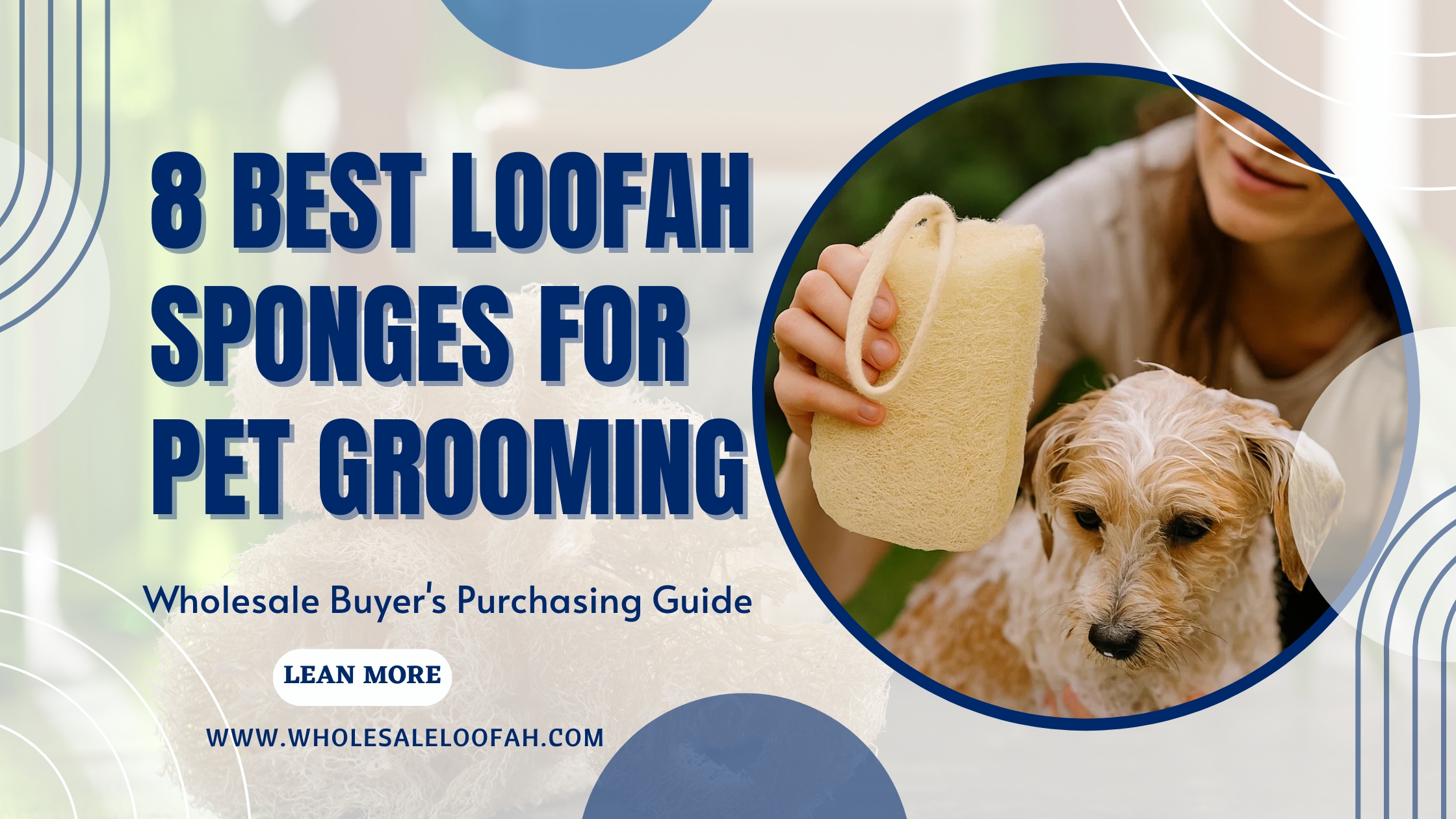
Capitalizing on the Natural Pet Care Product Boom
Wholesale buyers who understand the best loofah sponges for pet grooming position their businesses to capture significant market share in this rapidly growing sector.
Natural loofah has transitioned from niche specialty item to mainstream grooming essential as consumer awareness of sustainable pet care accelerates. Retailers report that natural grooming products now account for 28 percent of category sales, up from just 11 percent five years ago. This trajectory creates substantial opportunities for distributors, retailers, and service providers who stock quality loofah products.
This wholesale purchasing guide examines eight loofah product categories optimized for pet grooming applications. Each section addresses product specifications, target customer profiles, margin potential, and inventory planning considerations that inform smart wholesale purchasing decisions.
The analysis draws from our position as direct exporters of Egyptian loofah serving commercial buyers across 40 countries. Understanding cultivation grades, processing standards, and market dynamics helps wholesale purchasers evaluate suppliers and build profitable product assortments.
Buyers ready to explore immediate purchasing options can request wholesale quotations with volume pricing and shipping estimates tailored to their specific requirements.
Market Analysis: Why Pet Grooming Loofah Demands Wholesale Attention
Before examining specific products, understanding market forces driving demand helps wholesale buyers assess opportunity size and timing for inventory investments.
Consumer Behavior Shifts Favoring Natural Products
Pet owner surveys consistently reveal strengthening preference for natural grooming alternatives.
This preference intensifies among millennial and Gen Z pet owners who represent the fastest-growing demographic segments. These consumers demonstrate willingness to pay premium prices for products aligning with environmental values, creating margin opportunities for retailers stocking quality natural alternatives.
The humanization of pets continues driving premiumization across all pet care categories. Owners increasingly apply personal care standards to pet products, seeking the same natural ingredients and sustainable materials they choose for themselves.
Competitive Landscape Assessment
Major pet retail chains have expanded natural product shelf space significantly over the past three years. However, independent retailers and specialty stores often struggle to source quality natural grooming products at competitive wholesale pricing.
This supply gap creates opportunity for distributors and wholesalers who establish reliable sourcing relationships. Businesses offering consistent quality and competitive pricing capture accounts from retailers frustrated with inconsistent supply from general merchandise distributors.
Professional grooming salons represent another underserved market segment. Most groomers purchase supplies through general pet industry distributors who prioritize high-volume synthetic products over natural alternatives. Direct wholesale relationships appeal to groomers seeking differentiated service offerings.
Growth Projections and Timing Considerations
Early positioning in this expanding market establishes customer relationships and brand recognition before competition intensifies.
Seasonal demand patterns affect inventory planning significantly. Spring shedding season generates peak demand for de-shedding products, while holiday gift-buying creates retail opportunities for attractively packaged grooming sets. Strategic inventory building before these periods maximizes sales capture.
The 8 Best Loofah Sponges for Pet Grooming: Wholesale Product Analysis
Each product category serves distinct market segments with different purchasing behaviors and margin characteristics. This analysis helps wholesale buyers construct optimal product assortments.
1. Grade A Whole Loofah Cylinders for Professional Markets
Whole loofah cylinders measuring 25 to 40 centimeters represent the premium product tier commanding highest margins in professional grooming markets. Grade A designation indicates uniform fiber density, consistent coloring, and absence of structural defects throughout.
Professional groomers prefer whole cylinders because they can be customized through cutting to match specific application needs. A single cylinder yields multiple usable sections, providing groomers flexibility while demonstrating value that justifies premium pricing.
Retail positioning between 12 and 18 dollars generates margins of 65 to 75 percent, exceptional for consumable grooming supplies.
Minimum order quantities for Grade A product start at 200 units from most Egyptian suppliers, though larger orders of 1000 or more unlock additional volume discounts averaging 15 to 20 percent below standard wholesale.
Target customers include professional grooming salons, mobile groomers, veterinary clinics, and specialty pet retailers serving premium-conscious consumers.
2. Grade B Cylinders for Value-Oriented Retail
Grade B loofah cylinders meet functional quality standards while displaying minor cosmetic variations including slight color inconsistency or small structural irregularities. These variations do not affect grooming performance but disqualify products from premium Grade A classification.
Value-oriented retailers and price-sensitive professional buyers represent the primary market for Grade B product. The lower wholesale cost enables competitive retail pricing that captures budget-conscious consumers without sacrificing margin percentage.
Retail positioning between 6 and 10 dollars maintains margins of 55 to 70 percent while offering consumers meaningful savings versus premium alternatives.
Grade B product moves faster in mass-market retail environments where price sensitivity exceeds quality differentiation. Supermarket pet sections, discount retailers, and value-focused online sellers achieve strong velocity with appropriately priced Grade B inventory.
Mixed orders combining Grade A and Grade B product allow retailers to serve multiple customer segments from single supplier relationships. This strategy simplifies procurement while maximizing category coverage.
3. Pre-Cut Grooming Pads for Retail Convenience
Pre-cut loofah pads shaped for palm-fitting comfort represent the highest-velocity retail SKU in pet grooming loofah categories. Consumer research indicates that ready-to-use products outsell whole loofah requiring customer preparation by margins of four to one in retail environments.
Standard pad dimensions of 10 to 14 centimeters suit most adult hand sizes while providing adequate surface area for efficient grooming. Rounded edges and uniform thickness create polished appearance supporting premium retail presentation.
However, retail pricing tolerance of 8 to 14 dollars per pad maintains strong margins while meeting consumer expectations for convenience products.
Packaging significantly influences retail performance for pre-cut pads. Products with clear window packaging allowing tactile inspection outperform fully enclosed alternatives. Including brief usage instructions on packaging reduces customer hesitation and return rates.
Retail buyers should consider multi-pack configurations offering two or three pads at attractive per-unit pricing. Multi-packs increase transaction value while providing consumers with replacement inventory, extending time between repeat purchases.
4. Assorted Texture Variety Packs for Gift and Trial Markets
Variety packs containing multiple loofah textures serve gift-buying occasions and trial-seeking consumers exploring natural grooming for the first time. These curated assortments typically include soft, medium, and firm texture samples sized appropriately for evaluation.
Gift market positioning proves particularly effective for variety packs. Attractive packaging with clear product information supports impulse purchasing during holiday seasons and pet adoption celebrations. Retailers report variety pack sales increase 300 to 400 percent during November and December.
Retail pricing of 18 to 28 dollars positions variety packs as affordable gift options while delivering margins exceeding 60 percent.
Trial pack positioning helps retailers acquire new customers for natural grooming products. First-time buyers who discover preferred textures through variety packs frequently return for full-size replenishment purchases, building ongoing customer relationships.
Custom variety pack configurations accommodate retailer preferences and target market characteristics. Private label manufacturing services enable branded variety packs with customized contents and packaging.
5. Soft Texture Specialty Loofah for Sensitive Animal Markets
Soft texture loofah processed for reduced fiber stiffness serves specialty markets including puppies, kittens, senior pets, and animals with skin sensitivities. This segment commands premium pricing due to limited competition and specific customer needs.
Processing methods that produce consistently soft texture require additional manufacturing steps increasing production costs. However, customers seeking soft texture products demonstrate lower price sensitivity, accepting premiums of 20 to 40 percent above standard texture alternatives.
Veterinary clinics represent a key distribution channel for soft texture products. Clinic retail sections and recommendation programs drive sales to pet owners managing skin conditions or caring for young and elderly animals.
Breeding operations and rescue organizations purchase soft texture loofah for animals requiring gentle handling. These institutional buyers often prefer case quantities with simplified reordering, creating recurring revenue opportunities for distributors serving these accounts.
6. Dense Fiber Blocks for Double-Coated Breed Specialists
Dense fiber loofah blocks designed for undercoat penetration serve the specialized market segment of double-coated breed owners and groomers. Breeds including Huskies, Malamutes, Samoyeds, and German Shepherds require grooming tools capable of reaching shed undercoat beneath protective topcoat layers.
This niche product category faces limited competition from general grooming suppliers, enabling premium positioning without direct price comparison. Specialty positioning also reduces markdown pressure that affects commoditized grooming products.
The specialized nature supports margins of 65 to 80 percent for retailers successfully reaching target customer segments.
Marketing dense blocks requires targeted approaches reaching double-coated breed owners specifically. Breed club partnerships, specialty dog show presence, and targeted digital advertising generate awareness among qualified prospects more effectively than general pet retail placement.
Seasonal inventory building before spring and fall shedding seasons ensures adequate stock during peak demand periods. Dense block sales concentrate heavily during these seasons, requiring inventory planning that accounts for irregular demand patterns.
7. Flexible Strip Format for Equestrian and Large Animal Markets
Flexible loofah strips measuring 4 to 6 centimeters wide and 25 to 35 centimeters long serve equestrian markets and large animal care applications. The strip format wraps around legs and contoured body areas where flat grooming tools prove awkward.
Horse owners represent significant purchasing power with demonstrated willingness to invest in quality care products. The equestrian market exhibits different purchasing patterns than companion animal segments, favoring larger quantities and professional-grade specifications.
Distribution channels for equestrian products differ from pet retail. Tack shops, feed stores, equestrian supply catalogs, and barn direct sales require different sales approaches than pet store distribution. Established equestrian distributors may provide efficient market access for suppliers lacking direct channel relationships.
Large animal veterinary practices and livestock operations represent additional market segments for strip format products. These institutional buyers purchase in case quantities with simplified specifications, creating volume opportunities for suppliers capable of meeting institutional purchasing requirements.
Explore the complete Egexo product catalog for detailed strip specifications and bulk pricing.
8. Private Label Ready Blanks for Brand Development
Unbranded loofah blanks prepared for private label finishing enable retailers and distributors to develop proprietary branded product lines. These blanks undergo complete processing and quality verification but ship without packaging or branding, ready for customer customization.
Private label programs provide competitive differentiation that generic product resale cannot achieve. Branded products build customer loyalty, reduce price comparison shopping, and establish retailer identity in crowded markets.
Wholesale pricing for private label blanks matches corresponding grade levels, with additional costs for custom packaging, labeling, and minimum order requirements varying by customization complexity. Total landed costs typically range from 3.50 to 6.00 dollars per finished unit including packaging.
Minimum orders for private label programs generally start at 500 units to justify setup costs for custom packaging production. Larger programs of 2000 units or more unlock significant per-unit cost reductions and additional customization options.
Brand development support including label design templates, photography assets, and marketing copy assists retailers building private label programs. Contact our private label team to discuss custom program development.
Wholesale Pricing and Margin Analysis Table
This comprehensive pricing analysis helps wholesale buyers evaluate product economics and construct profitable assortments.
See our wholesale prices on egexo.com.
Supplier Evaluation Criteria for Wholesale Buyers
Selecting reliable suppliers determines long-term success in natural pet grooming product distribution. This evaluation framework identifies critical assessment areas.
Quality Consistency Standards
Consistent product quality across orders protects buyer reputation and reduces costly returns processing. Suppliers should provide grading documentation specifying objective quality criteria and inspection protocols.
Request samples from multiple production batches before committing to large orders. Batch-to-batch consistency indicates mature quality control systems capable of reliable ongoing supply.
Egyptian loofah suppliers with established export operations typically demonstrate superior consistency compared to newer market entrants. Decades of cultivation experience and refined processing knowledge produce predictable quality outcomes.
Review the quality standards documentation to understand grading criteria and inspection protocols used by professional Egyptian exporters.
Supply Chain Reliability Assessment
Reliable delivery timing enables inventory planning and prevents stockout situations that damage customer relationships. Evaluate supplier track records for on-time delivery performance and communication responsiveness when issues arise.
Geographic concentration of loofah cultivation in Egypt creates supply chain considerations including shipping transit times, customs processing, and seasonal harvest timing. Experienced exporters navigate these factors routinely, while less established suppliers may encounter delays affecting buyer operations.
Diversifying across multiple suppliers reduces concentration risk but increases procurement complexity. Most wholesale buyers balance these considerations by establishing primary supplier relationships with secondary backup sources for contingency situations.
Pricing Transparency and Stability
Clear pricing structures without hidden fees enable accurate margin planning. Request comprehensive quotes including product costs, shipping, customs duties, and any additional charges before order commitment.
Currency fluctuation exposure affects international purchasing economics. Suppliers offering pricing in buyer’s local currency or providing exchange rate guarantees reduce financial uncertainty in multi-month procurement cycles.
Volume commitment agreements may provide pricing stability in exchange for purchase guarantees. Evaluate whether predictable pricing justifies commitment obligations based on your demand forecasting confidence.
Communication and Support Capabilities
Responsive communication becomes critical when questions or issues arise during procurement and fulfillment. Assess supplier responsiveness during initial inquiry stages as indicator of ongoing relationship quality.
Language capabilities affect communication efficiency for international transactions. Suppliers with English-fluent staff streamline interactions for buyers in English-speaking markets.
Technical support including product information, marketing materials, and application guidance adds value beyond basic product supply. Suppliers investing in buyer support demonstrate partnership orientation benefiting long-term relationships.
Learn more about supplier selection considerations and relationship development approaches.
Inventory Planning Guide for Pet Grooming Loofah
Strategic inventory management balances stock availability against carrying costs and obsolescence risk. This planning framework addresses key considerations.
Demand Forecasting Methodology
Historical sales data provides the foundation for demand forecasting, but new product categories require estimation approaches combining market research, competitive analysis, and test marketing results.
For established product lines, calculate average monthly sales velocity and seasonal variation factors. Apply growth assumptions based on market trends and your specific business development activities.
New market entrants should plan conservatively, ordering minimum quantities for initial market testing before committing to larger inventory positions. Customer response validation reduces risk of excess inventory accumulation.
Safety Stock Calculations
Safety stock buffers protect against demand variability and supply chain delays. Calculate safety stock as a multiple of average lead time demand, with multiplier reflecting acceptable stockout risk tolerance.
International sourcing from Egypt typically involves lead times of four to eight weeks depending on shipping method and customs processing. Safety stock covering two to four weeks of demand provides reasonable protection without excessive inventory investment.
Higher safety stock levels make sense for products with concentrated seasonal demand or those serving accounts with strict delivery requirements. Lower levels suit products with stable demand patterns and flexible delivery timing.
Seasonal Inventory Building
Spring shedding season generates peak demand for de-shedding products including dense blocks and whole cylinders. Begin inventory building in January and February to ensure adequate stock before March demand increases.
Holiday gift season requires inventory positioning by October for variety packs and attractively packaged gift-oriented products. Late inventory arrivals miss critical early holiday shopping periods.
Coordinate with suppliers regarding production capacity and shipping schedules during peak seasons. Popular products may face allocation constraints when multiple buyers seek inventory simultaneously.
Inventory Turnover Optimization
Target inventory turnover rates balancing availability against carrying costs. Natural loofah products maintain quality for extended periods when stored properly, reducing obsolescence concerns that affect perishable inventory.
Turnover rates of four to six times annually represent reasonable targets for most pet grooming loofah categories. Higher turnover reduces carrying costs but increases stockout risk, while lower turnover ties up capital and storage capacity.
Monitor slow-moving inventory and implement promotional strategies to accelerate turnover before products age excessively. Though loofah remains functional for years, consumers prefer products appearing fresh and recently produced.
Distribution Channel Strategies
Different distribution channels require distinct approaches for successful pet grooming loofah sales. This analysis examines channel characteristics and optimization strategies.
Independent Pet Retail Distribution
Independent pet retailers seek differentiated products unavailable through mass-market competitors. Natural loofah grooming products meet this need while providing margins superior to commoditized synthetic alternatives.
Sales approaches emphasizing product uniqueness, margin potential, and consumer demand trends resonate with independent retailer buyers. Provide sell-through support including display materials, product information sheets, and staff training resources.
Credit terms and minimum order flexibility matter significantly for independent retailers managing limited working capital. Accommodating smaller initial orders with growth-based terms builds relationships that expand over time.
Professional Groomer Sales
Professional groomers evaluate products based on performance, durability, and client perception. Emphasize quality specifications, session life expectations, and premium positioning that supports groomer service pricing.
Sample programs allowing groomers to evaluate products before purchasing reduce adoption barriers for unfamiliar natural alternatives. Positive trial experiences convert to ongoing purchasing relationships.
Recurring order programs with automated replenishment simplify procurement for busy grooming professionals. Subscription-style arrangements ensure consistent supply while providing predictable revenue for suppliers.
Veterinary Clinic Placement
Veterinary clinics represent premium distribution channels reaching pet owners during care-focused interactions. Clinic recommendations carry significant influence on purchasing decisions.
Approach veterinary accounts emphasizing skin health benefits and suitability for sensitive patients. Clinical positioning differentiates from general retail products and justifies premium pricing.
Clinic display programs providing point-of-sale materials and inventory management support reduce adoption friction for practices unfamiliar with retail product management.
E-commerce and Online Marketplaces
Online channels require different inventory and fulfillment approaches than traditional distribution. Product photography, detailed descriptions, and review generation drive online sales performance.
Marketplace selling on platforms like Amazon and Chewy provides immediate customer access but involves fee structures affecting margins. Direct website sales preserve margins but require traffic generation investment.
Fulfillment options including drop-shipping arrangements and third-party logistics partnerships enable online selling without warehouse investment. Evaluate total cost structures when comparing fulfillment alternatives.
Wholesale Buyer Checklist
Use this checklist when evaluating suppliers and planning wholesale purchases.
| Evaluation Area | Key Questions | Documentation to Request |
|---|---|---|
| Product Quality | What grading standards apply? How is consistency verified? | Quality specifications, inspection protocols, grade certificates |
| Pricing Structure | What volumes unlock price breaks? Are there hidden fees? | Complete price lists, shipping cost estimates, terms documentation |
| Supply Reliability | What is typical lead time? How is capacity allocated? | Delivery performance history, capacity statements, contingency plans |
| Customization Options | What private label services are available? Minimum requirements? | Private label specifications, setup costs, timeline estimates |
| Support Services | What marketing materials are provided? Training available? | Marketing asset samples, support program descriptions |
| Financial Terms | What payment terms are offered? Currency and exchange handling? | Credit application, terms documentation, banking information |
| Sample Availability | Can samples be provided before commitment? Cost structure? | Sample program details, evaluation timeline expectations |
Request samples to evaluate product quality before making wholesale commitments.
Frequently Asked Questions for Wholesale Buyers
Q: What minimum order quantities should new wholesale buyers expect?
A: Standard minimum order quantities for pet grooming loofah range from 100 to 500 units depending on product type and supplier. Grade A whole cylinders typically require minimums of 200 units, while private label programs start at 500 units to justify setup costs. Some suppliers offer mixed product orders allowing buyers to meet minimum value thresholds while sampling multiple products. New buyers should communicate growth potential when negotiating minimums, as suppliers often accommodate smaller initial orders from accounts demonstrating expansion opportunity.
Q: How do shipping costs affect total landed cost calculations?
Consolidating orders to maximize container utilization significantly reduces per-unit shipping costs. Buyers should request complete landed cost quotes including freight, insurance, customs duties, and handling fees for accurate margin calculations.
Q: What quality documentation should wholesale buyers request from suppliers?
A: Professional suppliers should provide grade specifications defining objective quality criteria, inspection protocols describing verification procedures, and certificates of origin documenting product sourcing. Request batch-specific quality reports for initial orders and establish ongoing documentation requirements for recurring purchases. Photography of actual shipment contents before dispatch allows quality verification prior to goods arrival. Suppliers unwilling to provide quality documentation may not maintain consistent standards worth wholesale purchasing commitment.
Q: How should wholesale buyers handle currency fluctuation risk on international orders?
A: Several approaches mitigate currency risk for international loofah purchasing. Some suppliers offer pricing in buyer currencies, absorbing exchange rate variability themselves. Forward contracts through banking partners lock exchange rates for future payment dates. Timing purchases when exchange rates favor buyers reduces costs when flexibility exists. Building currency fluctuation assumptions into margin calculations ensures profitability even when rates move unfavorably. Discuss currency handling preferences with suppliers during relationship establishment.
Q: What shelf life expectations apply to natural loofah products?
A: Properly stored natural loofah maintains functional quality for three to five years without significant degradation. Storage requirements include cool, dry conditions with adequate air circulation preventing moisture accumulation. Avoid direct sunlight exposure that may cause fiber discoloration over extended periods. From consumer perception standpoint, products appearing fresh sell better, so inventory turnover within 12 to 18 months represents reasonable target even though longer storage remains technically acceptable. Packaging with production date coding helps manage inventory rotation.
Q: How do returns and quality claims get handled with international suppliers?
A: Establish return and claims procedures explicitly before initial orders. Professional suppliers accept responsibility for documented quality defects with remedies including replacement shipment, credit toward future orders, or refund depending on circumstances. Photographic documentation of defects submitted promptly after receipt strengthens claim validity. Minor cosmetic issues within grade specifications typically do not warrant claims, making clear grade understanding essential. Build supplier track record assessment into ongoing relationship evaluation.
Q: What certifications matter for pet grooming loofah products?
Import compliance documentation including phytosanitary certificates ensures smooth customs clearance. Some retailers require supplier certifications for social responsibility or environmental practices. Pet-specific safety certifications do not currently exist for loofah products, though general product safety compliance applies. Understand your target customer certification requirements before prioritizing specific credentials.
Expert Perspective: Building Profitable Loofah Distribution
Success in pet grooming loofah distribution requires understanding both product characteristics and market dynamics. Our experience supplying commercial buyers globally reveals patterns that differentiate thriving distributors from struggling operators.
Product knowledge creates sales effectiveness. Distributors who understand loofah cultivation, processing, and quality factors communicate value convincingly to downstream customers. Investing time learning product fundamentals pays returns through improved sales conversion and reduced customer service issues.
Relationship depth with suppliers matters more than transaction optimization. Buyers constantly seeking lowest prices across multiple suppliers rarely achieve the quality consistency and supply reliability that sustain profitable operations. Committed partnerships with capable suppliers generate advantages that price shopping cannot replicate.
Market education represents both challenge and opportunity. Many potential customers remain unaware of natural loofah grooming benefits. Distributors who invest in customer education capture demand they create, rather than competing purely for existing demand with established competitors.
Starting focused and expanding deliberately outperforms attempting broad market coverage immediately. Master one channel or customer segment before diversifying. The operational capabilities built serving focused markets transfer when expansion opportunities arise.
To discuss your order, request a quote from EGEXO.
Conclusion
Identifying the best loofah sponges for pet grooming requires evaluating product specifications against target market needs and business economics. The eight product categories analyzed provide wholesale buyers with comprehensive options serving diverse customer segments from premium professional groomers to value-conscious retail consumers.
Market conditions strongly favor natural pet grooming products, with consumer preference trends and competitive dynamics creating favorable conditions for well-positioned distributors. Quality Egyptian loofah delivers the product characteristics that satisfy demanding pet owners while generating margins that sustain profitable distribution operations.
Supplier selection, inventory planning, and channel strategy determine ultimate success more than product selection alone. Wholesale buyers who approach natural pet grooming products strategically, building supplier relationships and market presence systematically, capture disproportionate share of this expanding market opportunity.
Key Takeaways for Wholesale Buyers:
- Grade A Egyptian loofah commands premium positioning with margins of 65 to 75 percent in professional markets
- Pre-cut convenience formats generate highest retail velocity for consumer channels
- Seasonal demand concentration requires proactive inventory building before spring and holiday periods
- Private label programs enable competitive differentiation beyond commodity resale
- Supplier relationship quality determines long-term supply reliability and cost stability
Ready to Start Your Wholesale Pet Grooming Loofah Business?
- Request Volume Pricing: Get wholesale quotation
- Evaluate Product Quality: Order samples
- Explore Complete Selection: Download product catalog
- Discuss Private Label: Contact manufacturing team