A Wholesale Perspective on Loofah Bath Mitts
Commercial buyers evaluating loofah bath mitts for inventory face decisions that directly impact profitability, customer satisfaction, and brand positioning. The natural bath accessories market has expanded by 47 percent over the past four years as retailers and service providers respond to consumer demand for sustainable alternatives. Within this growth, loofah bath mitts represent one of the highest-volume product categories, generating consistent reorder cycles and strong margins when sourced strategically.
This analysis approaches loofah bath mitts specifically from the wholesale buyer perspective. Retailers stocking shelves, spa directors selecting treatment tools, hotel purchasing managers specifying amenities, and distributors building product portfolios all require different information than individual consumers. Understanding the genuine advantages these products offer, acknowledging their real limitations, and identifying optimal applications across commercial contexts enables purchasing decisions that support business objectives.
The information presented draws from extensive experience in Egyptian loofah cultivation and international wholesale distribution. Rather than marketing generalizations, this resource provides the specific details commercial buyers need including margin considerations, inventory management factors, quality assessment criteria, and supplier evaluation frameworks. The goal is equipping wholesale purchasers with knowledge that translates directly into better sourcing outcomes.
Business buyers seeking immediate supplier engagement can request wholesale quotations to begin the evaluation process while reviewing this comprehensive guide.
Product Overview: What Commercial Buyers Must Understand
Botanical Origins and Commercial Significance
Loofah bath mitts derive from the Luffa genus, specifically Luffa aegyptiaca and Luffa cylindrica varieties cultivated as agricultural crops. The mature fruit of these climbing vines contains a dense fibrous network that, when processed, creates the exfoliating material used in bath product manufacturing. This natural origin differentiates loofahs from petroleum-based synthetic alternatives and drives much of current market demand.
Commercial significance extends beyond simple product attributes to encompass supply chain dynamics, quality variability, and sourcing geography. Approximately 65 percent of premium-grade loofah production originates from Egypt, where Nile Delta cultivation conditions produce fiber characteristics unmatched by other growing regions. Understanding this geographic concentration helps buyers appreciate why supplier selection matters and why origin verification should feature in purchasing criteria.
The agricultural nature of loofah production introduces considerations absent from synthetic product sourcing. Harvest timing affects quality, weather patterns influence annual yields, and processing methods vary significantly between suppliers. Commercial buyers benefit from understanding these upstream factors that ultimately determine the products reaching their inventory.
Mitt Construction for Commercial Applications
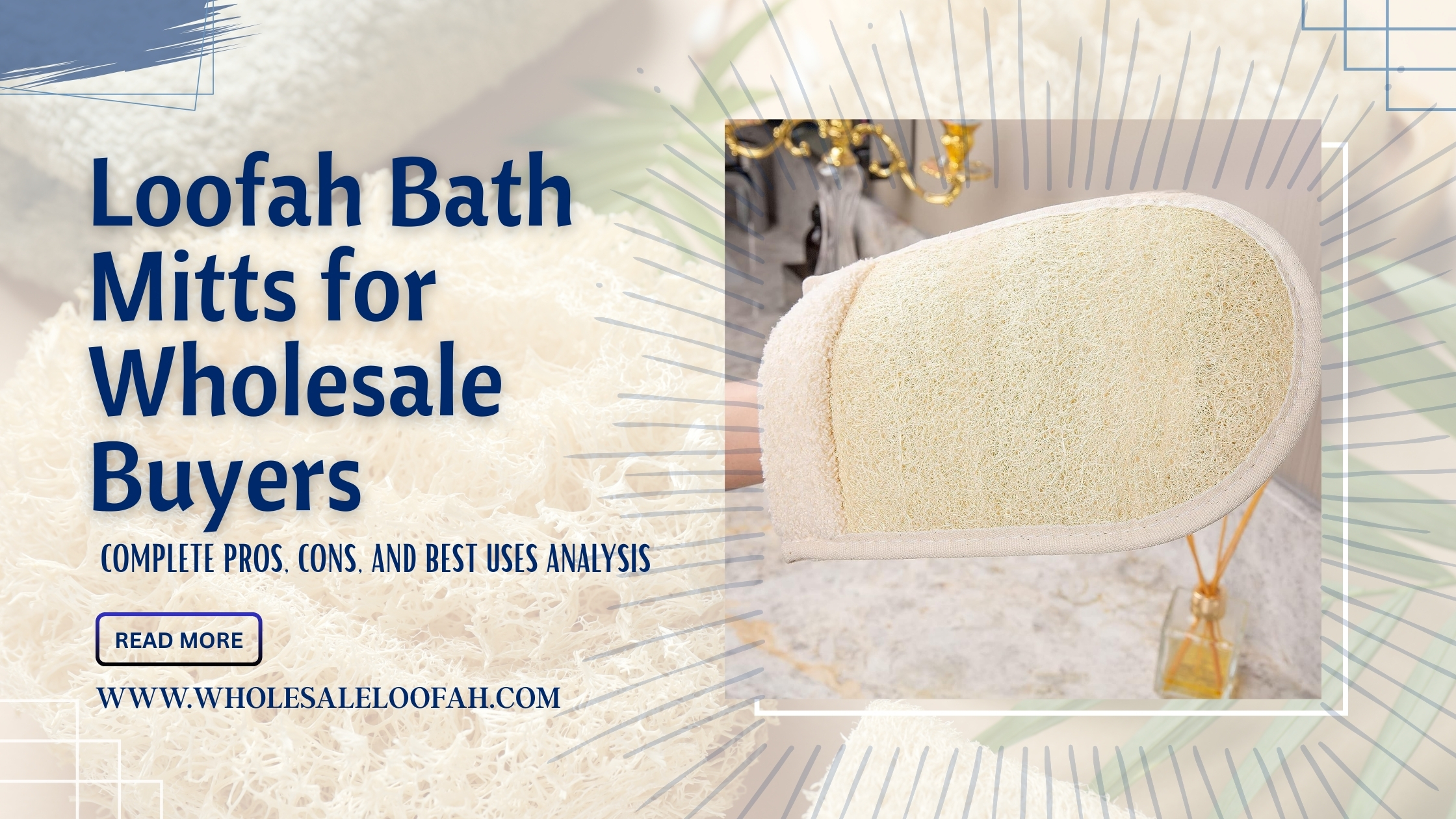
Bath mitt formats transform raw loofah material into finished goods suitable for retail sale or service application. Construction methods vary considerably, creating quality and price differentiation that wholesale buyers must navigate. The most common commercial formats include palm-style mitts with elastic cuffs, full-coverage mitts with loofah exterior surfaces, and combination designs incorporating multiple materials.
Construction quality directly impacts customer satisfaction and return rates. Wholesale buyers should evaluate stitching durability, attachment security between loofah and backing materials, cuff elasticity retention, and overall finishing standards. Products failing these criteria generate customer complaints that damage retailer reputation regardless of attractive wholesale pricing.
The Egexo product catalog illustrates construction variations available across different product lines and price points, enabling buyers to match offerings with target market requirements.
Commercial Summary: Loofah bath mitts represent agricultural products with geographic quality concentration, requiring wholesale buyers to prioritize supplier verification and construction quality assessment over simple price comparison.
Comprehensive Advantages for Wholesale Buyers
Market Demand and Sales Velocity
The primary advantage loofah bath mitts offer wholesale buyers is strong, sustained market demand. This demand translates into reliable sales velocity that supports inventory investment.
Reorder predictability strengthens the commercial case for loofah bath mitts. Unlike trend-driven products with unpredictable demand curves, natural bath accessories maintain consistent purchasing patterns tied to replacement cycles rather than fashion shifts. Wholesale buyers can forecast inventory needs with reasonable accuracy, reducing both stockout risk and overstock carrying costs.
Category growth projections remain positive across major retail and hospitality segments. Early category investment positions wholesale buyers advantageously as market expansion continues.
Margin Structure and Pricing Flexibility
Loofah bath mitts support favorable margin structures across wholesale, retail, and service applications. The perceived value of natural, sustainable products enables pricing that generates healthy returns while remaining competitive within bath accessory categories. Buyers sourcing from efficient suppliers can achieve gross margins of 45 to 65 percent at retail depending on market positioning and product grade.
Pricing flexibility exists across quality tiers, enabling wholesale buyers to serve diverse market segments from budget-conscious mass retail to premium boutique positioning. This range allows portfolio construction that captures demand across price sensitivities without requiring separate supplier relationships for each tier.
Volume pricing structures from established suppliers provide additional margin enhancement opportunities. Buyers committing to larger quantities or ongoing purchasing relationships typically secure per-unit cost reductions of 15 to 25 percent compared to minimum order pricing. These savings flow directly to bottom-line profitability or enable more competitive retail pricing.
Product Differentiation Opportunities
Natural loofah bath mitts offer differentiation potential that commodity synthetic products cannot match. Origin stories connecting products to Egyptian agriculture, sustainability credentials verified through biodegradability testing, and quality certifications all provide marketing narratives that support premium positioning and customer loyalty development.
Private label manufacturing capabilities transform generic loofah products into proprietary branded offerings. Wholesale buyers can develop exclusive products unavailable from competitors, building brand equity that reduces price sensitivity and increases customer retention. Private labeling options range from simple tag attachment to full custom product design incorporating unique shapes, materials combinations, or packaging configurations.
Sustainability certification increasingly drives purchasing decisions in both retail and hospitality contexts. Loofah bath mitts inherently support environmental claims that resonate with target demographics, providing marketing advantages without requiring separate certification investments beyond supplier documentation.
Operational Advantages
Beyond sales and margin benefits, loofah bath mitts offer operational advantages that simplify inventory management and reduce handling complexity. Lightweight products minimize shipping costs per unit and maximize storage efficiency. Standard sizing enables straightforward shelving and display without complex merchandising requirements.
Product stability under normal storage conditions eliminates spoilage concerns that affect some natural product categories. Properly packaged loofah mitts maintain quality for 18 to 24 months in warehouse environments, providing inventory flexibility that perishable alternatives cannot offer. This stability enables opportunistic purchasing when favorable pricing becomes available.
Return rates for quality loofah bath mitts typically fall below category averages for bath accessories. The straightforward product function and durable construction minimize customer dissatisfaction when sourcing from reliable suppliers. Lower return processing reduces operational burden and preserves margins that returns would otherwise erode.
Wholesale Advantages Summary Table
| Advantage Category | Specific Benefit | Commercial Impact |
|---|---|---|
| Market Demand | 73 percent consumer premium willingness | Strong sales velocity support |
| Demand Predictability | Replacement-driven purchasing cycles | Accurate inventory forecasting |
| Category Growth | 8 to 12 percent annual expansion projected | Favorable market positioning |
| Margin Structure | 45 to 65 percent gross margin potential | Healthy profitability |
| Pricing Flexibility | Multiple quality tiers available | Diverse market segment coverage |
| Volume Pricing | 15 to 25 percent cost reduction opportunity | Enhanced bottom-line returns |
| Differentiation | Origin stories and sustainability credentials | Premium positioning support |
| Private Labeling | Proprietary product development | Competitive advantage creation |
| Storage Stability | 18 to 24 month shelf life | Inventory management flexibility |
| Return Rates | Below category average | Reduced operational burden |
Honest Assessment of Wholesale Challenges
Quality Consistency Risks
The most significant challenge wholesale buyers face involves quality consistency across orders and over time. Agricultural product variability, processing differences between production batches, and supplier capability variations all contribute to potential inconsistency that can damage customer relationships and brand reputation.
Quality issues may not become apparent until products reach end customers, creating delayed feedback loops that complicate supplier accountability. A shipment passing initial inspection might generate customer complaints weeks later as usage reveals fiber degradation, construction failures, or other defects invisible during receiving inspection. Building supplier relationships that include quality guarantees and responsive issue resolution becomes essential.
Mitigation requires systematic supplier evaluation extending beyond initial sample quality to encompass production consistency documentation, quality control processes, and track record with comparable wholesale buyers. The quality standards documentation from established suppliers provides baseline expectations, but buyers should also request customer references and conduct ongoing quality monitoring across received shipments.
Supply Chain Vulnerabilities
Geographic concentration of premium loofah production creates supply chain vulnerabilities that wholesale buyers must acknowledge. Political instability, transportation disruptions, agricultural challenges, or trade policy changes affecting Egyptian exports can impact product availability and pricing. Diversification strategies have limited effectiveness given the quality differential between Egyptian and alternative sources.
Seasonal production patterns introduce timing considerations for large orders. Harvest periods concentrate in specific months, meaning suppliers build inventory during production windows to fulfill year-round demand. Late-season orders may encounter availability constraints or require acceptance of inventory from earlier harvests with potentially different characteristics.
Lead times for international shipments from Egypt to destination markets typically range from three to six weeks depending on logistics routing and customs processing. Wholesale buyers must incorporate these timeframes into inventory planning, maintaining adequate safety stock to bridge order-to-delivery periods without stockouts.
Customer Education Requirements
Natural loofah products require customer education that synthetic alternatives do not demand. End users unfamiliar with proper care may experience premature product failure, generating dissatisfaction despite adequate product quality. Retailers and service providers must invest in communicating care instructions to prevent negative experiences that reflect poorly on the product and seller.
Care education encompasses drying requirements, sanitization protocols, appropriate use frequency, and replacement timing indicators. Wholesale buyers should evaluate whether suppliers provide supporting materials such as care cards, packaging instructions, or digital resources that facilitate customer education without requiring significant retailer investment.
Skin sensitivity variations among end users create additional complexity. Products appropriate for most consumers may cause irritation for sensitive individuals, generating complaints and returns. Wholesale buyers serving diverse markets benefit from stocking multiple grades to address different sensitivity levels and clearly communicating intended use to retail customers.
Competitive and Market Risks
Market success attracts competition, and the natural bath accessories category increasingly draws new entrants seeking to capture growth. Wholesale buyers face potential margin pressure as competition intensifies and price-focused competitors enter established channels. Differentiation through quality, branding, and supplier relationships provides insulation against purely price-based competition.
Consumer preferences evolve continuously, and while current trends favor natural products, future shifts could redirect demand. Wholesale buyers should monitor market signals and maintain flexibility to adjust inventory commitments if demand patterns change. Avoiding excessive long-term inventory positions preserves adaptability.
Counterfeit and misrepresented products create market confusion that affects legitimate wholesale buyers. Products falsely claiming Egyptian origin, natural composition, or quality certifications erode consumer trust in the category generally. Working with verified suppliers and maintaining documentation that supports authenticity claims protects against association with fraudulent products.
Wholesale Challenges Summary Table
| Challenge Category | Specific Risk | Mitigation Strategy |
|---|---|---|
| Quality Consistency | Batch-to-batch variation | Systematic supplier evaluation and monitoring |
| Delayed Defect Discovery | Issues appearing after customer receipt | Quality guarantees with supplier accountability |
| Geographic Concentration | Egypt-dependent premium supply | Relationship building with reliable suppliers |
| Seasonal Production | Harvest timing constraints | Forward ordering and safety stock maintenance |
| Lead Times | 3 to 6 week international shipping | Inventory planning incorporating delivery windows |
| Customer Education | Improper care causing premature failure | Care instruction materials and communication |
| Sensitivity Variations | Irritation complaints from sensitive users | Multiple grade availability and clear guidance |
| Competitive Pressure | New entrants and price competition | Differentiation through quality and branding |
| Market Evolution | Potential preference shifts | Monitoring and inventory flexibility |
| Product Misrepresentation | Counterfeit and falsely labeled goods | Verified supplier relationships and documentation |
Best Uses Across Commercial Segments
Retail Merchandising Applications
Retail represents the largest commercial application for wholesale loofah bath mitt purchases. Successful retail merchandising requires understanding target customer demographics, competitive positioning within store assortments, and pricing strategies that balance volume and margin objectives.
Mass retail channels typically emphasize value positioning with standard-grade products at accessible price points. Wholesale buyers serving these channels prioritize per-unit cost efficiency and packaging that communicates value without requiring premium presentation. Volume commitments to suppliers support the pricing necessary for mass retail competitiveness.
Specialty retail including natural product stores, boutiques, and wellness-focused retailers supports premium positioning with higher-grade products and enhanced presentation. Wholesale buyers serving specialty channels should source from suppliers offering premium grades and product variety that enables curated assortment building.
Online retail adds considerations around shipping efficiency and unboxing experience. Lightweight loofah products ship economically, but packaging must protect against transit damage while creating positive customer impressions upon receipt. Wholesale buyers should evaluate supplier packaging options against e-commerce requirements.
Spa and Wellness Service Applications
Spa and wellness facilities use loofah bath mitts as treatment tools within service protocols. This application prioritizes consistent quality and professional appearance over cost minimization, as treatment experiences directly impact client satisfaction and facility reputation. Wholesale buyers serving spa clients should emphasize premium grades and reliable supply consistency.
Single-use protocols in many spa settings create higher volume requirements than product lifespan would otherwise suggest. Wholesale buyers should understand client usage models when sizing orders and negotiating pricing. High-volume single-use accounts may warrant customized pricing structures reflecting predictable, substantial ongoing demand.
Professional-grade appearance matters in spa contexts where clients observe products before and during treatments. Uniform coloring, consistent sizing, and quality packaging all contribute to professional presentation. Suppliers capable of grading and selecting for visual consistency provide advantages for spa-focused wholesale buyers.
Treatment protocol integration often requires specific product characteristics. Wholesale buyers should consult with spa clients about requirements including size specifications, texture preferences, and any special needs before finalizing supplier selections. The sample request process enables evaluation against specific client requirements before inventory commitment.
Hospitality and Amenity Applications
Hotels, resorts, and cruise lines incorporate loofah bath mitts as guest amenities that communicate quality and sustainability values. This application emphasizes brand alignment, packaging customization, and supply reliability that ensures consistent guest experiences across properties and over time.
Amenity applications typically involve smaller product formats than retail or spa uses. Wholesale buyers should confirm supplier capability to provide appropriately sized products and packaging configurations suitable for guest room placement. Custom packaging incorporating property branding transforms generic products into branded amenity experiences.
Sustainability messaging carries particular weight in hospitality contexts where corporate responsibility commitments drive purchasing policies. Wholesale buyers should secure documentation supporting sustainability claims including biodegradability verification, origin certification, and supply chain transparency information. This documentation supports both purchasing justification and guest-facing communication.
Volume requirements for hospitality accounts vary enormously based on property size and amenity scope. Large hotel groups may require tens of thousands of units monthly across multiple properties, while boutique properties might order hundreds quarterly. Wholesale buyers should verify supplier capability to scale appropriately for target accounts.
Distribution and Resale Applications
Distributors purchasing loofah bath mitts for resale to downstream buyers face distinct considerations around portfolio positioning, margin stacking, and service differentiation. Success requires understanding sub-market requirements and building supplier relationships that support diverse customer needs.
Portfolio breadth enables distributors to serve varied downstream customers through single supplier relationships. Wholesale buyers building distribution businesses should evaluate supplier product range across grades, formats, and packaging options. Comprehensive suppliers reduce relationship management complexity while enabling responsive customer service.
White-label and private-label capabilities allow distributors to offer exclusivity arrangements that strengthen downstream customer relationships. Wholesale buyers should assess supplier willingness and capability to support distributed private labeling that enables multiple downstream brands from single sourcing relationships.
Commercial Application Comparison
| Application Segment | Primary Priorities | Grade Focus | Volume Pattern |
|---|---|---|---|
| Mass Retail | Cost efficiency, value presentation | Standard | Large orders, periodic reorders |
| Specialty Retail | Premium positioning, curated selection | Premium to Standard | Moderate orders, frequent reorders |
| Online Retail | Shipping efficiency, unboxing quality | All grades | Variable based on platform |
| Spa Services | Consistent quality, professional appearance | Premium | Steady ongoing demand |
| Hotel Amenities | Brand alignment, sustainability documentation | Medium to Premium | Property-scaled volumes |
| Distribution | Portfolio breadth, private label support | Full range | Aggregated downstream demand |
Supplier Selection Framework for Wholesale Buyers
Essential Evaluation Criteria
Wholesale buyer success depends significantly on supplier selection. Systematic evaluation across multiple criteria identifies suppliers capable of supporting commercial objectives beyond simply providing product at competitive prices.
Production capability verification confirms supplier ability to fulfill anticipated order volumes reliably. Request information about cultivation acreage, processing capacity, inventory positions, and historical fulfillment rates. Suppliers unable to document adequate capability may create supply interruptions that damage downstream customer relationships.
Quality management systems documentation reveals supplier commitment to consistency. Formal quality processes including incoming material inspection, in-process controls, final product verification, and traceability systems indicate operational maturity. The farm to export process documentation illustrates quality-focused operations that wholesale buyers should expect from serious suppliers.
Export experience and logistics capability matter for international sourcing. Suppliers with established export operations navigate customs requirements, shipping logistics, and documentation needs efficiently. Inexperienced exporters may create delays, compliance issues, or unexpected costs that complicate wholesale purchasing.
Relationship Development Approach
Transactional supplier relationships limit wholesale buyer potential compared to strategic partnerships developed over time. Initial orders establish baseline expectations, but ongoing relationship investment creates advantages including priority allocation during supply constraints, early access to new products, and collaborative problem resolution when issues arise.
Communication patterns indicate supplier relationship orientation. Partners provide proactive updates on production status, potential delays, and market conditions affecting supply or pricing. Purely transactional suppliers communicate only when required, leaving buyers without visibility into factors affecting their supply chain.
Visit supplier operations when feasible for significant ongoing relationships. Direct observation of cultivation, processing, and quality operations provides assessment depth impossible through documentation alone. Many established suppliers welcome buyer visits as relationship-building opportunities.
Risk Mitigation Considerations
Supplier concentration creates risk that wholesale buyers should consciously manage. While relationship depth with primary suppliers provides advantages, maintaining qualified secondary supplier relationships provides backup capability if primary sources experience disruptions.
Contractual protections appropriate for significant purchasing relationships include quality specifications with rejection rights, delivery timeline commitments with remedies for delays, and pricing stability provisions that prevent unexpected cost increases. Wholesale buyers should invest in appropriate agreements rather than operating purely on purchase order terms.
Documentation retention supports dispute resolution and provides audit trails for downstream customer inquiries. Maintain records of specifications, quality certifications, correspondence, and delivery documentation for reasonable periods following transactions.
Supplier Evaluation Matrix
| Evaluation Area | Assessment Method | Quality Indicators |
|---|---|---|
| Production Capability | Capacity documentation request | Adequate scale with growth headroom |
| Quality Systems | Process documentation review | Formal controls at multiple stages |
| Export Experience | Track record inquiry | Established international shipping history |
| Communication | Initial interaction assessment | Responsive, proactive, substantive |
| Relationship Orientation | Partnership discussion | Collaborative problem-solving approach |
| Financial Stability | Business history review | Established operation with longevity |
| Flexibility | Customization capability inquiry | Willingness to accommodate requirements |
| References | Customer reference check | Positive feedback from comparable buyers |
Wholesale buyers ready to begin supplier evaluation can request quotations that initiate the assessment process with established Egyptian exporters.
Expert Insight from EGEXO
Commercial Sourcing Perspective from Egyptian Export Specialists
Wholesale buyers frequently underestimate how processing decisions affect the products they ultimately receive. Two loofah mitts from identical raw materials can perform entirely differently based on processing choices made between harvest and finished product. Understanding these factors helps buyers ask better questions and evaluate suppliers more effectively.
Fiber preparation methods significantly impact texture and durability. Some processors prioritize speed, using aggressive mechanical separation that damages fiber structure and reduces product lifespan. Quality-focused processors employ gentler methods requiring more time but preserving fiber integrity. The cost difference between approaches is modest, but the quality difference is substantial.
Curing duration after initial processing affects product stability. Rushed curing to accelerate inventory turnover produces loofahs that continue changing after packaging, potentially developing quality issues before reaching end users. Proper curing requires patience that production-pressured suppliers may not exercise.
Wholesale buyers should request processing information beyond simple grade specifications. Understanding how suppliers handle material between field and finished product reveals operational priorities that predict long-term supply relationship quality. Suppliers willing to discuss processing details demonstrate the transparency that supports successful commercial partnerships.
To discuss your order, request a quote from EGEXO.
Frequently Asked Questions for Wholesale Buyers
Q1: What minimum order quantities should wholesale buyers expect for loofah bath mitts?
A: Minimum order quantities vary by supplier and product grade, typically ranging from 500 to 2,000 units for standard products from established exporters. Premium grades may have lower minimums around 300 to 500 units due to limited availability and higher per-unit values. New buyer relationships sometimes face higher minimums that reduce after establishing purchase history. Discuss specific requirements with potential suppliers as flexibility often exists for serious commercial inquiries.
Q2: How do wholesale buyers verify Egyptian origin claims for loofah products?
A: Verify Egyptian origin through multiple documentation sources including certificates of origin issued by Egyptian export authorities, phytosanitary certificates documenting agricultural export compliance, and supply chain documentation tracing products from cultivation through processing and export. Established Egyptian suppliers maintain this documentation routinely and provide copies upon request. Visit supplier operations when possible for high-volume ongoing relationships to directly observe origin verification.
Q3: What quality grades should wholesale buyers specify for different market segments?
A: Market segment alignment with quality grades follows general patterns. Mass retail typically utilizes standard grades prioritizing cost efficiency. Specialty retail and e-commerce support premium grades with higher margins. Spa and wellness services require premium grades ensuring consistent professional appearance. Hotel amenities typically specify medium to premium grades depending on property positioning. Distributors generally stock multiple grades to serve diverse downstream customers.
Q4: How should wholesale buyers structure initial orders with new suppliers?
A: Initial orders should balance evaluation objectives against minimum order requirements and inventory risk. Request samples before committing to inventory orders to assess quality firsthand. Structure initial orders at or near minimum quantities to limit exposure while establishing supplier performance baseline. Specify quality requirements clearly in purchase documentation to establish accountability standards. Retain portions of initial shipments for comparison against future orders to monitor consistency.
Q5: What lead times should wholesale buyers expect for Egyptian loofah imports?
A: Lead times from order placement to delivery typically range from four to eight weeks for standard international shipping from Egypt to North American and European destinations. Production time of one to two weeks precedes shipping transit of three to four weeks, with customs clearance adding variable time depending on destination procedures. Air freight reduces transit to approximately one week but increases shipping costs substantially. Build lead time assumptions into inventory planning and maintain safety stock to bridge order cycles.
Q6: How do wholesale buyers protect against quality inconsistency across orders?
A: Protection strategies include establishing detailed quality specifications in supplier agreements with defined rejection rights for non-conforming products. Request quality documentation including inspection reports and testing results with each shipment. Conduct receiving inspections comparing delivered products against retained samples from previous acceptable orders. Develop supplier relationships that prioritize quality partnership over purely transactional pricing. Consider third-party inspection services for high-value or critical shipments.
Q7: What customization options exist for wholesale loofah bath mitt orders?
A: Customization options from capable suppliers include private label branding with custom tags and packaging, logo application through printing or embroidery on fabric portions, custom product dimensions and shapes, combination material designs incorporating loofah with other natural materials, and custom packaging configurations for specific retail or amenity applications. Discuss specific requirements with potential suppliers to assess capability and associated minimum quantities or pricing implications.
Q8: How should wholesale buyers evaluate supplier pricing competitiveness?
A: Evaluate pricing within quality context rather than comparing prices across different quality levels. Request quotes from multiple suppliers specifying identical grade requirements to enable direct comparison. Consider total landed cost including product price, shipping, duties, and handling rather than FOB pricing alone. Assess volume pricing tiers to understand cost trajectories as purchasing grows. Balance price against supplier capability, reliability, and relationship potential that affect total value beyond unit cost.
Conclusion
Loofah bath mitts present compelling opportunities for wholesale buyers across retail, spa, hospitality, and distribution segments. Strong market demand, favorable margin structures, and differentiation potential create commercial advantages that justify careful sourcing investment. Simultaneously, quality consistency challenges, supply chain considerations, and customer education requirements demand thoughtful supplier selection and relationship management.
Commercial success with loofah bath mitts depends less on product selection than on supplier partnership quality. The products themselves deliver genuine value when sourced properly, while quality failures and supply disruptions create business problems that attractive pricing cannot offset. Wholesale buyers benefit from prioritizing supplier evaluation and relationship development over purely transactional purchasing approaches.
Key Takeaways for Wholesale Buyers:
- Market demand supports 8 to 12 percent annual category growth with strong consumer premium willingness
- Margin potential of 45 to 65 percent at retail rewards strategic sourcing investment
- Quality consistency represents the primary risk requiring systematic supplier evaluation
- Egyptian origin concentration demands verified supplier relationships with reliable exporters
- Customization including private labeling creates differentiation against commodity competition
- Lead times of four to eight weeks require proactive inventory planning and safety stock maintenance
Next Steps for Wholesale Buyers:
- Begin Supplier Evaluation: Request a quotation to start the assessment process
- Review Product Options: Download the complete catalog for product range overview
- Assess Quality Firsthand: Request samples for direct quality evaluation
- Explore Customization: Learn about private label options for differentiated offerings