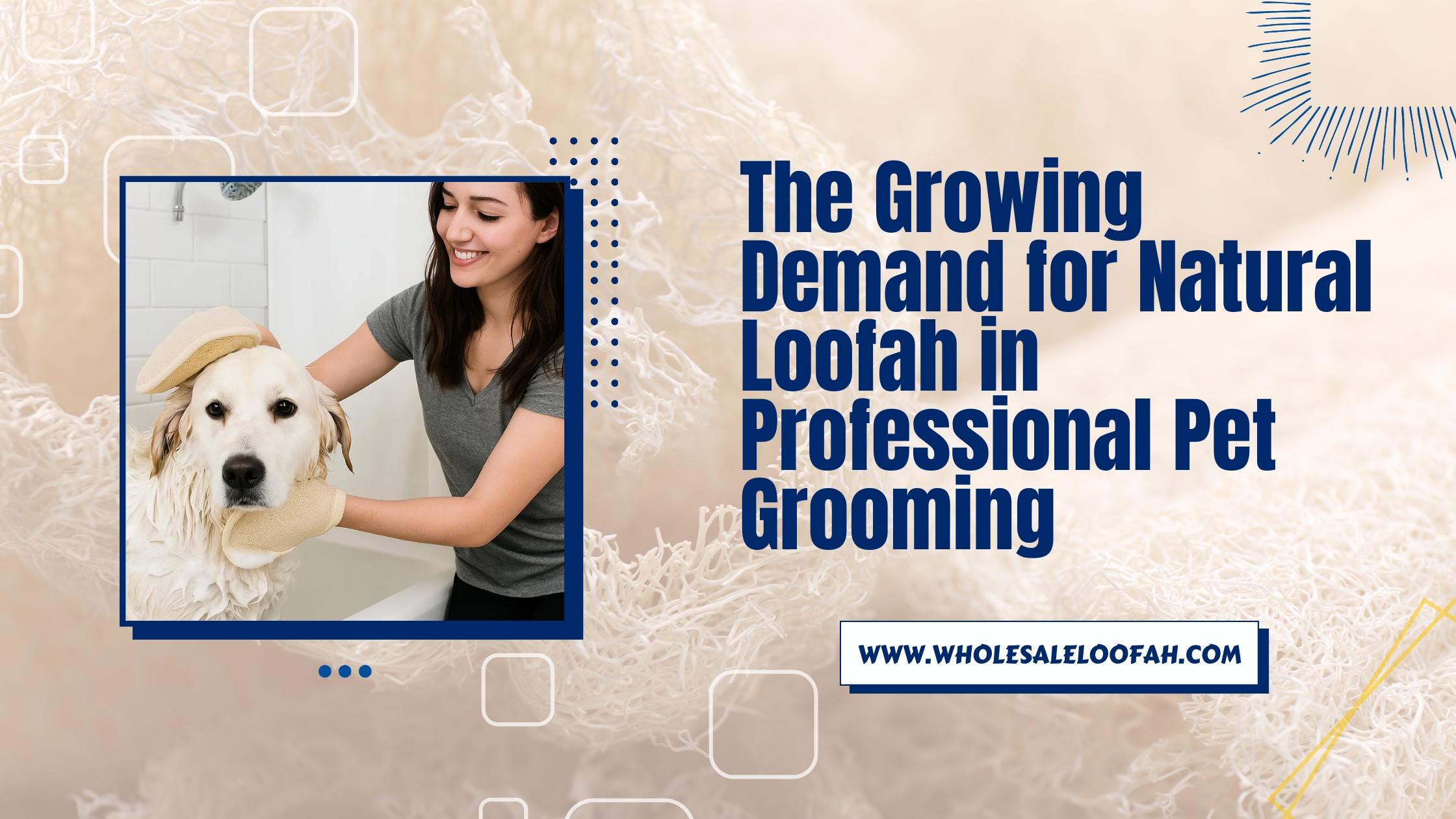
Professional pet grooming has undergone a fundamental shift toward natural, plant-based tools that deliver superior results while meeting consumer expectations for sustainable products. At the center of this transformation stands natural loofah, a versatile botanical product that has captured the attention of grooming professionals worldwide.
Why pet groomers love using loofah for exfoliation stems from a combination of performance advantages, business benefits, and client demand. The unique fiber structure of mature loofah plants provides exfoliation characteristics that synthetic alternatives simply cannot replicate. When applied properly, loofah removes dead skin, loose undercoat, and environmental debris while stimulating circulation and distributing natural oils throughout the coat. Pet owners recognize the difference immediately through improved coat appearance, reduced shedding, and healthier skin.
This comprehensive guide serves wholesale buyers, business owners, and procurement professionals seeking to understand the pet grooming loofah market. Readers will gain actionable knowledge regarding product specifications, quality assessment, supplier evaluation, and purchasing strategies that optimize both product performance and business profitability. The information presented reflects established industry practices and current market conditions relevant to wholesale purchasing decisions.
For businesses evaluating natural loofah as an inventory addition or seeking to improve existing sourcing arrangements, understanding the factors that drive groomer preference provides essential context for successful product selection and supplier partnerships.
Understanding Why Professional Groomers Prefer Natural Loofah
Professional groomers operate in a demanding environment where tool performance directly impacts service quality, client satisfaction, and business reputation. The widespread adoption of natural loofah reflects genuine advantages that experienced groomers have identified through practical application across diverse grooming scenarios.
Performance Characteristics That Drive Preference
The cellular structure of mature loofah creates a three-dimensional fiber matrix unlike any manufactured product. This natural architecture develops during the plant’s growth cycle as the fruit matures and the soft inner flesh gives way to an interconnected network of cellulose fibers. The resulting texture provides ideal characteristics for animal skin and coat care.
Loofah fibers capture loose hair and dander through mechanical adhesion rather than aggressive abrasion. This capture mechanism proves significantly more effective than smooth-surfaced synthetic tools while generating less friction against the skin surface.
The hydrophilic properties of natural cellulose fibers provide superior moisture management during wet grooming procedures. Loofah absorbs and releases water efficiently, preventing the waterlogging that causes synthetic products to become bacterial breeding grounds. This characteristic extends product life while maintaining hygienic conditions essential for professional operations processing multiple animals daily.
Additionally, loofah’s gentle action suits a wider range of skin sensitivities than synthetic alternatives. Many animals that react negatively to plastic or nylon bristles accept loofah readily, expanding the population that groomers can effectively serve with exfoliation services.
Business Benefits Beyond Performance
Professional groomers appreciate loofah for reasons extending beyond grooming effectiveness. The product enables service differentiation in competitive markets where establishing unique value propositions attracts and retains clients.
Natural loofah services command premium pricing that improves profit margins compared to standard grooming procedures. This pricing power transforms loofah from a simple supply expense into a revenue enhancement opportunity.
Client education around natural grooming tools builds professional credibility and strengthens customer relationships. Groomers who can explain why pet groomers love using loofah for exfoliation position themselves as knowledgeable authorities rather than commodity service providers. This expertise positioning supports client retention and generates referral business from satisfied customers.
The sustainability narrative surrounding natural loofah aligns with growing consumer environmental awareness. Pet owners increasingly prefer businesses demonstrating environmental responsibility, and natural loofah provides a tangible, visible expression of sustainable practices that resonates with this demographic.
Product Specifications for Wholesale Buyers
Successful wholesale purchasing requires detailed understanding of product specifications that influence grooming performance and business economics. This section provides the technical knowledge necessary for informed procurement decisions.
Size Classifications and Applications
Loofah products reach the wholesale market in various size classifications, each suited to specific grooming applications. Understanding these classifications enables buyers to stock appropriate inventory for their target markets.
| Size Classification | Typical Dimensions | Primary Applications | Target Buyers |
|---|---|---|---|
| Small | 10 to 15 cm length | Cat grooming, facial areas, small breeds | Specialty groomers, mobile operations |
| Medium | 15 to 25 cm length | General purpose, medium breeds | Full-service grooming salons |
| Large | 25 to 35 cm length | Large breeds, high-volume bathing | Large-scale operations, kennels |
| Extra Large | 35+ cm length | Commercial bathing systems, customization | Manufacturers, private label buyers |
| Slices | 2 to 5 cm thickness | Specialty products, retail packaging | Retail distributors, spa suppliers |
Professional grooming operations typically maintain inventory across multiple size categories to address diverse client needs. Wholesale buyers should consider their end-customer requirements when determining size distribution within orders.
Density and Fiber Grade Specifications
Loofah density significantly impacts grooming effectiveness for different coat types. Density varies naturally based on growing conditions, plant maturity at harvest, and processing methods. Quality suppliers grade products by density to enable appropriate application matching.
Soft density loofah features loosely arranged fibers with significant air space throughout the structure. This grade suits sensitive-skinned animals, short-coated breeds, and gentle facial grooming applications. Soft loofah compresses easily under light pressure and provides massage-like stimulation rather than intensive exfoliation.
Medium density loofah balances exfoliation effectiveness with gentle action. This versatile grade serves the majority of standard grooming applications and represents the most popular specification for general-purpose wholesale purchasing. The fiber arrangement provides effective debris removal while remaining comfortable for most animals.
Firm density loofah features tightly packed fibers with minimal air space. This grade suits double-coated breeds requiring intensive undercoat removal and animals with particularly robust skin. Firm loofah delivers aggressive exfoliation that penetrates through guard coat to reach accumulated dead undercoat.
| Density Grade | Fiber Arrangement | Compression Resistance | Best Applications |
|---|---|---|---|
| Soft | Loose, open structure | Low | Sensitive skin, cats, puppies |
| Medium | Moderate packing | Moderate | General grooming, most breeds |
| Firm | Tight, dense structure | High | Double coats, heavy shedding |
Egexo maintains rigorous density classification across product lines, enabling wholesale buyers to specify exact requirements for their target applications. Detailed specifications are available through the complete product catalog.
Quality Grading Standards
The wholesale loofah market utilizes standardized grading that categorizes products by overall quality characteristics. Understanding these grades helps buyers balance quality requirements against budget constraints.
Premium A grade represents the highest quality classification, featuring exceptional fiber uniformity, perfect natural coloration, complete processing, and no cosmetic defects. This grade commands highest pricing but delivers maximum performance and useful life. Professional grooming operations serving discerning clientele should specify Premium A for client-facing applications.
Grade A products meet high quality standards with uniform density, good coloration, and thorough processing. Minor variations acceptable within this grade do not affect grooming performance. This grade offers excellent value for professional applications balancing quality against cost considerations.
Grade B classification includes products with noticeable but functional variations in density, color, or processing completeness. These products suit budget-conscious applications, training purposes, or high-volume operations where replacement frequency offsets lower per-unit performance.
Grade C products exhibit significant variations but remain functional for basic applications. This grade typically serves single-use scenarios or non-grooming applications where premium characteristics provide no advantage.
For wholesale buyers, grade selection should reflect end-use requirements and target customer expectations. Egexo provides detailed quality documentation through their quality standards page to support informed purchasing decisions.
Sourcing Premium Loofah for Pet Grooming Applications
Geographic origin significantly influences loofah quality characteristics. Wholesale buyers benefit from understanding regional differences that affect product performance and value.
Why Egyptian Loofah Dominates Professional Markets
Egyptian loofah, particularly specimens cultivated in the Nile Delta region, consistently demonstrates superior characteristics for demanding professional applications. Multiple factors contribute to this quality advantage.
The Nile Delta’s unique environmental conditions create ideal growing circumstances. Ancient alluvial soils deposited over millennia provide exceptional mineral content that supports robust plant development. Consistent temperature ranges, abundant sunshine, and controlled irrigation enable optimal maturation timing that maximizes fiber development.
Cultivation expertise accumulated over generations distinguishes Egyptian production from newer growing regions. EGEXO has been exporting Egyptian loofah since 2015. This knowledge transfer ensures consistent results across growing seasons.
Processing infrastructure in established Egyptian production areas provides quality advantages unavailable in regions with less developed loofah industries. Purpose-built drying facilities, experienced processing workers, and established quality control procedures maintain consistent standards across large production volumes.
Comparative testing demonstrates that Egyptian loofah delivers 30 to 50 percent longer useful life in professional grooming applications compared to products from regions with less favorable conditions. This durability advantage offsets moderate price premiums through reduced replacement frequency and more consistent grooming results.
Supplier Evaluation for Wholesale Partnerships
Beyond regional sourcing, supplier capabilities determine wholesale purchasing success. Comprehensive evaluation protects against quality inconsistencies, supply disruptions, and business relationship problems.
| Evaluation Category | Key Assessment Factors | Documentation Requests |
|---|---|---|
| Production Capability | Annual volume capacity, seasonal consistency, inventory management | Production records, capacity statements |
| Quality Systems | Inspection procedures, grading accuracy, rejection rates | QC documentation, sample verification |
| Traceability | Farm-level sourcing records, processing documentation | Chain of custody records, farm certificates |
| Business Stability | Operating history, financial health, reference accounts | Business registration, reference contacts |
| Communication | Response timeliness, technical knowledge, problem resolution | Trial communication, reference feedback |
| Logistics | Shipping options, packaging quality, delivery reliability | Shipping records, packaging specifications |
| Flexibility | Custom specifications, order size accommodation, payment terms | Policy documentation, negotiation history |
Establishing supplier relationships requires investment beyond simple price comparison. Request samples before volume commitment to verify quality claims against actual products. Egexo offers sample ordering that enables hands-on evaluation prior to wholesale purchasing decisions.
For businesses requiring specific product configurations, inquire about customization capabilities early in supplier evaluation. Egexo provides private label manufacturing services for buyers seeking branded products tailored to their market positioning.
Wholesale Pricing and Order Economics
Understanding pricing structures and order economics enables wholesale buyers to optimize purchasing decisions for maximum business value.
Pricing Factors in the Wholesale Market
Wholesale loofah pricing reflects multiple factors that buyers should understand when evaluating supplier quotations and negotiating terms.
Product grade represents the primary pricing determinant. Premium A grade commands 40 to 60 percent premiums over Grade B products, reflecting the quality advantages that justify higher pricing for professional applications. Within grade classifications, pricing varies based on size, density specifications, and processing requirements.
Order volume significantly affects per-unit pricing. Wholesale suppliers structure pricing tiers that reward larger commitments with reduced per-unit costs. Understanding tier breakpoints enables strategic order sizing that captures maximum value.
See our wholesale prices on egexo.com.
Shipping costs represent a significant pricing component for lightweight, bulky products like loofah. Evaluate total landed cost including shipping rather than comparing product pricing alone. Suppliers with efficient logistics arrangements may offer better total value despite higher product pricing.
Seasonal factors affect both availability and pricing. Loofah harvesting occurs during specific periods, with post-harvest months typically offering best availability and pricing. Strategic buyers time major purchases to align with favorable market conditions.
For current pricing information tailored to specific requirements, request a bulk quotation that accounts for your volume, specifications, and delivery needs.
Calculating Total Cost of Ownership
Sophisticated wholesale buyers evaluate total cost of ownership rather than focusing exclusively on purchase price. This analysis captures the full economic impact of sourcing decisions.
Product useful life directly affects replacement costs. Premium quality loofah lasting 10 to 12 weeks in professional use delivers better economics than budget products requiring replacement every 4 to 6 weeks, even at significantly higher per-unit pricing. Calculate cost per week of service rather than cost per unit for accurate comparison.
Quality consistency affects operational costs beyond product replacement. Inconsistent products require additional inspection time, generate customer complaints, and may damage professional reputation. These hidden costs often exceed the savings from lower-priced products with inconsistent quality.
Supplier reliability impacts inventory management costs. Reliable suppliers enable lean inventory practices that reduce capital requirements and storage costs. Unreliable suppliers force safety stock accumulation and emergency purchasing at premium pricing.
| Cost Component | Premium Supplier | Budget Supplier |
|---|---|---|
| Per-Unit Cost | Higher | Lower |
| Useful Life | Longer | Shorter |
| Quality Consistency | High | Variable |
| Inspection Requirements | Minimal | Extensive |
| Customer Complaints | Rare | More Frequent |
| Supply Reliability | Predictable | Variable |
| Total Cost of Ownership | Often Lower | Often Higher |
Inventory Management for Loofah Products
Effective inventory management balances product availability against capital investment and storage requirements. These practices optimize loofah inventory performance for wholesale buyers and retail operations.
Storage Requirements and Best Practices
Natural loofah requires appropriate storage conditions to maintain quality throughout inventory holding periods. Understanding these requirements prevents quality degradation that reduces product value and customer satisfaction.
Moisture control represents the most critical storage factor. Loofah readily absorbs ambient humidity, and excess moisture promotes mold growth that renders products unusable. Maintain storage humidity below 60 percent relative humidity. Climate-controlled storage provides ideal conditions, though adequate ventilation in temperate environments may suffice.
Temperature extremes stress loofah fibers and accelerate degradation. Avoid storage locations subject to direct sunlight, heating equipment proximity, or freezing conditions. Moderate, consistent temperatures between 15 and 25 degrees Celsius preserve product quality.
Airflow around stored products prevents moisture accumulation and enables early detection of any humidity problems. Avoid tightly packed storage that restricts air circulation. Shelving systems that elevate products above floor level and allow air movement provide superior results compared to floor stacking.
Pest protection requires attention in natural product storage. While loofah does not attract pests as actively as food products, storage areas should maintain cleanliness and exclude rodents and insects that may damage inventory.
Inventory Rotation and Quality Monitoring
First-in-first-out rotation ensures that older inventory ships before newer arrivals, preventing extended storage periods that may affect product quality. Implement clear dating and rotation procedures, particularly for operations maintaining significant inventory depth.
Regular quality monitoring identifies any storage-related problems before they affect large portions of inventory. Inspect representative samples monthly for moisture absorption, discoloration, odor development, or structural changes. Address any identified issues immediately through improved storage conditions or accelerated rotation of affected inventory.
| Quality Indicator | Acceptable Condition | Problem Indicator | Action Required |
|---|---|---|---|
| Color | Consistent golden-tan | Darkening, gray patches | Improve ventilation, inspect for mold |
| Texture | Firm, springy | Soft, limp | Reduce humidity, increase airflow |
| Odor | Neutral, slightly earthy | Musty, sour | Isolate affected product, assess for mold |
| Structural Integrity | Maintains shape | Compression, brittleness | Review temperature, handling procedures |
Maintain inventory records that track receipt dates, storage locations, quality observations, and shipment timing. This documentation supports quality management and enables analysis of storage performance over time.
Market Opportunities in Pet Grooming Loofah
The pet grooming loofah market presents significant opportunities for wholesale buyers positioned to serve growing demand. Understanding market dynamics enables strategic positioning and investment decisions.
Current Market Trends
Consumer demand for natural pet care products continues expanding across all market segments. Pet owners increasingly research product ingredients and materials, actively seeking natural alternatives to synthetic options. This awareness creates receptive markets for loofah-based grooming services and retail products.
Professional grooming industry growth supports expanding loofah demand. The pet grooming services market has grown consistently, with premium service segments experiencing particularly strong expansion. Grooming businesses seeking differentiation increasingly adopt natural tools that support premium positioning.
Sustainability considerations drive purchasing decisions for both consumers and businesses. Environmental awareness has shifted from niche concern to mainstream purchasing factor, creating preference for biodegradable natural products over petroleum-derived synthetics.
The intersection of these trends positions natural loofah favorably for continued market growth. Wholesale buyers establishing supply relationships and market presence now benefit from expanding demand as these trends continue developing.
Target Customer Segments
Successful wholesale operations identify and serve specific customer segments with tailored product offerings and service approaches.
Professional grooming salons represent the primary market for wholesale loofah in pet applications. These businesses require consistent quality, reliable supply, and competitive pricing to support profitable service delivery. Build relationships through product knowledge, flexible ordering, and responsive service that addresses their operational needs.
Pet retail operations increasingly stock natural grooming tools for consumer purchase. This segment requires retail-ready packaging, competitive wholesale pricing, and product information supporting consumer education. Consider private label opportunities that enable retailers to build brand presence with natural product offerings.
Veterinary clinics and animal hospitals represent a specialized segment with specific quality requirements. These buyers prioritize product safety and professional-grade performance over price considerations. Quality documentation and professional positioning support this market segment.
Pet boarding and daycare facilities offer volume opportunities for businesses positioned to serve their needs. These operations prioritize durability and value given high usage volumes. Competitive pricing on appropriate product grades captures this price-sensitive segment.
Mobile grooming operations represent a growing segment with distinct requirements. These businesses need portable products and may prefer smaller quantities with more frequent ordering. Flexible order minimums and efficient shipping serve this segment effectively.
Building Wholesale Business Around Pet Grooming Loofah
For entrepreneurs and existing businesses evaluating loofah distribution opportunities, this section provides strategic guidance for market entry and business development.
Value Proposition Development
Successful wholesale operations deliver clear value that distinguishes them from alternative suppliers. Develop value propositions addressing specific customer needs within target segments.
Quality assurance provides foundation value for professional markets. Establish inspection procedures, maintain quality documentation, and stand behind product performance. Customers pay premiums for suppliers who eliminate quality uncertainty from their purchasing decisions.
Technical expertise creates differentiation through knowledge transfer. Understanding why pet groomers love using loofah for exfoliation enables informed customer guidance that builds relationships beyond transactional purchasing. Invest in product knowledge that positions your operation as an expert resource.
Service reliability reduces customer risk and operational friction. Consistent order fulfillment, accurate shipping, and responsive problem resolution build customer confidence that supports long-term relationships. Measure and improve service performance continuously.
Inventory availability eliminates customer stockout risk. Maintain adequate inventory depth to fulfill orders promptly without extended lead times. Customers value suppliers who can deliver when needed rather than requiring extended planning horizons.
Supplier Partnership Strategies
Strong supplier relationships provide competitive advantages through preferential access, favorable terms, and collaborative problem-solving. Develop partnerships rather than purely transactional supplier relationships.
Communicate your business plans and growth projections to suppliers. This transparency enables suppliers to plan capacity and prioritize your requirements during high-demand periods. Egexo maintains dedicated partnership resources for wholesale accounts seeking collaborative relationships.
Consolidate purchasing with preferred suppliers rather than fragmenting orders across multiple sources. Volume concentration earns better pricing, priority service, and stronger relationships. Evaluate suppliers thoroughly, then commit to relationships that deliver consistent value.
Provide feedback on product performance and customer requirements. Suppliers value information that helps them improve products and services. This feedback builds collaborative relationships while influencing product development in directions that benefit your business.
Practical Implementation Guide
This section provides actionable steps for wholesale buyers ready to implement or improve loofah sourcing for pet grooming markets.
Initial Market Entry Steps
For businesses entering the pet grooming loofah market, follow this sequence to establish operations efficiently.
Begin with market research confirming demand within your geographic area and target segments. Identify potential customers, assess competitive offerings, and validate pricing expectations before committing inventory investment.
Request samples from potential suppliers to evaluate quality firsthand. Egexo’s sample ordering process enables hands-on assessment of product characteristics relevant to your target market. Test samples with potential customers to gather feedback before volume purchasing.
Develop initial inventory plan based on market research and sample testing feedback. Start conservatively with fast-turning products, expanding assortment as market understanding develops. Plan initial orders to capture meaningful wholesale pricing while limiting inventory risk.
Establish quality control procedures before receiving initial inventory. Define inspection criteria, documentation requirements, and procedures for addressing quality issues. Consistent quality management builds reputation that supports business growth.
Create marketing materials that communicate product value effectively. Develop product descriptions, usage guidance, and comparative information that helps customers understand why natural loofah delivers superior grooming results.
Ongoing Optimization Practices
Established operations benefit from continuous improvement in sourcing, inventory management, and customer service.
Analyze sales patterns to optimize inventory investment. Identify fast-moving products that warrant deeper inventory and slow-moving items that may require assortment reduction or promotional support. Adjust purchasing to align with actual demand patterns.
Monitor quality trends across shipments and time periods. Document any quality variations and address patterns proactively with suppliers. Consistent quality monitoring protects business reputation and customer relationships.
Gather customer feedback systematically. Understand satisfaction levels, unmet needs, and competitive alternatives. This intelligence guides product development, service improvements, and strategic planning.
Review supplier performance regularly against expectations and alternatives. Strong relationships deserve continued investment, but performance problems require attention. Maintain awareness of alternative suppliers to ensure competitive positioning.
Evaluate pricing and margin performance across product categories. Identify opportunities to improve profitability through pricing adjustments, cost reduction, or product mix optimization. Regular financial analysis ensures business sustainability.
Expert Perspective from EGEXO
This expertise informs our approach to serving wholesale buyers in the pet grooming market.
The growing appreciation for natural loofah among professional groomers reflects genuine performance advantages that we have worked to optimize through continuous cultivation and processing refinement. Why pet groomers love using loofah for exfoliation connects directly to fiber characteristics that we carefully develop through controlled growing conditions and precise harvest timing.
For wholesale buyers evaluating the pet grooming market, we recommend focusing on quality consistency as the foundation for business success. End customers in professional grooming cannot accept quality variations that affect service delivery and client satisfaction. Establishing supply relationships with suppliers demonstrating rigorous quality systems protects your business reputation and customer relationships.
We encourage prospective wholesale partners to request samples and evaluate our products against their specific requirements. Our team provides technical support to help buyers understand product specifications and select appropriate grades for their target applications. Contact our wholesale team to discuss your requirements and explore partnership opportunities.
To discuss your order, request a quote from EGEXO.
Frequently Asked Questions
Q1: What minimum order quantities apply for wholesale loofah purchasing?
A: Minimum order quantities vary by supplier and product specifications. No minimum order on standard products. Private label from 1,000 units. Small wholesale orders typically start at 50 to 100 units, with significant price improvements at higher volume tiers. Contact our wholesale team for specific minimums applicable to your product requirements and discuss volume planning that captures optimal pricing.
Q2: How does loofah quality vary between suppliers, and what should buyers verify?
A: Quality varies significantly across the wholesale market due to differences in growing conditions, cultivation practices, processing methods, and quality control systems. Buyers should verify fiber uniformity, density consistency, complete seed removal, appropriate coloration, and absence of mold or contamination. Request samples before volume purchasing and inspect against stated specifications. Establish clear quality expectations in supplier agreements and document inspection procedures for incoming inventory. Premium suppliers like Egexo provide quality documentation and stand behind product specifications.
Q3: What certifications matter for loofah used in pet grooming applications?
While specific pet grooming certifications for loofah do not exist, quality documentation demonstrating safe cultivation and processing practices provides assurance appropriate for animal contact applications. Professional grooming operations may require documentation supporting claims made in their marketing materials. Request available certifications and quality documentation from suppliers during evaluation.
Q4: How should wholesale buyers evaluate pricing across different suppliers?
A: Evaluate total cost of ownership rather than per-unit pricing alone. Consider product useful life in professional applications, quality consistency that affects operational costs, shipping expenses to your location, and supplier reliability that impacts inventory management. Calculate cost per week of service for accurate comparison between products with different durability characteristics. Premium quality products often deliver lower total costs despite higher per-unit pricing due to extended useful life and reduced quality-related operational expenses.
Q5: What storage requirements apply for maintaining loofah inventory quality?
A: Store loofah in climate-controlled environments maintaining humidity below 60 percent and temperatures between 15 and 25 degrees Celsius. Ensure adequate ventilation around stored products to prevent moisture accumulation. Avoid direct sunlight, proximity to heat sources, and freezing conditions. Implement first-in-first-out rotation to prevent extended storage periods. Conduct monthly quality inspections checking for moisture absorption, discoloration, odor development, or structural changes. Address any identified issues promptly through improved storage conditions or accelerated rotation.
Q6: How quickly can wholesale orders typically be fulfilled and shipped?
A: Fulfillment timelines depend on supplier inventory levels, order specifications, and shipping method selection. Standard wholesale orders from suppliers maintaining adequate inventory typically ship within 3 to 7 business days. Custom specifications or unusually large orders may require additional lead time for production or consolidation. International shipping adds transit time varying by destination and shipping method. Discuss lead time expectations during supplier evaluation and plan ordering cycles to maintain adequate inventory without emergency purchasing requirements.
Q7: What support do suppliers provide for businesses new to loofah products?
A: Quality wholesale suppliers provide technical information, product specifications, usage guidance, and responsive communication supporting customer success. Egexo offers comprehensive support including detailed product documentation, application guidance for pet grooming uses, and dedicated wholesale account management. New buyers benefit from sample programs enabling product evaluation before volume commitment. Suppliers invested in long-term partnerships provide ongoing support as customer businesses develop and requirements evolve.
Conclusion
The professional pet grooming industry’s embrace of natural loofah reflects performance advantages that deliver measurable benefits for groomers, pet owners, and the animals receiving care. Understanding why pet groomers love using loofah for exfoliation provides essential context for wholesale buyers seeking to serve this growing market effectively.
Successful wholesale operations in pet grooming loofah require attention to product quality, supplier relationships, inventory management, and customer service. The guidance presented in this article provides actionable frameworks for both market entry and ongoing optimization. Buyers who invest in understanding product specifications, establishing reliable supplier partnerships, and developing strong customer relationships position themselves for sustainable success in this expanding market.
Quality sourcing remains the foundation for wholesale success. Egyptian loofah from experienced suppliers like Egexo delivers the consistency and performance that professional grooming applications demand. Investing in premium quality products protects business reputation, supports customer satisfaction, and often delivers superior total economics despite higher per-unit costs.
The market opportunity in natural pet grooming products continues expanding as consumer awareness grows and professional groomers increasingly adopt plant-based tools. Wholesale buyers establishing market presence and supplier relationships now benefit from favorable positioning as these trends continue developing.
Key Takeaways:
- Professional groomers prefer natural loofah for measurably superior exfoliation performance, expanded service capabilities, and premium pricing opportunities
- Product specifications including size, density, and quality grade significantly affect grooming performance and should guide purchasing decisions
- Egyptian loofah consistently delivers superior quality characteristics that justify moderate price premiums through extended useful life and consistent performance
- Total cost of ownership analysis often favors premium quality products despite higher per-unit pricing
- Effective inventory management protects product quality and optimizes capital investment in loofah inventory
- Growing consumer demand for natural pet care products creates expanding market opportunities for positioned wholesale operations
Ready to explore wholesale loofah sourcing for pet grooming markets?
- Request Pricing: Get a bulk quotation tailored to your volume and specifications
- Evaluate Products: Order samples for hands-on quality assessment
- Review Options: Download the complete product catalog
- Explore Branding: Learn about private label manufacturing for custom product development
- Browse Products: View the pet and spa grooming collection