Why Strategic Loofah Product Sourcing Determines Business Success
The global natural loofah market continues expanding as consumers increasingly reject synthetic alternatives in favor of sustainable, plant-based bath and cleaning products. This growth creates substantial opportunities for distributors, retailers, spa operators, and private label brands capable of securing reliable supply chains with consistent quality.
However, the apparent simplicity of sourcing what seems like a basic agricultural product masks significant complexity. Quality variations between growing regions, suppliers, and even harvest seasons dramatically impact product performance, customer satisfaction, and ultimately profitability. Businesses that approach loofah product sourcing strategically gain measurable competitive advantages over those treating procurement as a commodity transaction.
This comprehensive guide addresses the critical knowledge gaps facing B2B buyers entering or expanding within the natural loofah market. You will develop expertise in quality assessment methodologies, supplier evaluation frameworks, import logistics optimization, and pricing strategy development. EGEXO has been exporting Egyptian loofah since 2015.
Whether you operate a regional spa supply distributorship, manage procurement for a retail chain, or seek to launch a private label bath products line, the principles detailed here provide actionable guidance for building robust, profitable loofah sourcing operations.
Understanding the Global Loofah Supply Landscape
Primary Growing Regions and Their Characteristics
Successful loofah product sourcing requires understanding how geography influences product attributes. Growing conditions vary dramatically between major production regions, creating distinct quality profiles that suit different market applications.
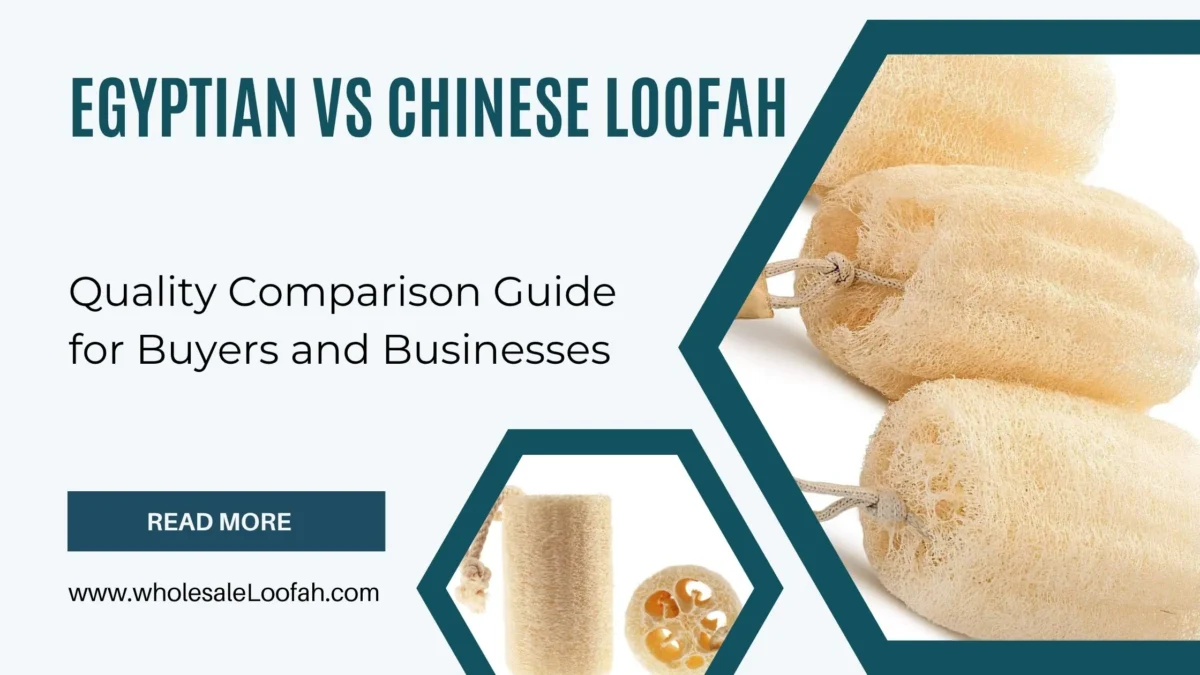
Egypt’s Nile Delta region produces loofahs widely recognized as the global quality benchmark. The unique combination of nutrient-rich alluvial soil, consistent sunshine, and controlled irrigation from the Nile River creates ideal growing conditions. Egyptian loofahs typically feature fiber density 30 to 45 percent higher than alternatives, translating to superior durability, faster drying characteristics, and extended product lifespan. The established agricultural infrastructure and export experience also provide supply chain reliability that newer producing regions cannot match.
China represents the largest volume producer globally, supplying predominantly price-sensitive market segments. Chinese loofahs generally feature lower fiber density and softer texture profiles. While suitable for disposable or short-term use applications, these products typically underperform Egyptian alternatives in durability testing and customer satisfaction metrics for premium positioning.
Central American producers including Guatemala, Honduras, and Mexico serve regional markets with moderate quality products. Transportation cost advantages for North American buyers partially offset quality differentials compared to Egyptian products. However, supply consistency challenges and limited processing infrastructure create procurement risks for larger operations.
Southeast Asian cultivation in Vietnam, Thailand, and the Philippines continues developing, primarily serving regional markets. Quality standardization remains inconsistent, though improving agricultural practices suggest future potential for buyers willing to invest in supplier development relationships.
Seasonal Considerations in Supply Planning
Natural loofah cultivation follows agricultural cycles that sophisticated buyers incorporate into procurement planning. Understanding these patterns prevents supply disruptions and enables strategic inventory positioning.
Egyptian harvest season runs primarily from September through December, with peak quality availability in October and November. Loofahs harvested during this window achieve optimal fiber maturity, demonstrating the best balance of density, flexibility, and durability. Post-harvest processing and export preparation means fresh harvest products typically reach international buyers between January and April.
Off-season inventory draws from stored stock, which maintains quality when properly warehoused but may show gradual characteristic changes over extended storage periods. Buyers planning major promotions or launches should align timing with fresh harvest availability when possible.
Climate variability introduces year-to-year quality fluctuations that experienced buyers monitor. Unusually wet growing seasons can reduce fiber density, while drought conditions may limit harvest volumes. Maintaining relationships with suppliers who communicate growing condition updates enables proactive adjustment of purchasing strategies.
Quality Grading Systems and Assessment Methodologies
Industry Standard Grading Frameworks
Professional loofah product sourcing requires fluency in quality grading terminology and assessment criteria. While no universal global standard exists, established exporters utilize consistent frameworks that buyers should understand and reference in supplier negotiations.
Grade A or Premium designation indicates top-tier products featuring uniform fiber density throughout the entire sponge body, consistent coloration in the cream to light tan range, no structural defects or weak points, and optimal flexibility with immediate springback when compressed. These products suit premium retail positioning, spa and hospitality applications, and private label programs targeting quality-conscious consumers.
Grade B or Standard classification encompasses products meeting commercial acceptability thresholds with minor imperfections. Characteristics include slight density variations between sections, minor color inconsistencies, small surface blemishes, or marginally reduced flexibility. These products perform adequately for mid-market retail, promotional applications, or price-sensitive segments where premium quality commands insufficient margin premium.
Grade C or Economy products exhibit noticeable quality limitations including significant density variation, color irregularities, structural weak points, or reduced flexibility. Applications include disposable use scenarios, industrial cleaning where appearance matters less than function, or markets where price sensitivity dominates purchasing decisions.
Reject or Substandard classification covers products failing minimum commercial acceptability. Characteristics include mold damage, pest damage, severe structural defects, or contamination. Reputable suppliers cull these products from export streams, but inconsistent suppliers may attempt inclusion in bulk shipments, making inspection protocols essential.
Hands-On Quality Assessment Techniques
Beyond grade classifications, B2B buyers benefit from developing direct assessment capabilities applicable during supplier visits, sample evaluations, and incoming shipment inspections.
The compression recovery test evaluates fiber resilience and structural integrity. Squeeze the loofah firmly to approximately 50 percent of original thickness, then release. Premium products spring back to original shape within two seconds with no permanent deformation. Products requiring longer recovery or showing residual compression indicate substandard fiber development or processing damage.
Density evaluation through weight comparison provides objective quality differentiation. Weigh multiple loofahs of similar dimensions, calculating weight per unit volume. Higher density correlates with superior durability and extended service life. Establish baseline expectations by weighing confirmed premium samples, then compare prospective supplier products against this benchmark.
Surface uniformity inspection identifies processing quality and potential weak points. Examine the entire exterior surface under good lighting, checking for thin spots, fiber separation, irregular texture patterns, or color variations. Rotate and view from multiple angles. Internal inspection proves more challenging but matters for thicker products. Consider cutting sample units to examine interior fiber development.
Flexibility stress testing reveals potential brittleness issues not apparent in static examination. Gently bend the loofah through various angles, feeling for cracking, resistance variation, or fiber separation. Products should flex smoothly without audible cracking or visible damage. Brittleness indicates either inadequate fiber maturity at harvest or processing damage.
Aromatic evaluation detects contamination or improper storage. Fresh, properly processed loofahs emit neutral or faintly plant-like aromas. Musty, chemical, or otherwise unpleasant odors indicate mold development, contamination, or improper storage conditions that may have compromised product integrity.
For detailed quality standards documentation, review Egexo’s quality grading specifications which provide comprehensive assessment criteria with visual references.
Supplier Evaluation and Selection Framework
Critical Evaluation Criteria for B2B Suppliers
Identifying reliable loofah suppliers requires systematic evaluation across multiple dimensions. The following framework enables objective comparison between potential sourcing partners.
| Evaluation Category | Key Assessment Questions | Verification Methods |
|---|---|---|
| Production Capability | Annual volume capacity? Scalability for growing orders? Own cultivation versus aggregation model? | Facility visits, capacity documentation, reference checks |
| Quality Control Systems | Grading procedures? Inspection frequency? Defect handling protocols? | Process documentation review, sample testing, facility observation |
| Export Experience | Years in export business? Destination countries served? Regulatory compliance history? | Export records, customer references, certification verification |
| Communication Responsiveness | Response time to inquiries? Language capabilities? Problem resolution approach? | Direct interaction assessment, reference feedback |
| Financial Stability | Business tenure? Payment term flexibility? Capacity for production investment? | Business registration, bank references, trade credit reports |
| Documentation Capability | Certificate of origin provision? Phytosanitary compliance? Custom documentation accuracy? | Sample document review, customs broker consultation |
Red Flags Indicating Problematic Suppliers
Experience reveals warning signs that predict future supplier relationship difficulties. Recognizing these indicators early prevents costly procurement mistakes.
Inconsistent communication patterns suggest organizational weaknesses likely to manifest in order fulfillment problems. Suppliers unable to respond promptly to pre-sale inquiries rarely improve post-order. Excessive delays, unanswered questions, or contradictory information warrant caution.
Reluctance to provide samples or facility access raises authenticity concerns. Legitimate suppliers welcome buyer due diligence as opportunity to demonstrate capabilities. Resistance often indicates quality or capacity misrepresentation.
Pricing significantly below market rates suggests quality compromises, unsustainable business models, or misrepresentation of product specifications. While competitive pricing remains desirable, dramatically undercutting established suppliers typically indicates problems buyers will eventually discover.
Absent or vague quality documentation prevents objective expectation setting and creates dispute resolution difficulties. Professional suppliers maintain detailed specifications, grading criteria, and inspection records. Those unable to provide such documentation likely lack systematic quality management.
Limited or unavailable references restrict due diligence verification. Established suppliers accumulate satisfied customers willing to confirm positive experiences. Inability to provide references suggests either limited experience or problematic customer relationships.
Building Strategic Supplier Relationships
Transactional purchasing approaches limit value capture from supplier relationships. Strategic partnership development generates benefits including priority allocation during supply constraints, quality consistency prioritization, flexible payment arrangements, and collaborative product development opportunities.
Invest in relationship building through regular communication beyond order transactions. Schedule periodic calls or video meetings to discuss market conditions, upcoming needs, and mutual business development. Visit supplier facilities when feasible, demonstrating commitment that commodity buyers rarely provide.
Provide accurate forecasting that enables supplier production planning. Sharing anticipated volume needs, even informally, helps suppliers allocate cultivation and processing capacity appropriately. This transparency builds trust while improving supply reliability.
Pay consistently according to agreed terms. Suppliers prioritize reliable payment partners during allocation decisions. Building reputation as a dependable customer generates returns exceeding the costs of alternative cash management approaches.
Explore partnership opportunities with Egexo including private label manufacturing, exclusive product development, and strategic supply agreements.
Import Logistics and Regulatory Compliance
Navigating International Shipping Considerations
Efficient loofah product sourcing requires competence in international logistics management. While experienced freight forwarders handle operational details, buyer knowledge enables informed decision-making and problem prevention.
Shipping method selection balances cost, speed, and volume considerations. Ocean freight provides the most economical option for container-quantity orders, with typical transit times of 25 to 40 days from Egyptian ports to major destination regions. This method suits planned inventory replenishment where extended lead times prove acceptable.
Air freight serves urgent needs, sample shipments, and smaller orders where ocean freight minimum volumes prove impractical. Transit times of three to seven days enable rapid inventory response but at significantly higher per-unit costs. Reserve air freight for situations where speed justifies premium pricing.
Consolidation services help smaller buyers access ocean freight economics without full container commitments. Less-than-container-load shipments aggregate multiple buyers’ goods, sharing container costs proportionally. Transit times extend slightly due to consolidation handling, but cost savings often justify this trade-off for emerging buyers.
Incoterms specification in purchase agreements determines responsibility allocation for shipping costs, insurance, and risk transfer. Common arrangements include FOB where the buyer assumes responsibility once goods load onto the vessel, CIF where the seller covers cost, insurance, and freight to the destination port, and DDP where the seller handles all logistics through final delivery. Understanding these terms prevents costly misunderstandings.
Regulatory Requirements by Major Markets
Natural loofah imports face regulatory requirements varying by destination country. Compliance failures create costly delays, product seizures, or market access restrictions.
United States imports require phytosanitary certificates confirming products are free from agricultural pests and diseases. The USDA Animal and Plant Health Inspection Service reviews documentation at entry points. Products must comply with FDA regulations for items contacting skin, though loofahs typically face minimal FDA scrutiny as non-medical devices. Accurate Harmonized System classification ensures correct duty assessment.
European Union requirements include phytosanitary compliance similar to U.S. standards, CE marking for products marketed as cosmetic accessories, and REACH regulation compliance confirming no prohibited chemical substances. Documentation must accompany shipments, with importing country customs agencies conducting verification.
Australian regulations impose particularly stringent biosecurity requirements. The Department of Agriculture conducts risk assessments and may require treatment or inspection of plant-derived products. Advance documentation submission and potential inspection delays should factor into supply chain planning for Australian market participants.
Canadian requirements align broadly with U.S. standards, with the Canadian Food Inspection Agency overseeing plant product imports. Bilingual labeling requirements apply to retail-packaged products for the Canadian consumer market.
Experienced exporters like Egexo maintain familiarity with major market requirements and provide compliant documentation. Review the export process overview for insight into documentation and compliance handling.
Pricing Strategy and Cost Analysis
Understanding Total Landed Cost Components
Sophisticated loofah product sourcing decisions require total landed cost analysis rather than simple unit price comparison. Multiple cost elements combine to determine actual profitability.
Product cost represents the supplier invoice amount for goods purchased. While the most visible cost component, this figure alone provides insufficient basis for supplier comparison or margin calculation.
International freight costs vary substantially based on shipping method, volume, origin and destination ports, fuel surcharges, and seasonal demand fluctuations. Obtain specific quotes rather than relying on estimates when comparing sourcing options.
Insurance coverage for international shipments typically runs 0.5 to 2 percent of shipment value depending on coverage scope and route risk assessment. While seemingly minor, insurance costs compound across multiple shipments annually.
Customs duties assessed on import value vary by product classification and destination country trade agreements. Many countries maintain relatively low duty rates for natural plant products, but verification of applicable rates prevents unwelcome surprises.
Customs brokerage fees cover documentation processing, compliance verification, and clearance handling. Fees vary by broker, shipment complexity, and service level. Establish relationships with reliable brokers who understand your product category.
Domestic transportation from port to warehouse adds final mile costs varying with distance, handling requirements, and carrier selection. Factor this component into location decisions for warehouse facilities.
Warehousing and inventory carrying costs accumulate throughout the holding period. Storage facility expenses, insurance, potential quality degradation, and capital opportunity costs all contribute. Efficient inventory management minimizes these ongoing expenses.
Pricing Negotiation Strategies
Effective negotiation with loofah suppliers requires preparation, market knowledge, and relationship awareness. The following approaches help secure favorable terms while maintaining productive supplier relationships.
Volume commitment leverage represents the most straightforward negotiation tool. Suppliers offer better per-unit pricing for larger orders that improve their production efficiency and reduce transaction costs. Even if unable to immediately place large orders, discussing growth projections and requesting volume-based pricing tiers establishes framework for improving economics over time.
Payment term negotiation balances supplier risk preferences with buyer cash flow needs. Standard terms often include deposits upon order placement with balances due before shipment. Established relationships may enable post-shipment payment terms, improving buyer cash positions. Offering faster payment in exchange for price concessions presents another negotiation avenue.
Long-term agreement structures provide suppliers with demand visibility they value. Annual or multi-year purchase commitments, even with flexible delivery scheduling, often unlock pricing unavailable for ad-hoc ordering. These arrangements also improve supply priority during allocation-constrained periods.
Competitive positioning through multiple supplier quotes establishes market rate awareness and negotiation reference points. Share competitive information appropriately without damaging relationships through excessive price pressure that undermines supplier quality motivation.
Request customized pricing from Egexo based on your specific volume requirements and product specifications.
Product Category Selection for Market Positioning
Matching Product Types to Target Markets
The natural loofah product category encompasses diverse items suited to distinct market segments and distribution channels. Strategic product selection aligns inventory investment with target customer needs and competitive positioning.
| Product Category | Primary Applications | Target Buyers | Margin Profile |
|---|---|---|---|
| Premium body loofahs | Luxury retail, spa services, gift sets | Specialty retailers, hospitality, premium e-commerce | High margin, lower volume |
| Standard body loofahs | Mass retail, everyday personal care | Mass merchants, drugstore chains, general e-commerce | Moderate margin, high volume |
| Kitchen and cleaning loofahs | Household cleaning, dish scrubbing | Grocery retailers, home goods stores, eco-focused retail | Moderate margin, steady demand |
| Raw unprocessed loofahs | Craft projects, DIY processing, specialty applications | Craft supply retailers, specialty wholesalers | Variable margin, niche volume |
| Pet grooming loofahs | Animal bathing and grooming | Pet supply retailers, grooming facilities | Growing segment, moderate margin |
| Facial and cosmetic loofahs | Gentle exfoliation, skincare routines | Beauty retailers, spa supply, cosmetic brands | Premium positioning potential |
Browse comprehensive product categories through Egexo’s complete catalog or download the PDF catalog for offline reference.
Private Label and Custom Product Opportunities
Beyond standard product sourcing, private label manufacturing enables differentiation and margin enhancement unavailable through commodity purchasing. Established suppliers offer various customization options for qualified buyers.
Custom sizing specifications allow products tailored to specific market preferences or packaging requirements. Whether seeking larger loofahs for particular retail presentation or smaller formats for travel kits, custom sizing creates differentiation.
Shape customization including rounds, rectangles, or specialty forms enables unique product offerings. Some suppliers maintain tooling for popular specialty shapes while others offer custom development for sufficient volume commitments.
Packaging customization ranges from simple hang tag additions to fully custom retail packaging with buyer branding. Options include polybag packaging with custom headers, boxed presentation for gift positioning, and multi-pack configurations for value offerings.
Product combinations pairing loofahs with complementary items create gift set opportunities. Soap and loofah combinations, bath accessory collections, or skincare bundles leverage loofah sourcing relationships into broader product programs.
Quality specification customization allows buyers to define exact grading criteria, fiber density requirements, or other parameters exceeding standard offerings. Premium positioning strategies often benefit from specifications unavailable through standard product lines.
Explore private label manufacturing capabilities and discuss custom product development opportunities with experienced suppliers.
Risk Management in Loofah Procurement
Supply Chain Risk Identification and Mitigation
Professional procurement operations systematically identify and mitigate risks threatening supply continuity or quality consistency. The following framework addresses primary risk categories in loofah product sourcing.
Supplier concentration risk emerges when single-source dependency creates vulnerability to supplier-specific disruptions. Mitigation approaches include qualifying secondary suppliers, maintaining safety stock levels, and building relationship depth that prioritizes your business during supply constraints.
Quality consistency risk reflects potential variation between orders, harvest seasons, or production batches. Mitigation requires clear specification documentation, incoming inspection protocols, and supplier performance tracking enabling trend identification before problems escalate.
Logistics disruption risk encompasses port congestion, carrier issues, customs delays, and transportation network failures. Mitigation strategies include lead time buffers in inventory planning, alternative routing options, and relationships with multiple freight providers.
Currency fluctuation risk affects international purchasing costs when exchange rates move unfavorably. Mitigation options include forward contracts locking exchange rates, supplier agreements denominating prices in buyer currency, or pricing structures with adjustment mechanisms.
Regulatory compliance risk involves changing import requirements or enforcement patterns creating unexpected barriers. Mitigation requires monitoring regulatory developments, maintaining supplier relationships with compliance expertise, and documentation practices exceeding current requirements.
Quality Assurance Protocol Development
Systematic quality assurance protocols prevent defective product from reaching customers while providing data for supplier performance management.
Pre-shipment inspection by independent third parties verifies quality before goods leave supplier facilities. Services like SGS, Bureau Veritas, or regional inspection companies provide standardized evaluation against buyer specifications. The modest inspection cost prevents far larger costs of receiving and handling substandard shipments.
Incoming inspection at receiving warehouse confirms shipment contents match documentation and quality expectations. Develop standardized checklists covering quantity verification, grade assessment, damage identification, and documentation review. Train receiving personnel on assessment techniques and escalation procedures.
Sample retention maintains reference specimens from each shipment enabling quality comparison over time and providing evidence for any dispute resolution. Store samples in conditions mimicking customer use environments, periodically reviewing for degradation patterns.
Supplier scorecard systems aggregate quality, delivery, and service metrics into composite performance ratings. Regular scorecard review identifies improvement needs, provides objective basis for supplier discussions, and informs sourcing allocation decisions.
Expert Perspective from EGEXO
Our direct involvement from seed to shipment provides visibility into quality factors and supply chain dynamics that trading intermediaries cannot offer.
The single most impactful sourcing decision B2B buyers make is supplier selection based on cultivation quality rather than trading capability. Many exporters aggregate product from multiple farms with inconsistent growing practices, creating lot-to-lot variation that frustrates buyers seeking reliable quality. Vertically integrated operations maintaining consistent cultivation standards across controlled acreage deliver the consistency professional buyers require.
We consistently observe that buyers achieving best outcomes invest time in supplier relationship development beyond transactional purchasing. Visiting facilities, understanding production processes, and communicating business needs creates partnership dynamics generating mutual benefit through quality prioritization, supply reliability, and collaborative problem solving.
Egyptian loofah cultivation represents agricultural expertise refined over generations, producing products that outperform alternatives from newer growing regions. Buyers serving quality-conscious market segments benefit from sourcing authenticity they can communicate to end customers.
Contact EGEXO to discuss your sourcing requirements with experienced export professionals.
Frequently Asked Questions
Q: What minimum order quantities should B2B buyers expect when sourcing loofahs directly from Egyptian suppliers?
A: Minimum order quantities from Egyptian loofah suppliers typically range from 500 to 2,000 pieces depending on product category and supplier policies. Premium suppliers may offer lower minimums for initial trial orders, recognizing relationship development value. Container-quantity orders of 10,000 to 50,000 pieces unlock optimal pricing and priority handling. Discuss specific requirements with potential suppliers, as flexibility often exists for serious buyers demonstrating growth potential.
Q: How do Egyptian loofahs compare to Chinese alternatives for wholesale purchasing decisions?
A: Egyptian loofahs consistently demonstrate 30 to 45 percent higher fiber density than Chinese alternatives, translating to superior durability, faster drying characteristics, and extended end-user service life. Chinese products typically cost 20 to 40 percent less but underperform in customer satisfaction metrics for quality-positioned applications. Buyers serving premium markets, spa facilities, or sustainability-focused consumers generally find Egyptian sourcing delivers better value despite higher unit costs. Price-sensitive applications or disposable-use scenarios may favor Chinese alternatives.
Q: What documentation should B2B buyers request from loofah suppliers before placing orders?
A: Essential documentation includes company registration and business license verification, phytosanitary certification confirming pest-free status, certificate of origin for customs compliance, detailed product specifications with grading criteria, and customer references for verification contact. Additional valuable documentation includes quality control procedure descriptions, facility certifications, insurance coverage confirmation, and sample export documentation demonstrating compliance capability. Reluctance to provide standard documentation warrants serious caution about supplier reliability.
Q: How can buyers verify loofah quality when purchasing internationally without facility visits?
A: Remote quality verification relies on multiple complementary approaches. Request samples before committing to orders, evaluating using systematic assessment techniques covering density, flexibility, uniformity, and aroma. Engage third-party inspection services for pre-shipment quality verification against specified criteria. Check references thoroughly, asking specific questions about quality consistency across multiple orders. Review any available certifications or quality management documentation. Establish clear specifications in purchase agreements creating recourse for non-conforming shipments.
Q: What are typical lead times for international loofah orders from Egypt?
A: Standard lead times for Egyptian loofah orders include production and preparation requiring two to four weeks depending on order size and current demand, ocean freight transit of 20 to 35 days to most major destination ports, and customs clearance adding three to ten days depending on destination country procedures. Total lead time from order placement to warehouse receipt typically ranges from six to ten weeks for ocean freight shipments. Air freight reduces transit to under one week but at significantly higher cost, best reserved for urgent needs or sample shipments.
Q: What payment terms do Egyptian loofah exporters typically offer to B2B buyers?
A: Standard payment arrangements include 30 to 50 percent deposit upon order confirmation with balance due before shipment or against shipping documents. Established relationships may enable more favorable terms including reduced deposits, letter of credit arrangements, or post-shipment payment windows. New buyer relationships typically require more protective terms from supplier perspective. Building payment reliability track record over multiple successful transactions unlocks progressively better terms. Discuss preferred arrangements during supplier negotiations.
Conclusion
Mastering loofah product sourcing creates sustainable competitive advantage for B2B buyers navigating an expanding natural products market. The systematic approaches detailed throughout this guide transform procurement from transactional purchasing into strategic capability development.
Success in this category requires understanding growing region quality differences, with Egyptian cultivation establishing the benchmark against which alternatives compare. It demands supplier evaluation rigor extending beyond pricing to encompass quality systems, export capability, communication effectiveness, and partnership potential. Logistics and compliance competence prevents costly disruptions while enabling efficient operations.
Quality assessment skills developed through hands-on evaluation experience enable confident purchasing decisions and incoming inspection effectiveness. Pricing sophistication incorporating total landed cost analysis rather than unit price fixation ensures margin protection. Risk management frameworks prevent supply disruptions from becoming business crises.
Key Strategic Takeaways:
Prioritize supplier cultivation quality over trading intermediary convenience. Develop systematic quality assessment capabilities applicable to samples, shipments, and supplier audits. Build strategic supplier relationships generating benefits beyond transactional purchasing. Incorporate total landed cost analysis into all sourcing decisions. Implement quality assurance protocols protecting customers and providing supplier feedback.
Take Action on Your Sourcing Strategy:
Request a wholesale quotation customized to your volume requirements and product specifications.
Download the complete product catalog for comprehensive product information.
Request samples to evaluate Egyptian loofah quality firsthand before committing to orders.
Contact Egexo directly to discuss partnership opportunities with experienced export professionals.