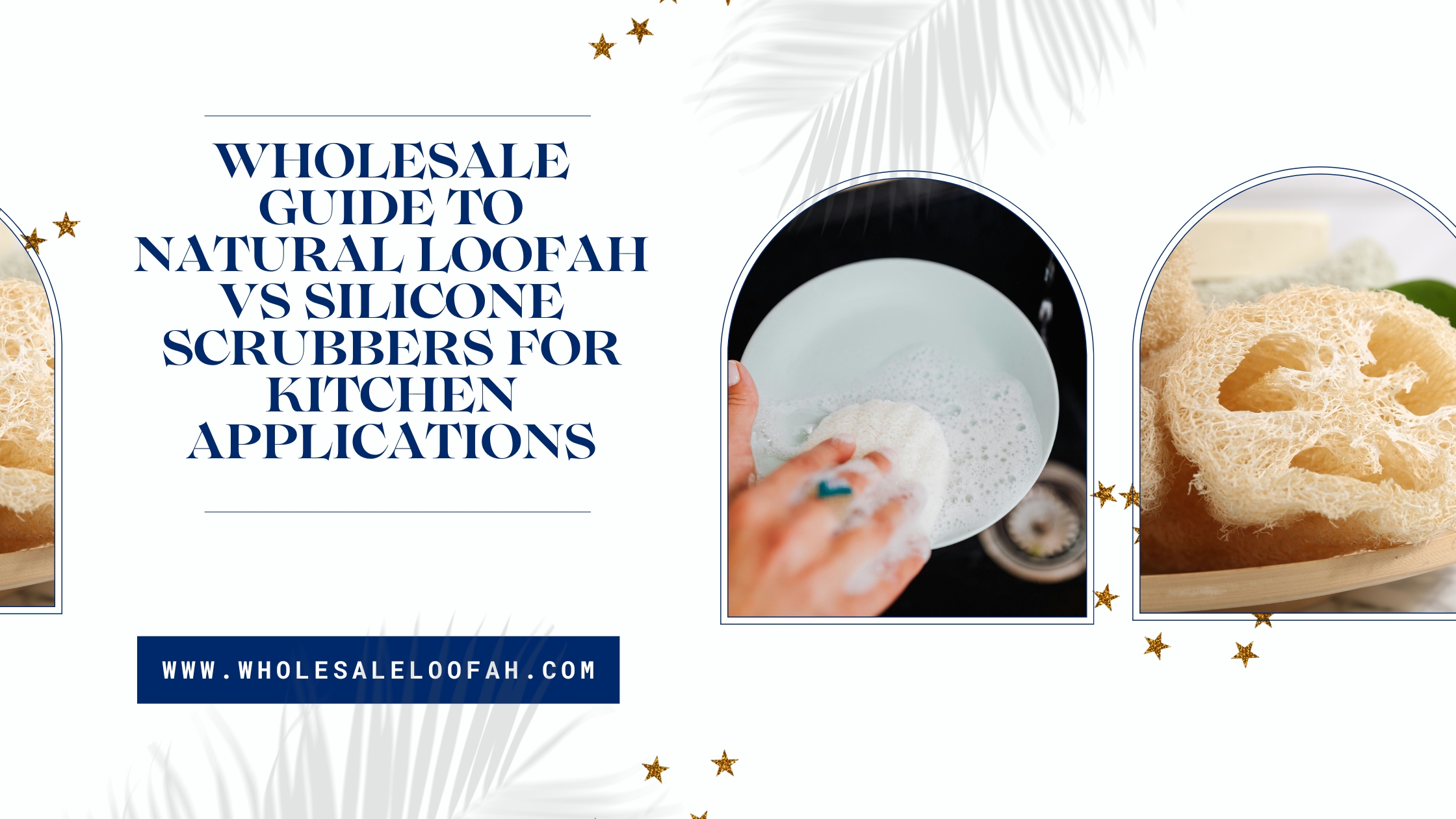
The sustainable household products sector continues expanding at 8.5 percent annually, outpacing traditional cleaning product growth by nearly three times. Within this accelerating market, natural loofah dish scrubbers represent one of the most accessible entry points for distributors and retailers seeking eco-friendly inventory with proven consumer demand. Understanding the wholesale dynamics of natural loofah vs silicone scrubbers helps purchasing professionals make informed sourcing decisions that maximize both profitability and customer satisfaction.
Wholesale buyers face unique challenges when evaluating product categories. Beyond unit economics, considerations include supplier reliability, quality consistency, storage requirements, and market positioning potential. The comparison between loofah and silicone scrubbers extends into these business dimensions alongside the consumer-facing performance differences that drive retail purchasing decisions.
This guide examines seven critical factors distinguishing natural loofah from silicone alternatives within wholesale and retail contexts. Specifications, margin calculations, quality grading systems, and supplier evaluation criteria provide actionable intelligence for procurement managers and business owners. Individual consumers researching purchase decisions will find practical product information woven throughout, making this resource valuable regardless of buying scale.
Egexo has supplied premium Egyptian loofah to international markets for over 25 years, establishing the quality benchmarks that distinguish commodity products from premium offerings. This experience informs perspectives shared throughout this analysis.
Market Position and Consumer Demand Analysis
Before examining specific product advantages, understanding market dynamics helps contextualize the wholesale opportunity. Consumer preference shifts toward sustainable alternatives have accelerated dramatically, creating demand that existing inventory often cannot satisfy.
Sustainability as Purchase Driver
Consumer research consistently identifies environmental sustainability among the top three purchase decision factors for household products. A 2024 global consumer survey found 73 percent of respondents willing to change buying habits to reduce environmental impact. Among younger demographics, this figure rises to 84 percent for ages 18 to 34.
Natural loofah directly addresses these preferences through complete biodegradability, renewable agricultural sourcing, and minimal processing requirements. These attributes translate into marketing messages that resonate with environmentally conscious shoppers, the fastest-growing consumer segment across developed markets.
Category Growth Projections
| Market Segment | Current Size | Projected 5-Year Growth | Opportunity Level |
|---|---|---|---|
| Natural Kitchen Products | 2.8 billion USD | 42 percent | High |
| Sustainable Household | 8.4 billion USD | 38 percent | High |
| Traditional Cleaning | 31 billion USD | 12 percent | Moderate |
| Synthetic Scrubbers | 1.2 billion USD | 8 percent | Low |
These projections reflect fundamental consumer behavior shifts rather than temporary trends. Retailers and distributors positioning inventory ahead of these curves capture market share from competitors slow to adapt. Natural loofah products, with established supply chains and proven consumer acceptance, represent lower-risk entries into sustainable product categories compared to unproven innovations.
Seven Wholesale Advantages of Natural Loofah Over Silicone
Advantage 1: Superior Margin Potential
Profit margin represents the foundational metric for wholesale purchasing decisions. Natural loofah delivers substantially better margins than silicone alternatives at equivalent retail price positioning.
Wholesale costs for quality Egyptian loofah dish scrubbers typically range from 0.50 to 1.80 USD per unit depending on grade, size, and order volume. Retail pricing for positioned eco-friendly products ranges from 3.00 to 8.00 USD, creating gross margins between 60 and 75 percent. Compare this to silicone scrubbers wholesaling at 3.50 to 7.00 USD with retail prices of 8.00 to 16.00 USD, yielding margins of 50 to 60 percent.
The margin advantage compounds over time. Loofah products require regular replacement, generating recurring revenue from satisfied customers. Silicone durability, marketed as a consumer benefit, actually reduces repeat purchase frequency and lifetime customer value for retailers.
Margin Comparison Matrix
| Metric | Natural Loofah | Silicone Scrubber |
|---|---|---|
| Typical Wholesale Cost | 0.50 to 1.80 USD | 3.50 to 7.00 USD |
| Suggested Retail Price | 3.00 to 8.00 USD | 8.00 to 16.00 USD |
| Gross Margin Range | 60 to 75 percent | 50 to 60 percent |
| Average Replacement Cycle | 4 to 8 weeks | 6 to 12 months |
| Annual Customer Purchases | 6 to 12 times | 1 to 2 times |
| Customer Lifetime Value | Higher | Lower |
Request current wholesale pricing for specific quantity requirements and product configurations.
Advantage 2: Faster Inventory Turnover
Inventory velocity directly impacts cash flow and warehouse efficiency. Products that sell quickly and require regular repurchase generate healthier business metrics than slow-moving durable goods.
Natural loofah scrubbers have built-in consumption cycles. Even the highest quality loofah requires replacement every four to eight weeks under normal household use. This creates predictable demand patterns that simplify inventory management and ensure steady reorder activity.
Silicone scrubbers, lasting six to twelve months, tie up inventory investment for extended periods. A case of silicone products may sit in warehouse for months before selling through, while equivalent loofah inventory turns multiple times within the same period.
Advantage 3: Lower Storage Risk
Product degradation during storage represents hidden cost for wholesale operations. Different materials exhibit varying storage sensitivity that impacts inventory management strategies.
Loofah stored properly maintains quality for 18 to 24 months without special environmental controls. Cool, dry conditions with adequate ventilation satisfy all preservation requirements. No refrigeration, climate control, or specialized packaging is necessary. Lightweight products also maximize warehouse space utilization compared to bulkier alternatives.
Silicone products resist degradation but present other storage challenges. Molded shapes require more cubic space per unit. Heavier materials increase shipping costs and warehouse handling labor. While silicone does not expire, the capital tied up in slow-moving durable inventory has opportunity cost that loofah avoids through faster turnover.
Advantage 4: Quality Grading Transparency
Wholesale buyers benefit from clear quality standards that enable informed purchasing decisions. Natural loofah has established grading systems that distinguish premium products from economy alternatives, allowing buyers to match quality levels to target market segments.
Egyptian Loofah Grade Specifications
| Grade | Fiber Density | Appearance | Applications | MOQ Typical |
|---|---|---|---|---|
| Premium A | Very High | Uniform golden color, intact edges | Spa, premium retail, gift sets | 500 units |
| Standard B | High | Minor color variation, clean cut | Mainstream retail, household | 1,000 units |
| Economy C | Moderate | Acceptable variations, functional | Promotional, budget retail | 2,500 units |
| Industrial D | Variable | Cosmetic imperfections | Cleaning services, bulk | 5,000 units |
This grading transparency allows wholesalers to stock appropriate quality levels for different channels. Premium grades suit upscale boutiques and spa suppliers, while economy grades serve discount retailers and promotional applications. Silicone products lack equivalent standardization, making quality comparison across suppliers more difficult.
Review complete quality standards documentation for detailed grade specifications and testing criteria.
Advantage 5: Differentiation Opportunities
Commodity products compete primarily on price, eroding margins throughout the distribution chain. Differentiated products command premium pricing and build customer loyalty. Natural loofah offers multiple differentiation avenues unavailable with standardized silicone products.
Private labeling transforms generic loofah into branded products that retailers own and control. Custom packaging, sizing, and presentation create unique market positioning that justifies premium pricing. Branded products also protect against price competition since customers cannot directly compare proprietary offerings to commodity alternatives.
Egexo offers comprehensive private label manufacturing services including custom die-cutting, packaging design, and brand development support. These services enable even small retailers to develop differentiated product lines without manufacturing expertise.
Advantage 6: Sustainable Sourcing Narrative
Modern consumers investigate product origins more thoroughly than previous generations. Supply chain transparency increasingly influences purchasing decisions, particularly among affluent demographics willing to pay premium prices for verified ethical products.
Natural loofah provides compelling sourcing narratives that support marketing efforts. Agricultural products from identified farming regions connect products to real places and people. Documentation verifying sustainable farming practices, fair labor standards, and minimal environmental impact strengthens brand positioning for eco-conscious retailers.
Silicone manufacturing lacks similar narrative potential. Petroleum-derived materials processed through industrial facilities offer little storytelling opportunity. Attempting sustainability messaging around silicone products risks credibility challenges from informed consumers who recognize manufacturing realities.
The farm to export process documented by Egexo provides content and imagery that wholesale customers can utilize in their own marketing materials, adding value beyond the physical product.
Advantage 7: Product Line Breadth
Wholesale relationships benefit from supplier capabilities extending beyond single product categories. Loofah suppliers offering diverse product lines enable one-stop sourcing that simplifies procurement while building stronger vendor partnerships.
Natural loofah product families include kitchen scrubbers, bath and body products, pet grooming accessories, spa supplies, and raw materials for further processing. This breadth allows distributors to test market response with kitchen products, then expand into additional categories with proven supplier relationships already established.
Loofah Product Category Overview
| Category | Primary Markets | Margin Profile | Growth Trend |
|---|---|---|---|
| Kitchen Scrubbers | Household retail, grocery | High | Strong |
| Bath Loofahs | Beauty retail, spa wholesale | Very High | Strong |
| Pet Grooming | Pet stores, veterinary | High | Moderate |
| Raw Materials | Craft suppliers, manufacturers | Moderate | Stable |
| Spa Products | Hospitality, wellness | Very High | Strong |
Explore the complete product catalog to identify product lines matching your market focus.
Performance Comparison for Retail Positioning
Wholesale purchasing decisions must consider end-consumer experience. Products that disappoint users generate returns, complaints, and lost repeat business. Understanding performance differences helps buyers stock products that build customer satisfaction.
Cleaning Effectiveness Data
Laboratory testing demonstrates meaningful performance differences between loofah and silicone dish scrubbers. Single-pass food residue removal measures 94 percent for quality loofah compared to 71 percent for silicone under controlled conditions. This 23 percentage point gap translates to noticeable real-world differences during actual dishwashing.
Loofah fiber structure creates multi-directional scrubbing action that silicone bristle patterns cannot replicate. Natural fibers conform to surface contours, maintaining contact across curved and textured areas where rigid silicone loses effectiveness. The combination of physical texture and soap-retaining absorbency produces superior cleaning results with less user effort.
Consumer Satisfaction Metrics
| Satisfaction Factor | Natural Loofah | Silicone Scrubber |
|---|---|---|
| Cleaning Effectiveness | 4.6 out of 5 | 3.8 out of 5 |
| Ease of Use | 4.4 out of 5 | 4.1 out of 5 |
| Value Perception | 4.3 out of 5 | 3.4 out of 5 |
| Environmental Perception | 4.8 out of 5 | 2.9 out of 5 |
| Repurchase Intent | 87 percent | 62 percent |
| Recommendation Likelihood | 84 percent | 58 percent |
These satisfaction metrics directly impact retail success. Products with high repurchase intent generate recurring revenue. Strong recommendation likelihood drives word-of-mouth acquisition that reduces marketing costs. Environmental perception scores influence purchasing decisions for the growing sustainable consumer segment.
Supplier Evaluation Framework
Quality wholesale relationships begin with thorough supplier evaluation. The criteria below help purchasing professionals assess potential loofah suppliers before committing to orders.
Critical Evaluation Categories
Experience and capability assessment examines supplier history, production capacity, and export competency. Established suppliers with decades of experience, like Egexo with over 25 years in Egyptian loofah cultivation, typically deliver more consistent quality and reliable service than newer market participants.
Quality control processes determine product consistency across shipments. Request documentation of inspection procedures, grading standards, and rejection rates. Suppliers unable to articulate clear quality processes likely deliver variable product quality.
Communication responsiveness indicates ongoing relationship quality. Initial inquiry response time, question-answering thoroughness, and proactive communication patterns predict future service levels.
Supplier Evaluation Checklist
| Evaluation Area | Key Questions | Red Flags |
|---|---|---|
| Experience | Years in business? Export history? | Less than 5 years, limited exports |
| Quality Control | What inspection processes exist? | Unable to describe procedures |
| Capacity | Maximum monthly production? | Cannot meet projected demand |
| Documentation | What certifications provided? | Missing phytosanitary certificates |
| Samples | Sample policy? Lead time? | Refuses samples, excessive delays |
| References | Client testimonials available? | No verifiable references |
| Communication | Response time? Language capability? | Slow responses, unclear communication |
| Flexibility | MOQ negotiations? Custom options? | Rigid terms, no customization |
Request samples to evaluate product quality before committing to wholesale orders. Physical examination reveals quality characteristics that photographs and descriptions cannot convey.
Practical Considerations for End Users
While this guide emphasizes wholesale perspectives, understanding end-user experience helps buyers stock appropriate products and provide useful customer guidance.
Consumer Usage Guidelines
New loofah users may require brief adjustment period when switching from synthetic scrubbers. Natural fibers soften with water exposure over the first few uses, reaching optimal pliability within one week of regular use. Pre-soaking in warm water for five minutes before first use accelerates this conditioning.
Technique differs from synthetic scrubbing. Loofah effectiveness comes from natural fiber texture rather than applied pressure. Light, broad strokes allow fibers to grip and lift residue efficiently. Excessive pressure compresses fibers and reduces cleaning action.
Care Instructions for Maximum Lifespan
| Care Activity | Frequency | Procedure |
|---|---|---|
| Rinsing | After each use | Thoroughly under running water |
| Drying | After each use | Squeeze gently, store with ventilation |
| Sanitizing | Weekly | Boiling water 2 to 3 minutes or vinegar soak |
| Inspection | Weekly | Check for fiber separation, odor, softening |
| Replacement | Every 4 to 8 weeks | When wear indicators present |
Including care instructions with retail products reduces customer complaints and extends product satisfaction. Egexo provides printed care cards as part of custom product design services for wholesale customers developing branded product lines.
Import and Documentation Considerations
International wholesale buyers must navigate import requirements specific to agricultural products. Proper documentation ensures smooth customs clearance and compliance with destination country regulations.
Required Export Documentation
Egyptian loofah exports require phytosanitary certificates confirming products are pest-free and meet agricultural import standards. Certificate of origin documentation verifies Egyptian sourcing for buyers seeking specific regional products. Commercial invoices with accurate product descriptions and values facilitate customs processing.
Established suppliers like Egexo maintain current certifications and provide complete documentation packages with every shipment. Working with experienced export partners eliminates documentation gaps that cause customs delays and additional expenses.
Import Compliance Checklist
| Document | Purpose | Source |
|---|---|---|
| Phytosanitary Certificate | Confirms pest-free status | Egyptian agricultural authority |
| Certificate of Origin | Verifies Egyptian sourcing | Chamber of commerce |
| Commercial Invoice | Declares value and contents | Supplier |
| Packing List | Details shipment contents | Supplier |
| Bill of Lading | Shipping documentation | Freight carrier |
Contact Egexo through the quotation request form to discuss specific import requirements for your destination market.
Expert Insight from Egexo
Over 25 years of supplying Egyptian loofah to international markets has taught us that wholesale success depends on partnership quality as much as product quality. Buyers who view suppliers as transactional commodity sources typically experience inconsistent quality and unreliable service. Those who invest in genuine relationships benefit from priority access during supply constraints, flexibility on terms during challenging periods, and proactive communication about market developments.
We encourage prospective wholesale customers to evaluate us thoroughly before committing. Request samples, ask detailed questions, check references, and visit our facilities if practical. Confident suppliers welcome scrutiny because they know relationships built on verified quality outperform those based on optimistic promises. The wholesale buyers who become our long-term partners invariably began as our most demanding evaluators.
Understanding that quality standards must align with market positioning helps buyers select appropriate grades. Premium spa retailers need Premium A grade to justify luxury pricing. Budget grocery chains may prefer Economy C grade offering adequate quality at accessible price points. Matching product quality to market segment expectations creates satisfied customers throughout the distribution chain.
Frequently Asked Questions
What minimum order quantities should wholesale buyers expect for loofah dish scrubbers?
Minimum order quantities for loofah dish scrubbers typically start at 500 units for premium grades and 1,000 units for standard grades, increasing to 2,500 or more for economy grades. These minimums reflect production efficiency and quality control economics rather than arbitrary supplier preferences. First-time buyers often negotiate lower initial orders for market testing, with commitments to larger volumes upon satisfactory results. Egexo offers flexible terms for qualified wholesale accounts, with sample orders available for quality evaluation before committing to production quantities.
How do loofah wholesale margins compare to silicone scrubber margins?
Natural loofah wholesale margins typically range from 60 to 75 percent compared to 50 to 60 percent for silicone scrubbers at equivalent retail positioning. This advantage stems from lower wholesale costs relative to achievable retail prices. A loofah costing 1.00 USD wholesale supports retail pricing of 4.00 to 6.00 USD positioned as eco-friendly premium. Equivalent silicone products wholesale at 4.00 to 5.00 USD with retail ceilings around 12.00 to 15.00 USD. The recurring purchase nature of loofah amplifies margin advantages through higher lifetime customer value.
What documentation do international buyers need when importing Egyptian loofah?
International loofah imports require phytosanitary certificates confirming pest-free status, certificates of origin verifying Egyptian sourcing, commercial invoices with accurate value declarations, detailed packing lists, and shipping bills of lading. Additional documentation may apply depending on destination country agricultural import regulations. Established Egyptian suppliers maintain current certifications and provide complete documentation packages. Buyers should confirm documentation capabilities during supplier evaluation to avoid customs complications that delay shipments and increase costs.
How should wholesale buyers assess loofah quality consistency?
Evaluate quality consistency by requesting multiple samples from different production batches and comparing fiber density, color uniformity, structural integrity, and dimensional accuracy. Significant variation across samples indicates quality control deficiencies likely to affect future shipments. Ask suppliers to describe their inspection processes at each production stage from harvest through export preparation. Suppliers unable to articulate clear quality procedures typically deliver inconsistent products. Establish quality specifications in purchase agreements with clear acceptance criteria and rejection procedures.
What storage conditions maintain loofah quality during warehouse holding?
Loofah maintains quality for 18 to 24 months when stored in cool, dry conditions with adequate ventilation. Ideal temperature range is 15 to 25 degrees Celsius with relative humidity below 60 percent. Avoid direct sunlight exposure, which can cause color fading. Store cases elevated off concrete floors to prevent moisture absorption. Standard warehouse environments without climate control typically satisfy these requirements. Rotate inventory using first-in, first-out practices to ensure customers receive freshest available products.
Can wholesale buyers request custom loofah products for private labeling?
Established loofah suppliers offer extensive customization for wholesale accounts including private label packaging, custom die-cut shapes, specific size requirements, and branded presentation options. Customization typically requires higher minimum orders than standard products, often starting at 2,500 to 5,000 units depending on complexity. Development lead times range from four to eight weeks for new designs. Private labeling creates differentiated products that command premium pricing and protect against direct price competition. Egexo provides complete private label services through their manufacturing program.
Conclusion
The wholesale comparison between natural loofah and silicone dish scrubbers demonstrates clear advantages for the agricultural product across margin potential, inventory dynamics, differentiation opportunities, and alignment with consumer sustainability preferences. Business buyers evaluating product categories for expansion find loofah offers accessible entry points with proven demand and attractive economics.
For retailers and distributors, natural loofah combines the best characteristics sought in wholesale products: strong margins, fast turnover, quality transparency, and marketing narratives that resonate with growing consumer segments. The recurring purchase nature of consumable products generates customer lifetime value that durable alternatives cannot match.
Individual consumers exploring loofah dish scrubbers discover cleaning performance surpassing synthetic alternatives while satisfying environmental values. The brief adjustment period required for natural fiber products yields long-term satisfaction that converts users permanently from plastic and silicone options.
Key Takeaways:
- Loofah wholesale margins of 60 to 75 percent exceed silicone margins of 50 to 60 percent
- Inventory turnover accelerates through 4 to 8 week replacement cycles versus annual silicone purchases
- Quality grading systems enable precise market segment targeting unavailable with silicone
- Private labeling creates differentiated products protected from commodity price competition
- Egyptian loofah from Egexo represents the global quality benchmark with 25 years export experience
Ready to explore wholesale loofah opportunities?
For Wholesale Buyers: Request a quote or download our catalog
For Individual Orders: Shop our collection or order samples
Visit Loofah Guide for comprehensive consumer resources and product information.