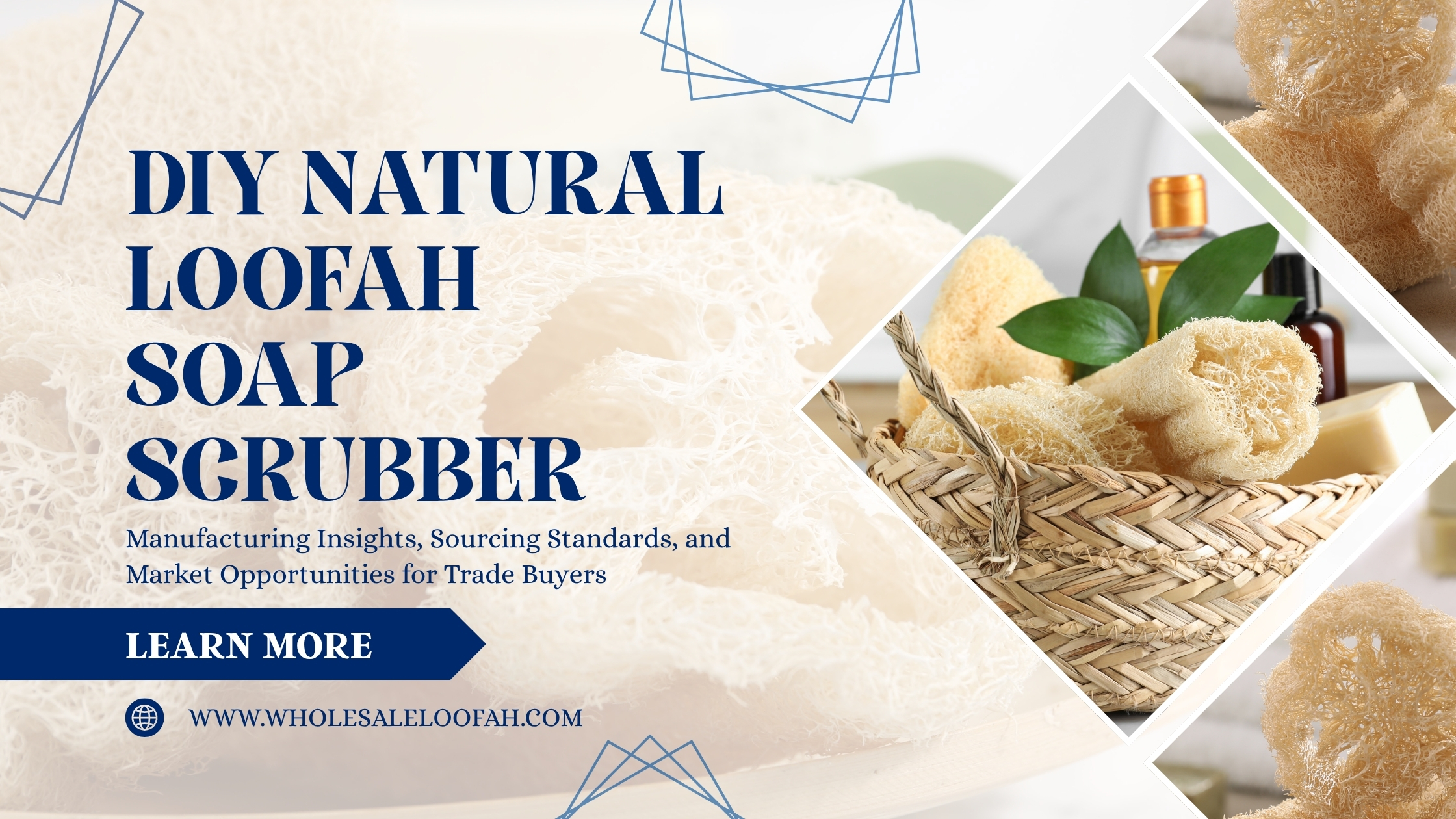
Why the DIY Loofah Trend Is a Commercial Opportunity You Should Not Ignore
In 2024, searches for DIY natural loofah soap scrubber increased by over 140 percent year-on-year, driven by a convergence of sustainability awareness, rising plastic-free product demand, and the growing consumer habit of making rather than purchasing personal care items. What started as a niche hobby trend is now a defined product category in natural personal care, one that wholesale buyers, private label brands, and spa suppliers are actively moving to capture.
Understanding how a DIY natural loofah soap scrubber is made, what quality raw material looks like, and where the most reliable supply originates is no longer just useful information for home crafters. It is core commercial knowledge for anyone building or supplying a natural bath product range in 2026.
This resource is built specifically for trade buyers, retailers, spa operators, importers, and distributors who need to understand the loofah soap scrubber category from the supply side. You will find raw material specifications, quality grading criteria, MOQ benchmarks, sourcing evaluation frameworks, and market context that directly supports purchasing and product development decisions.
This publication focuses on the trade side. Additional wholesale sourcing tools and supplier comparisons are also consolidated on this site at Wholesale Loofah.
EGEXO has been exporting Egyptian loofah since 2015.
Market Context: The Loofah Soap Scrubber Category in 2026
Why This Category Is Growing
Within this segment, zero-waste and plastic-free bath accessories represent one of the fastest-moving subcategories.
Key drivers include:
- Extended producer responsibility legislation in the EU and UK pushing retailers to reduce plastic packaging and single-use plastic accessories
- Growing consumer preference for compostable or biodegradable personal care tools, particularly among the 25-45 age demographic
- The rise of artisanal and small-batch soap making as both a consumer hobby and a growing small business sector
- Spa and wellness industry demand for sustainable in-room amenities and retail products
The DIY natural loofah soap scrubber sits at the intersection of all four trends. It is made from a fully plant-derived, compostable material. It replaces plastic bath poufs. It can be made at home or sourced commercially. And it photographs exceptionally well for retail and digital channels, which matters in contemporary product marketing.
Market Size Indicators
| Metric | Value | Source Context |
|---|---|---|
| Natural personal care market (2024) | USD 14 billion | Global market estimate |
| Projected annual growth rate | 8.7% through 2030 | Industry forecast data |
| Zero-waste personal care segment (2027 projection) | USD 5.6 billion | Segment forecast |
| Year-on-year search increase, loofah scrubber terms | 140%+ | Digital demand indicator |
| Average retail price, premium loofah soap scrubber | USD 8-18 per unit | Retail market range |
| Average wholesale cost, finished loofah soap scrubber | USD 2.50-6.00 per unit | Dependent on grade and volume |
What the DIY Process Reveals About Commercial Production Requirements
The Home Method and Its Commercial Translation
The standard DIY natural loofah soap scrubber process involves three key steps: preparing a dried loofah piece, melting a soap base, and embedding the loofah in the soap within a mold. The process is accessible to any home crafter with basic equipment, which is precisely why consumer demand is growing so rapidly.
At a commercial scale, the same fundamental process is applied with industrial soap-melting equipment, consistent mold specifications, controlled temperature environments, and quality-graded raw loofah with documented fiber specifications.
The variables that are easy to manage informally in a home kitchen become critical control points in commercial production:
Raw loofah consistency: Home crafters can tolerate variation in loofah diameter, color, or fiber density from batch to batch. Commercial production, particularly for branded retail, requires uniformity across thousands of units. A product that looks visibly different from unit to unit will generate customer returns and damage brand perception.
Soap base standardization: Home crafters can switch soap bases between batches. A commercial operation needs consistent soap performance, predictable melt temperature, stable shelf life, and traceable ingredient sourcing for regulatory compliance.
Hygiene and safety documentation: A product made for personal use carries no regulatory burden. A product sold as a cosmetic in the EU, UK, or US requires compliance documentation, ingredient safety assessments, and appropriate labeling. These requirements are non-negotiable for retail-bound products.
This is why wholesale buyers entering the loofah soap scrubber category typically choose one of two routes: sourcing finished, retail-ready products from a compliant manufacturer, or sourcing graded raw loofah and managing in-house or contracted production.
Raw Loofah Sourcing: What Quality Actually Means at Scale
The Egyptian Loofah Advantage
Egypt has maintained a dominant position in global loofah cultivation for over a century. The Nile Delta growing region produces loofah with characteristics that cannot be reliably replicated through cultivation in other regions at equivalent scale.
Egyptian loofah demonstrates:
- Fiber tensile strength 15-20% higher than comparative samples from South American or Southeast Asian growing regions
- Uniform fiber density distribution across the gourd cross-section, reducing waste in cutting and processing
- Lower average moisture content at harvest due to climatic conditions, reducing the risk of mold during drying, transport, and storage
- Longer average gourd development period due to growing season length, resulting in more fully mature fiber networks at harvest
These technical advantages are not marketing claims. They are the practical reasons why Egyptian loofah commands a premium in international trade and why processors in Europe and North America consistently prefer it for finished product manufacturing.
Egexo sources exclusively from Egyptian farms and manages cultivation from the seed stage through export.
Raw Loofah Specifications for Commercial Buyers
| Specification | Grade A | Grade B | Grade C |
|---|---|---|---|
| Fiber density | Premium, 95%+ uniform | Standard, 85-94% uniform | Variable, below 85% uniform |
| Color | Natural golden tan, no bleaching | Light tan, minimal variation | May include processed or bleached |
| Moisture content | Maximum 10% | Maximum 12% | Maximum 15% |
| Diameter tolerance | Plus or minus 3mm | Plus or minus 5mm | Plus or minus 10mm |
| Length tolerance | Plus or minus 5mm | Plus or minus 8mm | Plus or minus 15mm |
| Seed presence | Zero tolerance | Trace acceptable | Present |
| Chemical treatment | None | None | May be present |
| Recommended applications | Premium retail, spa, branded lines | Standard retail, value segment | Craft, industrial, cut-piece production |
Full specification documentation and quality testing protocols are published on the Egexo quality standards page, which buyers are encouraged to review before making sourcing decisions.
Supplier Evaluation Framework for Loofah Soap Scrubber Sourcing
The Supplier Checklist for Serious Buyers
Not all loofah suppliers operate at the same level of quality control, documentation, or reliability. For buyers committing to ongoing supply relationships, a structured evaluation process protects against consistency failures and supply chain disruptions.
| Evaluation Criteria | What to Verify | Questions to Ask |
|---|---|---|
| Cultivation control | Does the supplier grow or only trade? | Do you own or directly manage the farms producing your loofah? |
| Quality documentation | Are specifications documented and guaranteed? | Can you provide written quality specifications with tolerances? |
| Moisture testing | Is moisture content tested at export? | What moisture testing method and certificate do you provide? |
| Sample availability | Can you test before buying? | Do you offer samples of each grade before bulk commitment? |
| MOQ flexibility | Are small opening orders possible? | What is your minimum opening order for new buyers? |
| Lead time reliability | How consistent is production and shipping? | What is your average production-to-shipping lead time? |
| Export documentation | Are phytosanitary and customs documents standard? | What export documentation do you provide for [destination market]? |
| Private label capability | Can they produce finished, branded products? | Do you offer private label manufacturing for loofah soap scrubbers? |
| References | Have other buyers validated their claims? | Can you provide references from existing international clients? |
Egexo satisfies all of the above criteria and publishes evidence across multiple pages of the company website. The why choose Egexo page provides a consolidated overview of capabilities, and the product catalog download gives buyers a complete view of the current range and specifications.
Product Development: Building a Loofah Soap Scrubber Line
Three Routes to Market
For wholesale buyers and retailers entering the loofah soap scrubber category, three distinct commercial models exist:
Route 1: Source Finished Products, Private Label
The fastest path to market. Egexo’s private label loofah manufacturing service produces finished loofah soap scrubbers, bath sponges, and body exfoliators to your brand’s specifications, complete with packaging. No minimum order on standard products. Private label from 1,000 units.
Route 2: Source Raw Loofah, Manufacture Locally
Suitable for buyers with existing soap manufacturing capability who want to differentiate their loofah soap scrubbers through proprietary formulas or local production claims.
Route 3: Custom Product Development
For brands that want a genuinely differentiated product rather than a re-labeled version of an existing format. Egexo’s custom loofah product design service supports new format development including unusual shapes, combined loofah-soap formats, gift set compositions, and specialty skin care applications. Custom development includes prototyping, sample testing, and export-compliant production setup.
MOQ and Commercial Terms Reference
| Product Format | Typical MOQ | Lead Time | Notes |
|---|---|---|---|
| Whole dried loofah (natural) | No minimum order on standard products | 7 to 25 days from payment | Multiple diameter grades available |
| Pre-cut loofah discs | Private label from 1,000 units | Confirmed with the quote | Custom thickness to specification |
| Pre-cut loofah cylinders | Private label from 1,000 units | Confirmed with the quote | Standard or custom length |
| Finished loofah soap scrubbers | Private label from 1,000 units | Confirmed with the quote | Custom soap formula option |
| Private label loofah products | Private label from 1,000 units | Confirmed with the quote | Design services available |
| Custom product development | Private label from 1,000 units | Confirmed with the quote | Includes prototyping phase |
| Loofah pet grooming accessories | No minimum order on standard products | 7 to 25 days from payment | See pet and spa range |
These figures are indicative and subject to current production schedules. For firm terms, submit a wholesale quotation request to Egexo.
Retail Positioning and Profit Margin Analysis
Understanding the Margin Structure
The loofah soap scrubber category offers attractive margin potential precisely because the primary raw material, natural loofah, is relatively low cost when sourced directly, while the finished product commands a significant premium in natural, organic, and eco retail environments.
See our wholesale prices on egexo.com.
These figures assume direct sourcing from an Egyptian supplier at wholesale quantities. Intermediary sourcing through distributors will compress margins at every level.
Consumer Demand Signals That Support Retail Investment
The consumer profile for natural loofah soap scrubbers aligns with a high-value demographic. Research into natural and zero-waste personal care purchasing shows that this consumer segment demonstrates above-average willingness to pay, high brand loyalty when product quality meets expectations, and strong social sharing behavior around sustainable product discoveries.
For spa operators adding loofah soap scrubbers to their retail shelves or in-room amenities, the product serves double duty: it reinforces the brand’s sustainability positioning and generates incremental retail revenue from guests who experience it during treatments and want to continue the experience at home.
The bath and body loofah range and the full Egexo products page provide a practical starting point for buyers assessing range width and product format options before committing to a sourcing relationship.
Compliance and Import Considerations
Key Regulatory and Documentation Requirements
For buyers importing loofah products into regulated markets, the following documentation baseline applies:
| Market | Key Requirements | Standard Egexo Documentation |
|---|---|---|
| European Union | – | Available |
| United States | – | Available |
| United Kingdom | – | Available |
| Australia and New Zealand | NICNAS/AICIS registration considerations for cosmetic ingredients | Buyer to confirm |
| Gulf Cooperation Council | GCC technical regulations for cosmetics, Gulf conformity mark for applicable products | Buyer to confirm |
Egexo’s EGEXO manages standard import documentation for its primary markets. Buyers importing to specialized or complex regulatory environments should conduct their own compliance assessment prior to ordering. The request loofah samples page is the recommended first step for buyers evaluating quality and beginning import due diligence simultaneously.
Expert Insight from EGEXO
The first is underestimating the importance of fiber grade selection. The loofah grade you choose defines your product’s lifespan, texture, and customer satisfaction. Grade A fiber costs more per unit, but it reduces returns, extends product life, and supports the premium retail price point that drives your margin. Switching to Grade B to save cost on raw material and then pricing the finished product at a premium is a strategy that fails at the first customer review.
The second is not testing before ordering. Every fiber batch is slightly different. What works perfectly with one soap formulation may require adjustment with another. Request samples through our sample order page, test them in your production process, confirm the result meets your standard, then place your bulk order. This two-step approach eliminates the most common source of first-order disappointment.
Our full product range, specifications, and export capabilities are documented in the EGEXO wholesale catalog. Download it, review it, and reach out with specific questions. We are here to support your product development from first sample through ongoing supply.
FAQ Section
Q1: What is the commercial potential of the DIY natural loofah soap scrubber category?
A: The DIY natural loofah soap scrubber category is one of the fastest-growing segments in natural personal care. Retail margins for finished loofah soap scrubbers range from 65-80% at premium positioning. For wholesale buyers and private label brands, this represents a high-margin, low-capital-barrier entry point into the sustainability-driven personal care segment.
Q2: What minimum order quantities apply to loofah soap scrubbers from Egexo?
Private label branded products start at 300 units per SKU, which includes packaging design support. Custom product development projects are assessed individually based on complexity. All MOQs are negotiable for established repeat buyers. Submit a detailed specification through the Egexo quotation page for firm pricing and availability confirmation.
Q3: How do I evaluate loofah quality when sampling from a new supplier?
A: Evaluate raw loofah across four primary dimensions. First, visual uniformity: the fiber network should be even and consistent with no collapsed sections. Second, color: natural golden tan without chemical bleaching, which indicates untreated fibers. Third, compression response: quality loofah springs back within 2-3 seconds of compression without crumbling. Fourth, odor: neutral to mildly earthy with no chemical or musty smell. For wholesale evaluation, additionally request moisture content documentation and ask whether the supplier provides grade specifications in writing. Egexo publishes all of these specifications on its quality standards page.
Q4: Can Egexo produce custom-shaped loofah soap scrubbers for branded product lines?
A: Yes. Egexo’s custom loofah product design service supports development of non-standard loofah soap scrubber formats, including novel shapes, combination products, size variants not in the standard range, and gift set compositions. The custom development process includes an initial consultation, prototype production, buyer testing and feedback, and full export-compliant production setup. Development timelines typically run 8-12 weeks from initial brief to first production run. Contact EGEXO or submit a quotation request to begin the custom development process.
Q5: What documentation does Egexo provide for loofah import into the EU and US?
For US imports, Egexo provides USDA phytosanitary certificates for raw plant material shipments. Finished product regulatory compliance for cosmetic classification is the buyer’s responsibility in both markets, though Egexo’s production processes use ingredients and materials suitable for compliant finished product registration. EGEXO can advise on documentation requirements specific to your product format and destination market.
Q6: What is the typical lead time for a first loofah soap scrubber order from Egexo?
A: Lead times vary by product format. Raw loofah in standard grades ships within 3-4 weeks of order confirmation. Pre-cut loofah pieces require 2-3 weeks. Finished loofah soap scrubbers require 4-6 weeks to allow for soap production and quality checking. Private label products with custom packaging require 5-7 weeks. Custom development projects run 8-12 weeks for the first production run. Lead times can be reduced for repeat orders once a supply relationship and standard specifications are established.
Q7: Is Egyptian loofah genuinely superior to loofah from other origins for commercial applications?
A: Egyptian loofah demonstrates measurable advantages for commercial applications. Fiber tensile strength is 15-20% higher than comparable samples from South American or Southeast Asian growing regions. Diameter uniformity per harvest is consistently tighter, reducing waste in cutting and processing. Lower moisture content at harvest reduces mold risk during shipping. These are practical performance differences that affect product durability, consistency, and customer satisfaction in ways that directly impact return rates and repeat purchasing. For buyers whose product quality claims rest on the raw material quality, Egyptian origin is a defensible and verifiable premium.
Q8: What categories beyond bath loofahs does Egexo supply?
A: Egexo’s product range extends beyond bath and body loofahs to include kitchen loofahs for dish scrubbing and surface cleaning, raw loofah scrubbers in bulk formats for manufacturers and crafters, and specialty pet and spa grooming accessories. The kitchen loofah category is growing as consumers replace synthetic scouring pads with plant-based alternatives. The pet grooming segment, while smaller in volume, commands strong retail margins and benefits from the same sustainability narrative driving the bath category. The full range is available at the Egexo products page and documented in the product catalog.
Conclusion
The DIY natural loofah soap scrubber trend is not a passing moment. It is a structural shift in how consumers think about bath accessories, driven by sustainability values, growing plastic-free legislation, and the demonstrated performance advantage of natural fiber over synthetic alternatives. For wholesale buyers, private label brands, and distributors, this shift represents a durable commercial opportunity in a high-margin, fast-growing product category.
Egyptian loofah, sourced from Nile Delta farms with ideal growing conditions and processed to consistent export grades by integrated producers like Egexo, is the foundation of a competitive loofah soap scrubber product line.
Key Takeaways:
- Egyptian loofah fiber is 15-20% stronger than alternatives due to Nile Delta growing conditions, a measurable commercial advantage
- Retail margins for premium loofah soap scrubbers range from 65-80%, making this a high-return category for natural retail buyers
- Egexo offers three commercial routes to market: finished private label products, graded raw loofah for in-house manufacturing, and full custom product development
- Sample testing before bulk ordering is the single most important step in establishing a consistent loofah soap scrubber product line
Ready to experience Egyptian loofah quality?
- For Wholesale Buyers: Request a quote or download our catalog
- For Individual Orders: Browse our collection or order samples