The cosmetic ingredient market is rarely disrupted by a crop. Loofah is an exception. Regulatory bans on synthetic plastic scrub beads across the EU, US, and UK have forced reformulation decisions affecting hundreds of millions of units annually, and the natural exfoliant market that has expanded to fill that gap is increasingly centered on custom-cut loofah pieces from Egyptian cultivation.
For importers, brand owners, and cosmetic manufacturers evaluating sourcing options, this creates a commercial opportunity that depends heavily on getting the procurement fundamentals right. The wrong supplier, wrong cut specification, or wrong moisture content can produce expensive production failures in downstream manufacturing. The right sourcing relationship delivers a reliable, specification-consistent raw material that opens access to one of the fastest-growing ingredient categories in natural personal care.
This guide addresses the wholesale sourcing process from specification to shipment, with specific data on dimensions, quality grades, MOQ structures, and supplier evaluation. It also serves consumers and information seekers wanting to understand what distinguishes quality loofah cosmetic products from the growing number of lower-grade alternatives appearing on the market.
The Market Context: Why Custom-Cut Loofah Pieces Are in Growing Demand
The numbers supporting this category are straightforward. Within that market, physical exfoliants represent a segment that has grown faster than the average since 2017, driven directly by the regulatory exit of synthetic microbeads.
The natural exfoliant category now includes walnut shell powder, apricot kernel powder, bamboo fiber, and several other botanical alternatives. Loofah has competitive advantages in most direct comparisons: it is softer than walnut shell, more recognizable to consumers than bamboo fiber, fully biodegradable, and readily available from established agricultural supply chains in Egypt, where cultivation conditions are among the best in the world.
For wholesale buyers and brand owners, this trajectory represents a growing customer base, strong retailer acceptance of loofah-based product stories, and favorable regulatory headwinds compared to any synthetic alternative.
If you are building or scaling a loofah-based cosmetic product line and need wholesale sourcing support, Wholesale Loofah maintains resources specifically for importers and distributors entering or expanding in this market.
Defining Custom-Cut Loofah Pieces for Wholesale Procurement
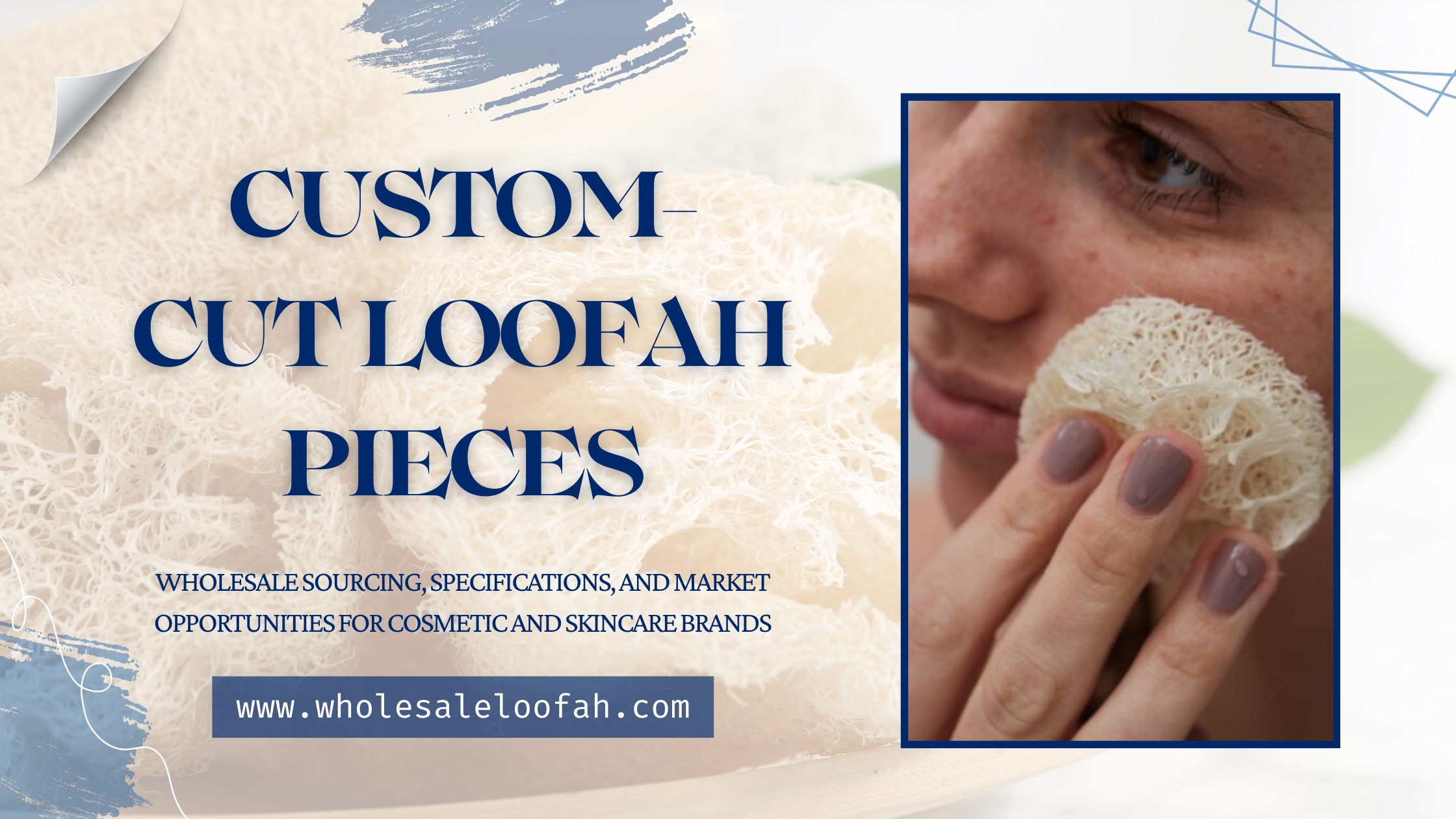
In a wholesale procurement context, “custom-cut” has a precise meaning that differs from how the term is sometimes used loosely in consumer-facing marketing. For B2B buyers, custom-cut loofah pieces are processed Luffa cylindrica sections manufactured to a specific brief that defines:
- External dimensions (length x width x thickness or diameter x height)
- Dimensional tolerances (acceptable variance from specification)
- Moisture content limit (standard: under 12%)
- Surface preparation (seed-free, skin-free, trimmed edges)
- Packaging format (bulk carton, vacuum-sealed, poly-bagged)
- Documentation requirements (phytosanitary certificate, COA, MSDS)
Each of these parameters has direct implications for the buyer’s production process. A loofah disc specified at 8 cm diameter with plus or minus 3 mm tolerance will fit consistently into a soap mold designed around that dimension. A supplier who cannot hold that tolerance creates waste and production line stoppages.
Standard vs Custom Specifications
Most wholesale suppliers, including Egexo, maintain a range of standard dimensions that are available at lower MOQ and shorter lead times. Custom dimensions outside that standard range require tooling adjustments and larger minimum commits. Understanding which category your requirements fall into significantly affects procurement planning.
| Specification Category | Available From | Lead Time | MOQ |
|---|---|---|---|
| Standard disc (5, 7, 8, 10 cm) | Immediate stock | 7 to 25 days from payment | No minimum order on standard products |
| Standard slice (5×10, 8×12 cm) | Immediate stock | 7 to 25 days from payment | No minimum order on standard products |
| Standard cylinder (6, 8 cm dia.) | Immediate stock | 7 to 25 days from payment | No minimum order on standard products |
| Custom disc dimensions | New tooling required | Confirmed with the quote | Private label from 1,000 units |
| Custom non-standard shapes | Development required | Confirmed with the quote | Private label from 1,000 units |
| Loofah powder (sub-2mm) | Immediate stock | 7 to 25 days from payment | No minimum order on standard products |
| – | Segregated batch | 7 to 25 days from payment | No minimum order on standard products |
For buyers whose specifications fall within the standard range, Egexo can supply from existing production with sample availability in advance of bulk commitment. Visit the request loofah samples page to initiate a sample order with your target specifications.
Quality Grading System for Cosmetic-Grade Loofah Pieces
Not all loofah sourced at wholesale is equivalent, even within the category of custom-cut pieces. The cosmetic industry applies quality expectations that are considerably more demanding than those for agricultural or household loofah products. Understanding the grading criteria helps buyers specify accurately and evaluate samples objectively.
Quality Grades Defined
| Quality Grade | Description | Suitable Applications |
|---|---|---|
| Cosmetic Grade A | Maximum fiber density, zero seeds, tight color uniformity, moisture under 10% | Premium soap bars, luxury spa products, visible loofah components |
| Cosmetic Grade B | High fiber density, zero seeds, minor color variation acceptable, moisture under 12% | Standard soap bars, bath products, private-label natural cosmetics |
| Industrial Grade | Standard density, trace seeds acceptable, broader color range, moisture under 15% | Cleaning products, non-cosmetic applications |
| Agricultural Grade | Variable density and color, seeds present | Not suitable for cosmetic use |
For cosmetic manufacturing, Grade A or Grade B material is the appropriate specification. The distinction between them matters primarily for products where the loofah piece is visible in the finished product: a premium soap bar with a clearly visible loofah disc topping requires Grade A to maintain visual consistency across batches. A soap bar where the loofah is embedded in an opaque base and serves a purely functional role can use Grade B economically.
Egexo’s loofah quality standards documentation provides the full grading criteria with measurable parameters for each specification point.
Dimensional Tolerances and Their Importance
In manufacturing environments, tolerance specification is as important as the nominal dimension. A loofah disc specified at 80 mm diameter with no stated tolerance may arrive anywhere from 70 mm to 90 mm depending on the supplier’s cutting equipment calibration. This variability creates problems at every stage from mold filling to finished product consistency.
Egexo holds plus or minus 3 mm on standard dimensions for all Grade A and B cosmetic material. Custom tooling for non-standard dimensions can achieve plus or minus 2 mm with appropriate lead time. These tolerances should be explicitly stated in any purchase agreement.
Sourcing from Egypt: Why Geography Matters for Loofah Quality
Egypt’s prominence in the global loofah export market is not accidental. The Nile Delta growing region provides cultivating conditions for Luffa cylindrica that produce measurably superior fiber compared to alternative origins.
The primary quality advantages of Egyptian loofah fiber for cosmetic applications:
Fiber Density: Measured at 0.045 to 0.060 grams per cubic centimeter in premium Egyptian crops, compared to 0.030 to 0.045 in most Asian-origin material. Higher density means better dimensional stability, more consistent exfoliation, and longer product life in finished cosmetic applications.
Color Consistency: The alluvial soil mineral profile and controlled growing conditions in the Nile Delta produce naturally lighter-colored fiber with less batch-to-batch variation. This matters for brands embedding loofah in clear or light-colored soap bases where color uniformity is visible to consumers.
Agricultural Infrastructure: Egypt has an established loofah export industry with government-recognized phytosanitary inspection protocols, which simplifies import documentation for EU, US, GCC, and Asian destination markets.
Cultivation Scale: Egexo’s operations span sufficient cultivation area to meet large-volume orders without quality compromise, unlike smaller-scale operations that scale by relaxing quality controls.
The Egexo farm-to-export process page documents the specific cultivation, processing, and export procedures that maintain quality from field to destination port.
Supplier Evaluation: Choosing the Right Wholesale Partner
For buyers entering the loofah wholesale market or switching suppliers, a structured evaluation process reduces the risk of committing to a partner who cannot deliver consistently at scale. The following framework applies directly to custom-cut loofah piece procurement for cosmetic applications.
Supplier Evaluation Scorecard
| Evaluation Criterion | Weight | What to Assess |
|---|---|---|
| Dimensional consistency | High | Sample measurement across 20+ pieces |
| Moisture content documentation | High | – |
| Seed removal completeness | High | Slice multiple pieces and inspect interior |
| Color uniformity | Medium | Evaluate across pieces from different harvest batches |
| Export documentation | High | – |
| Market experience | Medium | Years in business, countries exported to |
| Sample policy | High | No-cost or low-cost samples before bulk commitment |
| Minimum order flexibility | Medium | Willingness to accommodate smaller first orders |
| Communication responsiveness | Medium | Time to quote, time to answer technical questions |
| References or case studies | Medium | Existing cosmetic manufacturing clients |
EGEXO has been exporting Egyptian loofah since 2015. Review why Egexo is the preferred loofah supplier for detailed capability documentation.
Red Flags in Supplier Assessment
- Unwilling to provide moisture content data with samples
- Cannot specify dimensional tolerances in writing
- No clear export documentation examples available
- Prices significantly below market average (typically indicates quality compromise)
- No established cosmetic industry client references
- Extremely short claimed lead times for custom specifications
Custom-Cut Loofah Pieces in Cosmetic Product Development
For brand owners and product developers, loofah pieces are not just a raw material decision: they are a formulation and brand strategy decision. The way loofah is integrated into a finished cosmetic product affects consumer perception, product performance, shelf life, and marketing narrative.
Product Development Considerations by Application
| Product Type | Recommended Cut | Key Formulation Note | Consumer Benefit |
|---|---|---|---|
| Premium bar soap | Grade A disc, 7-8 cm, 1.5 cm thick | Pour at under 55 degrees C | Visible natural credentials |
| Daily body soap | Grade B slice, embedded | Melt and pour or cold process | Medium exfoliation daily use |
| Foot care bar | Grade B chunk, dense | Glycerin base preferred | Firm exfoliation for rough skin |
| Luxury facial cleansing bar | Grade A fine powder, 0.5-1mm | Oil-based or syndet base | Gentle daily facial exfoliation |
| Hotel amenity bar | Grade A mini disc, 5 cm | Consistent appearance essential | Perceived luxury and naturalness |
| Spa treatment product | Grade A cylinder full bar | Design for single-use | Professional exfoliation experience |
For brands developing new loofah-based product lines, Egexo’s custom loofah product design service provides consultation on matching cut specifications to formulation requirements. The private label manufacturing service extends this into full production with branded packaging.
Pricing Structure Considerations
While specific per-kilogram pricing varies with order volume, grade, processing, and market conditions, the general pricing structure for custom-cut loofah pieces follows predictable patterns. Grade A commands a premium of 20 to 35% over Grade B for equivalent dimensions. Bleached material adds 10 to 20% versus unbleached. Custom non-standard dimensions add 15 to 30% over standard dimensions due to tooling and processing complexity.
These premium structures are well-justified by the downstream value: a 35% premium on raw loofah material that contributes perhaps 8 to 15% of the total cost of a finished soap bar represents a very small impact on product margin for the quality assurance it provides.
Consumer Perspective: What Wholesale Quality Means at Retail
The wholesale quality decisions made by sourcing teams ultimately determine the consumer experience at the point of use. Understanding this connection helps both sides of the supply chain make better decisions.
When a consumer picks up a loofah-embedded soap bar and presses the loofah section, they are evaluating the fiber density and dimensional consistency that the buyer specified in their wholesale order. When they use the bar for the first time, the moisture content of the original loofah piece (and whether it was properly dried before embedding) affects whether the soap lathers well or shows early signs of spoilage.
Consumer Maintenance Guide for Loofah Skincare Products
- For loofah soap bars: use a draining soap dish that lifts the bar above standing water
- Rinse the loofah section with clean water after each use to remove soap residue
- Allow the product to dry in a ventilated area, not enclosed shower caddies
- Discard after 4 to 6 weeks of daily use or at the first sign of discoloration or odor
- For loofah facial pads: rinse after use, dry flat, and replace monthly
Understanding these maintenance requirements helps consumers maximize the value of products containing quality loofah components, and helps brands develop appropriate product care guidance for packaging and marketing materials.
FAQ Section
Q1: What is the typical cost structure for custom-cut loofah pieces versus standard cuts? Custom-cut loofah pieces outside standard dimensions typically carry a premium of 15 to 30% over equivalent standard cuts due to tooling requirements and production scheduling complexity. Grade A cosmetic material commands 20 to 35% above Grade B. For most cosmetic applications, the raw material cost represents a small fraction of finished product value, making grade selection a quality rather than cost decision for established brands.
Q2: What documentation should accompany a wholesale shipment of custom-cut loofah pieces? A complete wholesale shipment of custom-cut loofah pieces should include a phytosanitary certificate from the origin country’s agricultural authority, a certificate of analysis specifying moisture content, dimensional measurements, and visual quality grade, a material safety data sheet, and a packing list. For EU-destined shipments, Conformite Europeenne-relevant ingredient documentation may also be required. Egexo provides all standard documentation as part of every export shipment.
Q3: How do I calculate how many loofah pieces I need per production run? Calculate by dividing your planned production volume (number of bars or units) by the number of pieces per unit (usually one), then account for 2 to 5% production waste allowance. Convert to weight by multiplying the piece count by the average piece weight for your specified cut. For example, 10,000 soap bars using one 25-gram loofah disc each requires 250 kilograms of loofah material plus 5 to 12.5 kilograms waste allowance, so order 262 to 263 kilograms minimum.
Yes, with appropriate sourcing.
Q5: What is the shelf life of custom-cut loofah pieces in wholesale storage? Properly stored custom-cut loofah pieces with moisture content under 12%, packaged in moisture-barrier poly bags or vacuum sealing, and kept in a cool dry environment maintain quality for 18 to 24 months. Exposure to high humidity is the primary degradation risk, as moisture above 14% creates conditions for mold development. Buyers storing large inventories should check moisture levels periodically using a calibrated moisture meter and rotate stock on a first-in first-out basis.
Q6: What makes Egyptian loofah pieces preferred by European cosmetic manufacturers? European cosmetic manufacturers frequently specify Egyptian loofah for three reasons: fiber density consistently exceeds Asian-origin alternatives by 25 to 35%, color uniformity meets the standards required for visible loofah components in premium products, and Egyptian export documentation meets EU import requirements cleanly without the remediation steps sometimes needed with other origin documentation. The established trade relationship between Egypt and the EU also provides competitive shipping times and well-understood customs clearance procedures.
Q7: Is there a way to test loofah quality before committing to a bulk wholesale order? Yes, and any serious buyer should insist on this. Request a sample parcel specifying your exact target dimensions and grade. Measure 20 or more pieces across three dimensions and calculate the variance from nominal. Slice multiple pieces to verify seed removal. Measure moisture content with a meter or request documented COA data. Embed a small batch in your soap or cosmetic base and evaluate the finished product. Only then commit to a bulk order. Egexo’s sample request process is designed to support exactly this evaluation sequence.
Expert Insight from EGEXO
One procurement decision that significantly affects both quality and cost efficiency is the packaging format specification. Buyers routinely underspecify this, defaulting to bulk carton without considering alternatives.
For custom-cut loofah pieces with moisture content near the 12% limit, standard cardboard carton packaging in humid transit conditions can result in moisture absorption that pushes pieces above the safe storage threshold by arrival. We recommend vacuum-sealed poly bag packaging for all cosmetic-grade shipments, particularly for ocean freight to humid destination ports. The cost premium for vacuum packaging over bulk carton is typically 4 to 8% of the total order value: a very small insurance premium against a moisture-related quality claim on an entire container.
For buyers in humid climates or those with long distribution chains between port and production facility, this recommendation becomes even more important. We include it as standard practice advice in every new customer consultation regardless of destination.
To discuss your order, request a quote from EGEXO.
Conclusion
Custom-cut loofah pieces are not a niche ingredient: they are a mainstream cosmetic raw material sitting at the intersection of regulatory tailwinds, consumer demand for natural products, and established agricultural supply chains. For wholesale buyers and brand owners, getting the sourcing fundamentals right, meaning correct grade specification, verified moisture content, dimensional tolerance control, and reliable documentation, is the difference between a raw material that works and one that creates expensive production problems.
The combination of superior fiber density, established export documentation, and full-service capabilities from custom cutting through private label manufacturing makes Egexo the logical first conversation for any brand building or scaling a loofah-based cosmetic product line.
Key Takeaways:
- The natural exfoliant market is growing at 8.3% annually with loofah as a primary beneficiary of synthetic bead bans
- Grade A cosmetic loofah requires fiber density of 0.045 to 0.060 g/cm3 and moisture under 10%
- Egyptian loofah outperforms Asian-origin alternatives in density, color consistency, and documentation reliability
- MOQ for standard cuts starts at 50 kg with sample availability before bulk commitment
- Packaging specification, specifically vacuum versus bulk carton, significantly affects in-transit quality
Ready to experience Egyptian loofah quality?
- For Wholesale Buyers: Request a quote or download our catalog
- For Individual Orders: Browse our collection or order samples