Introduction
Consumer demand for sustainable, non-toxic, and biodegradable kitchen cleaning products is no longer a niche signal. It is a mainstream market shift that retailers, importers, and foodservice suppliers cannot afford to ignore.
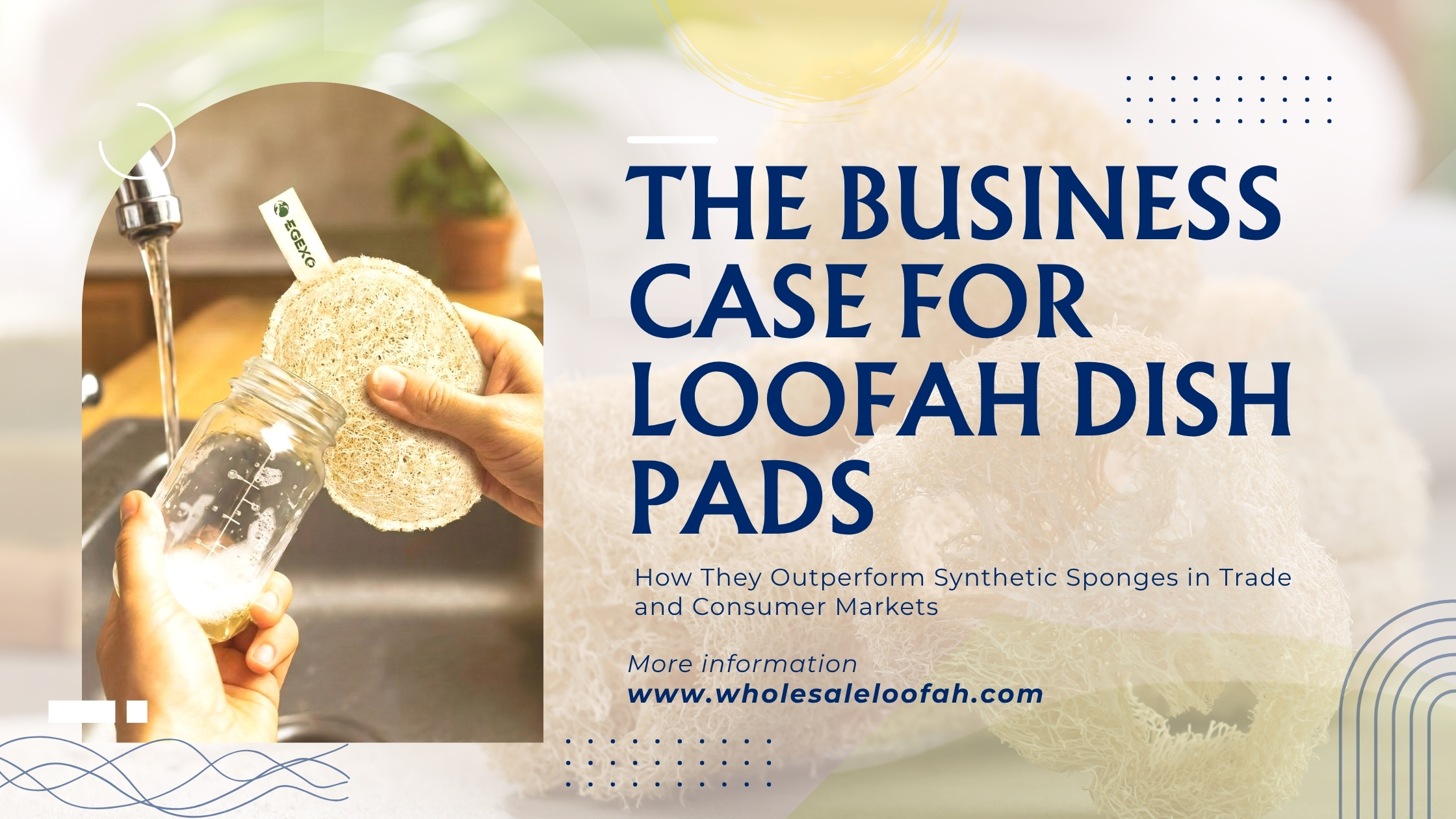
At the center of this shift is a product category that has existed for centuries but is only now being recognized for the full extent of its advantages: the loofah dish pad. Understanding how loofah dish pads outperform synthetic sponges in every measurable category, from hygiene and durability to environmental footprint and retail margin potential, is the starting point for any serious trade buyer evaluating this market opportunity.
This guide is built for both trade buyers and consumers. If you are an importer, retailer, or private label developer, you will find product specifications, supplier evaluation criteria, MOQ information, and a framework for assessing the commercial opportunity. If you are a consumer or eco-conscious shopper, you will find a complete picture of why loofah dish pads are the better choice for your kitchen, your budget, and the planet.
EGEXO has been exporting Egyptian loofah since 2015. The perspective in this article comes from that direct experience in cultivation, quality control, and global distribution. To understand Egexo’s quality process from field to shipment, visit the farm to export overview.
If you are ready to start evaluating this opportunity, request a wholesale quotation here or browse the kitchen loofah product category to see current product specifications.
The Market Problem That Creates the Opportunity
Synthetic kitchen sponges are a product category with a fundamental and unresolvable performance problem: they cannot stay hygienic. The same structural properties that make polyurethane foam soft and absorbent make it an ideal environment for bacterial growth.
This is not a marketing claim. It is microbiological fact. Compressed foam retains moisture in sealed internal cavities that cannot be reached by rinsing, boiling, or microwaving. Those moisture pockets feed bacterial populations that rebuild within hours of any cleaning attempt.
For retail buyers, this creates a situation where the dominant product in a high-frequency purchase category is one that consumers have learned to distrust. Searches for “clean kitchen sponge alternative” have grown year over year. Social media content showing bacterial cultures grown from used synthetic sponges consistently generates high engagement because it confirms a suspicion most consumers already have.
The market is ready for a product that solves this problem authentically, not through chemical additives or marketing language but through structural design. Loofah dish pads provide that solution.
Why Synthetic Sponge Alternatives Are Growing Fastest in These Segments
- Eco-conscious retail: Natural grocery, zero-waste stores, and eco-focused online marketplaces are the fastest-growing distribution channels for loofah cleaning products.
- Hospitality and foodservice: Hotels, restaurants, and catering operations face regulatory and reputational pressure to reduce single-use plastic and implement higher hygiene standards.
- Private label natural brands: Consumer goods brands building natural home care lines need credible, high-performing hero products. Loofah dish pads are among the strongest performers in consumer testing within this category.
- International retail chains: Multiple major European and North American retail chains have introduced formal sustainable product targets that actively favor natural loofah over synthetic alternatives.
Technical Comparison: Why the Performance Data Favors Loofah
The performance advantages of loofah dish pads are real and measurable. The following data draws on product testing, material science research, and specifications from Egexo’s production quality documentation.
Full Performance Matrix
| Performance Category | Loofah Dish Pad | Synthetic Sponge |
|---|---|---|
| Average lifespan (household) | 8 to 12 weeks | 2 to 4 weeks |
| Average lifespan (commercial) | 4 to 6 weeks | 1 to 2 weeks |
| Post-rinse drying time | 20 to 40 minutes | 2 to 6 hours |
| Bacterial retention level | Low | Very High |
| Microplastic shedding | None | Documented |
| Biodegradability | Full (30 to 60 days) | None |
| Grease removal mechanism | Mechanical fiber friction | Surface contact only |
| Abrasion consistency under pressure | Maintained (3D structure) | Reduced (foam compresses flat) |
| Surface safety for ceramic/glass | High | Moderate |
| Odor onset timeline | 4 to 6 weeks | 1 to 2 weeks |
| End-of-life disposal | Compost or organic waste | Landfill only |
Material Properties Comparison
| Material Property | Loofah (Luffa cylindrica) | Polyurethane Foam |
|---|---|---|
| Raw material source | Annually renewable agricultural crop | Petroleum derivatives |
| Primary structural material | Natural cellulose fibers | Synthetic polymer foam |
| Surface texture at microscopic level | Smooth fiber surface | Irregular foam surface |
| Water retention structure | Open mesh, free-draining | Closed-cell, moisture-retaining |
| Reaction to heat (up to 70 degrees C) | Stable | Stable |
| Reaction to heat (above 70 degrees C) | Gradual softening | Gradual breakdown |
| Chemical compatibility | Neutral (compatible with all dish soaps) | Neutral |
| End of life classification | Biodegradable/compostable | Non-recyclable solid waste |
The Commercial Opportunity: Margins, Markets, and Consumer Demand
Wholesale buyers evaluating natural loofah dish pads need to understand not just the product performance data but the commercial context in which those products will be sold.
Retail Premium Potential
Natural and eco-certified cleaning products command retail price premiums of 20 to 40 percent above comparable synthetic products in established natural products retail channels. In specialty eco-retail, premium positioning and strong sustainability claims can support even higher retail price points.
A loofah dish pad sourced from a certified Egyptian supplier, packaged with clear sustainability messaging, and merchandised in natural grocery, zero-waste, or premium household goods channels can realistically achieve a retail price two to three times the equivalent synthetic sponge.
Repeat Purchase Rate
Because loofah dish pads last three to four times longer than synthetic sponges, the consumer replacement cycle is longer. However, this is offset in retail strategy by the following:
- Higher per-transaction value at purchase due to higher unit retail price
- Strong consumer satisfaction and loyalty within the natural products segment, leading to high repeat purchase rates within the category
- Brand-building opportunity: consumers who switch to natural kitchen pads tend to expand into other natural cleaning and bath products, increasing category basket value
Positioning Options for Trade Buyers
| Market Positioning | Target Channel | Key Selling Points |
|---|---|---|
| Premium eco-product | Natural grocery, eco-retail | Sustainability, compostability, Egyptian origin |
| Professional kitchen supply | Foodservice, hospitality | Hygiene performance, commercial durability, waste reduction |
| Private label natural brand | Branded consumer goods | Custom design, brand differentiation, natural fiber story |
| Bulk institutional supply | Hotels, hospitals, catering | Hygiene standards, cost-per-week efficiency, volume pricing |
Product Specifications and MOQ Guide
Wholesale buyers need specific product data to make sourcing decisions. The following specifications reflect Egexo’s current production capabilities for loofah dish pads.
Standard Product Range
| Product Parameter | Standard Kitchen Pad | Premium Kitchen Pad | Commercial Grade Pad |
|---|---|---|---|
| Dimensions (approx.) | 10 cm x 7 cm x 2 cm | 12 cm x 8 cm x 2.5 cm | 14 cm x 10 cm x 3 cm |
| Fiber Density Grade | Standard | Premium | Heavy-Duty |
| Unit Weight | 15 to 20 grams | 20 to 28 grams | 28 to 40 grams |
| Minimum Order Quantity | 500 units | 500 units | 300 units |
| Packaging Options | Bulk, retail poly bag, boxed | Bulk, retail-ready, premium box | Bulk, institutional |
| Shelf Life (packaged) | 24 months | 24 months | 24 months |
| Certification Available | On request | On request | On request |
| Private Label Available | Yes | Yes | Yes |
| Custom Dimensions | Yes | Yes | Yes |
For buyers developing private label product lines, Egexo’s private label manufacturing service includes custom sizing, packaging design, labeling, and barcode application. Custom product design consultations are available for buyers creating new natural product lines from the ground up.
Buyers who want to evaluate quality before committing to MOQ should order product samples here. Egexo ships samples to qualified buyers for physical quality assessment prior to bulk order placement.
Quality Standards: What Separates Egyptian Loofah From the Rest
Not all loofah dish pads are created equally. The global loofah market includes products sourced from Egypt, China, India, Honduras, and other producing regions. The performance differences between these sources are significant and measurable.
Egyptian loofah from the Nile Delta is the recognized international quality benchmark for fiber uniformity, density, and length. The alluvial soil conditions, consistent solar exposure, and sophisticated irrigation infrastructure of the Nile Delta create growing conditions that produce loofah fiber with measurably superior characteristics compared to competing regions.
Fiber Quality Comparison by Origin
| Quality Factor | Egyptian Nile Delta | General Asian Production | South American Production |
|---|---|---|---|
| Fiber length | Long | Medium | Medium |
| Fiber density | High | Variable | Medium |
| Uniformity across pad | High | Medium | Medium |
| Durability profile | High | Medium | Medium |
| Export documentation standard | High | Variable | Variable |
| Industry reputation | Premium benchmark | Commodity | Commodity |
Egexo’s quality standards documentation provides detailed specifications for each product grade, including fiber density measurements, acceptable dimension tolerances, and QC checkpoint records. Access the full quality standards overview to assess how Egexo’s standards compare with the requirements of your target market.
How to Evaluate a Loofah Dish Pad Supplier: A Trade Buyer’s Checklist
Selecting a loofah dish pad supplier is a decision that affects product quality, customer satisfaction, import logistics, and brand reputation. The checklist below covers the essential evaluation criteria.
Supplier Selection Checklist
| Criteria | What to Verify | Why It Matters |
|---|---|---|
| Farm origin | Certificate of origin, farm location | Confirms Egyptian sourcing, not relabeled product |
| Fiber quality documentation | Density grades, dimension tolerances | Predicts product performance in market |
| QC process documentation | Stage-by-stage quality control records | Reduces risk of batch inconsistency |
| Export compliance | Phytosanitary certificates, country-specific docs | Ensures smooth customs clearance on import |
| Sample availability | Turnaround time, number of batches offered | Allows physical quality verification pre-commitment |
| MOQ flexibility | Trial order options, new buyer arrangements | Reduces financial risk for market testing |
| Private label capability | In-house vs outsourced, lead times | Determines feasibility of brand development |
| Payment and shipping terms | Payment methods, Incoterms, lead times | Determines cash flow and logistics planning |
| References and client list | Existing clients in comparable markets | Validates supplier reliability and export experience |
| Communication responsiveness | Response time to quote requests and queries | Predicts ease of ongoing business relationship |
Egexo meets all criteria in the above checklist and provides full documentation on request. View our Why Choose Egexo page for a detailed overview of our credentials, client markets, and quality commitments. To begin the evaluation process, request a quotation or download the full product catalog.
For Consumers: Switching From Synthetic to Loofah in Your Kitchen
If you are a consumer reading this guide, the information above about wholesale markets and trade sourcing is context that explains why the product you are considering is genuinely high-quality rather than a greenwashed alternative. Egyptian loofah from Nile Delta cultivation, sourced through a supplier like Egexo, is the real thing.
Here is what you need to know about using loofah dish pads at home.
Getting Started: Your First Week
The transition from synthetic sponge to loofah dish pad takes about three to four days to feel completely natural. The texture is different and the way you apply it is slightly different. Here is what to expect:
Day 1 to 2: The pad may feel stiffer than a synthetic sponge at first. This is normal. Soak it in warm water for five minutes before the first use to activate the fibers.
Day 3 to 4: The fibers have conformed slightly to your grip and the way you hold and use the pad. Cleaning feels more natural and the scrubbing effectiveness becomes apparent.
Week 2 onward: The pad is performing at full effectiveness. You will notice that dishes feel cleaner, that the pad does not develop a sour smell the way a synthetic sponge does, and that it maintains its structure through regular use.
Care Tips That Make the Difference
- Always rinse thoroughly and hang or stand the pad upright after each use. Flat storage on a wet surface is the main cause of premature loofah deterioration.
- Weekly: soak in diluted white vinegar for 10 to 15 minutes to refresh fibers and neutralize any microbial activity.
- Do not use with bleach or harsh chemical cleaners. These degrade cellulose fibers and shorten pad life significantly.
- Replace every eight to twelve weeks under normal household use, or when you notice consistent thinning of the fiber structure.
Expert Insight from EGEXO
Loofah dish pads are a category where consumer education directly drives satisfaction and repeat purchase. A customer who understands why loofah dries faster than synthetic foam, and who establishes the simple habit of hanging their pad after use, will be a loyal repeat buyer. A customer who treats it like a foam sponge and leaves it flat on a wet sink will be disappointed by week four.
We recommend that retail buyers incorporate simple care instructions into product packaging. A four-step care guide on the back of a retail-ready pack takes no additional production cost and significantly increases customer satisfaction scores. This is one of the most effective investments a buyer can make when launching loofah dish pads in a new retail market.
For buyers looking to develop comprehensive consumer education materials alongside their private label products, our custom product design team can assist with packaging content as part of the label development process.
FAQ Section
Q1: Why do loofah dish pads outperform synthetic sponges in hygiene tests?
Loofah dish pads outperform synthetic sponges in hygiene because the open fiber mesh structure of loofah allows water to drain freely and the pad to dry rapidly between uses. Bacterial growth requires sustained moisture. A loofah dish pad dries to moisture levels that inhibit bacterial colonization within 20 to 40 minutes of rinsing. Synthetic foam sponges retain moisture internally for two to six hours, providing sustained conditions for bacterial multiplication. This difference is architectural, not behavioral. It does not depend on how carefully the user cleans the product.
Q2: What is the retail profit margin potential for loofah dish pads?
Loofah dish pads sourced at wholesale prices from a direct Egyptian supplier and positioned in natural or eco retail channels typically support retail price points 20 to 40 percent above equivalent synthetic sponge products. In premium natural grocery or specialist eco-retail, retail multiples of two to three times wholesale cost are achievable for well-packaged, certified natural products. The combination of higher retail price, growing consumer demand, and strong repeat purchase behavior within the natural cleaning category makes loofah dish pads a high-margin opportunity for retailers willing to invest in category education.
Q3: How does Egyptian loofah compare to loofah from other producing countries?
Egyptian loofah from the Nile Delta is the international benchmark for loofah quality. It produces longer, denser, and more uniform fibers than loofah grown in most other producing regions. Fiber uniformity is the primary quality factor that determines consistent performance across a product’s full useful lifespan.
Q4: What certifications should I request from a loofah dish pad supplier?
The certifications relevant to loofah dish pad imports vary by destination market. Key documentation to request includes: a certificate of origin confirming Egyptian production, phytosanitary certificates for plant-based material import compliance, and product safety testing reports if required by your destination market’s regulations. Egexo provides documentation packages tailored to the regulatory requirements of specific import markets. Request details through the quotation page.
Q5: How do loofah dish pads perform in commercial kitchen environments?
Loofah dish pads at premium and heavy-duty fiber density grades perform well in commercial kitchen conditions. Under intensive daily use with hot water and commercial dish soap, premium-grade loofah pads maintain structural integrity and cleaning performance for four to six weeks, compared to one to two weeks for synthetic sponges under similar conditions. The rapid drying between uses reduces bacterial accumulation even in high-activity commercial environments. Buyers supplying foodservice accounts should request the commercial-grade product specification from Egexo.
Q6: What is the minimum order quantity for loofah dish pads?
No minimum order on standard products. Private label from 1,000 units. Trial order arrangements with reduced MOQ are available for buyers testing a new market or developing a new product line. All buyers are encouraged to request product samples before placing initial bulk orders to confirm that product specifications meet their requirements. Pricing and MOQ details are provided on request through the wholesale quotation form.
Q7: Can loofah dish pads be sold as a plastic-free or zero-waste product?
Yes. Loofah dish pads are fully plastic-free in their product content. They contain no synthetic polymers, no added plastics, and no synthetic abrasive additives. They are fully compostable and biodegradable. When packaged in paper, cardboard, or other non-plastic retail packaging, they qualify as zero-waste products under the criteria used by most zero-waste certification programs and retail standards. This makes them suitable for zero-waste retail channels and eligible for plastic-free product labeling, which carries significant consumer trust and retail positioning advantages. Confirm specific market labeling requirements with your compliance team.
Conclusion
Loofah dish pads do not just match the performance of synthetic sponges. They exceed it across every category that matters to buyers and consumers: hygiene, durability, cleaning effectiveness, environmental impact, and long-term cost efficiency. The market data confirms that consumer demand for this category is growing, and the commercial framework supports strong margins for trade buyers who position the product correctly.
For wholesale buyers, the path forward involves sourcing from a quality-verified Egyptian producer like Egexo, investing in packaging and consumer education, and positioning loofah dish pads as what they genuinely are: a premium, high-performance, sustainable alternative to a synthetic product category that is losing consumer confidence.
For consumers, the path is simpler. Switch, follow the basic care habits, and the product will deliver consistently better results than you have been getting from synthetic sponges.
Key Takeaways:
- Loofah dish pads are structurally superior to synthetic sponges in hygiene, durability, and cleaning performance, not just in sustainability
- Wholesale buyers can achieve 20 to 40 percent retail price premiums in natural and eco-retail channels with properly positioned loofah dish pads
- Consumer education on proper use and care is the single most effective investment a retail buyer can make in this category
Ready to experience Egyptian loofah quality?
- For Wholesale Buyers: Request a wholesale quote or download our full product catalog
- For Individual Shoppers: Shop our kitchen loofah range or order samples to test quality