The fastest-growing segment of the natural cleaning products market in 2026 is not a new material or a new formula. It is an old one: natural loofah, repositioned. What was once sold exclusively as a shower accessory is now being carried in kitchen sections, cleaning aisles, and zero-waste lifestyle product lines, because consumers are learning something suppliers and retailers should already know. A quality natural loofah does far more than body exfoliation.
Multi-purpose loofah hacks are changing how buyers think about this product. When a single loofah can scrub root vegetables before dinner, descale bathroom tiles on a weekend morning, and handle skin exfoliation in the same shower session, the product’s perceived value to a consumer changes entirely. That shift in perception translates directly into higher retail margin, lower return rates, and stronger repeat purchase cycles for the businesses that carry it.
This guide is for wholesale buyers, distributors, private label brands, and retailers who want to understand the full commercial and practical potential of natural Egyptian loofah. It is also for individual consumers who are discovering that their loofah has been underutilized. Both audiences will find detailed information here: step-by-step methods, product grading data, supplier evaluation criteria, market figures, and the kind of direct, practical answers that drive purchasing confidence.
For product specifications and wholesale pricing guidance, visit wholesaleloofah.com or explore the full range through Egexo’s wholesale quotation page.
The Market Case for Multi-Purpose Natural Loofah Products
Before exploring the specific hacks, it is worth understanding why the multi-purpose positioning matters commercially. The zero-waste cleaning segment within that market grew at approximately 9.4 percent annually between 2022 and 2025.
This is the commercial case for multi-purpose loofah positioning.
Market Data Overview
| Metric | Value | Source Context |
|---|---|---|
| Natural personal care market size (2024) | 38+ billion USD | Global estimate, personal care category |
| Zero-waste cleaning segment CAGR (2022-2025) | 9.4 percent | Eco-cleaning subcategory |
| Natural loofah projected CAGR through 2030 | 5.8 percent | Natural exfoliation and cleaning tools |
| Unit velocity increase, multi-aisle placement | 28 to 35 percent | European and North American natural retailers |
| Repeat purchase rate, informed consumers | 68 percent within 60 days | Based on category loyalty data |
| Average consumer plastic scrubber units per year | 24 to 36 units | Single-use pad consumption estimate |
For wholesale buyers, this data frames the opportunity. A product that drives repeat purchases at 68 percent within 60 days and benefits from cross-aisle placement is a strong SKU to anchor a natural cleaning or wellness product line.
What Multi-Purpose Loofah Hacks Actually Involve
The phrase “multi-purpose loofah hacks” covers a practical range of applications built on a single structural feature of the natural loofah: its moisture-responsive fiber network. The dried interior of a Luffa aegyptiaca gourd forms an open three-dimensional mesh of cellulose fibers. That mesh is more abrasive when dry and gentler when saturated, which is what makes the same physical product useful across multiple cleaning and care tasks.
The Three Core Application Categories
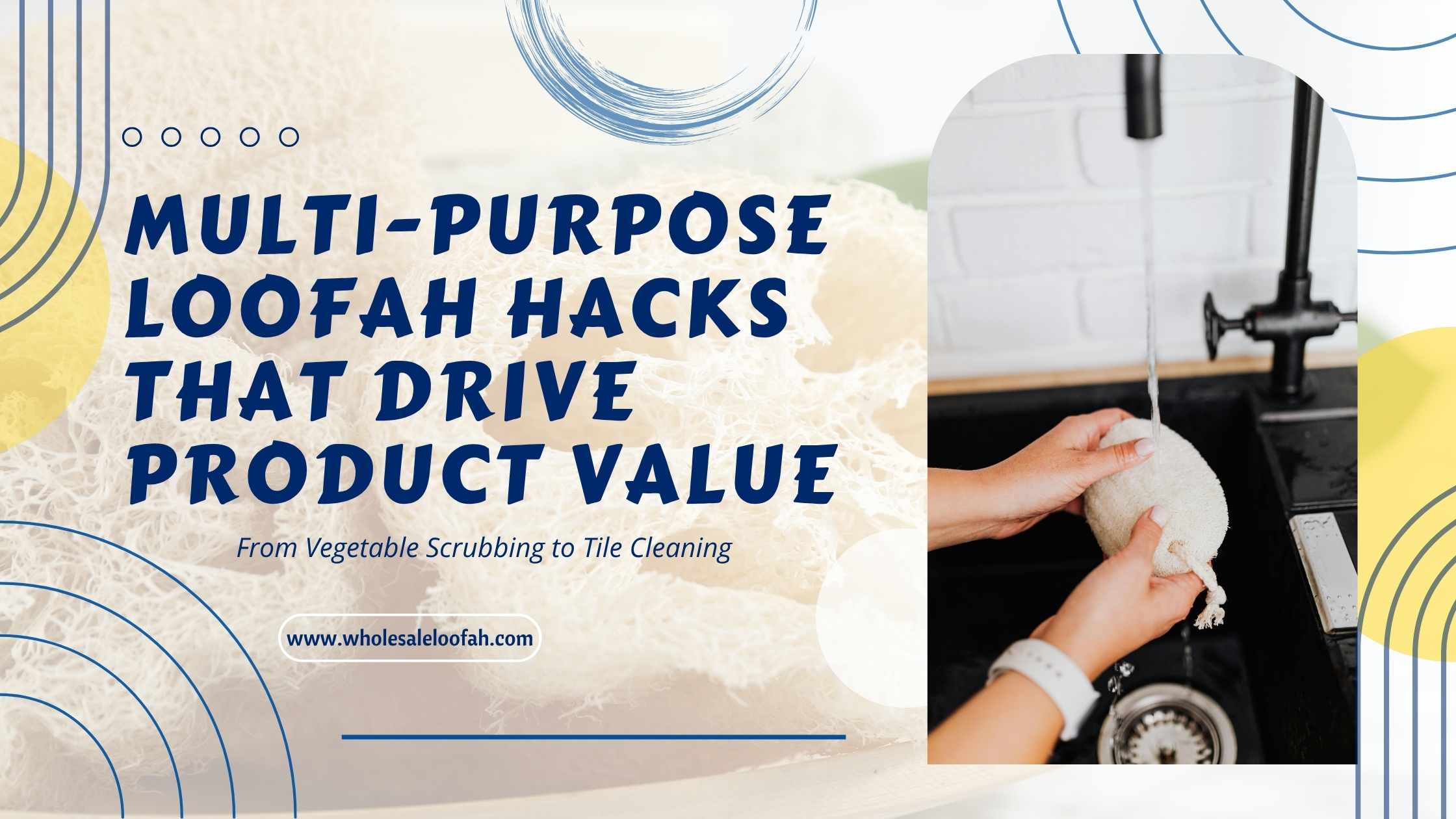
Category 1: Food Preparation A natural loofah in a slightly damp state is effective for scrubbing root vegetables and firm-skinned produce. The fiber mesh removes soil from skin crevices without the chemical exposure of produce washes or the nutrient loss of peeling. Untreated, unbleached kitchen loofahs are the appropriate product for this application.
Category 2: Surface Cleaning A semi-dry to dry loofah provides the abrasion needed to lift soap scum, mineral deposits, and mildew from bathroom tiles and grout. Combined with a diluted vinegar solution, this application replaces commercial tile scrubbers without plastic shedding or chemical residue.
Category 3: Personal Care A fully saturated loofah in spa-grade quality provides mechanical exfoliation for the body and, in finer-fiber varieties, the face. This is the application most consumers already associate with loofah products and the one that most retailers currently focus on.
The commercial opportunity is in communicating all three categories to the same customer at the point of sale.
Step-by-Step Application Methods for All Three Categories
Vegetable and Produce Scrubbing
Why this matters for retailers: Consumers who discover their loofah works in the kitchen replace it more frequently and are more likely to purchase multiple units simultaneously. A kitchen-specific SKU in smaller sizes (10 to 15 cm) serves this use case and carries a clear differentiated positioning from bath-size products.
Method:
- Soak the loofah in cold water for 45 to 60 seconds.
- Hold produce firmly under cool running water.
- Apply light to moderate pressure in circular motions over the skin.
- Focus on crevices and root attachment points where soil accumulates.
- Rinse produce and inspect before use.
- After use, rinse loofah under hot water, wring firmly, and air-dry upright.
Safe for: potatoes, carrots, beets, cucumbers, zucchini, turnips, firm squash, ginger. Not suitable for: soft-skinned produce like tomatoes, stone fruit, or berries.
The Egexo kitchen loofah range carries untreated varieties certified safe for food-contact applications. Retailers sourcing for kitchen or zero-waste cleaning categories should verify untreated processing with any supplier before listing.
Bathroom Tile and Grout Cleaning
Why this matters for retailers: Positioning a product for bathroom cleaning creates entry into a market dominated by plastic scrubbers, chemical cleaners, and disposable wipes. A natural loofah priced competitively against those products on a per-week-of-use basis wins on sustainability and performance.
Method:
- Prepare a spray solution of one part white vinegar to two parts water. For heavy scale buildup, use vinegar at full strength.
- Spray tile surface thoroughly and allow 4 to 6 minutes of dwell time.
- Use a semi-dry loofah in circular scrubbing motions across the tile face.
- Compress the loofah for grout lines and apply linear pressure along the seam.
- For stubborn staining, apply a baking soda paste directly to the loofah and scrub.
- Rinse the wall with warm water. Dry with a clean cloth.
Surface compatibility: ceramic tile, porcelain tile, glazed natural stone. Not recommended for uncoated marble or travertine with acidic solutions.
Body and Skin Exfoliation
Method:
- Saturate the loofah fully in warm shower water for 30 seconds.
- Apply body wash or soap directly to the loofah surface.
- Use gentle circular strokes on the body, starting from the feet and moving upward.
- Avoid the face unless using a spa-grade, fine-fiber variety specifically rated for facial use.
- After showering, rinse the loofah under hot water, wring out, and hang in a ventilated area.
For the premium bath and body loofah range in spa-grade quality, the Egexo body loofah category covers multiple sizes and densities suitable for different retail positioning strategies.
Wholesale buyers building a branded product line around natural Egyptian loofah can explore custom product design services and private label manufacturing through Egexo.
Egyptian Loofah Quality: Why Origin Determines Commercial Performance
For wholesale buyers, the origin of the raw material is not a marketing consideration. It is a product performance variable that affects return rates, customer reviews, and repeat purchase behavior. Egyptian loofah from the Nile Delta consistently outperforms varieties from other growing regions on three measurable dimensions: fiber density, structural consistency, and lifespan under use.
Egexo’s cultivation process, documented in the farm-to-export supply chain overview, gives wholesale buyers the traceability data they need to verify claims and meet sustainability disclosure requirements in regulated markets like the EU and UK.
Quality Grading Specifications for Wholesale Orders
| Grade | Fiber Density (fibers/cm2) | Typical Size | Color Consistency | Primary Market |
|---|---|---|---|---|
| Grade A Premium | 220 to 280 | 25 to 35 cm | High uniformity | Spa, premium retail, wellness brands |
| Grade B Standard | 170 to 220 | 20 to 30 cm | Moderate variation | Kitchen, general cleaning, eco retail |
| Grade C Economy | 120 to 170 | 15 to 25 cm | Variable | Industrial, craft, volume filler |
| Raw Unprocessed | Variable | Custom cut | Natural brown | Private label processing, DIY brands |
These specifications, along with full quality certification documentation, are available through Egexo’s quality standards page.
Minimum Order and Lead Time Reference
| Product Type | MOQ (units) | Lead Time | Customization Available |
|---|---|---|---|
| Standard grade loofah (stock sizes) | No minimum order on standard products | 7 to 25 days from payment | No (stock product) |
| Premium grade loofah (stock sizes) | No minimum order on standard products | 7 to 25 days from payment | No (stock product) |
| Private label with custom packaging | Private label from 1,000 units | Confirmed with the quote | Yes (branding, sizing) |
| Custom cut or shaped loofah | Private label from 1,000 units | Confirmed with the quote | Yes (size, shape) |
| Sample order (pre-bulk evaluation) | No minimum order on standard products | 7 to 25 days from payment | No |
You can request loofah samples from Egexo at no obligation before committing to a bulk purchase order.
Retail Strategy: How to Sell Multi-Purpose Loofah More Effectively
For retailers currently selling loofah only in the bath and body section, the biggest untapped opportunity is repositioning the product with multi-purpose messaging at the point of sale.
Retail Placement and Messaging Strategy
| Placement Location | Target Consumer | Key Message | Supporting SKU |
|---|---|---|---|
| Bath and body aisle | Existing loofah buyers | Upgrade to Egyptian quality | Premium Grade A body loofah |
| Kitchen and cleaning aisle | Plastic-scrubber users | Zero-waste kitchen cleaning | Small Kitchen Grade B loofah |
| Zero-waste or eco section | Sustainability shoppers | Replace 3 scrubbers with 1 loofah | Multi-pack or starter set |
| Spa and wellness section | Self-care buyers | Natural exfoliation, spa grade | Large Grade A spa loofah |
| Online bundle | Multi-purpose researchers | The complete loofah household kit | 3-pack kitchen plus bath |
Retailers who implement multi-aisle placement with differentiated messaging and SKUs report significantly higher loofah category revenue than those carrying a single size and positioning in the bath section alone.
For retailers developing their own brand around natural Egyptian loofah, Egexo’s private label manufacturing allows custom packaging, sizing, and branding on Egyptian-origin products with full supply chain transparency.
Loofah Care: What Retailers Need to Communicate to End Customers
One of the most impactful things a retailer can do to improve customer satisfaction and repeat purchase rates for natural loofah is provide clear care instructions at the point of sale. The majority of early loofah replacements are driven by care failure, not product quality failure.
Consumer Care Guide (Suitable for Packaging Insert or Product Page Copy)
| Action | Frequency | Details |
|---|---|---|
| Rinse with hot water | After every use | Removes soap, food particles, cleaning chemicals |
| Wring out fully | After every use | No standing water in fiber network |
| Air-dry in ventilated position | After every use | Upright or hanging, not flat or enclosed |
| Vinegar soak | Once per week | 1 part vinegar to 4 parts water, 10 minutes, then rinse |
| Visual inspection | Once per week | Check for discoloration, sliminess, or fiber breakdown |
| Replace | Every 4 to 8 weeks under daily use | Compost or add to garden mulch at end of life |
Providing this information at the point of sale reduces early returns and increases the likelihood that customers replace their loofah on schedule rather than abandoning the product category entirely.
Expert Insight from EGEXO
The wholesale buyers who build the most successful loofah product lines share a common approach: they do not sell a product, they sell an understanding of the product. A retailer who educates their customers on multi-purpose loofah hacks, care routines, and the quality difference between Egyptian-origin and generic imports creates a loyal customer base that returns for replenishment every four to eight weeks. EGEXO has been exporting Egyptian loofah since 2015. Whether you are a distributor supplying retailers across a region or a brand developing your first private label loofah line, the most valuable thing you can offer your downstream customers is clarity about what a high-quality Egyptian loofah actually does. Our why choose EGEXO page outlines the full scope of what we offer wholesale partners.
FAQ Section
Q1: What are multi-purpose loofah hacks and why do they matter for retailers? A: Multi-purpose loofah hacks refer to the range of practical uses a single natural loofah can serve beyond body exfoliation, including vegetable scrubbing, bathroom tile cleaning, dish scrubbing, and counter wiping. For retailers, this versatility matters because it enables multi-aisle placement, justifies higher unit prices relative to single-use scrubbers, and drives stronger repeat purchase behavior among informed consumers. A product that replaces three or four separate tools commands more shelf space and a stronger value narrative.
Q2: What loofah grades should wholesale buyers source for multi-purpose retail positioning? A: For a multi-purpose retail strategy, wholesale buyers typically need at least two grades: Grade A premium for spa, body care, and premium lifestyle segments, and Grade B standard for kitchen cleaning and general household use. Some retailers also carry raw loofah scrubbers for the DIY and zero-waste craft market. No minimum order on standard products. Private label from 1,000 units. Full grade specifications are available in the product catalog or through Egexo’s quality standards documentation.
Q3: How do I verify that a loofah is safe for food-contact use before listing it in a kitchen category? A: The key verification is processing method. A loofah that is safe for food-contact use must be unbleached and untreated, meaning no chemical bleach, preservatives, or synthetic coatings were applied during processing. Ask your supplier for written confirmation that the product is free from bleaching agents and request a Certificate of Analysis or similar documentation if your market requires it. Egexo provides processing documentation for all kitchen loofah varieties and can confirm food-contact safety specifications in writing for wholesale buyers.
Q4: How does natural loofah compare to synthetic scrubbers on total cost of ownership for end consumers? A: A natural Egyptian loofah used for 4 to 8 weeks at moderate retail pricing costs between 0.15 and 0.40 USD per day of use, depending on purchase format and frequency. A synthetic nylon scrubbing pad at similar retail price points lasts 2 to 4 weeks, putting the daily cost in a comparable range. The natural loofah wins on environmental impact (zero microplastic shedding, fully compostable), multi-task capability (replacing three or four separate tools), and perceived quality among eco-conscious consumers. The cost argument is neutral to favorable, and the sustainability argument is strongly in favor of natural loofah.
Q5: What documentation does Egexo provide for import compliance in regulated markets? A: Egexo provides phytosanitary certificates for all exported loofah products, which are required for agricultural product imports in most regulated markets including the EU, UK, USA, and Canada. For buyers in markets with specific labeling or composition disclosure requirements, Egexo can provide processing method documentation, country-of-origin certificates, and product composition statements. Contact Egexo’s EGEXO through the quotation page to discuss documentation requirements for your specific import destination.
Q6: Can a loofah be used to clean grout effectively without scratching surrounding tiles? A: Yes. A natural loofah at a semi-dry moisture level provides enough fiber abrasion to lift grout staining and mildew without the rigidity that causes tile surface scratching. The technique is to compress the loofah to create a narrow edge that fits along the grout seam and apply firm linear pressure rather than broad circular scrubbing. Combined with a dwell time of 4 to 6 minutes using a vinegar or baking soda solution, this method is effective for regular grout maintenance without the tile damage associated with metal scrubbers or stiff synthetic brushes.
Q7: What is the best way to introduce natural loofah to customers who have never used one before? A: The most effective introduction for first-time loofah customers is a multi-pack or starter set that includes a small kitchen loofah, a medium bath loofah, and a clear care and usage guide. This format reduces the barrier to experimentation, allows the customer to experience the product in more than one application immediately, and demonstrates value across categories from the first purchase. Including a simple care card in the packaging significantly reduces early abandonment due to care failure, which is the primary reason first-time buyers do not repurchase.
Conclusion
The commercial opportunity in multi-purpose loofah hacks is not hypothetical. It is grounded in measurable market growth, documented retail performance data, and the structural properties of a plant-based material that has been used for cleaning and personal care for centuries. Retailers who position natural Egyptian loofah across kitchen, bathroom, and personal care categories with clear multi-purpose messaging consistently outperform those treating it as a single-use bath product.
For wholesale buyers, the decision starts with sourcing.
Key Takeaways:
- Natural loofah unit velocity increases 28 to 35 percent with multi-aisle placement and multi-purpose positioning
- Egyptian Nile Delta loofah with 220 to 280 fiber density per cm2 outperforms most imported alternatives
- Two grades, premium and standard, cover the majority of multi-purpose retail category needs
- Care education at the point of sale reduces early returns and drives on-schedule replenishment
- Egexo offers private label, custom design, and full export documentation for wholesale buyers in regulated markets
Ready to experience Egyptian loofah quality?
- For Wholesale Buyers: Request a quote or download our catalog
- For Individual Shoppers: Browse our collection or order samples