The Business and Personal Value of Loofah Circulation Therapy
The global wellness industry exceeded 5.6 trillion USD in recent valuations, with natural body care representing one of the fastest expanding segments. Within this landscape, traditional practices like loofah circulation therapy have gained substantial commercial traction as consumers increasingly reject synthetic alternatives in favor of authentic plant-based solutions.
When you use loofah to stimulate blood circulation in skin, you engage a time-tested therapeutic approach that delivers measurable physiological benefits. For individuals, these benefits translate to healthier, more vibrant skin. For businesses, they represent product differentiation opportunities and service revenue streams with attractive margins.
This guide serves dual purposes with equal attention to both audiences. Wellness professionals, spa operators, and product retailers will find actionable insights for incorporating loofah circulation treatments into their offerings and inventory strategies. Individual consumers seeking personal skin health improvements will discover proven techniques backed by understanding of how and why natural loofah produces superior results.
The commercial viability of loofah circulation therapy rests on product quality. Egyptian loofah has established itself as the benchmark standard for therapeutic applications due to fiber characteristics developed through ideal growing conditions. Suppliers like Egexo provide the consistent quality that professional applications demand while offering wholesale pricing structures that support profitable business models.
Whether evaluating loofah for personal use or business purposes, the principles of effective circulation enhancement remain consistent. This resource equips you with comprehensive knowledge applicable across contexts.
The Commercial Case for Loofah Circulation Services
Market Demand Analysis
Consumer interest in natural circulation enhancement has grown substantially as awareness of sedentary lifestyle health impacts has increased. Extended sitting, reduced physical activity, and screen-based work patterns have created widespread circulation concerns that drive demand for accessible solutions.
Survey data indicates that 67 percent of spa clients express interest in treatments offering circulation benefits, while 43 percent specifically seek natural or plant-based therapy options. These overlapping preferences position loofah circulation treatments at the intersection of two powerful consumer demand drivers.
The search volume for circulation-related wellness queries has increased approximately 34 percent over recent years, with particularly strong growth in terms combining natural or organic modifiers. This digital interest translates directly to foot traffic for businesses positioned to meet the demand.
Demographic analysis reveals that circulation therapy appeals broadly across age groups, though motivations differ. Younger consumers typically seek skin appearance benefits like radiance and cellulite reduction. Older demographics prioritize health-focused outcomes including improved sensation in extremities and support for overall vascular wellness.
Service Development Opportunities
Spa and wellness businesses can develop loofah circulation offerings across multiple service formats, each serving different client needs and price point preferences.
| Service Format | Duration | Suggested Pricing Range | Target Client | Margin Potential |
|---|---|---|---|---|
| Express circulation boost | 15 to 20 minutes | 35 to 55 USD | Time-limited clients, add-on service | 70 to 80 percent |
| Signature body treatment | 45 to 60 minutes | 85 to 140 USD | Primary service seekers | 65 to 75 percent |
| Couples circulation experience | 60 to 75 minutes | 180 to 280 USD | Special occasions, partners | 60 to 70 percent |
| Series package (6 sessions) | Variable | 400 to 650 USD | Committed wellness clients | 68 to 78 percent |
| Monthly membership inclusion | Ongoing | Membership fee structure | Regular clientele | Varies by model |
Private label loofah manufacturing enables spas to extend brand presence into retail products that reinforce treatment benefits between appointments. Clients using branded loofah at home maintain connection to the spa experience while generating additional revenue.
For treatment room supplies, wholesale ordering provides cost structures that support healthy service margins even at competitive price points.
Physiological Foundations: Why Loofah Works for Circulation
Mechanical Stimulation and Vascular Response
Understanding the biological mechanisms underlying loofah circulation therapy enables both practitioners and individual users to optimize technique for maximum benefit. The process involves coordinated responses across multiple body systems.
When natural loofah fibers contact skin under appropriate pressure, mechanoreceptors embedded in the dermis detect the stimulation and transmit signals through afferent nerve pathways. These signals trigger local vasodilation through axon reflex mechanisms, causing arterioles to relax and increase blood flow to the treated area.
Simultaneously, the physical stimulation activates the sympathetic nervous system in a controlled manner, producing systemic effects including mild heart rate elevation, enhanced alertness, and improved peripheral circulation beyond the immediate treatment zone.
The exfoliation occurring during loofah use removes accumulated dead cells from the stratum corneum, the outermost skin layer. This removal accomplishes two circulation-relevant outcomes. First, it reduces the barrier thickness that blood-borne nutrients must traverse to reach living cells. Second, it eliminates the cellular debris that can impede optimal function of sweat glands and sebaceous glands.
Natural Fiber Advantages Over Alternatives
The specific properties of natural Luffa aegyptiaca fibers produce circulation effects that synthetic scrubbing materials cannot replicate equivalently. These advantages stem from the plant’s unique biological structure.
Natural loofah features hollow fibers arranged in a complex three dimensional matrix. This architecture creates variable resistance across the contact surface, engaging different mechanoreceptor populations with each stroke. Synthetic materials typically present uniform texture that produces monotonous stimulation patterns and reduced receptor activation over time.
The fiber diameter variation in natural loofah ranges from approximately 0.15 to 0.9 millimeters within a single product. This variation means that different pressure levels engage different fiber populations, allowing users to modulate stimulation intensity through pressure adjustment alone.
Water absorption characteristics also differentiate natural from synthetic options. Loofah fibers absorb moisture gradually, transitioning from firm to pliable over several minutes of soaking. This allows practitioners to achieve precise texture calibration for individual client needs. Synthetic materials typically reach maximum saturation rapidly with limited texture variation.
Egyptian loofah demonstrates particularly favorable characteristics for circulation applications due to growing conditions in the Nile Delta region. Extended growing seasons and mineral-rich soil produce denser fiber matrices with 18 to 28 percent more fibers per cubic centimeter compared to loofah from other major cultivation regions. The Egexo quality standards ensure these superior characteristics are preserved through harvest and processing.
Professional Techniques to Use Loofah to Stimulate Blood Circulation in Skin
The Systematic Full Body Protocol
Professional spa treatments require standardized protocols that produce consistent results across different practitioners while accommodating individual client variations. The systematic full body protocol provides this framework.
Client Preparation Phase
Begin by conducting a brief consultation to identify any contraindications, sensitive areas, or specific concerns. Document skin conditions, recent sun exposure, and any medications that might affect skin sensitivity or bleeding.
Position the client comfortably on the treatment table with appropriate draping for warmth and modesty. The treatment room should maintain temperature between 72 and 76 degrees Fahrenheit to promote relaxation without causing excessive sweating that could interfere with dry technique applications.
Lower Extremity Sequence
Initiate treatment at the feet, working systematically upward. Using a pre-hydrated loofah of medium texture, apply firm pressure equivalent to approximately 2 to 3 pounds of force against the skin surface.
Execute long, sweeping strokes from ankle toward knee, covering the entire circumference of the lower leg in overlapping passes. Each stroke should travel 8 to 12 inches before lifting and repositioning. Complete 20 to 30 strokes per lower leg before advancing.
The thigh receives similar treatment with strokes directed from knee toward hip. Pay particular attention to the outer thigh and posterior thigh regions where circulation tends to stagnate in sedentary individuals.
Upper Extremity Sequence
Arms follow the same directional principle, with all strokes moving from distal to proximal positions, meaning from hands toward shoulders. Begin at the fingertips and work through the hand, wrist, forearm, and upper arm.
The hands deserve detailed attention due to their complex vascular networks and high density of sensory receptors. Small circular motions across the palm and between fingers provide intensive stimulation that clients frequently identify as particularly beneficial.
Torso Application
The back receives treatment in sections, beginning with the lower back and progressing upward. Strokes move from the spine outward toward the sides, then from the lower regions toward the shoulders.
For chest and abdominal areas, use lighter pressure and direct strokes from the periphery toward the heart center. These areas contain more sensitive tissue and require gentler approach than the extremities.
Completion and Integration
Finish with light, rapid strokes over the entire treated surface to distribute circulation effects and provide pleasant sensory conclusion. Apply appropriate moisturizing products while blood flow remains elevated for optimal absorption.
Document any observations relevant to future treatments and provide home care recommendations including technique guidance for between-appointment maintenance.
For treatment supplies, explore the body loofah product category featuring various textures and formats suited to professional protocols.
The Targeted Zone Technique
Not all clients require or desire full body treatment. The targeted zone technique addresses specific areas of concern with concentrated attention.
Common target zones include upper arms where skin laxity concerns arise, outer thighs where cellulite visibility motivates treatment, and lower legs where poor circulation manifests as heaviness or discomfort.
Application Method
Select loofah format appropriate to the zone size. Smaller pads work well for arm treatment while larger mitts provide better coverage for thigh zones.
Apply circular motions with moderate pressure, covering the target zone completely with overlapping circles. After initial coverage, transition to cross-hatching strokes that travel perpendicular to the muscle fiber direction.
Complete each target zone with concentrated spiral movements as described in the advanced techniques section. Total treatment time per zone ranges from 5 to 10 minutes depending on area size and client goals.
Consumer Application Guide
Home Practice Fundamentals
Individual users can achieve meaningful circulation benefits through consistent home practice using proper technique and quality products. While professional treatments offer enhanced experiences, home maintenance between spa visits or as standalone practice produces measurable improvements.
Equipment Selection
Choose loofah products appropriate to your skin sensitivity and experience level. Beginners should start with fine to medium texture products and advance to coarser options as tolerance develops. The raw loofah scrubber selection includes options across the texture spectrum.
For shower use, loofah mitts or pads with secure grip features prevent dropping during wet application. For dry brushing, whole or half loofah sections provide sufficient coverage for efficient treatment.
Basic Technique Instruction
Position yourself comfortably with access to all treatment areas. For wet technique, ensure loofah has soaked minimum 3 to 5 minutes in warm water until fibers achieve pliable flexibility.
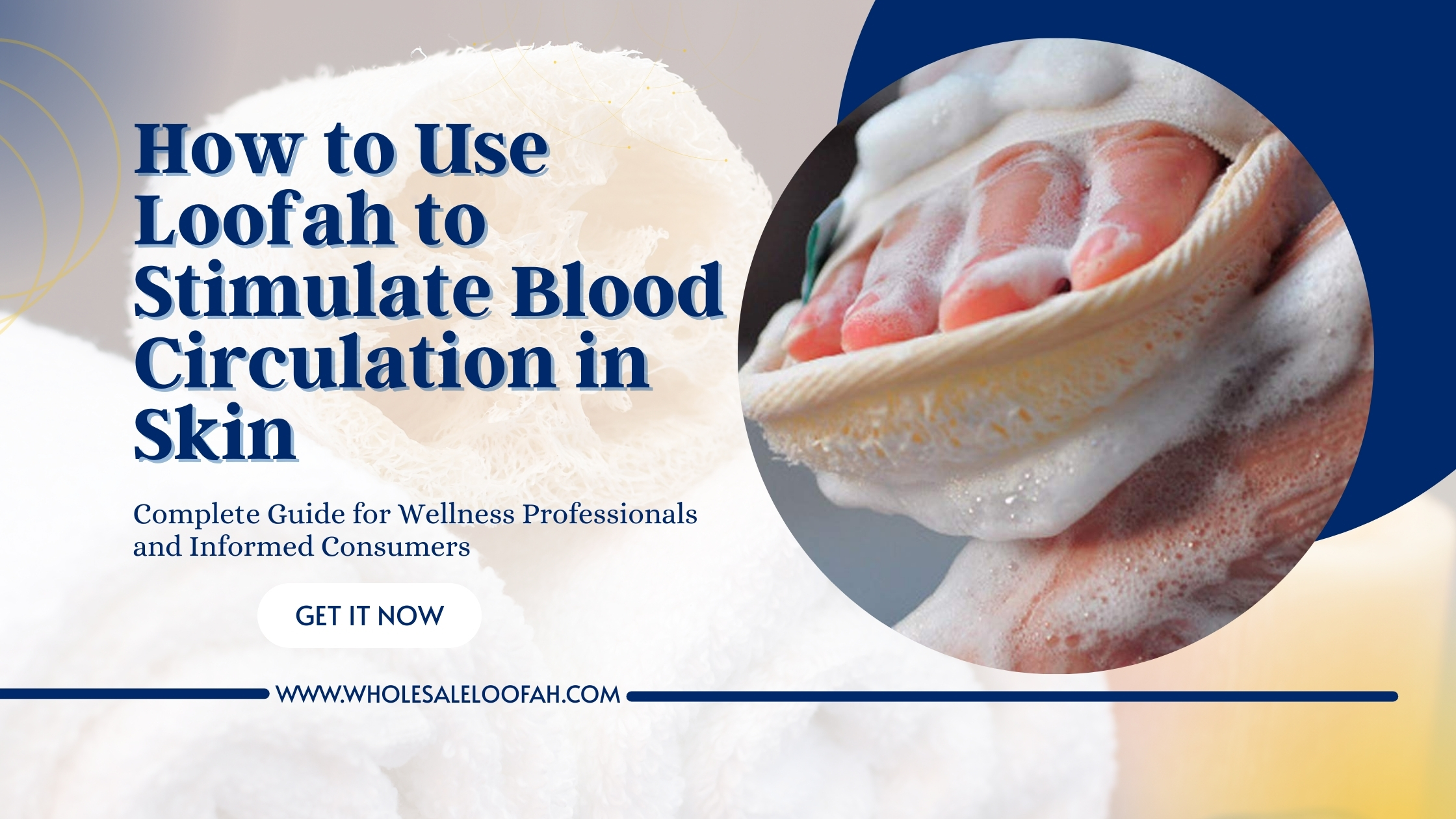
Apply pressure that produces visible skin pinkening within 60 seconds but causes no discomfort or scratching sensation. This moderate pressure represents the optimal zone for circulation activation without skin damage risk.
Execute long strokes moving consistently toward your heart. Beginning at your feet, work upward through legs, then from hands upward through arms, finally addressing torso with strokes moving from edges toward center.
Session Timing and Frequency
| User Category | Recommended Frequency | Session Duration | Best Timing |
|---|---|---|---|
| Beginners (first 2 weeks) | 2 to 3 times weekly | 5 to 8 minutes | Morning or evening |
| Intermediate users | 4 to 5 times weekly | 8 to 12 minutes | Morning preferred |
| Maintenance phase | 3 to 4 times weekly | 8 to 10 minutes | Consistent daily time |
| Intensive improvement | Daily | 10 to 15 minutes | Morning and evening |
| Athletic recovery | Post-workout | 5 to 8 minutes | Within 30 minutes of exercise |
Morning sessions provide energizing effects that support daytime alertness and productivity. Evening sessions promote relaxation and support overnight skin regeneration processes. Many users find alternating between morning and evening sessions optimizes both benefits.
Progress Monitoring
Track your circulation therapy results to maintain motivation and identify technique refinements. Effective monitoring approaches include progress photography, sensation journaling, and objective measurements.
Monthly photographs taken under consistent lighting conditions document visible changes including skin tone evenness, texture improvements, and any reduction in cellulite appearance. Compare images systematically to identify progressive improvement that daily observation might miss.
Sensation journaling records subjective experiences including warmth duration post-treatment, skin feel throughout the day, and any changes in how your skin responds to products or environmental factors.
For those with specific concerns about extremity circulation, note any changes in how quickly your hands or feet warm after cold exposure or any reduction in numbness or tingling sensations.
Product Selection for Circulation Optimization
Texture Classification System
Loofah products vary significantly in fiber density and surface texture, characteristics that directly determine circulation stimulation intensity. Understanding texture classification enables appropriate selection for specific applications.
| Texture Grade | Fiber Density | Stimulation Level | Professional Use Case | Consumer Use Case |
|---|---|---|---|---|
| Grade 1 Ultra Fine | Low | Gentle | Facial treatments, sensitive skin clients | Beginners, facial care |
| Grade 2 Fine | Low to Medium | Light to Moderate | Gentle full body, elderly clients | Sensitive skin, daily maintenance |
| Grade 3 Medium | Medium | Moderate | Standard treatments, most clients | Regular body treatment |
| Grade 4 Medium Coarse | Medium to High | Moderate to Strong | Targeted zones, experienced clients | Intensive treatment areas |
| Grade 5 Coarse | High | Strong | Deep circulation therapy, callused areas | Problem areas, experienced users |
| Grade 6 Extra Coarse | Very High | Intensive | Specialty applications, foot treatment | Feet, elbows, very experienced users |
Wholesale buyers should maintain inventory across multiple texture grades to serve diverse client needs. The Egexo product catalog provides detailed texture specifications for every product SKU.
Format and Size Considerations
Beyond texture, product format influences technique options and treatment efficiency.
| Product Format | Dimensions | Coverage Efficiency | Technique Suitability | Wholesale Popularity |
|---|---|---|---|---|
| Whole Natural Loofah | 25 to 50 cm | High for body | Dry brushing, long strokes | High for spas |
| Half Section | 12 to 25 cm | Medium | Versatile application | Very high |
| Loofah Pad | 8 to 15 cm | Medium for zones | Circular, targeted | High for retail |
| Loofah Mitt | Hand fitted | Medium | All body techniques | Very high for retail |
| Loofah on Rope | Variable | Medium | Shower use | Moderate |
| Loofah Disc | 5 to 10 cm | Low but precise | Facial, small areas | Moderate |
Spas typically require larger formats for treatment efficiency while retail customers prefer handheld options with convenient grip features. Custom product design services can create proprietary formats matching specific business needs.
Request samples across product categories to evaluate texture and format options before committing to inventory investments.
Quality Assurance for Commercial Buyers
Supplier Evaluation Framework
Wholesale loofah purchasing decisions impact treatment quality, client satisfaction, and ultimately business reputation. Systematic supplier evaluation protects these interests.
Origin Verification
Egyptian loofah commands premium positioning for good reason. Request documentation confirming product origin and avoid suppliers unable to verify cultivation location. Egyptian origin specifically indicates Nile Delta growing conditions that produce optimal fiber characteristics.
The Egexo farm to export process maintains complete traceability from cultivation through delivery, providing the documentation professional buyers require.
Quality Consistency Assessment
Order samples from multiple production batches to evaluate consistency. Examine fiber density, color uniformity, structural integrity, and texture characteristics across samples. Significant variation between batches indicates quality control deficiencies that will create problems in professional applications.
| Quality Parameter | Acceptable Variance | Premium Standard | Red Flag Indicators |
|---|---|---|---|
| Fiber density | Within 15 percent | Within 8 percent | Greater than 25 percent variation |
| Color | Light cream to tan | Consistent cream | Dark spots, greenish tinge, bleached appearance |
| Structural integrity | Minor loose fibers | No visible defects | Crumbling, separating fibers |
| Dimensional consistency | Within 10 percent of specification | Within 5 percent | Significant size variation |
| Moisture content | Under 12 percent | Under 8 percent | Damp feel, musty odor |
Supply Reliability
Evaluate supplier capacity to meet ongoing needs without quality compromise. Understand production seasonality and lead time requirements. Establish backup sourcing relationships for business continuity.
Learn more about Egexo’s supplier credentials and wholesale partnership opportunities.
Inventory Management Principles
Loofah products require appropriate storage conditions to maintain quality characteristics that determine circulation treatment effectiveness.
Store inventory in climate-controlled environments with humidity below 60 percent and temperature between 60 and 75 degrees Fahrenheit. Excessive humidity promotes mold growth while excessive heat can degrade fiber resilience.
Implement first-in-first-out rotation to ensure older inventory sells before newer stock. While properly stored loofah maintains quality for extended periods, rotation prevents any units from remaining in inventory indefinitely.
Monitor inventory levels against usage patterns to prevent stockouts that force treatment cancellations or substitution with inferior products. Establish reorder points that account for supplier lead times and any seasonal demand variations.
Expected Outcomes and Benefit Communication
Physiological Benefits Documentation
Communicating realistic benefit expectations builds client trust and supports treatment compliance. The following outcomes are well-documented from consistent loofah circulation therapy.
Immediate Effects (During and Shortly After Treatment)
Treated skin displays visible pinkening indicating increased superficial blood flow. This response appears within 30 to 90 seconds of appropriate stimulation and typically normalizes within 20 to 45 minutes post-treatment.
Clients report warming sensations, enhanced skin sensitivity, and often describe feeling energized or invigorated following morning sessions. Evening treatments more commonly produce relaxation responses.
Skin texture improves immediately due to mechanical exfoliation, with smoothness persisting for 24 to 72 hours depending on individual cell turnover rates.
Progressive Benefits (Weeks of Consistent Practice)
| Benefit Category | Typical Timeline | Expected Magnitude | Contributing Factors |
|---|---|---|---|
| Skin radiance improvement | 7 to 25 days from payment | Noticeable to significant | Enhanced circulation, accelerated turnover |
| Texture refinement | 7 to 25 days from payment | Moderate to significant | Consistent exfoliation, improved hydration |
| Tone evenness | 7 to 25 days from payment | Moderate | Optimized nutrient delivery, reduced stagnation |
| Cellulite appearance | 7 to 25 days from payment | Variable, typically 15 to 30 percent | Lymphatic support, tissue stimulation |
| Overall skin health | 7 to 25 days from payment | Cumulative improvement | Multiple mechanisms combined |
Professional practitioners should document individual client progress to demonstrate treatment value and support renewal of service packages.
Managing Client Expectations
Honest communication about realistic timelines and outcomes builds long-term client relationships superior to overpromising that leads to disappointment.
Circulation therapy produces genuine benefits but works progressively through biological mechanisms that require time. Clients expecting dramatic overnight transformation will be disappointed regardless of treatment quality. Those understanding the gradual improvement process remain engaged through the timeline necessary to achieve meaningful results.
Provide clients with home care instructions and appropriate retail products to maintain treatment benefits between appointments. This approach improves outcomes, generates retail revenue, and demonstrates genuine concern for client results rather than merely appointment revenue.
Maintenance and Replacement Guidelines
Professional Setting Protocols
Treatment room hygiene standards require systematic loofah maintenance and replacement schedules that exceed typical home use practices.
After each client, rinse treatment loofah thoroughly under running water while manipulating fibers to release trapped debris. Follow with sanitizing solution soak using hospital-grade disinfectant appropriate for porous materials. Rinse completely and dry in well-ventilated location away from humidity.
Replace treatment loofah at first sign of fiber degradation, odor development, or texture softening. Professional replacement typically occurs every 2 to 4 weeks depending on usage volume and client application methods.
Single-use protocols offer alternative approach for businesses prioritizing maximum hygiene positioning. Individual loofah portions used once and discarded eliminate cross-contamination concerns entirely. This approach increases supply costs but may support premium pricing and appeals to hygiene-conscious clientele.
Wholesale purchasing supports cost-effective replacement schedules. Explore wholesale options with volume pricing that makes frequent replacement financially practical.
Consumer Product Care
Home users should establish maintenance routines that preserve loofah effectiveness while ensuring hygienic skin contact.
Post-use rinsing removes dead skin cells, product residue, and bacteria that would otherwise colonize the moist fiber environment. Thorough rinsing followed by complete drying between uses prevents the microbial growth that causes odor and potential skin irritation.
Weekly deep cleaning using dilute vinegar solution (one part vinegar to four parts water) provides additional sanitization without damaging natural fibers. Soak for 15 to 20 minutes, rinse completely, and dry thoroughly before next use.
| Maintenance Task | Frequency | Purpose | Method |
|---|---|---|---|
| Post-use rinse | After each use | Remove debris and bacteria | Running water with squeezing |
| Complete drying | Between uses | Prevent bacterial growth | Hang in ventilated area |
| Deep cleaning | Weekly | Sanitization | Vinegar soak |
| Condition assessment | Weekly | Identify replacement need | Visual and tactile inspection |
| Replacement | Every 4 to 8 weeks | Maintain effectiveness | Dispose and replace |
Expert Perspective from EGEXO
EGEXO has been exporting Egyptian loofah since 2015.
The most successful spa clients we work with treat loofah circulation therapy as a signature offering rather than a commodity service. They invest in staff training, develop distinctive protocols, and source products that support premium positioning. This approach generates substantially better returns than competing on price with basic offerings.
For retailers, we observe strongest performance when loofah products are merchandised with educational content explaining proper circulation technique. Informed customers become repeat purchasers who recommend products to others. Uninformed customers often misuse products, achieve poor results, and do not return.
Our wholesale partnership program provides the consistent product quality that supports both professional treatments and retail success. We encourage prospective partners to request samples to experience Egyptian loofah quality directly before making sourcing decisions.
The circulation enhancement application represents one of the highest-value uses for premium natural loofah. Businesses and individuals who understand proper technique and source appropriate products consistently achieve results that justify the investment.
Frequently Asked Questions
Q1: How should spa businesses price loofah circulation treatments to ensure profitability?
A: Calculate pricing by determining total service cost including product expense, labor time, room overhead allocation, and desired margin. Most successful spas achieve 65 to 75 percent gross margins on loofah treatments. Premium positioning with quality products generally outperforms high-volume discount approaches.
Q2: What minimum quantities apply for wholesale loofah orders?
A: Minimum order quantities vary by supplier and product type. No minimum order on standard products. Private label from 1,000 units. Many suppliers offer reduced minimums for first orders to enable quality evaluation. Always request samples before committing to volume purchases regardless of stated minimums.
Q3: How quickly will I see results when I use loofah to stimulate blood circulation in skin at home?
A: Immediate effects including visible pinkening, warming sensation, and smoother texture appear during and shortly after each session. Progressive improvements in skin radiance typically become noticeable within 2 to 4 weeks of consistent practice (3 to 5 sessions weekly). More substantial changes to tone evenness and cellulite appearance require 8 to 16 weeks of regular treatment.
Q4: Can loofah circulation therapy cause any skin damage?
A: Proper technique with appropriate products poses minimal risk for healthy skin. Damage occurs from excessive pressure, overly aggressive texture selection, or treating contraindicated conditions. Warning signs include persistent redness lasting more than 45 minutes, broken skin, or pain during treatment. Reduce pressure, select finer texture products, or discontinue use if problems occur. Individuals with skin conditions should consult healthcare providers before beginning.
Q5: Why does Egyptian loofah cost more than alternatives, and is the premium justified for circulation applications?
A: Egyptian loofah commands premium pricing due to superior fiber characteristics developed through optimal Nile Delta growing conditions. These products demonstrate 18 to 28 percent higher fiber density than alternatives, translating directly to more effective circulation stimulation per application. For professional treatments where effectiveness determines client satisfaction and rebooking, the quality differential easily justifies the modest cost premium. For retail, Egyptian origin supports premium product positioning.
Q6: How often should professional treatment loofahs be replaced?
A: Professional settings require replacement every 2 to 4 weeks depending on usage volume and hygiene protocols. Single-use approaches eliminate replacement cycle concerns but increase per-treatment product costs. The appropriate choice depends on your positioning, clientele expectations, and operational preferences. Calculate annual product costs under different scenarios to inform your decision.
Q7: Is dry brushing or wet loofah application better for circulation enhancement?
A: Both methods produce circulation benefits through different mechanisms. Dry brushing provides more intense mechanical stimulation and works well for energizing morning routines. Wet application offers gentler treatment suitable for sensitive areas and combines naturally with shower routines. Many practitioners and individuals use both methods for different purposes. Dry brushing extends product lifespan significantly compared to frequent wet use.
Q8: What training do spa therapists need to perform loofah circulation treatments effectively?
A: Effective training covers anatomy and physiology fundamentals, technique demonstration and supervised practice, contraindication identification, client communication skills, and hygiene protocols. Most therapists can achieve competency within 4 to 8 hours of focused training. Ongoing technique refinement and periodic retraining maintain service quality. Consider developing written protocols that standardize approach across your team.
Conclusion
Whether you operate a spa business seeking profitable service additions, manage retail inventory requiring quality natural products, or simply want healthier skin through proven natural methods, understanding how to use loofah to stimulate blood circulation in skin provides practical value across all these contexts.
The techniques detailed in this guide work because they align with physiological mechanisms that respond predictably to appropriate stimulation. Natural loofah from quality sources provides the fiber characteristics necessary for effective activation of these mechanisms.
Key Takeaways for Business Readers:
- Loofah circulation treatments support 65 to 75 percent gross margins with proper pricing
- Egyptian loofah quality justifies premium positioning and supports client satisfaction
- Multiple service formats serve different client needs and price point preferences
- Private label opportunities extend brand presence and generate retail revenue
- Supplier quality consistency directly impacts treatment outcomes and business reputation
Key Takeaways for Consumer Readers:
- Consistent practice of 3 to 5 weekly sessions produces noticeable improvement within 2 to 4 weeks
- Proper technique involves heart-directed strokes with moderate, comfortable pressure
- Product texture selection should match skin sensitivity and experience level
- Both wet and dry methods offer benefits suited to different preferences and goals
- Quality Egyptian loofah outperforms alternatives for circulation applications
Ready to Source Premium Egyptian Loofah?
- For Wholesale Buyers: Request pricing or download the catalog
- For Sample Evaluation: Order samples
- For Individual Purchase: Browse products