Within that market, natural exfoliation tools, led by loofah products, represent one of the fastest-growing subcategories. Spas, pedicure salons, wellness retailers, and eco-conscious consumers are all converging on the same conclusion: knowing how to use loofah for exfoliating dry feet correctly is foundational to foot care, and the product category behind it is worth serious commercial attention.
This guide serves a dual purpose. For individual consumers, it delivers a precise, effective technique for achieving soft, healthy feet at home using nothing but a natural loofah and warm water. For spa owners, retailers, and wholesale buyers, it provides product specifications, quality benchmarks, sourcing insights, and market data that support smart purchasing decisions.
EGEXO has been exporting Egyptian loofah since 2015. The techniques, quality standards, and product data in this guide reflect that experience directly.
For sourcing tools and wholesale comparisons, you are in the right place at wholesaleloofah.com.
The Market Case for Natural Loofah Foot Care Products
Before examining technique, it is worth understanding why this specific product category, loofah tools designed or well-suited for foot exfoliation, deserves the attention of anyone in the wellness supply chain.
Consumer surveys consistently show that foot care is one of the most neglected self-care categories, yet one of the highest in unmet need. This creates a significant education-and-conversion opportunity for retailers and spa operators.
The natural loofah sits at the intersection of three powerful consumer trends in 2026: sustainability, clean beauty, and affordable self-care. It is 100% biodegradable, chemical-free, long-lasting relative to its price point, and highly effective when used correctly. Positioning loofah products clearly within foot care, through in-store placement, service menus, and product descriptions, addresses a consumer pain point with a product that has genuine merit and strong margin potential.
Loofah Market Position: Foot Care Segment
How to Use Loofah for Exfoliating Dry Feet: Consumer and Professional Protocols
The technique itself is the foundation. Wholesale buyers need to understand how the product is actually used so they can communicate its value accurately to end users, whether through product packaging, staff training, or service menu descriptions.
Consumer Home Use Protocol
The correct home use protocol for loofah foot exfoliation begins with skin preparation. Dry, hardened foot skin resists exfoliation because its outer dead cell layer is too stiff and dehydrated to lift away cleanly.
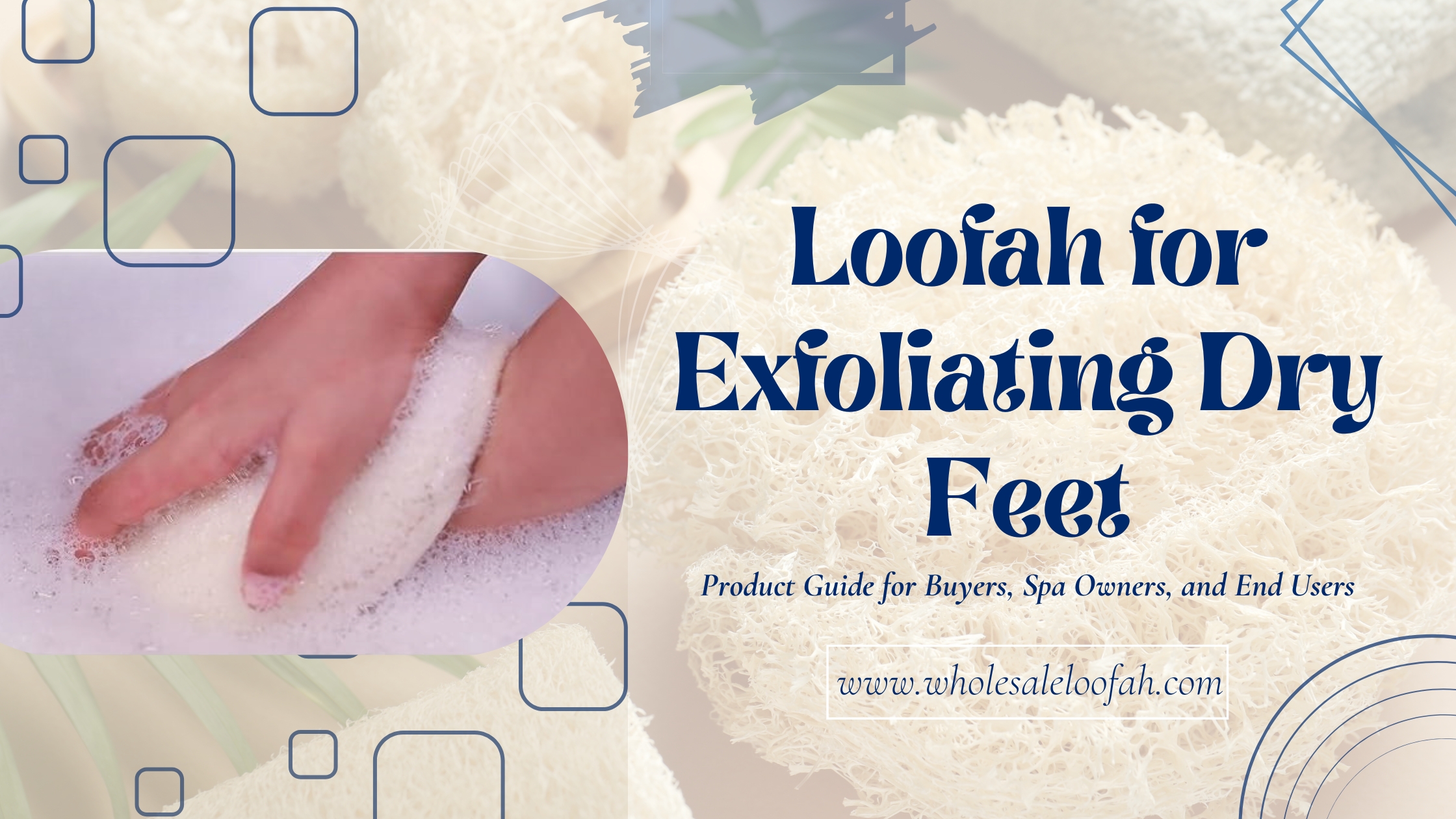
Preparation: Soak feet in warm water at 38 to 40 degrees Celsius for 10 to 15 minutes. The addition of Epsom salt is optional but beneficial, as magnesium sulfate softens keratin more effectively than water alone. Both the feet and the loofah should be fully saturated before scrubbing begins.
Exfoliation: With soap applied to the wet loofah, use circular motions at moderate pressure on the heels and soles, and lighter pressure on the arch and sides. This is the stage where most users make mistakes, either pressing too hard on sensitive areas or using linear back-and-forth strokes that create uneven abrasion. The session should last 8 to 12 minutes across both feet.
Aftercare: Rinse thoroughly and apply moisturizer within 60 seconds of drying. This timing maximizes moisture absorption into the freshly exfoliated skin surface.
Professional Spa Protocol
For spa and pedicure professionals, the protocol adds hygiene and client management layers to the basic technique.
Pre-treatment: Conduct a brief foot assessment. Note the presence of any open cracks, wounds, skin conditions, or client-reported sensitivities. Contraindications for mechanical exfoliation include active infections, open wounds, severe eczema flares, and uncontrolled diabetic foot conditions.
Treatment: Use a Grade A natural loofah appropriate for professional use. Single-use per client is the gold standard. If reusing (not recommended for high-end spas), the loofah must undergo complete sterilization between clients, which practical experience shows significantly degrades fiber quality after just a few cycles.
Post-treatment: Apply a professional-grade foot mask or intensive cream immediately after exfoliation while pores and skin surface are maximally receptive. Document any skin reactions or client feedback for service refinement.
| Protocol Element | Home Use | Professional Spa Use |
|---|---|---|
| Skin soak duration | 10 to 15 minutes | 10 to 15 minutes (foot bath) |
| Loofah per session | Personal reusable | Single-use per client (recommended) |
| Session duration | 8 to 12 minutes | 12 to 18 minutes (full service) |
| Post-care product | Consumer foot cream | Professional mask or treatment |
| Frequency | 2 to 3 times per week | Single thorough session per visit |
| Contraindication check | Self-assessed | Professional pre-treatment assessment |
| Loofah replacement | Every 4 to 6 weeks | Per client or daily stock |
Product Selection Guide: Choosing the Right Loofah for Foot Care
Not all loofah products in the market are suited for foot exfoliation use. The foot requires a higher fiber density and firmer structure than lighter body or facial applications. This section helps both consumers and buyers identify the right product.
Loofah Types for Foot Care: Specification Overview
| Product Type | Fiber Density | Firmness (Wet) | Best Foot Application | MOQ (Egexo) | Grade Available |
|---|---|---|---|---|---|
| Natural Loofah Sponge (round) | High | Medium-Firm | General foot exfoliation | No minimum order on standard products | A, B |
| Flat Loofah Pad | High | Firm | Heel targeting, pedicure use | No minimum order on standard products | A |
| Raw Loofah Scrubber | Very High | Very Firm | Severe calluses, professional use | No minimum order on standard products | Premium, Standard |
| Loofah-on-a-Stick | Medium-High | Medium | Top of foot, between toes | No minimum order on standard products | A |
| Custom Shape/Size | Variable | Per spec | Branded kits, private label | Private label from 1,000 units | Customizable |
The raw loofah scrubbers available through Egexo are particularly popular with professional spa buyers for their higher fiber density and longer usable lifespan compared to processed forms. The body loofah range provides the most versatile options for retail and general spa use.
Quality Evaluation Checklist for Wholesale Buyers
When evaluating loofah suppliers for foot care product sourcing, the following criteria are essential. This checklist applies whether you are assessing samples from Egexo or any other supplier.
| Evaluation Criterion | What to Assess | Pass Standard |
|---|---|---|
| Fiber color | Natural tan to golden with uniform distribution | No bleached white areas, no dark patches |
| Fiber density | Count visible fiber bundles per cm squared when dry | Minimum 8 to 10 bundles per cm squared for foot grade |
| Tensile strength | Pull gently on a fiber section | No tearing under light manual tension |
| Water absorption | Submerge for 2 minutes, check expansion | Should increase 30 to 50% in surface flexibility |
| Odor assessment | Smell dry and wet samples | Neutral; no chemical, musty, or bleach odor |
| Shedding test | Scrub against a dark cloth | Minimal fiber loss after 10 strokes |
| Shape retention | Wet, compress, release, dry | Returns to original shape within 12 hours |
| Certifications | Request documentation | Natural processing, export-certified, no restricted chemicals |
Egexo’s detailed quality standards page provides the full grading framework used across all product categories. For buyers new to the natural loofah supply chain, this framework is an invaluable reference point.
Order samples from Egexo to run your own evaluation against these criteria before placing a first bulk order.
Wholesale Business Opportunities in Loofah Foot Care
Understanding the commercial landscape helps buyers position loofah foot care products for maximum return.
Channel Analysis: Where Loofah Foot Care Products Sell Best
Pedicure and Nail Salons: High-volume, recurring purchase channel. The average pedicure salon performs 15 to 40 services per day. At single-use loofah standards, this represents 300 to 800 loofah units monthly per location. Bulk purchasing at commercial MOQs significantly reduces per-unit cost and improves service margin.
Day Spas and Wellness Centers: Premium positioning opportunity. Natural Egyptian loofah can be positioned as a premium service upgrade over synthetic tools, supporting higher service pricing. Branded or private label packaging reinforces the quality narrative.
Pharmacy and Health Retail: Consumer education is the primary challenge here. Point-of-sale materials explaining the correct loofah foot exfoliation technique convert browsers to buyers and reduce the return rate from incorrect use.
Online Retail and DTC Brands: The eco-conscious consumer market is driving strong DTC growth in natural personal care. Bundling loofah products with foot scrubs or soaks creates higher average order values and natural repurchase cycles.
Gift and Lifestyle Retail: Foot spa kits containing a loofah, Epsom salt sachet, and a foot cream sample perform well as impulse and gifting purchases, particularly in Q4.
Financial Reference: Wholesale vs Retail Loofah Pricing Dynamics
See our wholesale prices on egexo.com.
Note: All prices are in USD. Contact Egexo for specific pricing through the quotation request page.
For businesses looking to build a differentiated product line rather than resell commodity products, Egexo’s private label loofah manufacturing and custom product design services offer branded foot care loofah solutions with custom dimensions, packaging design, and labeling, all produced from premium Egyptian loofah stock.
Download the complete Egexo product catalog for full product range, specifications, and export terms.
Why Egyptian Loofah Is the Supplier Standard for Foot Care Products
The choice of loofah origin matters significantly when the intended application is foot exfoliation, which demands higher fiber quality than softer body or facial use.
Egyptian loofah, grown in the alluvial soils of the Nile Delta under optimal sunlight and irrigation conditions, produces Luffa cylindrica plants with measurably superior fiber characteristics. The fiber cell walls are thicker, the network density is higher, and the tensile strength before breakdown is greater than in loofahs grown in shorter growing seasons or less ideal soil conditions.
For buyers, this translates directly into product performance metrics their customers will notice. A foot loofah made from Egyptian Grade A fiber maintains its exfoliating effectiveness through more sessions before degrading, produces more consistent client results in spa applications, and generates fewer complaints or returns in retail channels.
Contact info@egexo.com. The farm to export process is fully documented and available for buyer review, which is increasingly important as import compliance requirements in EU, US, and Asian markets tighten.
Explore the full range at the Egexo products page or contact the team directly for wholesale terms.
FAQ Section
Q1: How to use loofah for exfoliating dry feet in a spa pedicure service?
In a professional spa context, loofah foot exfoliation begins with a 10 to 15 minute warm foot bath. The therapist then uses a Grade A natural loofah with professional foot scrub product, applying circular motions at medium pressure on the heels and reduced pressure on the rest of the sole. Sessions typically last 12 to 18 minutes per client. Single-use loofah per client is the industry standard for hygiene compliance. Follow immediately with a foot mask or intensive moisturizer while skin is still maximally absorbent.
Q2: What is the minimum order quantity for wholesale loofah foot care products from Egexo?
MOQ varies by product type. Raw loofah scrubbers start at 200 units, standard sponge formats at 500 units, and flat pads at 1,000 units. Custom and private label orders have specific MOQ thresholds depending on the product specifications. All MOQ thresholds can be discussed with EGEXO. New buyers are encouraged to request samples first before finalizing bulk order specifications.
Q3: What loofah grade should spa owners use for professional foot exfoliation services?
Spa owners should specify Grade A natural Egyptian loofah for all professional foot exfoliation services. Grade A product meets the highest fiber density, uniformity, and tensile strength standards, ensuring consistent client experience and minimizing the risk of skin irritation from irregular fiber density. Grade B product is suitable for retail or self-care applications where slight variation is acceptable. Egexo’s quality standards documentation details the full grading criteria.
Q4: How does loofah foot exfoliation compare to chemical foot peels for retail product positioning?
Natural loofah exfoliation and chemical foot peels serve different market positions. Loofahs are low-cost, reusable, safe for ongoing use, and appropriate for all consumer groups including pregnant women and those with mild skin sensitivities. Chemical peels deliver dramatic results but carry higher risk, require a longer gap between uses, and are not suitable for sensitive or compromised skin. For retail, a natural loofah as a weekly maintenance tool complements rather than replaces occasional chemical peel use, creating a broader foot care category rather than a either-or competition.
Q5: Can loofah foot care products be sold as part of a private label wellness brand?
Yes, and this is one of the strongest growth opportunities in the category. Egexo offers full private label manufacturing for foot care loofah products, including custom dimensions, shapes, and branded packaging. Many wellness brands and spa chains use this service to create signature foot care kits. The combination of premium Egyptian loofah quality with branded presentation allows for premium retail pricing and strong brand differentiation in a growing market segment.
Q6: What is the correct way to dispose of a natural loofah after its useful life?
Natural loofah is 100% biodegradable and compostable. Once a loofah has reached the end of its useful life, typically at 4 to 6 weeks for home use or as scheduled for professional settings, it can be added to a compost bin or disposed of with organic waste. This end-of-life advantage is a significant selling point for eco-conscious retail brands and consumers seeking sustainable alternatives to synthetic bath tools. Including composting instructions on product packaging reinforces the sustainability narrative and supports premium pricing.
Q7: Does Egexo offer export support and documentation for international wholesale buyers?
Yes. Egexo provides full export documentation support including certificates of origin, phytosanitary certificates, and quality certification letters for international shipments. The team has extensive experience shipping to the EU, North America, Southeast Asia, and the Middle East, and can advise on import compliance requirements for specific destination markets. Visit the Why Choose Egexo page for a full overview of export services and international buyer support.
Expert Insight from EGEXO
From a wholesale supply perspective, the single most underappreciated factor in the loofah foot care market is how dramatically product quality affects end-user experience and retailer reputation. A low-grade loofah sold in a spa or wellness retail setting will be used, fail to deliver results, and generate a negative association with the entire product category. A premium Egyptian Grade A loofah, used correctly, delivers measurable results within a few sessions and turns the customer into a repeat buyer. This is why EGEXO invests in full traceability and grading consistency rather than simply offering the lowest-cost option per kilogram. The economics of the loofah market favor quality because the repurchase cycle is already short and the switching cost to a better product is low. Buyers who build their loofah category around genuine quality consistently outperform those who compete purely on price. Review our full supplier credentials and why our partners choose us before making your sourcing decision.
Conclusion
The intersection of consumer demand for natural foot care solutions and the growing professional spa market creates a well-defined commercial opportunity for loofah products specifically suited to foot exfoliation. Knowing how to use loofah for exfoliating dry feet correctly is what drives repeat purchase behavior in consumers and repeat orders in the B2B channel.
For end users, the protocol is clear: prepare the skin, use correct circular technique with a wet natural loofah, and moisturize immediately. For buyers and spa operators, the protocol is equally clear: source Grade A Egyptian loofah, understand the correct use case so you can educate your clients and customers, and build replenishment cycles into your inventory planning.
Key Takeaways:
- Natural Egyptian loofah is the superior choice for foot exfoliation due to fiber density and tensile strength
- Correct technique requires soaking, circular pressure control, and immediate post-exfoliation moisturizing
- Professional spa use demands single-use per client and Grade A product for hygiene compliance
- The foot care loofah segment has strong commercial fundamentals: short replacement cycles, growing natural product demand, and wide channel applicability
- Egexo provides Grade A Egyptian loofah with full export support and private label capability
Ready to experience Egyptian loofah quality?
- For Wholesale Buyers: Request a quote or download our catalog
- For Individual Orders: Browse our collection or order samples