The Aromatherapy Loofah Market Is Growing Fast and Most Suppliers Are Not Ready
Within that broader category, aromatherapy-enhanced bath tools represent one of the fastest-growing subcategories, driven by post-pandemic wellness spending, rising consumer interest in home spa experiences, and a structural shift away from synthetic personal care products toward plant-based alternatives.
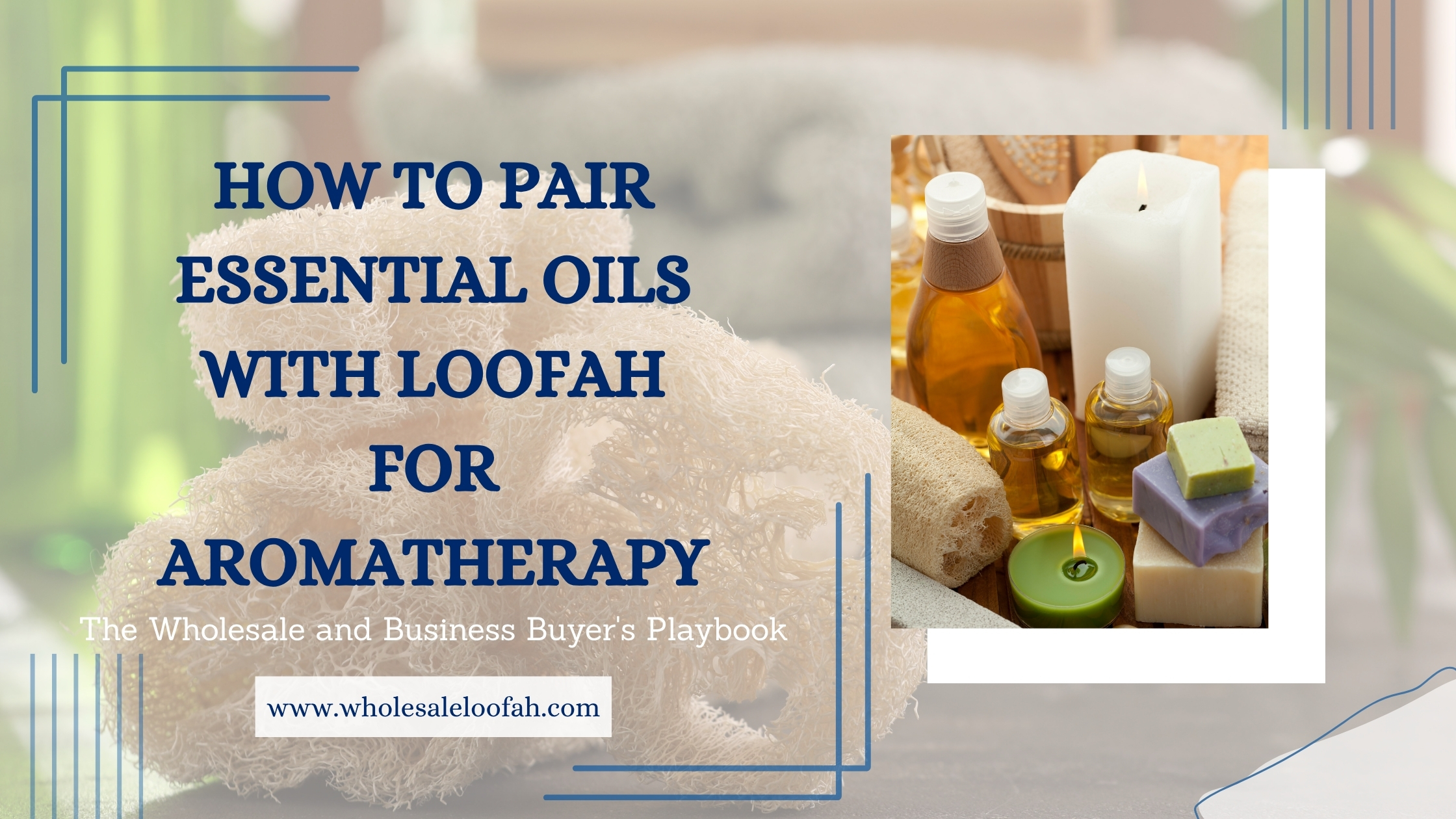
At the center of this growth is a deceptively simple product pairing: natural loofah and essential oils. Knowing how to pair essential oils with loofah is not just a consumer skill. For spa owners, wellness retailers, importers, and private-label product developers, it is a product development and sourcing competency that directly determines the quality, marketability, and profitability of an entire product line.
This guide is written primarily for business buyers: the spa director sourcing treatment supplies, the wellness brand building its first aromatherapy loofah kit, the importer adding natural bath tools to a catalog, and the retailer trying to understand what separates a loofah that sells at a premium from one that ends up on a clearance shelf. We cover the technical side of essential oil and loofah pairing, the product development opportunities it creates, the quality standards that matter most, and how to source the loofah base that makes every other variable work.
Consumers who stumble across this guide will also find practical value here, but the strategic lens throughout is commercial. If you are building a business around aromatherapy loofah products, this is the reference you need in 2026.
The Product Opportunity: Why Aromatherapy Loofah Is a High-Margin Category
Before getting into the technical details of pairing oils with loofah, it is worth understanding exactly why this product category deserves your attention as a business buyer.
Market Drivers Fueling Aromatherapy Loofah Demand
Three converging forces are driving sustained demand for aromatherapy loofah products in 2026 and beyond.
The first is the home spa movement. The remainder became permanent home spa consumers, a market segment that did not meaningfully exist at scale before 2019.
The second is sustainability pressure. Single-use plastic bath tools are facing regulatory restrictions in the European Union and growing consumer backlash in North American and Asian markets. Natural loofahs are the most credible sustainable replacement, and when paired with essential oils, they carry a wellness positioning that adds perceived value well beyond the underlying product cost.
The third is the premiumization of daily rituals. Consumer research consistently shows that buyers across income brackets are willing to pay premium prices for products that transform functional tasks into experiential moments. An aromatherapy loofah kit converts a two-minute shower into a 15-minute wellness ritual and commands a retail price that reflects that transformation.
Margin Profile for Aromatherapy Loofah Products
See our wholesale prices on egexo.com.
These margins are among the strongest in the natural personal care category. The aromatherapy positioning is what enables the premium pricing. A plain loofah sold at USD 3.50 and a loofah sold as part of an aromatherapy kit at USD 28.00 may differ by less than USD 1.50 in material cost, with the difference entirely attributable to positioning, packaging, and the essential oil pairing concept.
For wholesale sourcing inquiries, visit egexo.com/get-quotation-loofah-wholesale or access the complete product catalog at egexo.com/wp-content/uploads/2026/08/EGEXO-Loofah-Wholesale-Supplier-Product-Catalog.pdf.
Understanding How Essential Oils Pair with Loofah: The Technical Foundation
To develop and market aromatherapy loofah products credibly, you need to understand the mechanism that makes the pairing work. This is also the information your marketing team, your spa training staff, and your retail sales associates need to communicate product value effectively.
The Fiber Science That Drives Product Performance
A natural loofah is the dried vascular skeleton of the Luffa aegyptiaca plant. Its internal structure consists of a three-dimensional network of cellulose fiber channels. These channels function as a natural capillary system. When the loofah contacts water containing essential oil, the oil is drawn into the fiber network and held there against gravity and rinsing pressure.
During the mechanical action of exfoliation, the loofah alternately compresses and expands these channels, pumping controlled amounts of oil onto the skin surface with each stroke. This is not passive oil transfer. It is an active mechanical delivery system embedded in the plant structure itself.
The performance of this system depends almost entirely on the quality of the loofah fiber. High-density Egyptian loofah, cultivated in the mineral-rich alluvial soils of the Nile Delta and processed without bleaching or artificial heat treatment, maintains its channel integrity and delivers sustained oil release throughout a full 15 to 20 minute session. Lower-quality or bleached loofah fiber has partially collapsed channels that absorb less oil and release it less consistently.
For product developers, this means the loofah is not a commodity base component. It is the functional core of the product, and its quality determines whether your aromatherapy claim is substantiated by user experience.
Oil Retention Comparison: Loofah Quality Grades
| Loofah Grade | Oil Capacity per Unit | Release Duration | Fiber Recovery After Use | Best Application |
|---|---|---|---|---|
| Premium A (unbleached Egyptian) | 8 to 12 ml | 15 to 20 minutes | Full recovery within 2 hours | Spa treatment, premium retail |
| Grade B (standard processed) | 5 to 8 ml | 10 to 15 minutes | Partial recovery within 3 hours | Mid-tier retail kits |
| Grade C (bleached or over-processed) | 2 to 4 ml | 5 to 8 minutes | Minimal recovery | Budget retail, single use |
| Synthetic mesh pouf | Less than 1 ml | Less than 2 minutes | N/A (non-absorbent material) | Not suitable for aromatherapy |
This data makes the product development decision straightforward for any serious aromatherapy line: Premium A-grade unbleached Egyptian loofah is the only tier that substantiates an aromatherapy product claim with functional performance. Grade B is acceptable for mid-tier retail positioning. Anything below that will generate customer complaints and returns.
Essential Oil Pairing Guide for Product Developers
Understanding which oil pairings work best enables product developers to build differentiated product lines rather than generic bath collections. Each pairing below is evaluated for both its consumer appeal and its commercial viability as a product line anchor.
High-Demand Commercial Oil Pairings
Lavender and Chamomile: The Sleep and Relaxation Anchor
This is the safest and highest-volume pairing for any aromatherapy loofah product line. Lavender is the most recognized and trusted essential oil across all consumer demographics. A lavender-chamomile aromatherapy loofah kit requires minimal consumer education and sells across spa, wellness retail, pharmacy, and gifting channels.
The clinical backing for this pairing is substantial, with multiple peer-reviewed studies documenting measurable stress and anxiety reduction from lavender inhalation and skin contact. This provides your marketing team with credible third-party substantiation for benefit claims.
Eucalyptus and Peppermint: The Performance and Recovery Line
This pairing targets the active lifestyle and sports recovery consumer segment, which grew 23 percent in natural wellness product purchases from 2021 to 2024. Eucalyptus oil’s documented anti-inflammatory and respiratory opening properties, combined with peppermint’s invigorating sensory effect, creates a product experience that gym-goers, outdoor sports enthusiasts, and physically active consumers seek out repeatedly.
This pairing has the highest repeat purchase rate among aromatherapy bath products because of its consistent, immediately perceptible functional benefit. Consumers who feel the difference after their first use become reliable repeat buyers.
Tea Tree and Lemon: The Clean and Hygienic Line
As consumers become more educated about the antimicrobial properties of tea tree oil, hygienic wellness products built around this pairing are gaining significant shelf space in pharmacy chains and health-focused retailers. The loofah pairing adds a mechanical cleaning dimension, physical exfoliation, to the chemical antimicrobial benefit of the oil, making this a genuinely differentiated functional product.
Bergamot and Sweet Orange: The Mood and Lifestyle Line
Mood-focused wellness products are one of the fastest-growing retail categories globally. Bergamot and sweet orange create a premium, uplifting citrus experience that photographs and markets extremely well for social commerce channels. This pairing is particularly effective for gifting, subscription box inclusion, and resort retail.
Essential Oil Line Architecture for a Complete Aromatherapy Loofah Range
This six-line architecture covers the major consumer wellness motivations and allows a buyer to build a complete aromatherapy loofah category with clear differentiation between products.
For custom line development, Egexo offers full design and manufacturing support through their custom loofah product design service and private label manufacturing program.
How to Pair Essential Oils with Loofah: The Operational Protocol for Spas
For spa owners and wellness center operators, standardizing the aromatherapy loofah treatment protocol is both a quality assurance requirement and a training necessity. Inconsistent oil application leads to inconsistent client experiences, which is the primary cause of negative reviews in the spa sector.
Standard Spa Aromatherapy Loofah Treatment Protocol
| Stage | Action | Standard | Notes |
|---|---|---|---|
| Preparation | Soak loofah in warm water | 3 to 5 minutes | Water temperature 38 to 42 degrees Celsius |
| Oil mixing | Dilute essential oil in carrier | 2.5 percent dilution, 5 ml carrier | Use measured pipettes for consistency |
| Application | Apply blend to loofah center | 8 to 10 drops diluted blend | Allow 30 seconds absorption |
| Treatment | Apply to client skin | Circular motions, feet to shoulders | Avoid broken skin, facial areas unless facial grade |
| Duration | Full body exfoliation | 12 to 18 minutes | Adjust based on treatment menu |
| Rinse | Rinse loofah under running water | 30 to 45 seconds minimum | Squeeze, do not wring |
| Disposal | Single use or sterilization | Autoclave or UV if reusing | Single-use policy recommended for premium services |
| Post-treatment | Client skin rinse | Cool to lukewarm water | Enhances oil absorption, closes pores |
This protocol can be adapted directly into staff training manuals and service menu descriptions. For spas that source loofahs in bulk for treatment use, Egexo’s spa and grooming loofah category offers treatment-grade options with appropriate MOQs and documentation.
Supplier Evaluation: What Separates an Aromatherapy-Grade Loofah Supplier from a Commodity Source
Not every loofah supplier can meet the quality bar required for aromatherapy product development. The following framework is designed to help wholesale buyers evaluate and compare suppliers objectively.
Comprehensive Supplier Evaluation Checklist
| Evaluation Criteria | Minimum Standard | Premium Standard | Verification Method |
|---|---|---|---|
| Loofah species | Luffa cylindrica acceptable | Luffa aegyptiaca (Egyptian) preferred | Request phytosanitary certificate |
| Processing method | Machine dried acceptable | Sun-dried, unbleached preferred | Request processing documentation |
| Moisture content at shipping | Below 14 percent | Below 10 percent | Request lab certificate |
| Pesticide residue testing | Self-declaration acceptable | Third-party lab certification | – |
| Fiber density specification | General grade description | Quantified fiber weight per unit | Request product specification sheet |
| MOQ flexibility | 1,000 units minimum | 500 units with sample options | Confirm in writing |
| Sample availability | Paid samples acceptable | Free or refundable samples | Request sample policy |
| Lead time | 4 to 6 weeks | 2 to 3 weeks | Confirm current capacity |
| Private label capability | Basic label application | Full packaging design and production | Request case study or portfolio |
| Export documentation | Standard commercial invoice | Full documentation including certificates of origin | Request document checklist |
| Years in business | 5 plus years | 20 plus years | Verify with trade references |
| Countries served | Regional | Exporting since 2015 | Request client reference list |
Egexo meets the premium standard across every criterion in this framework. EGEXO has been exporting Egyptian loofah since 2015. Review the full profile at egexo.com/why-choose-egexo-loofah-supplier and the complete quality documentation at egexo.com/loofah-quality-standards.
For buyers who want to verify quality before committing to a volume order, sample requests are processed through egexo.com/request-loofah-samples.
Building Your Aromatherapy Loofah Kit: Component Sourcing and Assembly Guide
Once you have identified the essential oil pairings for your product line and selected a loofah supplier, the next step is designing the complete kit structure. The following framework covers component selection, assembly considerations, and packaging requirements.
Aromatherapy Loofah Kit Component Specifications
| Component | Specification | Notes for Aromatherapy Use | Typical MOQ |
|---|---|---|---|
| Primary loofah | Egyptian, unbleached, 15 to 20 cm | Confirm oil absorption rate before committing | No minimum order on standard products |
| Essential oil blend | Pre-formulated, 10 ml bottle | Source from GC/MS-tested supplier | No minimum order on standard products |
| Carrier oil | 30 ml bottle, jojoba or sweet almond | Match to skin benefit of oil blend | No minimum order on standard products |
| Usage guide card | Printed, laminated preferred | Include dilution ratios and safety notes | No minimum order on standard products |
| Primary packaging | Kraft box or glass jar presentation | Align with sustainability positioning | No minimum order on standard products |
| Secondary packaging | Kraft tissue paper, no plastic | Critical for eco-conscious consumer market | No minimum order on standard products |
| Branding elements | Custom label, sticker, or printed box | Work with private label supplier on design | Private label from 1,000 units |
Total assembled kit cost at these specifications ranges from approximately USD 4.50 to USD 8.00, depending on packaging tier and order volume. Retail pricing from USD 18.00 to USD 45.00 is well-supported by this category, depending on channel and brand positioning.
For full private label kit development support including loofah production, packaging design, and export documentation, contact Egexo through their custom product design service or explore the raw loofah options at egexo.com/product-category/raw-loofah-scrubbers for businesses that process and package in their home market.
Import and Export Considerations for Aromatherapy Loofah Products
Buyers importing Egyptian loofah for aromatherapy kit development should be aware of the following regulatory and logistical considerations.
Import Documentation and Compliance Checklist
| Document | Required By | Notes |
|---|---|---|
| Phytosanitary certificate | Most importing countries | Confirms product is free of plant pests and diseases |
| Certificate of origin | Required for preferential tariff rates | Egyptian loofah benefits from preferential rates in many markets |
| Certificate of analysis | Optional but recommended | Confirms pesticide residue levels, moisture content |
| Commercial invoice | All shipments | Include HS code 1401.90 for loofah products |
| Packing list | All shipments | Specify individual unit weights, dimensions, carton count |
| Bill of lading or airway bill | All shipments | Coordinate with freight forwarder |
| MSDS for essential oil components | Required for kits containing oils | Oils may require hazardous material declarations for air freight |
Egexo’s EGEXO handles all documentation requirements for international buyers and has experience exporting to the European Union, United States, United Kingdom, Canada, Australia, and Gulf Cooperation Council markets. The full export process is documented at egexo.com/loofah-farm-to-export-process.
FAQ Section
Q1: What makes Egyptian loofah the best base for aromatherapy loofah products? Egyptian loofah cultivated in the Nile Delta has a fiber density and capillary channel structure that surpasses loofah grown in most other regions. The combination of mineral-rich alluvial soil, optimal growing temperatures, and centuries of agricultural expertise produces a fiber that absorbs 40 to 60 percent more essential oil than average-grade loofah and releases it gradually throughout a 15 to 20 minute session. For business buyers, this performance difference is what allows an aromatherapy claim to be substantiated by actual user experience rather than just marketing language.
Q2: What is the minimum order quantity for aromatherapy-grade loofah from Egexo? No minimum order on standard products. Private label from 1,000 units. Grade B retail-quality loofahs are available from 1,000 units. Raw and unprocessed loofah for buyers who handle finishing in their home market is available from 500 kg. Pre-order sample sets are available at egexo.com/request-loofah-samples for buyers who want to evaluate fiber quality against their product development specifications before placing a volume order.
Q3: How do you pair essential oils with loofah for a spa treatment menu? The standard spa protocol for pairing essential oils with loofah involves diluting the chosen essential oil blend to a 2 to 2.5 percent concentration in a carrier oil, applying 8 to 10 drops of the diluted blend to a pre-soaked natural loofah, allowing 30 seconds for absorption, and applying to client skin in circular motions from feet to shoulders over 12 to 18 minutes. Consistency is achieved through measured dispensing tools, standardized carrier oil volumes, and staff training that includes an understanding of why dilution ratios matter for both safety and product performance.
Egyptian loofah from Egexo is a 100 percent natural plant-derived product grown without synthetic pesticides under standard agricultural practice.
Q5: What retail channels are most profitable for aromatherapy loofah kits? Premium independent wellness retailers and spa boutiques deliver the highest per-unit margins for aromatherapy loofah kits, typically supporting retail prices from USD 22 to USD 45. Online direct-to-consumer channels offer strong margins but require investment in customer acquisition. Subscription wellness boxes provide lower per-unit revenue but drive volume and brand awareness. Pharmacy and mass market channels offer volume but compress margins significantly. For new market entrants, starting with independent wellness retail and online direct-to-consumer is the most capital-efficient path to profitability.
Q6: How should wholesale buyers evaluate essential oil quality for loofah kit development? Essential oils used in commercial aromatherapy loofah kits should be sourced with gas chromatography and mass spectrometry testing documentation, commonly referred to as GC/MS reports, which confirm the chemical composition and purity of the oil. Avoid oils labeled simply as fragrance oils or parfum, which are synthetic compounds that do not deliver therapeutic benefit and may cause skin reactions when used with the enhanced absorption mechanism of loofah exfoliation. For consistency across production runs, specify the botanical source, extraction method, and country of origin in your supplier agreement.
Q7: What private label options does Egexo offer for aromatherapy loofah products? Egexo provides a complete private label manufacturing service that covers loofah production to specified grades and dimensions, custom packaging design and production, branding application including custom labels and printed boxes, quality control documentation, and full export services. Product development timelines from brief to first production run typically range from six to ten weeks depending on packaging complexity. Details are available at egexo.com/private-label-loofah-manufacturing.
Q8: What are the most important quality tests for loofah before committing to a bulk order? The four most important practical tests for evaluating loofah quality before a bulk order commitment are absorption speed, which should be full saturation within 90 seconds of water contact; fiber recovery, meaning the loofah should return to at least 80 percent of its original shape within two hours of compression; oil retention, where the loofah should hold a teaspoon of carrier oil blend for at least 30 minutes without dripping when held horizontally; and odor neutrality, confirming no chemical, bleach, or musty smell that would interfere with essential oil performance. Egexo provides standardized sample sets designed specifically for these evaluations at egexo.com/request-loofah-samples.
Expert Insight from EGEXO
The commercial aromatherapy loofah market is younger than most buyers realize. Ten years ago, the vast majority of natural loofah sold globally was positioned as a simple exfoliation tool with no aromatherapy association. The pairing of essential oils with loofah as a defined product category began gaining commercial traction only around 2018 to 2019, which means the market is still in an early growth phase with significant shelf space and channel opportunity still available.
What we observe consistently across the buyers who come to us at EGEXO with aromatherapy loofah development projects is that the ones who succeed commercially are those who invest in understanding the fiber quality difference before they invest in branding and packaging. The aromatherapy claim is only credible if the loofah delivers the experience that claim promises. A beautifully packaged kit built around a bleached, low-density loofah will generate a single purchase and then a negative review.
Our recommendation is always to order the premium unbleached Egyptian loofah, test it against your specific oil blends and your target user’s skin feedback, and build your brand story around the genuine functional differentiation that Egyptian fiber provides. That story will sell on its own merits, in every retail channel, because it is true.
Request samples and begin your product development evaluation at egexo.com/request-loofah-samples or explore the full wholesale range at our products page.
Conclusion
For wholesale buyers, spa operators, and product developers, understanding how to pair essential oils with loofah is both a technical competency and a commercial strategy. The aromatherapy loofah category delivers margins of 70 to 88 percent, aligns perfectly with current consumer wellness and sustainability values, and remains underpenetrated in most retail markets outside of premium wellness boutiques.
The product works because the science is real. Natural Egyptian loofah fiber absorbs and delivers essential oils in a way no synthetic alternative can replicate. The business opportunity is real because consumer demand for natural, experiential wellness products is growing faster than the supply of well-positioned, high-quality aromatherapy loofah options.
The suppliers who can deliver aromatherapy-grade fiber with full documentation, private label capability, and reliable export logistics are rare. Egexo is one of them.
Key Takeaways:
- The aromatherapy loofah market is in early growth phase with strong margins and expanding channel opportunities
- Premium A-grade unbleached Egyptian loofah is the only tier that substantiates an aromatherapy product claim with genuine performance
- A six-line product architecture covering sleep, performance, hygiene, mood, skincare, and detox covers the full consumer wellness motivation spectrum
- Proper oil selection, dilution, and application protocol are as important as loofah quality in determining product performance
Ready to build your aromatherapy loofah product line?
- For Wholesale Buyers: Request a quote or download our complete catalog
- For Product Samples: Order evaluation samples before your first production run